

TL;DR:
- Effective currency risk management requires thorough exposure assessment and a disciplined strategy. Building a clear hedging framework, selecting appropriate instruments, and leveraging technology help firms protect profitability amidst volatile FX markets. Continuous monitoring and regular policy updates are essential to adapt to changing conditions and maintain risk resilience.
A single sharp move in currency markets can wipe out months of carefully earned operating margin. For international companies running cross-border transactions daily, foreign exchange volatility is not a theoretical concern — it is a direct threat to the bottom line. Whether your firm invoices in euros, settles in yen, or consolidates across a dozen currencies, unmanaged FX exposure translates into unpredictable cash flows and earnings surprises that erode investor confidence. The good news: a disciplined, step-by-step approach to FX management can turn this risk into a manageable, even strategic, advantage.
Table of Contents
- Assessing FX exposure: Prerequisites and requirements
- Developing a strategic FX management framework
- Implementing hedging strategies and FX risk tools
- Verifying effectiveness: Monitoring, reporting, and troubleshooting
- What most FX management articles miss: Practical lessons from global treasury teams
- Enhance your FX strategy with specialized tools
- Frequently asked questions
Key Takeaways
| Point | Details |
|---|---|
| Identify FX exposure type | Clarify if your risk is transactional, translational, or economic before choosing a strategy. |
| Tailor hedging strategies | Apply cash flow vs balance sheet hedging based on business needs; not interchangeable. |
| Select the right tools | Use appropriate financial instruments and technology platforms for effective risk reduction. |
| Monitor and refine | Establish strong reporting and verification practices to continuously improve your FX strategy. |
| Choose simplicity over complexity | Simpler workflows and clear communication often outperform multi-layered, opaque risk systems. |
Assessing FX exposure: Prerequisites and requirements
Before you can manage currency risk, you need to see it clearly. Many treasury teams underestimate this step, jumping straight to hedging instruments without fully mapping their actual exposure. That creates blind spots that cost real money.
The three types of FX exposure every treasury manager must know:
- Transactional exposure refers to gains or losses on foreign currency denominated contracts, purchase orders, or invoices that have not yet settled. If your German subsidiary invoices a U.S. client in dollars, every day that invoice is open carries transactional risk.
- Translational exposure arises when consolidating financials across subsidiaries. A strong dollar relative to the euro can shrink the reported value of your European earnings overnight, even if operations performed well.
- Economic exposure is broader and longer-term. It captures how exchange rate shifts affect your competitive position, pricing power, and future cash flow generation.
Understanding corporate FX risk explained gives you the foundation to work from. Without categorizing your exposure correctly, your hedging efforts will be misdirected.
Building your exposure inventory
Start by mapping every currency pair that touches your business. Collect data from accounts payable, accounts receivable, intercompany loans, and any financial instruments denominated in foreign currency. Identify which business units generate the largest exposures and at what frequency. A useful starting framework:
| Exposure type | Business unit | Currency pair | Estimated annual volume | Hedging priority |
|---|---|---|---|---|
| Transactional | Procurement | EUR/USD | $45M | High |
| Translational | European subsidiary | GBP/USD | $20M | Medium |
| Economic | APAC operations | JPY/USD | $10M | Low |
| Transactional | Revenue | CAD/USD | $8M | Medium |
This kind of structured visibility tells you where to focus first.
One critical distinction that frequently gets lost in practice: proven currency risk steps consistently emphasize differentiating cash flow hedging from balance sheet hedging. These two approaches protect different things. Cash flow hedging covers future expected transactions, like a pending import payment. Balance sheet hedging covers existing assets or liabilities already on your books. According to JP Morgan's FX hedging framework, fixed income positions are often fully hedged for FX because FX volatility can exceed the yield advantage entirely, whereas equities are sometimes left unhedged to preserve diversification benefits.
Getting this right upfront saves you from costly mismatches between your hedge positions and your actual risk profile.
Developing a strategic FX management framework
With your exposure inventory in hand, you are ready to build the framework that governs how your team responds to currency risk. Think of this as your operating manual for FX decisions. Without a written framework, every currency move becomes an ad hoc crisis. With one, it becomes a managed process.
The core steps of an effective FX management framework
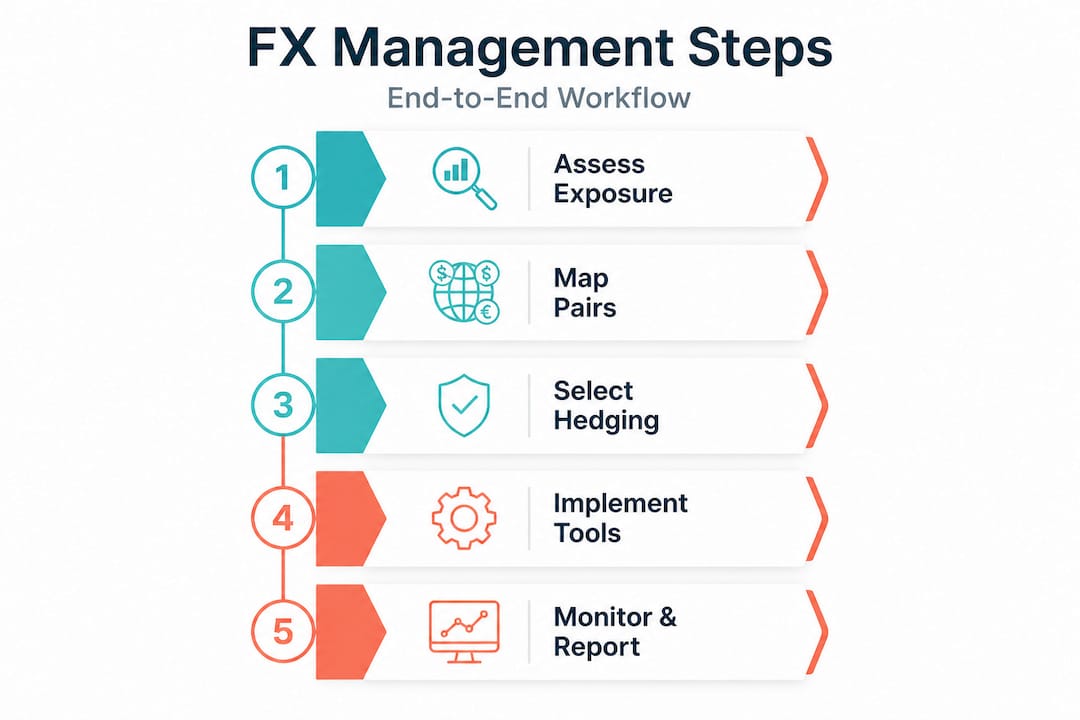
- Design your hedging policy. Define which exposures get hedged, at what thresholds, and with what instruments. Specify who has authority to execute hedges and what approval levels apply.
- Conduct a structured risk assessment. Quantify your net open positions across all currency pairs. Use scenario analysis to model how a 10% or 20% adverse currency move affects earnings, cash flows, and key financial ratios.
- Select appropriate tools. Match instruments to exposure types. Forwards work well for known future cash flows. Options preserve upside when you face uncertainty about transaction volumes. Swaps fit longer-duration liabilities.
- Implement workflows. Define how hedge execution, confirmation, and settlement flow through your treasury management system. Automate where possible. Reduce manual steps that introduce operational risk.
- Schedule regular reviews. At minimum quarterly, but more frequently during volatile periods.
Exploring advanced forex risk strategies will surface additional design choices that fit specific business models.
Classical vs modern hedging approaches
| Feature | Classical approach | Modern approach |
|---|---|---|
| Decision basis | Intuition and experience | Quantitative models, VaR |
| Instrument range | Forwards, spot contracts | Forwards, options, swaps, structured products |
| Review cycle | Annual or as needed | Continuous or event-triggered |
| Technology use | Spreadsheets | Integrated platforms with real-time data |
| Reporting | Manual | Automated dashboards |
Modern treasury teams consistently outperform because they combine quantitative discipline with faster execution. The FX hedging strategies that work in 2026 rely on real-time data, not end-of-month reports.
Pro Tip: Do not hedge equity-based investments by default. As JP Morgan highlights, equities often left unhedged for diversification allow international portfolios to benefit from currency movements that partially offset equity drawdowns. Layering a full hedge on equities can actually increase overall volatility in some scenarios. Discuss this tradeoff explicitly in your hedging policy.
The framework you build here is not a one-time document. It evolves as your business grows, as new markets open, and as currency dynamics shift. Build revision cycles into the policy itself.
Implementing hedging strategies and FX risk tools
With a framework signed off, the work becomes practical and specific. This is where most treasury teams either gain real traction or get tangled in complexity. Keep the implementation anchored to your exposure analysis, not market speculation.
Core hedging instruments explained
- Forward contracts lock in an exchange rate for a future date. They are straightforward and cost-effective for predictable cash flows. The main limitation is inflexibility: if your expected transaction does not materialize, you may face mark-to-market losses on the forward position.
- FX options give you the right but not the obligation to exchange at a set rate. They cost a premium upfront but protect against adverse moves while allowing you to benefit from favorable ones. They are particularly valuable when transaction volumes or timing are uncertain.
- Cross-currency swaps are used to convert long-term debt or assets from one currency to another. They are common for multinationals with foreign currency-denominated bonds or intercompany loans.
- Value at Risk (VaR) models quantify the maximum expected loss over a given period at a specific confidence level. VaR provides a statistical floor for risk conversations and is central to setting hedge ratios under modern frameworks.
Reviewing FX risk mitigation frameworks helps treasury professionals understand how these instruments interact in practice, not just in theory.

Technology as a force multiplier
Manual FX management at scale is both slow and error-prone. A dedicated platform changes the equation fundamentally. Real-time visibility into open positions, automated hedge execution triggers, and integrated reporting mean your team spends less time gathering data and more time making informed decisions.
Key platform capabilities to look for include live currency position dashboards, VaR-based strategy modeling, integration with ERP and payment platforms, and audit trails for regulatory compliance. Efficient currency risk reduction strategies almost always involve technology as a core enabler, not an afterthought.
Statistic callout: Fixed income assets carry a specific risk where, according to JP Morgan's analysis, FX volatility exceeds bond yields in many scenarios, making full FX hedging on bond portfolios essential to preserving the asset class's risk-reducing role in a portfolio.
Pro Tip: Build a "hedge ladder" rather than concentrating all your hedges at a single maturity date. Staggering hedge expirations across one, three, six, and twelve months reduces rollover risk and smooths out the impact of rate changes at any single point in time. This also gives you flexibility to reassess your position periodically without disrupting your entire hedge book.
Ongoing monitoring is not optional. Exchange rates move continuously, and a hedge that was correctly sized in January may be significantly over or underweight by April. Build explicit review triggers into your workflow: a currency move beyond a set threshold, a significant change in transaction volume, or a macroeconomic event that alters your exposure forecast.
Verifying effectiveness: Monitoring, reporting, and troubleshooting
Implementation without verification is just activity. The difference between companies that genuinely protect profitability and those that merely go through the motions is a rigorous, consistent review cycle. This is where your global finance risk management discipline either pays off or exposes gaps.
Setting up your monitoring framework
- Define your KPIs. Useful metrics include hedge effectiveness ratio, net open FX position by currency pair, VaR utilization versus limit, and realized versus budgeted FX rates. Each KPI should have a clear owner and a tolerance band.
- Build your reporting cadence. Weekly snapshots for operational currencies, monthly deep-dives for all exposures, and quarterly strategy reviews for policy-level decisions. This rhythm keeps management informed without creating noise.
- Use scenario reporting. Run monthly "what if" scenarios: what happens to earnings if EUR/USD moves 5% in either direction? This keeps your leadership team calibrated to actual risk rather than discovering it in quarterly results.
- Establish troubleshooting protocols. Define what triggers an escalation: a hedge effectiveness ratio below 80%, a position that exceeds your policy limit, or a counterparty credit event.
- Document every decision. Audit trails matter not just for regulators but for internal learning. When a hedge works or fails, you want to understand why.
The FX risk workflow strategies that build institutional knowledge focus on documentation and feedback loops, not just execution.
Common mistakes to correct
Overhedging is surprisingly common. When business volume drops but hedges remain in place, companies end up with speculative positions they did not intend to hold. Always tie hedge notionals to updated forecasts, not stale budgets.
Underhedging occurs when treasury teams focus only on transactional exposure and ignore economic or translational exposures. A competitor pricing in a weakening currency can undercut your margins even when your own transactions are fully covered.
"Strategic verification is as crucial as execution in FX management; reporting and troubleshooting cycles underpin success." — JP Morgan FX hedging framework
Understanding how to mitigate forex volatility sustainably requires treating monitoring as a core discipline, not a quarterly checkbox. The companies that do this well tend to have smaller earnings surprises, tighter cash flow forecasting accuracy, and stronger relationships with their banks and hedge counterparties because they are clearly informed and in control.
What most FX management articles miss: Practical lessons from global treasury teams
Most articles on FX management give you a clean process and call it done. Real-world treasury management is messier. Here is what the frameworks rarely tell you.
The single most undervalued distinction in daily practice is the difference between cash flow and balance sheet hedging. Teams often conflate them because both involve FX instruments, but they solve different problems and need different governance. A cash flow hedge tied to a procurement cycle has a natural end point — the transaction. A balance sheet hedge on a foreign subsidiary requires continuous recalibration as asset values change. Mixing up the two results in mismatched coverage and misleading hedge effectiveness reports.
The FX risk mitigation insights that come from experienced multinational treasury operations consistently point to one uncomfortable truth: complexity kills execution. Teams that layer four or five hedging instruments across multiple maturities and structures often end up with positions they cannot explain to senior management, auditors, or even themselves during a crisis. The most effective programs we have seen use two or three instruments consistently, understand them deeply, and monitor them rigorously.
Another overlooked point: unhedged equity exposure is not a failure of risk management. It is often a deliberate and rational choice. When FX volatility is lower than equity volatility, the diversification benefit of holding foreign equities in their local currency can outweigh the FX risk. Automatically hedging everything feels safer but can actually reduce the portfolio's resilience.
Finally, the "set it and forget it" mentality is the silent killer of FX programs. Currency regimes change, business models evolve, and the exposure that mattered most two years ago may be marginal today while a new one has grown unchecked. Continuous improvement, built into your team's operating rhythm as a genuine discipline rather than a compliance exercise, is what separates programs that consistently protect profitability from those that deliver pleasant surprises in good years and painful ones in bad.
Enhance your FX strategy with specialized tools
The steps covered in this guide — from exposure mapping to monitoring and troubleshooting — require not just process discipline but the right technology to execute at scale. Spreadsheets will take you only so far before the volume and velocity of modern FX markets outpace your team's capacity to keep up.
CorpHedge is built specifically for treasury teams and financial professionals who need more than generic risk software. The platform provides real-time visibility into your currency positions, hedging based on value at risk to quantify and manage exposure with precision, and integrations with payment platforms like Corpay for seamless execution. Whether you are refining your hedging policy or building a monitoring framework from scratch, CorpHedge provides the infrastructure to move from reactive to strategic. Explore the full FX risk solutions on the product tour or review the complete FX exposure management feature set to see exactly how the platform maps to your needs.
Frequently asked questions
What is the difference between cash flow and balance sheet hedging?
Cash flow hedging protects anticipated future transactions from adverse rate moves, while balance sheet hedging addresses foreign currency assets or liabilities already recorded on your financial statements. Both require different instruments and governance structures, as the two hedging types serve fundamentally different risk profiles.
How often should FX risk management strategies be reviewed?
At minimum quarterly, but best practice calls for monthly monitoring with immediate reviews triggered by significant market events or material changes in your business volumes. As JP Morgan notes, strategic verification cycles are as important as initial execution.
What is value-at-risk hedging and when should it be used?
Value-at-risk (VaR) hedging uses statistical modeling to quantify the maximum probable loss from FX exposure over a defined period at a set confidence level, making it most useful when managing large, volatile, or multi-currency portfolios where intuition-based sizing is insufficient.
Do all assets need to be fully hedged for FX risk?
Not necessarily. Fixed income positions are typically fully hedged because FX volatility can easily exceed the yield advantage, but equities are often intentionally left unhedged to preserve cross-currency diversification benefits that can reduce overall portfolio volatility.