

Currency risk is not a theoretical concern for finance teams at international companies. It is a direct threat to earnings, cash flow, and competitive position. 4 out of 5 North American corporates lose money from unhedged foreign exchange exposure, yet many organizations still operate without a formal hedging program. This article breaks down the three core types of FX risk, the most effective hedging tools available, and the policy discipline that separates companies that protect their margins from those that don't.
Table of Contents
- What is corporate FX risk?
- Key hedging strategies: Tools and real-world outcomes
- Policy, materiality, and discipline: Why most companies get FX risk wrong
- Applying FX risk strategies: Steps for executives and common pitfalls
- Upgrade your FX risk management with CorpHedge
- Frequently asked questions
Key Takeaways
| Point | Details |
|---|---|
| Know your FX risk types | Identify transaction, translation, and economic exposures to build a robust risk management strategy. |
| Layer hedging tools | Combine natural and financial hedges for optimal volatility reduction and earnings protection. |
| Policy and discipline matter | Formal board-approved policies and disciplined execution are essential for mitigating FX losses. |
| Measure impact with benchmarks | Use empirical volatility reduction data to evaluate the effectiveness of hedging strategies. |
| Upgrade with integrated solutions | Technology-driven platforms streamline analytics, policy and execution for superior FX risk management. |
What is corporate FX risk?
FX risk, at its core, is the possibility that changes in exchange rates will reduce the value of your revenues, assets, or competitive position. But not all FX risk is the same, and treating it as a single problem is one of the most common mistakes finance teams make.
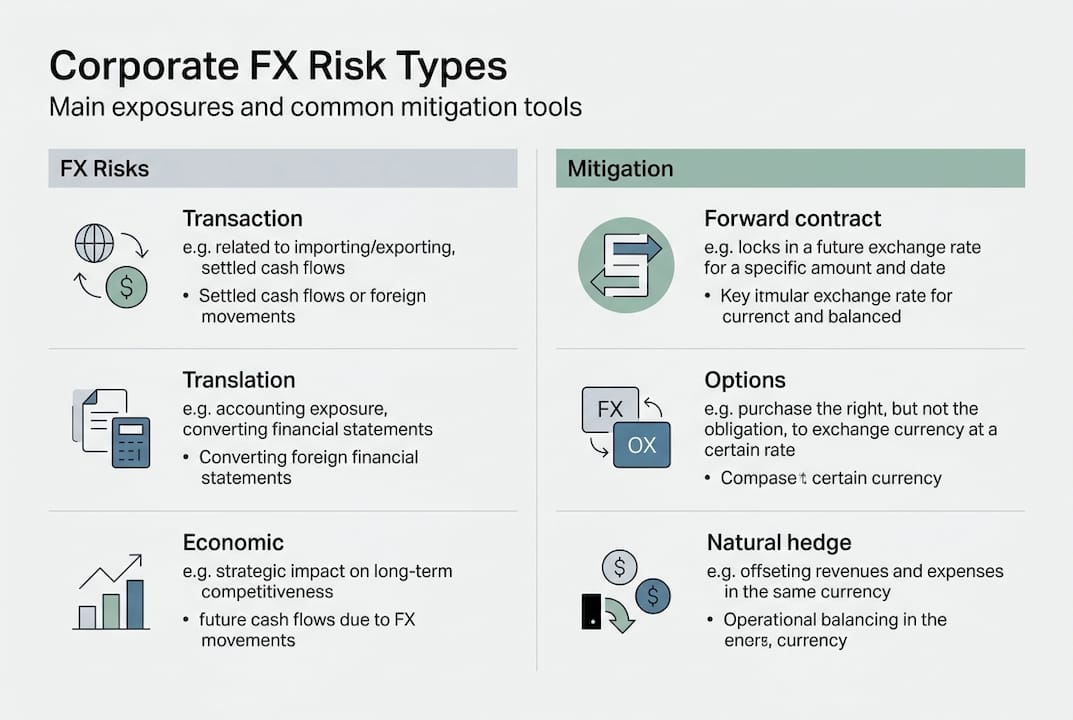
Corporate FX risk breaks down into three distinct categories:
- Transaction risk: This is the most immediate type. It arises when a company has contracts, invoices, or receivables denominated in a foreign currency. If the rate moves before settlement, the actual cash received or paid changes. A U.S. exporter invoicing in euros faces this every time the dollar strengthens before payment clears.
- Translation risk: When a multinational consolidates its subsidiary financials into a single reporting currency, exchange rate movements distort the numbers. A profitable European subsidiary can look weaker on paper simply because the euro weakened against the dollar during the reporting period.
- Economic risk: This is the long-term version. It reflects how sustained currency shifts affect a company's competitive position in global markets. A Japanese manufacturer whose yen strengthens significantly may find its export pricing uncompetitive against rivals operating in weaker-currency countries.
Understanding risk analytics in currency risk management is essential for identifying which of these exposures is most material to your business before you design any mitigation strategy.
| Risk type | Primary impact | Typical mitigation |
|---|---|---|
| Transaction | Cash flow shortfalls on contracts | Forward contracts, options |
| Translation | Distorted financial statements | Balance sheet hedges, swaps |
| Economic | Long-term competitiveness erosion | Natural hedges, pricing strategy |
Exploring FX risk management solutions early in your planning process helps you match the right tools to each exposure type rather than applying a one-size-fits-all approach.
Key hedging strategies: Tools and real-world outcomes
Once you know what you're exposed to, the next question is how to protect against it. The four primary hedging tools each serve a different purpose, and the best programs use them in combination.
Core hedging methodologies include:
- Forward contracts: Lock in an exchange rate for a future transaction. Simple and cost-effective, but inflexible. If the market moves in your favor, you don't benefit.
- Options: Give you the right, but not the obligation, to exchange at a set rate. More flexible than forwards, but you pay a premium upfront.
- Currency swaps: Exchange cash flows in different currencies over a defined period. Ideal for long-term financing arrangements and managing interest rate exposure simultaneously.
- Natural hedges: Match revenues and costs in the same currency. No financial instrument required, but coverage is often incomplete and depends on operational structure.
| Tool | Flexibility | Cost | Best use case |
|---|---|---|---|
| Forward contract | Low | Low | Known future payments |
| Option | High | Medium to high | Uncertain exposures |
| Currency swap | Medium | Medium | Long-term financing |
| Natural hedge | Medium | Very low | Operational alignment |
The empirical case for structured hedging is strong. Structured hedging programs reduce earnings volatility by 30% to 50%, with hedge accounting alone cutting volatility by 35%. In one documented case, a company called SolarTech used currency swaps to reduce FX-driven earnings volatility by 41%, while dynamic loan hedging cut its FX beta by 30.5%.

Pro Tip: Start with natural hedges wherever your operations allow. Then layer forward contracts for near-term known exposures and options for uncertain or larger-scale risks. This tiered approach, outlined in risk management best practices, gives you cost efficiency without sacrificing protection.
For a deeper look at how these tools apply to specific business models, the currency risk management strategies guide covers practical frameworks for 2026. You can also review how to hedge forex risk to protect both profits and cash flow in volatile markets. The FX exposure management features available on modern platforms make implementing these strategies far more accessible than it was even five years ago.
Policy, materiality, and discipline: Why most companies get FX risk wrong
Having the right tools is only half the equation. The other half is governance. Most FX losses at corporations don't happen because the tools failed. They happen because the organization lacked a clear policy, misjudged how material their exposure was, or allowed hedging to drift into speculation.
A formal, board-approved FX policy is the foundation of any effective program. It should define:
- Which exposures are hedged and which are retained
- Approved instruments and counterparties
- Hedge ratios and time horizons
- Reporting and review cadence
- Clear separation between hedging and speculative activity
The consequences of skipping this step are well documented. Volkswagen lost over €1 billion by allowing its treasury function to take speculative FX positions rather than sticking to pure risk reduction. Contrast that with Unilever and Caterpillar, both of which use layered 6 to 12 month forward programs focused entirely on volatility reduction, not profit generation.
"Discipline is the difference between a hedge and a bet. VW's €1B+ loss came from treating the FX desk as a profit center rather than a risk management function."
Contrasting approaches reveal important nuances. Dynamic hedging adjusts positions as exposures change, while static hedging locks in a fixed ratio for the period. Neither is universally better. The right choice depends on your exposure predictability, operational flexibility, and risk appetite. Some companies with genuinely low FX materiality may rationally choose to retain the risk entirely rather than incur hedging costs.
Pro Tip: Integrate your treasury management system with real-time FX analytics before finalizing your policy. Board-approved policies that rely on stale data create false confidence. Review FX hedging use cases and corporate FX risk management cases to see how peer companies structure their governance frameworks. The FX risk management techniques available today make real-time policy enforcement far more practical than manual processes.
Applying FX risk strategies: Steps for executives and common pitfalls
Knowing the theory is one thing. Building a program that actually works inside your organization is another. Here is a practical sequence for finance executives starting or overhauling their FX risk management approach.
- Conduct a full exposure audit. Map every currency pair your business touches, including revenues, costs, intercompany loans, and balance sheet items. You cannot manage what you haven't measured.
- Assess materiality. Not every exposure warrants a hedge. Focus resources on the currency pairs and transaction sizes that can meaningfully move your earnings or cash flow.
- Draft and approve a formal FX policy. Define scope, instruments, ratios, and governance. Get board sign-off. This is non-negotiable for disciplined execution.
- Select your hedging tools. Match instruments to exposure types. Use the tiered approach: natural hedges first, then forwards, then options or swaps for complex or long-dated exposures.
- Implement analytics and monitoring. Real-time visibility into your FX positions is essential. Structured hedging programs that use live data consistently outperform those relying on periodic manual reviews.
- Review and adjust regularly. FX risk is dynamic. Quarterly reviews of hedge ratios, instrument performance, and policy alignment keep your program calibrated to actual business conditions.
The most common pitfalls are underestimating how material a currency pair is until a large move hits, ignoring the technology available for real-time monitoring, and allowing hedging mandates to creep toward speculative positions. All three are avoidable with the right policy and tools in place.
Pro Tip: Hybrid strategies that combine natural hedges with financial instruments consistently outperform single-method approaches. Review financial risk reduction strategies to find the combination that fits your specific exposure profile and business model.
Upgrade your FX risk management with CorpHedge
Putting everything covered in this article into practice requires more than spreadsheets and manual processes. CorpHedge is built specifically for finance teams that need to move from reactive FX management to a structured, policy-driven program.
The platform brings together real-time currency position tracking, Value at Risk analytics, and hedging strategy execution in a single environment. Whether you're managing transaction risk across dozens of currency pairs or building a board-approved policy framework from scratch, the FX risk management solutions at CorpHedge give you the infrastructure to act with confidence. Explore the full suite of FX risk management features or book a FX risk demo tour to see how the platform fits your organization's specific exposure profile.
Frequently asked questions
What are the main types of corporate FX risk?
Transaction, translation, and economic risk are the three primary FX exposures faced by international corporations. Each affects a different part of the business and requires a different mitigation approach.
How much can structured hedging reduce volatility?
Empirical studies show structured FX hedging can cut earnings volatility between 30% and 50%, with specific cases like SolarTech achieving a 41% reduction through currency swaps.
Are natural hedges enough for managing FX risk?
Natural hedges are a strong first step but usually require layering financial instruments for full protection. Hybrid strategies combining operational and financial tools consistently deliver better outcomes than either approach alone.
What common mistakes lead to FX losses?
Lack of formal policy, speculative trading, and incorrect materiality assessments are leading causes of FX losses. VW's €1B+ loss is the most cited example of what happens when hedging discipline breaks down.