

TL;DR:
- Currency risk management is crucial for protecting profitability and stakeholder confidence across global operations.
- Dynamic and hybrid hedging strategies outperform static approaches by adapting to market changes and reducing costs.
- Centralized, real-time governance and exposure tracking are essential for effective FX risk mitigation in 2026 and beyond.
Currency volatility is not a background risk anymore. In 2025, unhedged FX losses averaged £6.71M for UK firms and $9.85M for US companies, and those numbers are forcing finance teams to rethink everything. For international businesses operating across multiple currencies, the difference between a profitable quarter and a devastating one often comes down to how well you manage exchange rate exposure. This article walks you through the core methodologies, empirical benchmarks, common pitfalls, and the strategic mindset shifts that separate companies that thrive from those that simply survive volatility.
Table of Contents
- Why risk management is critical for international business
- Core risk management methodologies for currency exposure
- Benchmarking and optimizing FX risk procedures
- Nuances, pitfalls, and advanced practices in FX risk management
- A contrarian view: Why strategic risk management must evolve in 2026
- Enhance your FX risk management with CorpHedge
- Frequently asked questions
Key Takeaways
| Point | Details |
|---|---|
| Currency risk can erode margins | Failing to manage FX volatility exposes international businesses to multimillion-dollar losses. |
| Structured hedging boosts profits | Financial and hybrid hedging strategies measurably reduce volatility and improve financial stability. |
| Benchmarking guides optimization | Empirical data helps decision-makers set the right hedging ratios and measure impact. |
| Avoid over- and under-hedging | Costly mistakes can be mitigated with centralization, automation, and scenario planning. |
| Hybrid strategies future-proof results | Dynamic and AI-powered risk techniques outpace static methods for 2026 priorities. |
Why risk management is critical for international business
Currency risk is not just a treasury concern. It flows through every layer of your business, from pricing decisions and supplier contracts to financial reporting and investor confidence. When exchange rates move against you, margins shrink fast, and the damage compounds across business units.
Foreign exchange risk comes in three forms. Transaction exposure affects cash flows from existing contracts. Translation exposure distorts reported earnings when foreign subsidiary results are converted to the home currency. Economic exposure is the broadest and hardest to manage: it reflects how currency shifts change your competitive position over time.
"Unhedged exposures caused average losses of £6.71M in the UK and $9.85M in the US in 2025. Companies that adopted dynamic or hybrid hedging strategies consistently outperformed those relying on static approaches in both profitability and stability." — CFO Tech News
The practical impact shows up in ways that are easy to underestimate until it is too late. Consider how mitigating FX volatility requires a coordinated response across finance, operations, and commercial teams, not just a single hedging trade placed by treasury.
Here are the main channels through which currency risk erodes value:
- Pricing pressure: A stronger home currency makes your exports more expensive and less competitive abroad.
- Invoicing mismatches: Billing in a foreign currency transfers risk to you without always reflecting that in your pricing.
- Cash flow uncertainty: Delayed receivables in a depreciating currency reduce actual cash received versus what was projected.
- Reporting distortions: Translation losses can mislead stakeholders and affect credit ratings even when underlying operations are healthy.
- Strategic paralysis: Unquantified FX risk makes it harder to commit to long-term contracts, investments, or market expansion.
The companies that treat FX risk as a strategic issue, not just a financial one, are the ones consistently protecting cash flow from FX risk while their competitors absorb preventable losses.
Core risk management methodologies for currency exposure
Once you understand why currency risk is so damaging, the next question is which tools actually work. The good news is that the toolkit is well-established. The challenge is choosing the right combination for your specific exposure profile.
Core methodologies include financial hedging instruments, natural hedging techniques, operational adjustments, and dynamic strategies that blend multiple approaches based on market signals.
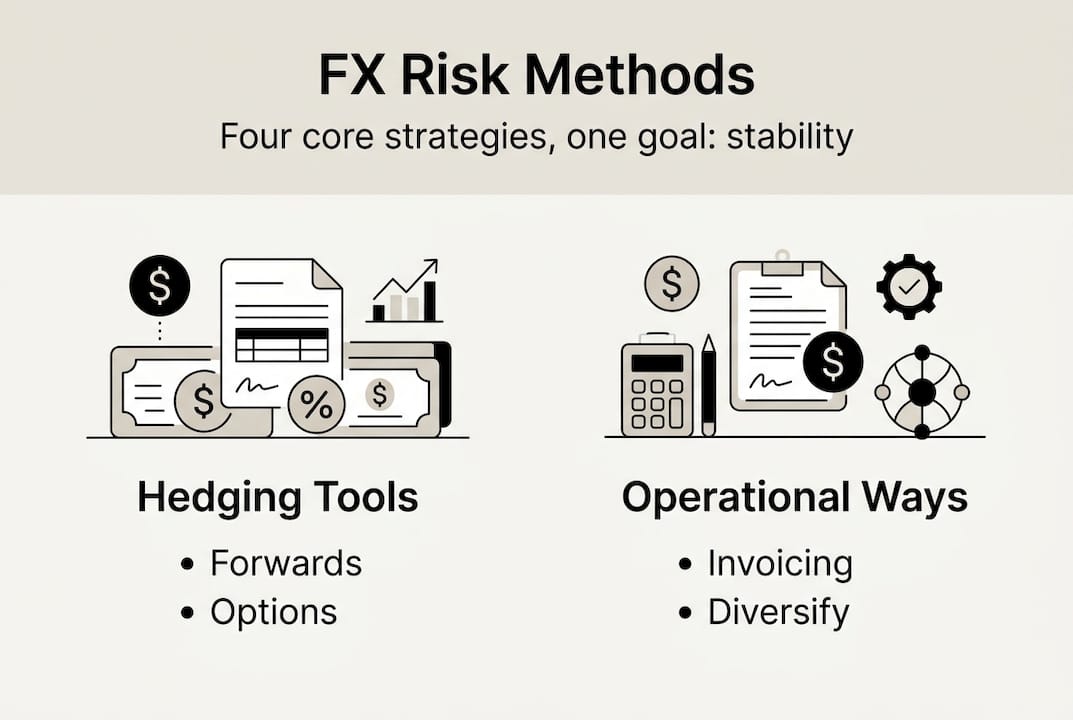
Financial hedging uses derivatives to lock in or protect exchange rates. Forwards fix a rate for a future transaction. Options provide the right, but not the obligation, to exchange at a set rate. Swaps exchange cash flows in different currencies over time. Futures are standardized exchange-traded contracts. Each instrument has a specific use case depending on your exposure horizon and risk tolerance. You can explore hedging instrument use cases to match instruments to your actual business scenarios.
Natural hedging means matching currency inflows and outflows so gains and losses offset each other. For example, a company that earns in euros and also pays suppliers in euros has a built-in hedge. It sounds simple, but timing mismatches make it unreliable as a standalone strategy.
Operational adjustments include invoicing in your home currency, diversifying supplier and customer bases across currency zones, and relocating production to match revenue currencies.

| Methodology | Best for | Key advantage | Main limitation |
|---|---|---|---|
| Forward contracts | Known future cash flows | Rate certainty | Misses favorable moves |
| Options | Uncertain exposures | Flexibility | Premium cost |
| Currency swaps | Long-term debt/financing | Reduces volatility 41% | Complexity |
| Natural hedging | Operational alignment | No instrument cost | Timing mismatches |
| Dynamic/hybrid | Volatile, complex exposures | Outperforms static | Requires active management |
For selecting the right approach, follow these steps:
- Map all currency exposures by type (transaction, translation, economic) and time horizon.
- Quantify the financial impact of each exposure under stress scenarios.
- Identify which exposures can be naturally offset through operational changes.
- Select financial instruments for residual exposures based on cost, flexibility, and certainty needs.
- Review and rebalance your hedging mix quarterly using updated market and business data.
For a broader framework, FX risk reduction strategies and currency fluctuation best practices offer structured guidance for building a program that scales with your business.
Pro Tip: Natural hedges often look perfect on paper but break down in practice because inflows and outflows rarely align in timing. Always layer a financial hedge on top of natural positions when timing gaps exceed 30 days.
For a broader view of how FX hedging frameworks are evolving globally, the divergence between major central bank policies in 2026 is making instrument selection more consequential than ever.
Benchmarking and optimizing FX risk procedures
Choosing the right methodology is only half the work. You also need to measure whether it is actually performing. Without clear benchmarks, you cannot tell if your hedging program is reducing risk or just adding cost.
Empirical benchmarks show significant variation in outcomes across instruments. Futures and forwards carry a basis risk deviation of around 5.9% and can cause companies to miss favorable moves worth up to €3.4M. Options reduce premiums by 68% when structured correctly but require active delta hedging to maintain effectiveness. Currency swaps cut earnings volatility by 41%. Dynamic loan hedging reduces FX beta by 30.5% while cutting costs by 29%.
| Instrument | Basis risk | Volatility reduction | Cost impact | Missed upside |
|---|---|---|---|---|
| Forwards/Futures | 5.9% deviation | Moderate | Low | Up to €3.4M |
| Options (structured) | Low | High | Premium reduced 68% | Minimal |
| Currency swaps | Low | 41% reduction | Medium | Low |
| Dynamic loan hedging | Very low | High | Costs reduced 29% | Minimal |
Key performance metrics your team should track regularly include:
- Hedge ratio effectiveness: Are you covering the right percentage of exposure at each time horizon?
- Basis risk: How much does your hedge instrument deviate from the actual exposure being hedged?
- Cost of carry: What are you paying in premiums, spreads, and opportunity cost?
- Earnings volatility reduction: Has your program measurably smoothed reported results?
- Cash flow predictability: Can your business plan with greater confidence because of your hedging program?
For reducing earnings volatility, the data is clear: dynamic and hybrid strategies consistently outperform static hedging because they adapt to changing market conditions rather than locking in a fixed position regardless of context.
Manufacturing companies face greater FX sensitivity than service businesses because their cost structures are more fixed and their pricing is more exposed to import competition. This means advanced FX risk strategies for manufacturers need to account for both input cost hedging and revenue-side protection simultaneously.
For additional quantitative FX hedging outcomes across industries, the research supports building sector-specific benchmarks rather than applying generic hedge ratios.
Nuances, pitfalls, and advanced practices in FX risk management
Even experienced treasury teams make costly mistakes. The most common ones are not about choosing the wrong instrument. They are about calibration, governance, and assumptions that stop being true when markets move.
Here are the pitfalls that consistently hurt companies:
- Over-hedging: Locking in too large a position costs 1-3% of notional value and can create losses when the market moves in your favor.
- Under-hedging: Leaving significant exposures uncovered erodes margins when rates move against you, often at the worst possible time.
- Basis risk in private markets: Hedging instruments do not always track the actual exposure perfectly, creating residual risk even in a "hedged" position.
- Counterparty risk in swaps: Credit valuation adjustments (CVA) on swap portfolios can reach €15.6M for large programs, a cost that is often underestimated.
- Static hedge ratios: Applying the same ratio across all time horizons ignores the very different risk profiles of short-term versus strategic exposures.
"Tiered hedge ratios of 95-100% for short-term exposures and 0-25% for strategic horizons reflect the fundamental difference between protecting known cash flows and preserving optionality for long-term decisions."
Scenario planning is becoming a non-negotiable practice in 2026, given the divergence between major central bank policies and ongoing geopolitical uncertainty. Companies that model multiple exchange rate paths and stress-test their hedging programs against each one are far better positioned to respond quickly when conditions shift.
Global risk management strategies increasingly emphasize centralization of treasury functions so that exposure data is consolidated and decision-making is not fragmented across regional teams.
For hedging tiered ratios in a divergent rate environment, the framework needs to be reviewed at least quarterly, not annually.
Pro Tip: Centralize your treasury operations and automate exposure reporting before 2026 year-end. Manual processes create blind spots that become expensive when volatility spikes unexpectedly.
A contrarian view: Why strategic risk management must evolve in 2026
Most FX risk guides tell you to hedge consistently and review annually. That advice was adequate in stable rate environments. It is not adequate now.
Static hedging programs lock in rates and call it risk management. But in a year defined by central bank divergence, geopolitical shocks, and AI-driven capital flows, locking in is often the same as giving up optionality at exactly the wrong moment. The dynamic vs static hedging debate is settled empirically: dynamic wins on both cost and upside capture.
What most financial leaders still miss is the governance gap. Risk management is treated as a treasury function when it should be embedded in corporate strategy. Real-time visibility, AI-assisted forecasting, and hybrid short and long-term instruments are not advanced features. They are baseline requirements for 2026. Integrating risk management into strategy with proper governance structures is what separates companies that absorb volatility from those that profit from it.
The 2026 hedge ratio trends confirm that companies are increasing hedge ratios after years of complacency. But increasing ratios without improving the underlying strategy just means paying more for the same inadequate protection. The real opportunity is in building programs that are smarter, not just bigger.
Enhance your FX risk management with CorpHedge
The strategies covered in this article require real-time data, precise exposure tracking, and the ability to act quickly when market conditions change. That is exactly what CorpHedge is built for.
CorpHedge gives financial decision-makers a centralized platform to monitor currency positions, apply Value at Risk frameworks, and execute hedging strategies without the delays and blind spots that come with manual processes. Whether you are managing transaction exposure across multiple currencies or building a hybrid hedging program, the FX risk management product tour shows you exactly how the platform works in practice. Explore the full range of FX exposure management features and see how CorpHedge helps you protect margins and move faster than volatility.
Frequently asked questions
What is the main role of risk management in global finance?
Risk management protects profits and stability by identifying, measuring, and mitigating currency and market fluctuations before they erode cash flow and earnings for international businesses.
How do companies decide which currency exposures to hedge?
Companies use tiered hedge ratios of 95-100% for short-term known exposures and 0-25% for strategic horizons, balancing cost against the need to preserve optionality.
What are the most effective risk management methodologies for currency volatility?
Financial hedging instruments such as forwards, options, and swaps, combined into hybrid or dynamic strategies, consistently outperform natural hedges and static single-instrument approaches.
Why is over-hedging or under-hedging problematic?
Over-hedging costs 1-3% of notional value and eliminates beneficial rate moves, while under-hedging leaves margins exposed to sudden adverse currency shifts that can compound quickly across business units.
Are dynamic and hybrid FX risk strategies superior to static approaches?
Yes. Dynamic and hybrid strategies measurably outperform static methods by reducing costs, capturing favorable rate movements, and adapting to changing market conditions in ways that fixed-ratio programs simply cannot.