

TL;DR:
- Effective FX management training empowers finance teams to reduce cash-flow volatility and protect earnings.
- Advanced strategies involve hybrid approaches with instruments like options, forwards, NDFs, and structured products.
- Proper training should cover complex scenarios including trapped cash, emerging markets, and political risks for comprehensive risk mitigation.
Currency risk is not a niche concern reserved for treasury departments. Every finance professional at a global company, from FP&A analysts to CFOs, faces decisions shaped by exchange rate movements. Yet most teams operate without structured training, relying on intuition or outdated frameworks that leave measurable value on the table. Effective foreign exchange management training changes that equation entirely. This guide covers what real FX training delivers, which advanced strategies hold up under scrutiny, and how to translate new skills into concrete financial improvements for your organization.
Table of Contents
- Why foreign exchange management matters for global companies
- Core components of effective FX management training
- Advanced FX hedging strategies and their practical impact
- Applying FX management training: Best practices for organizations
- A fresh perspective: What FX training overlooks and how to bridge the gap
- Take your FX management skills further with specialized solutions
- Frequently asked questions
Key Takeaways
| Point | Details |
|---|---|
| FX risk is measurable | Empirical studies show currency risk can be quantified and significantly reduced with proper hedging. |
| Training drives results | Effective FX management training enables finance professionals to implement proven risk strategies and improve financial outcomes. |
| Hybrid approaches work best | Combining multiple hedging products and methods is optimal for multinational companies facing complex currency exposure. |
| Edge cases need attention | Advanced training addresses challenging scenarios like trapped cash, illiquid currencies, and political risk, not just textbook situations. |
| Measurable impact | Hedging and smart FX management can cut cash-flow volatility by 8-12% and shield EBIT from unpredictable market movements. |
Why foreign exchange management matters for global companies
Exchange rate shifts can quietly erode margins faster than any pricing decision you make internally. For multinational companies, this is not a theoretical concern. A Princeton study found that currency risk is highly concentrated across firms: roughly half of companies carry essentially zero FX exposure, while firms in the top decile face cash-flow variance of up to 28%. Among those exposed firms, strategic hedging reduces that variance by 8 to 12 percentage points. Critically, the same research found that cash-rich firms hedge more often, not less, overturning the common assumption that only financially stressed companies need protection.
"Currency movements are not noise, they are signal. For exposed firms, unhedged FX risk can represent the single largest source of earnings volatility, dwarfing operational risks that receive far more management attention."
Understanding the mechanics of that risk starts with recognizing its three main categories:
- Transaction exposure: The risk that currency movements change the value of existing contracts, receivables, or payables before settlement.
- Translation exposure: The accounting effect of converting foreign subsidiary financials into the parent company's reporting currency.
- Economic exposure: The long-term impact of sustained currency trends on competitive positioning and future cash flows.
You can explore each of these in depth via a detailed breakdown of FX risk types and their mitigation strategies.
The earnings impact is also measurable at the EBIT level. A BIS study found that a one-percentage-point change in the NICER (Narrow Index of Currency Exposure and Rates) reduces exporter EBIT by 0.19 percentage points and importer EBIT by 0.13 percentage points. Financial hedging demonstrably mitigates this impact and outperforms reliance on trade-weighted exchange rate benchmarks. Manufacturing companies consistently show greater FX sensitivity than services firms, which matters when tailoring a training curriculum to your industry.
The financial rationale for managing currency risk is no longer about guessing whether rates will move. Rates will move. The question is whether your team has the knowledge and tools to respond intelligently before the quarter closes.
Core components of effective FX management training
Not all FX training programs are built the same. Some focus exclusively on product knowledge, teaching you what a forward contract is without explaining when to use one. Others skip foundational concepts entirely and jump into exotic derivatives. The most effective curricula balance theory, tools, and judgment, giving finance teams both frameworks and practice.
The BAFT Certificate in Foreign Exchange (CFX) is a widely recognized benchmark for transaction banking professionals. It covers FX market structure, product types, risk management fundamentals, payment flows, client prospecting, and regulatory considerations. It is structured for professionals who need a rigorous and current overview rather than deep technical specialization.
For finance teams seeking hands-on hedging competency, executive programs go further. The Oxford Centre executive training course teaches FX market fundamentals alongside risk measurement techniques, hedging with spots, forwards, swaps, and options, how to distinguish genuine hedging from speculative positioning, and how to develop an internal FX policy that governance teams can actually implement.
Here is how key training programs compare across the dimensions that matter most for corporate finance teams:
| Feature | BAFT CFX | Oxford Centre Executive | Advanced Specialist Courses |
|---|---|---|---|
| Market fundamentals | Strong | Strong | Moderate |
| Hedging instruments | Moderate | Strong | Very strong |
| Regulatory context | Strong | Moderate | Varies |
| Policy development | Moderate | Strong | Moderate |
| Edge cases and EM currencies | Weak | Moderate | Strong |
| Practical case studies | Moderate | Strong | Very strong |
When evaluating a program, follow this sequence:
- Identify your team's current knowledge gaps, product familiarity, risk measurement, or policy design.
- Match course depth to your exposure profile, a manufacturer with 60% revenues in EM currencies needs different training than a services firm with a single USD invoice.
- Confirm the program includes regulatory context relevant to your jurisdictions.
- Prioritize curricula that use live case studies rather than purely theoretical frameworks.
- Check whether the program connects hedging decisions to accounting treatment, particularly IFRS 9 or ASC 815.
Pro Tip: Look specifically for programs that walk through policy design from start to finish. Knowing what instruments exist is far less valuable than knowing when and why to deploy them under your company's specific constraints.
You can also use the structured resources available through the FX hedging course from CorpHedge's learning academy alongside external certifications, especially when you want content mapped directly to your firm's existing risk management framework. A solid grounding in FX management strategies helps you filter course offerings and invest training budget wisely.

Advanced FX hedging strategies and their practical impact
Once your team understands the basics, the real leverage comes from advanced instruments and how they interact with your firm's broader risk framework. Standard forwards and options are familiar to most finance teams, but the performance differences between strategies become significant under real market conditions.
Eureka Financial's advanced course on FX hedging and enterprise risk management (ERM) integration covers a suite of structured products including participating forwards, seagull options, and barrier options. It also addresses hedge accounting under IFRS 9 and ASC 815, Value at Risk (VaR), Conditional Value at Risk (CVaR), stress testing, and edge cases such as emerging market NDFs (non-deliverable forwards) and crypto-fiat hedging scenarios.
A compelling real-world illustration comes from the SolarTech case study, which compared multiple hedging approaches against the same EUR-denominated revenue stream:
| Strategy | Key metric | Result |
|---|---|---|
| Futures and forwards | Basis risk | 5.9% residual; missed gains of €3.4M |
| Options (asymmetric) | Premium reduction via delta hedging | 68% reduction possible |
| Cross-currency swaps | Volatility reduction | 41% reduction; €15.6M CVA risk |
| Dynamic loan hedging | FX beta reduction | 30.5% lower; cost savings of 29% |
The study's recommendation was a hybrid approach, combining instruments in proportion to the exposure type and time horizon. This is not a theoretical preference. It reflects the reality that no single instrument performs optimally across all market conditions.
Key insights from advanced FX hedging strategies training that most professionals only learn after costly experience:
- Participating forwards let you set a floor rate while retaining upside participation, but they carry wider spreads than vanilla forwards.
- Seagull structures combine a bought option with two sold options to reduce net premium, but introduce complex payoff profiles that require active monitoring.
- Barrier options are cheaper than plain vanilla options but can expire worthless at the worst moment if a trigger level is breached during high-volatility events.
- NDFs are essential for currencies with capital controls (think Brazilian real or Indian rupee), where physical delivery is restricted and settlement occurs offshore in USD.
Statistic callout: Among firms with meaningful FX exposure, strategic hedging cuts cash-flow volatility by 8 to 12 percentage points, making it one of the highest-return risk management activities available to corporate finance teams.
Understanding the FX risk workflow and how these instruments fit together is what separates teams that use hedging strategically from those that simply buy forwards reflexively at quarter-end. Advanced training also covers the organizational side: how to document hedge rationale, satisfy external auditors, and integrate hedging into your ERM reporting so finance and risk functions stay aligned. Combining instruments thoughtfully, as the SolarTech analysis showed, and using appropriate mitigation frameworks is what generates durable, measurable results.
Applying FX management training: Best practices for organizations
Training without implementation is just education. The goal is to change how your team makes decisions under pressure, when currencies move 3% in a week and the board wants answers by Thursday morning. Rolling out FX management training effectively requires a structured approach.
Follow this sequence to convert training investment into organizational capability:
- Baseline your exposure. Before any training, quantify your transaction, translation, and economic exposures by currency and time horizon. This gives you a benchmark to measure improvement against.
- Prioritize based on materiality. Focus training resources on the currency pairs and instruments that affect the largest share of revenues or costs, not on exotic scenarios with minimal real impact.
- Assign ownership. Training without clear accountability creates diffuse responsibility. Designate a currency risk owner per business unit who applies new skills directly to active positions.
- Run live simulations. Use historical volatility scenarios, including periods like 2022's EUR/USD parity breach or 2015's Swiss franc shock, to stress-test hedging decisions in a low-stakes environment before real exposure materializes.
- Set measurable targets. Track cash-flow volatility reduction, EBIT impact per currency unit, and hedge effectiveness ratios. Empirical benchmarks show that well-structured programs cut cash-flow volatility by 8 to 12%, so set your target within that range and report progress quarterly.
- Integrate into budget cycles. FX assumptions should be revisited at each budget review, not just annually. Teams trained to think dynamically catch misalignments between forward assumptions and market conditions before they create P&L surprises.
Integration pitfalls are real and common. The biggest one is siloing: treasury trains on hedging while FP&A builds forecasts using spot rates, and no one reconciles the gap until a variance review. A second common failure is treating training as a one-time event rather than a continuous practice. Currency markets evolve, regulations change (particularly IFRS 9 amendments), and geopolitical risks create new exposure patterns that no single course covers permanently.
Pro Tip: Use risk reduction strategies as a structured reference when designing post-training workflows. Map each instrument your team learns directly to a specific exposure in your portfolio, with documented rationale for why that instrument was chosen.
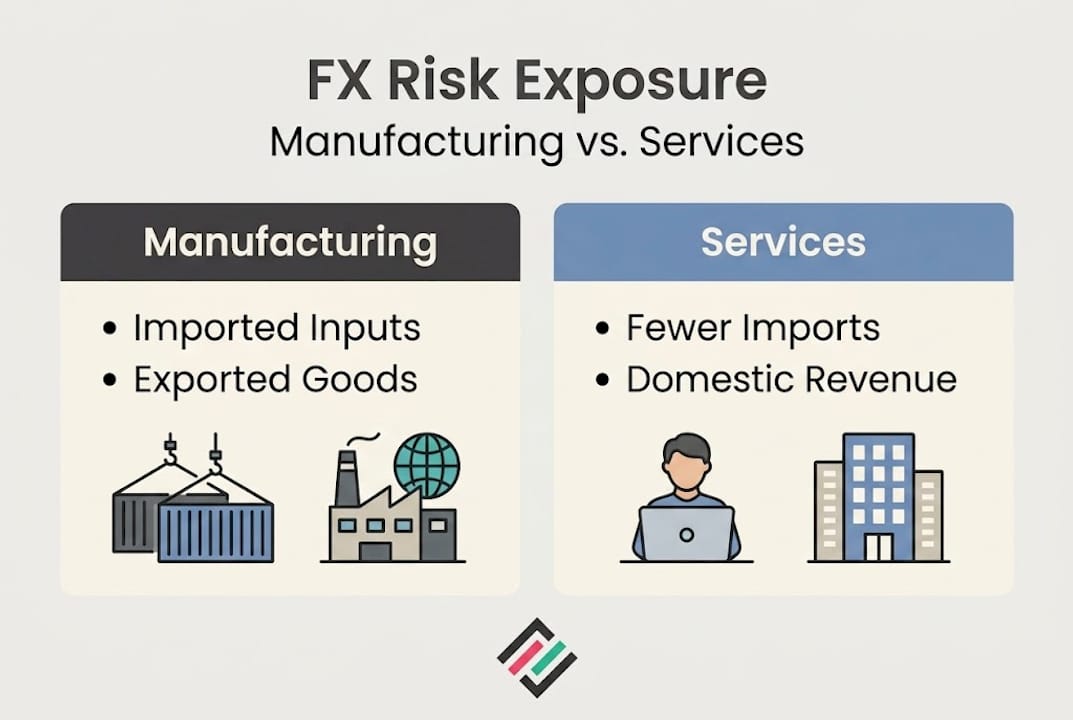
Manufacturing companies generally face greater FX exposure than services firms due to imported inputs and exported finished goods. Their training needs lean heavily on operational hedging and pricing strategies alongside financial instruments. Services firms with USD-denominated contracts tend to need deeper understanding of translation exposure and long-term economic risk. Tailoring training content to your firm's actual business model is not optional, it is the difference between training that generates ROI and training that generates certificates.
For multinationals, hybrid strategies are consistently optimal. This is also confirmed by the Princeton research, which found that cash-rich firms hedge more aggressively precisely because they have the capacity to absorb premium costs while protecting cash-flow predictability. Embedding this insight into your organization's financial risk management practice separates reactive teams from those that drive results.
A fresh perspective: What FX training overlooks and how to bridge the gap
Most FX training programs do a solid job on the fundamentals. They struggle, however, when it gets complex. Political risk, counterparty credit risk, embedded derivatives in supplier contracts, and the mechanics of trapped cash in jurisdictions with capital controls rarely get the attention they deserve. Yet these are exactly the scenarios where finance teams at global companies make costly mistakes.
Eureka Financial's advanced curriculum is one of the few that explicitly covers illiquid and pegged currencies, trapped cash, embedded derivatives, EM NDFs, crypto-fiat hedges, political risks, and basis risk. These are not exotic edge cases reserved for academic discussion. They are live issues for any company operating in markets like Turkey, Nigeria, Argentina, or Southeast Asia.
Our view is that training programs should be evaluated first on how they handle complexity, not on how well they explain vanilla forwards. A team that can price a standard option but cannot navigate a Brazilian NDF or account for counterparty credit exposure is only partially equipped. Continuously updating your knowledge through scenario analysis and FX stability basics refreshers beats any single certification. The competitive advantage in FX management comes from nuance, not from mastering textbook solutions everyone else already knows.
Take your FX management skills further with specialized solutions
Understanding FX risk at a conceptual level is a starting point. Executing consistently, with real-time data and structured workflows, is where measurable results are generated.
CorpHedge offers a purpose-built platform for corporate FX risk management, combining hedging based on value at risk analytics, real-time currency position tracking, and seamless integration with payment platforms. Whether you are building out a structured hedging program from scratch or optimizing an existing one, the FX risk management solutions available through CorpHedge give your team the infrastructure to act on what training teaches. You can also accelerate your team's practical skills through the CorpHedge FX hedging course, designed specifically for finance professionals at international companies who need results, not just theory.
Frequently asked questions
What are the most important skills taught in FX management training?
The core skills include risk measurement, hedging with spots, forwards, options, and swaps, distinguishing genuine hedging from speculative positioning, and developing internal FX policies that hold up under both market stress and governance review.
How does currency hedging impact financial results?
Strategic hedging reduces cash-flow variance by 8 to 12% for exposed firms and protects EBIT, with a one-point NICER change reducing exporter EBIT by 0.19 percentage points and importer EBIT by 0.13 percentage points when hedging is absent.
Are hybrid hedging strategies effective for multinational companies?
Yes. Research consistently shows that hybrid approaches are optimal for multinationals, combining instruments and time horizons to manage diverse currency exposures more effectively than any single product can.
Does FX training address edge cases like trapped cash or emerging market currencies?
Advanced programs explicitly cover illiquid currencies, NDFs, trapped cash, embedded derivatives, and crypto-fiat hedging, equipping finance professionals to manage risks that standard training typically ignores.