

TL;DR:
- Currency risk management requires identifying, assessing, and mapping all exposures regularly.
- A structured FX policy with dynamic hedging strategies improves risk mitigation and outcomes.
- Continuous monitoring and technology enable optimization and adaptability of currency risk programs.
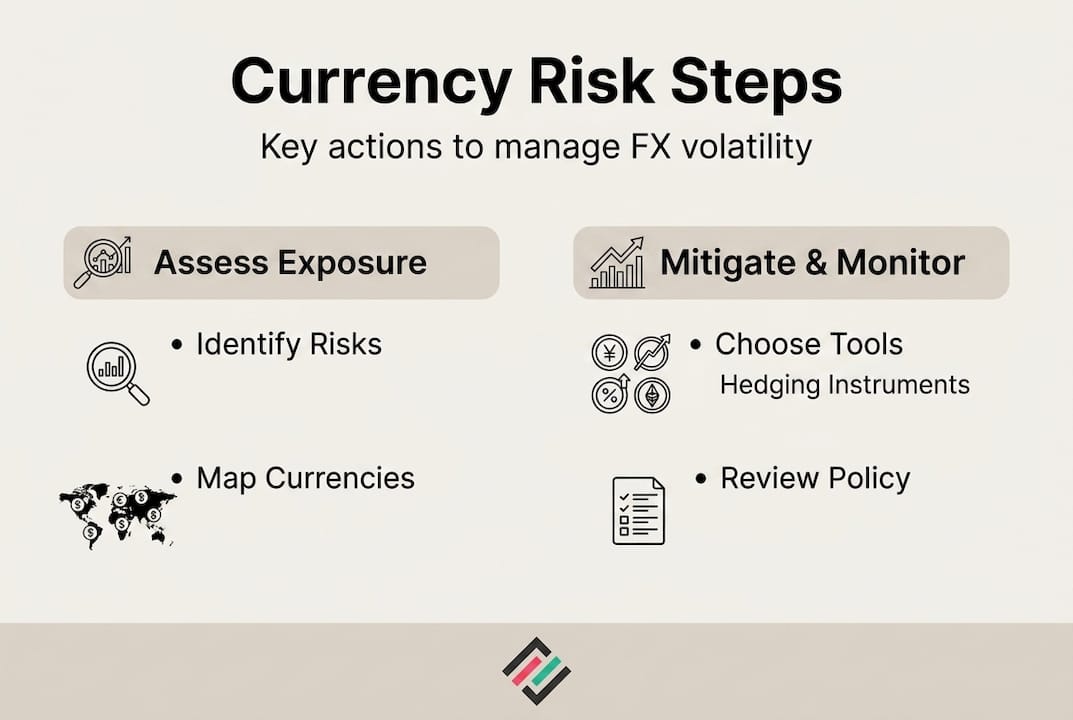
Currency volatility can quietly destroy margins before your quarterly close even begins. A single adverse move in EUR/USD or GBP/USD can wipe out the operating profit on a major contract, turning a projected win into a documented loss. US multinationals using derivatives saw a 5% increase in firm value, which tells you that getting this right is a strategic advantage, not just a treasury housekeeping task. This guide walks finance executives and risk professionals through five critical steps: identifying exposure, designing a policy, selecting strategies, implementing tools, and continuously improving the program.
Table of Contents
- Identify and assess your currency exposure
- Design a robust FX risk management policy
- Choose and implement risk mitigation strategies
- Monitor, evaluate, and optimize your FX program
- Why most FX risk management programs underperform
- Take your FX risk management further with CorpHedge
- Frequently asked questions
Key Takeaways
| Point | Details |
|---|---|
| Assess your exposure | Mapping all currency exposures is the foundation of effective management. |
| Establish a clear FX policy | A formal policy with defined thresholds, ratios, and review cycles improves outcomes. |
| Mix strategies for resilience | Combining financial and natural hedges optimizes cost, flexibility, and protection. |
| Leverage technology | Real-time platforms and analytics streamline exposure tracking and decision-making. |
| Prioritize ongoing review | Regular program evaluation ensures your strategy adapts to markets and business needs. |
Identify and assess your currency exposure
Before you can take action, you need a clear view of the risks facing your firm. Most organizations have more exposure than they realize, spread across business units, geographies, and deal structures that don't always talk to each other.
Start by distinguishing between the three core risk types:
- Transaction risk: The risk that cash flows from existing contracts will change value before settlement. This is the most immediate and measurable form.
- Translation risk: The accounting impact of converting foreign subsidiary financials into the parent company's reporting currency. It affects the balance sheet even when no cash changes hands.
- Economic risk: The long-term competitive impact of currency moves on pricing power, market share, and cost structures. This is the hardest to quantify but often the most consequential.
Once you've categorized the types, catalog your actual key FX risk exposures by geography, currency pair, contract size, and deal type. A practical exposure register might look like this:
| Currency pair | Exposure type | Annual volume | Volatility (1Y) | Priority |
|---|---|---|---|---|
| EUR/USD | Transaction | $45M | 8.2% | High |
| GBP/USD | Translation | $18M | 9.7% | High |
| JPY/USD | Economic | $12M | 11.4% | Medium |
| BRL/USD | Transaction | $6M | 14.1% | Medium |
Apply a materiality, predictability, correlation framework to decide which exposures actually warrant hedging. Not everything on the register deserves the same attention. Focus resources on exposures that are large in dollar terms and in highly volatile currency pairs.
Modern exposure mapping technology allows real-time aggregation of FX positions across ERPs, treasury management systems, and banking platforms. This replaces the spreadsheet-based guesswork that still plagues many mid-market firms. Combine that with FX risk management basics to build a structured view of your entire exposure landscape.
Pro Tip: Reassess your exposure register every quarter, not just annually. Tariff changes, supply chain shifts, and new trade policies can create significant new exposures overnight.
Design a robust FX risk management policy
With exposures mapped, a formal framework ensures consistent, controlled management. Too many organizations operate on informal norms and verbal agreements between treasury and the CFO. That approach fails during volatility spikes.
A well-structured FX policy should cover:
- Risk tolerance and thresholds: Defined at the board or CFO level, expressed in both percentage of revenue and absolute dollar terms.
- Hedge ratios: Most firms target a partial hedge in the 50 to 70% range of forecasted exposures. This balances protection against volatility with the ability to benefit from favorable moves.
- Eligible instruments: Specify which instruments treasury may use. Forwards, vanilla options, and cross-currency swaps are typical. Exotic derivatives should require senior approval.
- Segregation of duties: The person executing a hedge should not be the same person who approves the exposure assessment.
- Review cycles: Quarterly operational reviews and an annual strategic review at minimum.
Effective FX policy implementation requires clearly defined risk tolerance, exposure limits, hedge ratios, and review processes. Companies like Caterpillar and Unilever have long operated with tiered hedge policies that adjust ratios based on forecast confidence and market conditions. That adaptive structure is worth modeling.
"Formal FX policies yield 23% better hedging outcomes."
A hedging policy effectiveness study supports the link between structured governance and measurable risk reduction. Refer to currency risk governance best practices for templates and frameworks you can adapt directly to your organization.

Pro Tip: Build scenario analysis and stress testing directly into the policy. Require treasury to model at least two adverse scenarios (a 10% and a 20% adverse currency move) before any major hedge is executed.
Choose and implement risk mitigation strategies
The right strategy mix ensures your risk management policy works in the real world. Selecting instruments without understanding their cost-benefit profile is one of the most common reasons programs underperform.
Primary currency risk strategies include financial hedging through forwards, options, and swaps; natural hedging by matching currency inflows with outflows; netting across subsidiaries; geographic diversification; and dynamic hedging that adjusts based on market signals.
Here is a practical comparison to guide instrument selection:
| Instrument | Protection level | Upside preserved | Cost | Best use case |
|---|---|---|---|---|
| Forward contract | High | No | Low | Known, fixed cash flows |
| Vanilla option | High | Yes | Medium | Variable or uncertain flows |
| Cross-currency swap | High | Partial | Medium | Long-term debt/liability hedging |
| Natural hedge | Medium | Yes | Minimal | Supply chain restructuring |
| Dynamic hedging | Adaptive | Yes | Variable | Active portfolios |
A currency hedging whitepaper from WisdomTree outlines the discipline required to execute dynamic strategies without introducing speculative risk. The core principle: hedge to manage risk, not to profit.
Here is a step-by-step implementation process:
- Confirm exposure data is current and complete from your exposure register.
- Apply your materiality and predictability filters to shortlist hedgeable exposures.
- Select the appropriate instrument for each exposure category using the table above.
- Execute through approved counterparties within your policy's authorized limits.
- Document every trade with a clear linkage to the underlying exposure.
- Set automated alerts for rate triggers or exposure threshold breaches.
For more on structuring a complete program, see currency risk strategies for 2026, financial risk reduction strategies, and enterprise risk management steps.
Pro Tip: Use layered hedging, splitting a single exposure across multiple instruments and tenors, to build in flexibility without sacrificing core protection.
Monitor, evaluate, and optimize your FX program
Implementation is only the beginning. Close the loop with rigorous monitoring and improvement to ensure your program is actually delivering the risk reduction you expect.
Track these metrics at minimum on a monthly basis:
- Hedge ratio vs. target: Are you consistently within your policy's defined range?
- Hedge effectiveness rate: Under IFRS 9 or ASC 815, effectiveness testing is required; aim for 80 to 125% effectiveness.
- Earnings volatility impact: Compare FX-related earnings variance before and after hedging. This is your clearest measure of program value.
- Cash flow forecast accuracy: Poor forecasting is a leading cause of over-hedging and under-hedging alike.
- Settlement error rate: Track operational errors in execution and documentation.
AI and real-time FX platforms are now essential for dynamic monitoring and exposure mapping, dramatically reducing manual errors and lag time. A live dashboard that aggregates all positions, mark-to-market values, and threshold breaches in one view changes how quickly your team can respond to market moves.
Hybrid strategies reduce FX beta by 30.5% and costs by 29%, according to a hybrid hedging study. That level of improvement is not achievable through static, set-and-forget programs.
After major volatility events, trigger a formal policy review. Don't wait for the annual cycle. Markets move fast, and a strategy built for a low-volatility environment may be inadequate when conditions shift. Review currency fluctuation best practices and market risk strategies for CFOs to build a culture of continuous improvement.
Pro Tip: Schedule an annual technology audit alongside your policy review. Platforms evolve quickly, and a system that was best-in-class two years ago may no longer integrate with your current ERP or banking infrastructure.
Why most FX risk management programs underperform
Having covered the standard steps, let's address why even well-intentioned programs can falter. The most common failure is not a lack of policy. It is the wrong relationship with uncertainty.
Firms often swing between two extremes: hedging 100% of every exposure because it feels safe, or avoiding hedging entirely because the premium costs feel like waste. Both approaches miss the point. Over-hedging risks missing upside; under-hedging exposes firms to costly volatility. Neither outcome serves shareholders.
"A 50% hedge ratio often aligns best with the random walk nature of FX."
The best programs we have seen at CorpHedge match hedge ratios dynamically to forecast confidence, exposure materiality, and where we are in the business cycle. They treat the policy as a living document, not a compliance artifact. And they invest in technology that surfaces actionable data rather than raw numbers. Read more in our global risk management insights for the patterns that separate high-performing programs from average ones.
Take your FX risk management further with CorpHedge
If you are ready to move from a reactive, spreadsheet-driven approach to a proactive, data-powered FX program, CorpHedge is built for exactly that transition.

The platform gives your treasury team live visibility into all currency positions, customizable hedge ratio targets, Value at Risk modeling, and automated alerts, all in one place. Whether you need to formalize your first FX policy or optimize a program that has grown too complex to manage manually, our FX exposure management features deliver the structure and speed you need. Take a self-guided FX risk solutions tour or book a personalized demo to see how CorpHedge helps international firms reduce earnings volatility and improve FX ROI.
Frequently asked questions
What is the most effective way to hedge currency risk?
Primary strategies include financial hedging, natural hedging, and hybrid approaches. Most global firms combine instruments and underpin everything with a formal FX policy and regular reviews.
How often should a company review its FX hedging policy?
Companies should review policies at least annually and immediately after major market disruptions. Regular reviews and scenario analyses are considered best practice under leading treasury standards.
Does hedging guarantee profit or eliminate all risk?
No. Hedging reduces earnings volatility but does not guarantee profit. Full hedging removes risk but may forfeit upside when currencies move favorably; partial hedging balances protection with opportunity.
What are the risks of over-hedging?
Over-hedging risks opportunity cost and unnecessary premium expenses when currencies move in your favor. Under-hedging, on the other hand, leaves firms exposed to earnings volatility they could have avoided.