

TL;DR:
- Effective FX risk management reduces earnings volatility and boosts firm valuation.
- Combining dynamic and hybrid hedging strategies optimizes protection in volatile markets.
- Continuous review and automation are essential for successful, adaptable forex risk programs.
Currency volatility can erase a quarter's worth of profit gains in days. For international corporations, unhedged foreign exchange exposure is not just a treasury inconvenience; it is a direct threat to earnings per share, cash flow predictability, and competitive positioning. FX hedging reduces cash-flow variance by 8-12% for exposed firms, according to empirical benchmarks. This guide delivers a structured, evidence-driven approach for corporate finance teams to identify exposure, select the right instruments, execute hedging programs, and verify results. If you manage FX risk at scale, the frameworks here will sharpen both your strategy and your outcomes.
Table of Contents
- Understanding corporate forex exposure and its risks
- Assessing and preparing for forex risk management
- Implementing advanced hedging strategies: Static, dynamic, and hybrid
- Monitoring, verifying, and adjusting: Closing the loop
- Troubleshooting pitfalls and edge cases in FX risk reduction
- Why most corporate FX risk programs underperform—and the keys to real-world success
- Take the next step: Make forex risk reduction automatic with CorpHedge
- Frequently asked questions
Key Takeaways
| Point | Details |
|---|---|
| Quantify FX exposure | A clear understanding and measurement of FX risk is the foundation for any effective risk reduction strategy. |
| Combine dynamic and static hedges | Hybrid approaches balance risk, cost, and missed opportunity better than single-method hedges. |
| Monitor and iterate | Continuous benchmarking and verification ensure your hedging tactics stay aligned with business goals. |
| Mind edge cases | Be aware of basis, counterparty, and nonlinear risks that can undermine an otherwise solid hedge program. |
| Automate for scale | Technology can make forex risk reduction consistent and repeatable as your exposure grows. |
Understanding corporate forex exposure and its risks
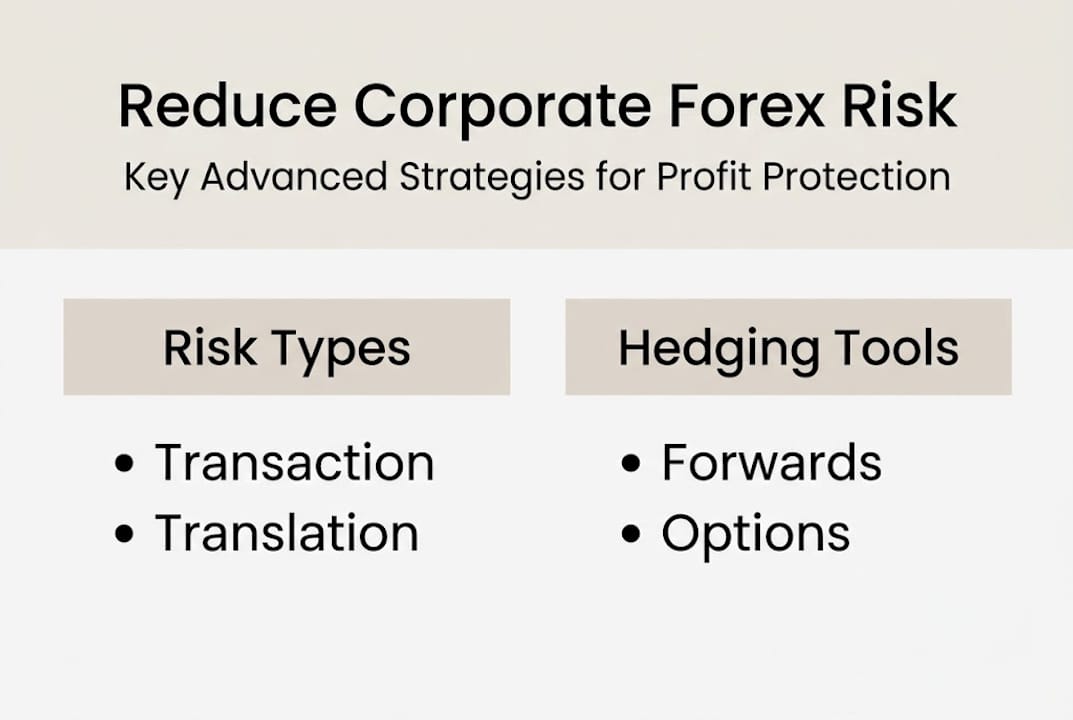
Before you can reduce forex risk, you need to know exactly what you are carrying. Corporate FX exposure falls into three distinct categories: transaction exposure, which arises from receivables and payables denominated in foreign currencies; translation exposure, which affects the consolidated balance sheet when foreign subsidiary results are converted to the reporting currency; and economic exposure, the long-term impact of currency shifts on competitive position and future cash flows. Each type demands a different response, and confusing them is a common source of hedging error.
The financial consequences are significant. A 10% adverse move in a major currency pair can reduce operating margins by several percentage points for a firm with unhedged cross-border revenues. Valuation is equally at stake. A 5-year study of 6,000+ firms links active hedging to lower earnings volatility and a 4.87% higher firm valuation compared to unhedged peers. That is not a rounding error; it is a material difference that shows up in your cost of capital and investor confidence.
Key drivers of corporate forex risk include:
- Currency volatility: Realized and implied volatility in major and emerging market pairs
- Deal cycle timing: The gap between contract signing and settlement creates open exposure windows
- Sector sensitivity: Manufacturing, commodities, and export-heavy industries face greater exposure than domestic services
- Geographic concentration: Heavy reliance on a single foreign market amplifies currency-specific shocks
The table below illustrates typical FX risk levels by industry and region:
| Industry | Primary exposure type | Risk level | Key currency pairs |
|---|---|---|---|
| Manufacturing | Transaction, economic | High | EUR/USD, CNY/USD |
| Technology (SaaS) | Translation, transaction | Medium | GBP/USD, EUR/USD |
| Commodities | Economic, transaction | Very high | USD/BRL, USD/ZAR |
| Financial services | Translation, counterparty | Medium-high | Multiple |
| Retail (domestic) | Economic | Low-medium | Regional pairs |
For a deeper look at how these exposure types interact, understanding FX risk is a practical starting point. Building on that foundation with financial risk reduction strategies helps teams move from diagnosis to action. With the costs of inaction clear, the next step is to map out what preparation looks like for effective risk reduction.
Assessing and preparing for forex risk management
A hedging program without a solid assessment phase is just speculation with better paperwork. Start with a structured exposure mapping exercise before you touch a single instrument. Here is a numbered sequence that works for most corporate treasury teams:
- Catalog all foreign currency cash flows: Identify every revenue stream, payable, intercompany loan, and capital expenditure denominated in a non-functional currency.
- Quantify net exposure by currency pair: Netting naturally offsetting flows reduces the gross position you need to hedge.
- Assign time horizons: Separate near-term transaction exposures from multi-year economic exposures.
- Select measurement tools: Match the tool to the exposure type and decision horizon.
- Define risk appetite and targets: Set explicit thresholds for acceptable cash-flow variance and maximum tolerable loss.
The right measurement tool depends on your exposure profile. The comparison table below summarizes suitability:
| Tool | Best for | Strengths | Limitations |
|---|---|---|---|
| Value-at-Risk (VaR) | Short-term portfolio risk | Standardized, widely accepted | Assumes normal distributions |
| Cash Flow at Risk (CFaR) | Operational cash flow planning | Directly tied to business outcomes | Requires reliable forecast data |
| Scenario analysis | Strategic and economic exposure | Captures tail events | Subjective scenario selection |
The data supports the urgency of getting this right. 76-82% of corporates actively hedge amid rising hedging costs, signaling that most sophisticated firms view FX risk management as non-negotiable. The BIS corporate hedging research further confirms that firms with formal programs consistently outperform those relying on ad hoc responses.
Pro Tip: Engage treasury, accounting, and operations teams in the exposure mapping phase, not just at sign-off. Ops teams often know about supplier contracts and payment terms that treasury misses, and accounting can flag translation mismatches before they become surprises.
For teams building or refreshing their foundation, FX risk management basics and enterprise risk management frameworks offer complementary guidance. Once preparations and assessments are in place, the focus shifts to executing sophisticated risk reduction strategies.
Implementing advanced hedging strategies: Static, dynamic, and hybrid
Execution is where the theory meets the market. The three primary hedging architectures are static, dynamic, and hybrid, and choosing the right one depends on your exposure profile, risk appetite, and operational capacity.
Here is a step-by-step implementation sequence:
- Static hedging: Lock in a fixed hedge ratio (typically 50-80% of forecast exposure) using forwards or options for a defined period. Simple to administer, but inflexible when market conditions shift.
- Dynamic hedging: Adjust the hedge ratio continuously based on market signals, updated exposure forecasts, or VaR thresholds. Dynamic hedging cuts FX beta by 30.5% and swaps reduce volatility by 41%, making this approach significantly more effective in volatile environments.
- Hybrid hedging: Combine a static core hedge with a dynamic overlay. The core protects baseline cash flows; the overlay manages residual or tactical exposure.
- Layer in natural hedges: Before adding financial instruments, offset exposures by matching revenue and cost currencies, or relocating production closer to key markets.
- Select instruments: Match the instrument to the specific exposure and objective.
Instrument options and when to use them:
- Forwards: Best for known, fixed transaction exposures with clear settlement dates. Low cost, but you forfeit upside if the rate moves favorably.
- Options: Ideal when exposure is uncertain or when you want to retain upside. Higher premium cost, but provides asymmetric protection.
- Cross-currency swaps: Suited for long-term debt or intercompany loan exposures. Effective for managing both interest rate and currency risk simultaneously.
- FX collars: Combine a bought option and a sold option to cap premium cost while limiting upside participation.
For outperforming hedging strategies, the BIS research consistently points to dynamic and hybrid programs as superior in volatile market regimes.
"Liquidity alone is insufficient to drive effective hedging outcomes; risk aversion and a clearly defined appetite are necessary conditions for sustained performance." — BIS Working Paper finding
Pro Tip: In periods of elevated volatility, dynamic and hybrid hedges consistently outperform static programs. If your team lacks the bandwidth to manage dynamic overlays internally, consider FX hedging strategies and risk management best practices to identify where automation can fill the gap. Implementing a solution is only part of the process; ongoing monitoring and adjustment are essential.

Monitoring, verifying, and adjusting: Closing the loop
A hedging program that is never reviewed is a program that drifts. Monitoring is not a quarterly checkbox exercise; it is the mechanism that keeps your risk reduction aligned with your actual exposure and market conditions.
Key performance metrics to track and their review frequency:
- Hedge effectiveness ratio: Monthly. Measures how closely hedge gains or losses offset exposure changes.
- Cash-flow variance vs. target: Quarterly. Compares realized variance to the threshold set in your risk appetite statement.
- Mark-to-market P&L on hedging portfolio: Weekly or real-time for active programs.
- Cost of hedging as a percentage of revenue: Quarterly. Rising costs may signal the need to restructure the program.
The performance impact of a well-run program is measurable. The 4.87% higher valuation documented across 6,000+ firms does not happen by accident; it is the result of consistent execution and regular recalibration. Instrument-specific risks also require ongoing attention: basis risk in futures, delta hedging for options, and counterparty risk in swaps must each be monitored as separate line items, not bundled into a single hedge effectiveness score.
Red flags that signal a strategy adjustment is needed:
- Model drift: VaR or CFaR outputs diverge significantly from realized outcomes
- Cost spikes: Hedging costs increase sharply without a corresponding increase in exposure
- New exposures: M&A activity, new supplier contracts, or market entry creates unhedged positions
- Counterparty credit deterioration: Swap counterparty ratings decline, increasing credit valuation adjustment (CVA)
Pro Tip: Use third-party benchmarks and regulatory guidance, including BIS/IMF settlement risk guidelines, to verify that your program meets current best practice standards. Internal benchmarks alone create blind spots. For a practical view of what verified results look like, hedge effectiveness results and currency risk strategies for 2026 offer relevant reference points. Even with a robust program, certain pitfalls and challenges persist; these are critical for risk leaders to appreciate.
Troubleshooting pitfalls and edge cases in FX risk reduction
Even well-designed programs run into problems. Recognizing the most common failure modes before they materialize is the difference between a minor adjustment and a material loss event.
Top pitfalls to watch for:
- Over-hedging: Hedging more than your actual net exposure introduces speculative risk. If your forecast is wrong, you are now carrying a directional position, not a hedge.
- Ignoring basis risk: Futures contracts can deviate from spot rates by up to 5.9% in stressed markets, meaning the hedge does not perfectly offset the underlying exposure.
- Underestimating nonlinear exposure: Options portfolios and complex cross-currency structures create convexity that linear VaR models miss entirely.
- Counterparty concentration: Relying on a single bank for all swap execution creates single-point-of-failure counterparty risk.
- Neglecting economic exposure: Transaction hedges protect near-term cash flows but do nothing for the long-term competitive impact of sustained currency moves.
Manufacturing firms face a distinct challenge. Research from the ICEMED Corporate Hedging Casebook confirms that manufacturing is more sensitive to currency shocks than services, partly because input costs and output prices are often denominated in different currencies with mismatched timing.
"Over-reliance on forwards ignores nonlinear risks embedded in complex exposure profiles; counterparty risk requires active diversification across banking relationships and instrument types."
For CFOs navigating these edge cases, market risk strategies for CFOs provides a decision framework that addresses both common and rare scenarios with practical specificity.
Why most corporate FX risk programs underperform—and the keys to real-world success
Here is the uncomfortable truth: most corporate FX programs are built for the market conditions that existed when they were designed, not for the ones that will exist when they are tested. Static, one-size-fits-all approaches look efficient on paper until a regime shift, a geopolitical shock, or a sudden liquidity squeeze exposes their rigidity.
The BIS finding that liquidity alone is insufficient without clear risk aversion is not just academic. We see it repeatedly: firms with deep liquidity but no defined risk appetite end up making ad hoc hedging decisions under pressure, which is precisely when decision quality is lowest.
The companies that consistently outperform are not the ones with the most sophisticated models. They are the ones that build adaptability into the program structure itself, with regular review cycles, pre-approved response playbooks for stress scenarios, and cross-functional ownership. Following risk management best practices means accepting that slight under-hedging with iterative adjustment beats false precision every time. A program that is 70% right and continuously improving will outperform one that is 95% right on day one but never revisited.
Take the next step: Make forex risk reduction automatic with CorpHedge
You now have the framework: exposure mapping, tool selection, instrument execution, and continuous monitoring. The next challenge is making these steps repeatable without overloading your treasury team.
CorpHedge is built specifically for finance teams that need to operationalize FX risk management at scale. The platform delivers real-time visibility into currency positions, VaR-based strategy execution, and seamless integration with existing workflows. Explore the advanced FX risk features to see how automated monitoring and dynamic hedging tools reduce manual effort while improving program precision. Take a product tour to walk through the workflows, or visit CorpHedge to see how the platform supports everything from initial exposure mapping to ongoing hedge effectiveness reporting.
Frequently asked questions
What is the best way for corporates to reduce forex risk?
Corporates achieve the best results by combining dynamic and hybrid hedging programs with continuous monitoring, rather than relying on static forwards alone. The approach should be matched to the firm's specific exposure profile and risk appetite.
How much can hedging reduce earnings volatility for a global firm?
Empirical data shows 8-12% reduction in cash-flow variance for hedged firms, with swap-based programs delivering up to 41% less volatility in stressed market conditions. Results depend on program design and execution consistency.
What are the main risks corporates face with FX hedging?
The primary risks include basis risk, counterparty risk, and nonlinear exposure from complex instrument structures. Over-hedging with forwards can also eliminate upside participation when rates move favorably.
Why do financial hedges outperform operational and natural strategies?
Financial hedging tools can be sized, timed, and adjusted with precision that operational methods simply cannot match. Natural hedges are valuable but often limited in scale and slow to implement relative to market-moving events.