

TL;DR:
- Unmanaged FX risk can wipe out profit margins with small currency movements.
- Building a disciplined, structured workflow ensures proactive risk mitigation and accurate reporting.
- Focus on operational rigor and data accuracy is more impactful than complex hedging strategies.
Unmanaged foreign exchange risk is one of the quietest profit killers in international business. A single currency move of 5% can eliminate margins on a cross-border contract that took months to negotiate. Yet most finance teams react after the damage is done, scrambling to explain variance in earnings calls or restate consolidated figures. There is a better path. A structured, repeatable FX risk workflow gives you the visibility and control to act before exposure becomes loss. This guide walks through every stage, from identifying exposures to verifying outcomes, so you leave with a process you can implement immediately.
Table of Contents
- Understand foreign exchange risk types and exposures
- Prepare your FX risk management toolkit and data sources
- Execute a step-by-step FX risk management workflow
- Verify, audit, and optimize your FX risk workflow
- What most FX risk guides overlook: Why workflow discipline trumps theory
- Explore advanced FX risk management solutions
- Frequently asked questions
Key Takeaways
| Point | Details |
|---|---|
| Know your exposures | Begin with a meticulous inventory of FX exposures to build an effective workflow. |
| Prepare the right toolkit | Gather accurate data and standardized tools before executing your FX risk strategy. |
| Follow a structured workflow | A reliable, repeatable process for hedging, recording, and adjusting FX positions enhances results. |
| Review and optimize regularly | Frequent workflow reviews uncover gaps and ensure your strategy adapts to market changes. |
Understand foreign exchange risk types and exposures
You cannot manage what you have not measured. Before selecting a single hedging instrument or reviewing a treasury policy, the first task is to build a clear map of every currency exposure your company carries. That starts with understanding the FX risk types that apply to your operations.
Three main FX risk types shape corporate financials in distinct ways: transaction risk, translation risk, and economic risk. Transaction risk applies to short-term cash flows, such as receivables and payables denominated in foreign currencies. When rates shift between the invoice date and the settlement date, your realized revenue or cost changes. Translation risk affects balance sheet reporting, particularly when a parent company consolidates subsidiaries that operate in different currencies. A strong home currency can make overseas assets appear smaller than they are, affecting reported equity and earnings per share. Economic risk is broader and longer-term, touching your competitive position. If your costs are in euros but a competitor prices in a weaker currency, their structural advantage compounds over time.
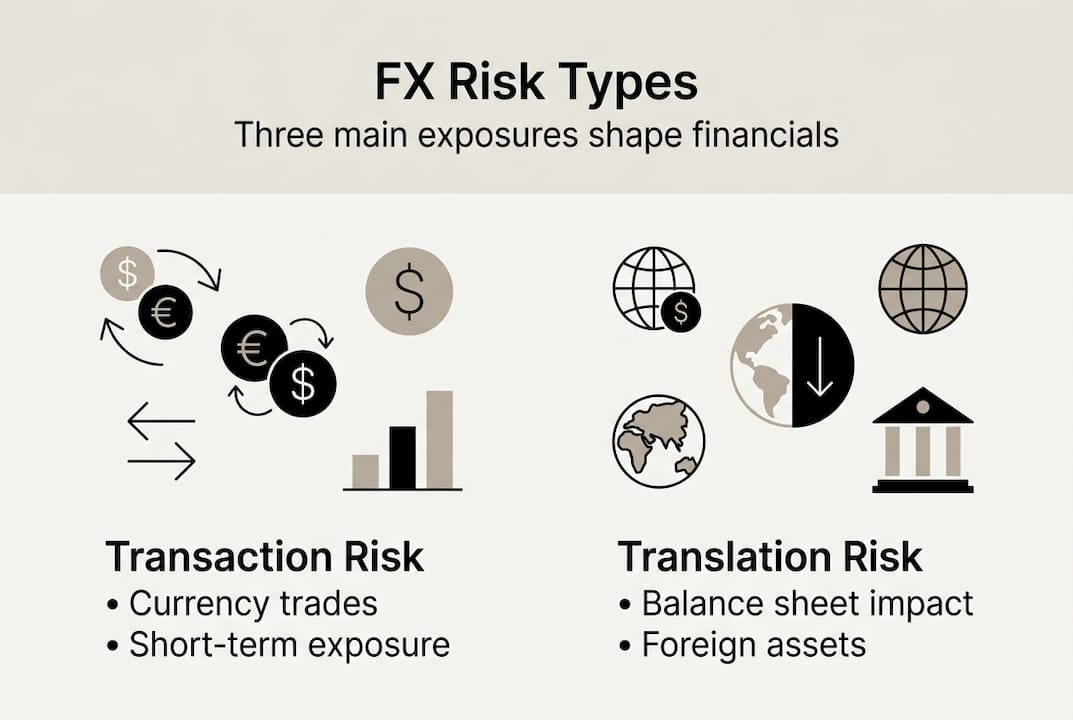
| Risk type | Main driver | Typical exposure | Example |
|---|---|---|---|
| Transaction | Exchange rate moves between booking and settlement | Foreign currency invoices, contracts | USD receivable from EU client |
| Translation | Consolidation of foreign subsidiary financials | Balance sheet, income statement restatement | EUR subsidiary reported in GBP |
| Economic | Long-term currency trends affecting competitiveness | Pricing power, cost structure, market share | JPY depreciation benefiting Japanese exporters |
Mapping these exposures is not a one-time exercise. Markets shift, your business grows into new geographies, and contract terms evolve. A quarterly exposure inventory is the foundation of any credible FX risk process. Once you know what you are exposed to, you can begin to mitigate FX volatility through instruments and natural hedges that match your actual risk profile.
Common signals that your company faces significant FX risks:
- More than 15% of revenues or costs are denominated in a foreign currency
- You consolidate financial statements across multiple currency jurisdictions
- Your profit margins are thin enough that a 3% rate move would create a reporting problem
- Competitors operate from lower-cost currency environments
- You have long-dated contracts priced in a currency you do not control
Prepare your FX risk management toolkit and data sources
After understanding exposures, the next priority is assembling the right tools and data sources to ensure process accuracy. Even a well-designed strategy will underperform if it runs on incomplete or inconsistent data. Getting this foundation right is less exciting than executing trades, but it is where most workflow failures originate.

Forwards and options remain the core instruments for hedging currency exposure, while natural hedging, matching foreign currency inflows with outflows, reduces your need for market transactions altogether. Knowing which approach fits your situation requires solid data inputs across several dimensions.
| Data category | What to collect | Why it matters |
|---|---|---|
| Exposure details | Currency pairs, notional amounts, maturity dates | Defines what needs to be hedged |
| Cash flow forecasts | 12-month rolling projections by currency | Aligns hedge timing with actual flows |
| Accounting policies | Hedge accounting eligibility, reporting standards | Affects how gains and losses are reported |
| Counterparty information | Bank lines, ISDA agreements, credit limits | Required before any derivative is executed |
| Market data | Live spot rates, forward curves, volatility surfaces | Needed to price and evaluate instruments |
Follow FX risk management best practices by reviewing your hedge accounting policy documentation annually, ensuring your treasury management system integrates with your ERP, and confirming that all ISDA master agreements are current before you need them.
Must-have documentation and access for your FX toolkit:
- Board-approved treasury and hedge policy with defined risk appetite
- Treasury management software with real-time rate feeds
- Signed ISDA or CSA agreements with at least two banking counterparties
- Access to FX settlement infrastructure and confirmations
- Clear internal authority matrix for who can approve trades and at what size
Pro Tip: Maintain a single source of truth for all exposure data. If treasury, accounting, and commercial teams each maintain separate spreadsheets, gaps and double-counting will distort your hedge ratios and create audit findings. One centralized system, refreshed on a defined schedule, eliminates this problem.
Execute a step-by-step FX risk management workflow
With your toolkit and data ready, you can now execute a structured workflow for managing FX risk. The goal is a repeatable sequence that removes ad-hoc decisions and creates a defensible audit trail.
- Measure exposures. Pull your current exposure report from your treasury system. Verify notional amounts, currencies, and maturity dates against your ERP and cash flow forecasts. Identify any net open positions that fall outside your approved hedge ratio bands.
- Select your hedge instrument. Match the instrument to the exposure. Short-term, highly certain cash flows suit forward contracts. Uncertain or contingent exposures, like bids or pipeline deals, suit options. Consider financial risk reduction strategies that combine instruments to address different probability scenarios.
- Execute the trade. Contact counterparties or execute via your treasury platform within the approved dealing mandate. Confirm rate, notional, settlement date, and currency pair. Store the trade confirmation immediately in your system of record.
- Record and report. Book the hedge in your accounting system with correct designation if hedge accounting applies. Prepare the required effectiveness testing documentation before the reporting period closes. Circulate a trade summary to the CFO and relevant controllers.
- Monitor and adjust. Set calendar alerts for upcoming maturities, option expiries, and effectiveness testing deadlines. Currency risk strategies that include rolling reviews catch drift before it becomes a problem.
Pro Tip: Define specific hedge ratio limits in your policy, for example, hedge between 60% and 90% of forecast exposure for the next six months. This automates the decision trigger and keeps individual judgment out of routine execution, which reduces error and speeds up approval.
"Time-varying hedging explains roughly 30% of exchange rate variation, meaning that how and when you hedge matters as much as whether you hedge at all. Favorable carry, such as high US rates in USD hedging, can meaningfully improve outcomes for revenue hedgers who time their program well."
Verify, audit, and optimize your FX risk workflow
Following trade execution, ongoing verification ensures your workflow consistently delivers intended results. Many teams execute hedges correctly but fail at the back end, where reconciliation, audit readiness, and continuous improvement separate average programs from excellent ones.
Start each reporting period by reconciling your hedged positions against your original exposure forecast. Ask whether actual cash flows matched what you hedged. If you hedged 80% of forecast EUR receivables and actual collections came in at 60% of forecast, you are over-hedged. Understanding these variances helps you refine forecast quality, which is often the biggest lever in improving program performance. Review advanced FX risk reduction techniques that incorporate rolling forecasts to minimize this kind of mismatch.
| Common workflow error | Best verification practice |
|---|---|
| Hedging stale or outdated exposures | Refresh exposure data monthly, not just quarterly |
| Missing effectiveness testing deadlines | Build testing into the monthly close calendar |
| Inconsistent trade documentation | Use standardized templates for every confirmation |
| No post-trade variance analysis | Compare hedge outcomes to unhedged benchmark each quarter |
| Ignoring counterparty credit risk | Review bank credit limits alongside exposure limits |
For FX risk governance, compliance requires more than executing the right trades. Auditors and regulators expect clear documentation of your policy, your rationale for each hedge decision, and evidence that you tested and measured effectiveness.
Optimization levers to build into your annual workflow review:
- Increase review frequency to monthly during high-volatility periods
- Update benchmark rates and hedge ratio bands annually to reflect current market conditions
- Integrate treasury software with accounting and ERP systems to reduce manual reconciliation
- Add scenario analysis and stress testing to your exposure reporting
- Track hedge program cost, net of carry and premium, against realized protection value
What most FX risk guides overlook: Why workflow discipline trumps theory
Most resources on corporate FX risk spend considerable time on the mechanics of forwards, options, and swaps. Fewer spend any time on the discipline required to run these programs effectively at scale. That gap is where most real-world programs break down.
The uncomfortable truth is that a company running a simple, consistent hedging program with strong governance will outperform one using sophisticated instruments but inconsistent execution. Missed documentation, skipped effectiveness tests, and ad-hoc decisions all corrode results over time. The basics of FX risk management, properly executed, consistently beat advanced strategies applied carelessly.
"The strength of your workflow determines the reliability of your results." This is not a platitude. It reflects what happens when a hedge is executed correctly but booked under the wrong accounting designation, or when an exposure report is two weeks stale when the trade is placed. The competitive edge in FX risk management belongs to teams that treat process design as seriously as instrument selection. Operational rigor is not a supporting role. It is the main event.
Explore advanced FX risk management solutions
If you're ready to move from manual spreadsheets to a streamlined, automated FX risk program, CorpHedge was purpose-built for exactly that transition. Our platform gives corporate treasury teams real-time visibility into currency positions, Value at Risk analysis, and automated workflow tools that enforce your policy at every stage of execution.
Explore the FX risk management solutions available on our product tour, or walk through specific capabilities on our FX workflow features page. If you want to see the platform in action before committing, the interactive demo lets you explore real workflows without a sales call. Every step in this guide, from exposure mapping to post-trade reconciliation, has a corresponding tool in CorpHedge.
Frequently asked questions
What are the main types of foreign exchange risk?
Transaction, translation, and economic are the three main FX risk types, each affecting a different layer of your financial results, from cash flows to balance sheet reporting to long-term competitive positioning.
What tools do companies use to manage FX risk?
Companies rely on forwards and options alongside treasury management software and automated workflow platforms to track exposures, execute hedges, and maintain compliance documentation.
How often should FX risk workflows be reviewed and updated?
Best practice is to review workflows quarterly at minimum and immediately after significant market events, ensuring your hedge ratios, benchmarks, and documentation stay current.
What is the benefit of time-varying currency hedging?
Time-varying hedging accounts for roughly 30% of exchange rate variation and can significantly improve outcomes for companies that adjust their hedge timing based on carry and market conditions.