

TL;DR:
- Currency risk management is essential to protect profits and reduce earnings volatility for global firms.
- Frameworks and tools like VaR, stress testing, and hedging strategies help manage financial exposures effectively.
- Continuous, cross-functional risk assessment and adaptive strategies are vital amid evolving market and regulatory environments.
Currency swings can quietly erase margins that took years to build. For multinational companies, a 10% shift in a major currency pair can wipe out an entire quarter's profit, yet many finance teams still treat currency risk as an afterthought. Financial risk management reduces earnings volatility and is critical to global companies operating across multiple currencies and jurisdictions. This guide walks you through the core concepts, proven frameworks, practical hedging strategies, and the latest advances shaping how leading firms protect their financial performance.
Table of Contents
- What is financial risk management?
- Core frameworks and tools for financial risk management
- Hedging strategies for international companies
- Recent shifts and advanced considerations in risk management
- Why most companies misjudge financial risk management
- Take your risk management further with CorpHedge
- Frequently asked questions
Key Takeaways
| Point | Details |
|---|---|
| FRM defines and targets risk | Financial risk management systematically identifies, measures, and reduces threats to global company assets. |
| Effective frameworks matter | Using proven tools like VaR and stress tests helps leaders manage volatility and protect cash flow. |
| Hedging reduces volatility | Companies with formal hedging programs see notably less earnings fluctuation due to market swings. |
| Adapting drives results | The best firms continuously review and adapt their risk approaches in line with market shifts and technology. |
What is financial risk management?
Financial risk management (FRM) is the structured process of identifying, analyzing, evaluating, and acting on threats that could harm a company's assets, cash flows, or overall financial stability. According to Gartner's definition, FRM is the process of identifying, analyzing, evaluating, and mitigating financial risks across the enterprise. It is not a one-time audit. It is an ongoing discipline that evolves as markets, regulations, and business models change.
At its core, FRM has three objectives: safeguard assets, reduce earnings volatility, and protect operating cash flows. These goals sound straightforward, but achieving them requires understanding the distinct categories of risk your firm faces. Investopedia's risk management framework identifies four primary types: market, credit, liquidity, and operational risks. Each behaves differently and demands a different response.
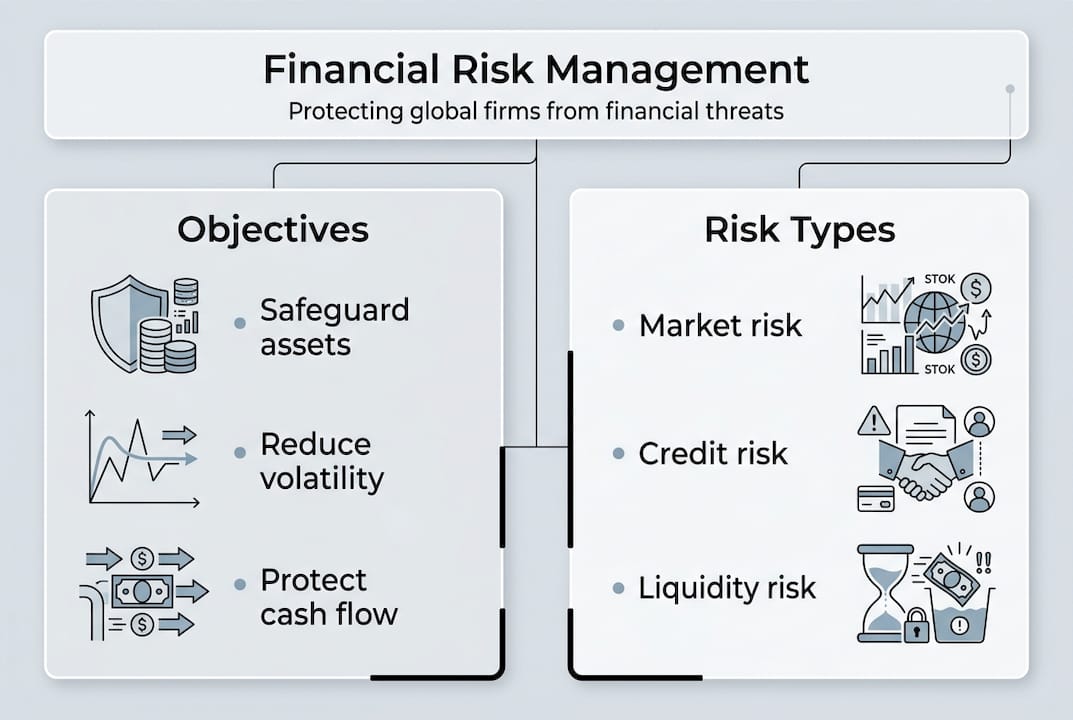
| Risk type | Example | Potential impact |
|---|---|---|
| Market risk | EUR/USD moves 8% against you | Revenue shortfall, margin compression |
| Credit risk | A key counterparty defaults | Receivables loss, cash flow disruption |
| Liquidity risk | Inability to meet short-term obligations | Operational halt, forced asset sales |
| Operational risk | System failure or process error | Reputational damage, regulatory fines |
Understanding which FX risk types apply to your business is the first step toward building a resilient program. A company with 60% of revenues in foreign currencies faces a fundamentally different risk profile than one with only 15%.
Why FRM matters for international companies:
- Regulatory bodies increasingly require documented risk frameworks
- Investors and boards demand earnings predictability
- Currency volatility can erode competitive pricing in export markets
- Unmanaged operational risks compound during economic downturns
- A formal program signals financial discipline to lenders and rating agencies
For CFOs managing market risk across borders, the stakes are especially high. A poorly calibrated risk program does not just cost money. It costs credibility.
Pro Tip: Always tailor your risk assessments to your firm's actual global footprint. A generic framework copied from a peer may miss the specific currency corridors, counterparty concentrations, or regulatory environments that define your real exposure.
Core frameworks and tools for financial risk management
Once you recognize the risks, effective management relies on robust and proven frameworks and tools. Most leading finance teams organize their FRM process around five phases: identification, measurement, mitigation, monitoring, and governance. Each phase feeds the next, creating a continuous cycle rather than a static checklist.
The measurement phase is where many firms either gain or lose their edge. Three tools dominate modern risk quantification. Federal Reserve market risk models confirm that key tools include Value at Risk (VaR), stress testing, and Monte Carlo simulations, each serving a distinct analytical purpose.
| Tool | What it measures | Best used for |
|---|---|---|
| Value at Risk (VaR) | Max expected loss at a confidence level | Daily portfolio risk limits |
| Stress testing | Loss under extreme but plausible scenarios | Regulatory reporting, crisis planning |
| Monte Carlo simulation | Range of outcomes across thousands of scenarios | Complex derivatives, long-horizon planning |
The EBA stress test methodology provides a benchmark for how regulators expect firms to model adverse scenarios, and aligning your internal stress tests with these standards strengthens both your risk culture and your regulatory standing.
Steps in a sound risk management cycle:
- Map all financial exposures across business units and geographies
- Quantify each exposure using VaR, scenario analysis, or sensitivity models
- Select and implement mitigation instruments (hedges, limits, diversification)
- Monitor positions and market conditions in real time
- Report to governance bodies with clear metrics and thresholds
- Review and revise the entire program at least quarterly
For firms building or upgrading their programs, exploring ERM frameworks and currency risk strategies provides practical starting points grounded in real-world application. The frameworks overview from EDHEC also offers a solid academic grounding for teams building internal training materials.
Pro Tip: Align your internal benchmarking with reputable external sources like the Federal Reserve and the EBA. This not only improves model quality but also prepares your team for regulatory scrutiny before it arrives.
Hedging strategies for international companies
With frameworks in place, firms need practical strategies to reduce exposure. Hedging is the most direct tool available. At its simplest, a hedge is a financial position that offsets potential losses in another position. Done well, it gives your business the predictability it needs to plan, price, and invest with confidence.

FX hedging programs reduce earnings volatility by 23%, according to BIS research, a number that should get any CFO's attention. The same data shows that FX turnover reached $9.5 trillion per day in 2025, partly driven by corporate hedging activity, which signals just how mainstream formal hedging programs have become among global firms.
Main hedging approaches used by international companies:
- Forward contracts: Lock in an exchange rate for a future transaction, eliminating rate uncertainty on known cash flows
- FX options: Purchase the right, but not the obligation, to exchange at a set rate, preserving upside while capping downside
- Natural hedges: Match revenues and costs in the same currency to reduce net exposure without financial instruments
- Cross-currency swaps: Exchange principal and interest payments in different currencies, useful for long-term financing structures
- Currency baskets: Diversify exposure across multiple currencies to reduce concentration risk
Statistic: Companies with formal FX hedging programs experience 23% less earnings volatility than those without structured programs, based on BIS Quarterly Review data.
The choice between dynamic and static hedging is one of the most consequential decisions a treasury team makes. Static hedging sets a fixed coverage ratio and leaves it alone. Dynamic hedging adjusts positions as market conditions and underlying exposures shift. Dynamic approaches require more resources and expertise, but they tend to outperform static programs when volatility is high or exposures are irregular.
For teams building out their approach, reviewing risk reduction strategies and FX risk management basics provides a practical foundation before committing to specific instruments.
Pro Tip: Review and adjust your hedging ratios at least quarterly. Exposures change as contracts are signed, revenues shift, and market conditions evolve. A ratio that made sense six months ago may leave you over-hedged or under-hedged today.
Recent shifts and advanced considerations in risk management
Risk management is not static. Regulatory, market, and technology changes drive continuous evolution, and the post-2022 environment has been particularly disruptive for corporate treasury teams.
Rising interest rates after 2022 made hedging significantly more expensive. Hedging costs rose sharply post-2022, shifting strategies and coverage ratios for many companies. Firms that previously hedged 80% to 90% of their exposure began selectively reducing ratios or shortening hedge tenors to manage carry costs. This shift forced treasury teams to become more precise about which exposures truly warranted protection.
Machine learning (ML) and big data tools have entered the risk management toolkit with real promise and real limitations. ML models outperform traditional tools for identifying tail risks, the extreme but low-probability events that can cause outsized damage. However, these models often lack explainability, meaning risk committees and regulators cannot always understand why a model produced a specific output. That creates governance challenges that firms are still working through.
"Machine learning changes the nature of risk oversight. The precision gains are real, but so is the risk of trusting a black box during a market crisis." — Risk management practitioner perspective
Key pitfalls to avoid in modern risk programs:
- Over-hedging: Locking in too much exposure at unfavorable rates, especially when underlying revenues are uncertain
- Hedge accounting traps: Failing to qualify hedges for accounting treatment, which creates P&L volatility that the hedge was meant to prevent
- Basis risk: The risk that the hedging instrument does not move in perfect correlation with the underlying exposure
- Model overconfidence: Relying on quantitative outputs without stress-testing assumptions against real-world scenarios
- Governance gaps: Treating risk management as a finance function only, rather than a cross-functional discipline
For firms looking to modernize their approach, resources on risk governance in 2026 and risk management best practices offer grounded guidance. The SSRN hedging methodology study also provides rigorous analysis of how corporate hedging decisions have evolved in recent years.
Why most companies misjudge financial risk management
Here is the uncomfortable truth: most firms treat financial risk management as a compliance exercise rather than a strategic capability. They build a framework, check the regulatory boxes, and assume the work is done. It is not.
The companies that genuinely outperform on risk are not the ones with the most sophisticated models. They are the ones that treat risk mapping as a living process, revisiting exposures as business conditions shift rather than waiting for annual reviews. Context and culture matter more than most finance textbooks acknowledge. A risk program built for a company with stable, predictable revenues will fail a firm navigating rapid international expansion.
Many teams also underestimate the value of cross-border collaboration. Local teams often have visibility into regulatory changes, counterparty behaviors, and market dynamics that central treasury misses entirely. Building that intelligence into your risk reviews is a genuine competitive advantage. Strategies for mitigating FX volatility consistently show that firms with integrated, cross-functional risk cultures outperform those relying on siloed, top-down reporting.
Pro Tip: Prioritize collaborative risk reviews that incorporate insights from cross-border teams, not just static reports from headquarters. The people closest to local markets often see risk signals first.
Take your risk management further with CorpHedge
Understanding financial risk management is one thing. Operationalizing it across multiple currencies, entities, and time zones is another challenge entirely.
CorpHedge is built for exactly that challenge. Our platform gives global finance teams real-time visibility into currency positions, VaR-based strategy tools, and seamless integrations that connect your risk program to the instruments and data you already use. Whether you are formalizing your first structured hedging program or optimizing an existing one, you can explore our product features to see how we support every stage of the risk management cycle. Ready to see it in action? Book a demo and talk through your specific exposures with our team. You can also browse real-world use cases to find scenarios that match your company's profile.
Frequently asked questions
What are the main types of financial risk?
The main types include market risk, credit risk, liquidity risk, and operational risk, each requiring distinct measurement and mitigation approaches. Investopedia's risk framework provides a clear breakdown of how each category affects corporate financial stability.
How does financial risk management help global companies?
It reduces earnings volatility, protects cash flow, and stabilizes performance amid currency fluctuations. Formal hedging programs alone can reduce volatility by 23%, according to BIS Quarterly Review data.
What is Value at Risk (VaR) and why is it important?
VaR measures the maximum expected loss over a defined period at a given confidence level, making it essential for setting daily risk limits. Federal Reserve risk models confirm VaR as a foundational tool alongside stress testing and scenario analysis.
What's the difference between static and dynamic hedging?
Static hedging maintains a fixed coverage ratio regardless of market changes, while dynamic hedging continuously adjusts positions based on shifting exposures and conditions. WisdomTree's currency hedging research outlines when each approach delivers better outcomes.
How are machine learning tools used in risk management?
ML tools help identify tail risks with higher accuracy than traditional statistical models, but they often lack the explainability that governance teams and regulators require. Frontiers in AI research documents both the performance gains and the interpretability gaps that firms must manage carefully.