

TL;DR:
- Effective FX hedging requires understanding transaction, translation, and economic risks.
- Matching appropriate instruments like forwards and options to specific exposures reduces costs and volatility.
- Implementing a disciplined, dynamic hedging workflow with regular reviews enhances risk management resilience.
Currency swings don't care about your budget. A single unfavorable rate move on a cross-border receivable can wipe out months of margin before your finance team even opens the morning report. For financial professionals managing international transactions, the gap between a protected position and an unhedged one is often measured in points of EBITDA, not basis points. This guide gives you a practical, sequential framework: how to identify and quantify your FX exposures, select the right instruments, execute a disciplined hedging workflow, and troubleshoot real-world edge cases so your program actually holds up when markets get volatile.
Table of Contents
- Understand FX risk types and why hedging is critical
- Choose the right hedging instruments for your transactions
- Build your international transaction hedging process: Step-by-step
- Troubleshoot common challenges and advanced hedging opportunities
- A practitioner's view: Balancing simplicity and dynamic precision in FX hedging
- Level up your FX risk management with CorpHedge
- Frequently asked questions
Key Takeaways
| Point | Details |
|---|---|
| Prioritize transaction risk | Focus your hedging program on transaction risk, where FX swings most impact cash flows. |
| Match instruments to objectives | Select forwards, options, or swaps based on your company's needs, timeline, and risk profile. |
| Favor dynamic over static | Update hedging ratios and strategies regularly for better results during volatile market periods. |
| Avoid selective speculation | Evidence shows that forecast-based selective hedging increases risk—stick with systematic or blended strategies. |
| Review and adjust regularly | Quarterly program reviews prevent over-hedging and missed opportunities. |
Understand FX risk types and why hedging is critical
Not all FX risk is created equal. Before you can hedge effectively, you need to know exactly which type of exposure is eating into your returns. FX risk basics break down into three core categories, and each one hits your financials differently.
Transaction risk is the most direct. It's the risk that a specific cross-border receivable, payable, or contractual cash flow changes in value between the deal date and the settlement date. If you invoice a European buyer in euros today and collect in 90 days, any EUR/USD move in that window hits your bottom line. This is the category that deserves the most attention for international deals.
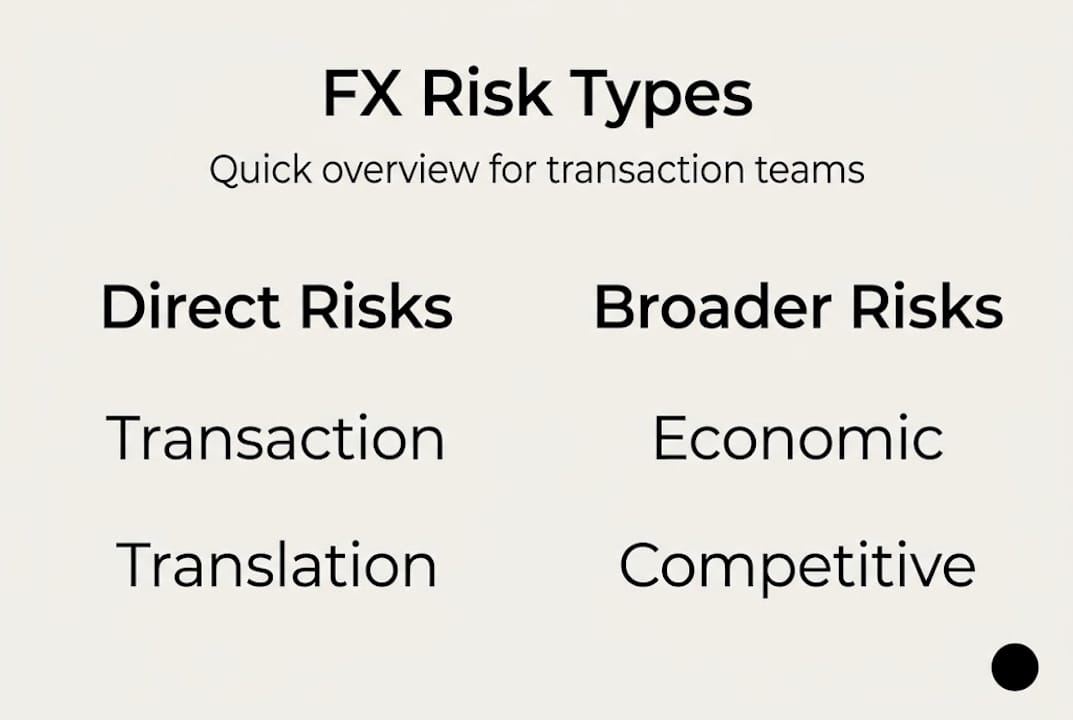
Translation risk arises when a parent company consolidates the financial statements of foreign subsidiaries. The subsidiary's assets and liabilities get restated at current exchange rates, creating reported earnings swings that may not reflect actual cash impact but still move your stock price and debt covenants.
Economic risk is broader and harder to hedge. It describes how prolonged rate shifts change your competitive positioning. A structurally strong dollar, for example, can make your U.S.-produced goods more expensive than those of a local competitor abroad, squeezing revenue over years, not quarters.
For most international transaction teams, key FX risk exposures center on transaction risk. That's where precise hedging pays off most directly.
| FX risk type | Primary impact | Typical time horizon | Hedging feasibility |
|---|---|---|---|
| Transaction | Cash flow, realized P&L | Days to 18 months | High |
| Translation | Reported earnings, book value | Quarterly, annual | Moderate |
| Economic | Competitive position, long-run revenue | Multiyear | Low to moderate |
Signs your company carries significant FX transaction risk:
- More than 20% of revenues or costs are denominated in foreign currencies
- You hold open receivables or payables beyond 30 days in non-functional currencies
- Your hedging policy hasn't been reviewed since rates were stable
- Earnings misses have been attributed to "FX headwinds" more than once in two years
Pro Tip: Before picking an instrument, map every open position by currency pair, notional amount, and settlement date. That exposure ladder tells you what you actually need to hedge versus what you're tempted to over-hedge.
Choose the right hedging instruments for your transactions
With a clear exposure map in hand, instrument selection becomes a matching exercise rather than a guessing game. The four main tools you'll use are forward contracts, options, currency swaps, and natural hedging, and each fits different scenarios.
Forward contracts lock in a rate today for a future settlement. They eliminate uncertainty on a specific payable or receivable but forfeit upside if rates move in your favor. Best suited for high-certainty cash flows with fixed dates.

Options give you the right, but not the obligation, to transact at a predetermined rate. You pay a premium, but you keep the upside. According to real-world case studies, instruments structured around options can lower net premium by 68% compared to vanilla approaches while still reducing volatility up to 41%.
Currency swaps exchange principal and interest in one currency for another over a longer term. They're the go-to for multi-year funding needs or companies with recurring foreign currency debt service.
Natural hedging means structuring operations to create offsetting exposures, sourcing inputs in the same currency as your revenues, for example. It has no direct instrument cost but requires operational flexibility most CFOs don't have in the short term.
| Instrument | Protection type | Cost | Best-fit scenario |
|---|---|---|---|
| Forward contract | Full rate lock | Spread/bid-ask | Fixed-date, certain cash flows |
| Option | Downside protection, upside retained | Premium | Variable or uncertain exposures |
| Currency swap | Long-term rate exchange | Structuring fee | Multi-year financing or debt |
| Natural hedge | Operational offset | Operational cost | Recurring, predictable currency flows |
How to match instrument to transaction type:
- Identify whether your cash flow date and amount are certain or variable.
- Determine your organization's appetite for paying upfront premium versus accepting a locked rate.
- Assess whether mitigating volatility or preserving upside is the higher priority for this exposure.
- Check liquidity: forwards are available in almost every currency pair; options have wider spreads in exotic pairs.
- Layer instruments if needed. A forward covering 70% of exposure combined with an option on the remaining 30% gives cost efficiency and flexibility.
Pro Tip: A blended structure, part forward, part option, outperforms a pure-forward or pure-option book in most FX hedging strategies because it controls cost while managing downside. Run the numbers on both before committing.
Build your international transaction hedging process: Step-by-step
Knowing your instruments is necessary but not sufficient. What separates firms that consistently protect margins from those that scramble after every rate shock is a repeatable, documented workflow.
Step-by-step hedging workflow:
- Assess exposure. Pull all open foreign currency positions by settlement date. Separate high-certainty flows (purchase orders, invoices) from contingent ones (bids, forecasts).
- Set hedge objectives. Define whether you're targeting cash flow certainty, budget rate protection, or minimizing P&L volatility. This anchors every subsequent decision.
- Select instrument and ratio. Match the instrument to the exposure type using the framework above. Decide on hedge ratio: 100% for certain flows, partial for contingent ones.
- Execute the hedge. Trade through your bank or platform, document the trade, and confirm it against your policy.
- Monitor positions. Track MTM (mark-to-market) values weekly. Flag positions where the underlying exposure has changed.
- Adjust dynamically. If market conditions shift materially or the underlying transaction changes, rebalance. Dynamic hedging research consistently shows that dynamic strategies reduce volatility more effectively than static ones, while hybrid approaches cut FX beta relative to passive benchmarks.
Key considerations at each stage:
- Liquidity: Ensure the currency pair has sufficient market depth at your trade size.
- Cost: Model full transaction cost including spreads, premiums, and margin requirements.
- Compliance: Confirm hedge accounting treatment under IFRS 9 or ASC 815 before execution to avoid P&L mismatches.
- Documentation: Hedge accounting requires formal designation at inception. Missing this step forces you to mark derivatives through earnings.
Risk warning: Selective hedging based on rate forecasts has been shown empirically to increase costs and risk relative to traditional min-variance or passive strategies. Firms that hedge opportunistically, timing the market rather than the exposure, often end up with advanced FX hedging strategies that look sophisticated on paper but underperform out-of-sample.
Pro Tip: Run scenario analysis on outlier rate moves, a 15% to 20% shift in your primary currency pair, before finalizing hedge ratios. Most teams only stress-test the base case. Reviewing best practices for 2026 shows that firms incorporating tail scenarios into planning recover faster after shocks.
Troubleshoot common challenges and advanced hedging opportunities
Even disciplined programs hit friction. Here are the pitfalls that most commonly derail hedging effectiveness, along with recommended actions.
Common pitfalls to watch:
- Over-hedging: Hedging more than your actual exposure creates a speculative position. If the underlying transaction falls through, you're holding a derivative with no offset.
- Basis risk: The hedge instrument and the exposure don't move in perfect correlation, leaving residual risk even with a notionally matched position.
- Counterparty exposure: OTC derivatives carry credit risk. If your counterparty defaults, you lose the hedge when you need it most.
- Missed gain from rigid structures: A fully locked forward prevents you from benefiting if rates move favorably, a real cost in trending markets.
| Challenge | Recommended action |
|---|---|
| Multi-currency complexity | Use netting to consolidate exposures before hedging; reduces transaction count and cost |
| Regulatory "perfect hedge" requirements | Document hedge relationships formally at inception; work with legal on local reporting rules |
| Extreme volatility (2025/2026 market conditions) | Shift to shorter-tenor forwards and add option overlays for flexibility |
| Counterparty concentration | Diversify across two or more bank counterparties; use CSAs (credit support annexes) to limit exposure |
| Over-hedging | Reconcile hedged notional to underlying exposure monthly; trim positions that exceed actual flows |
Empirical benchmarks confirm that hybrid strategies lower both FX beta and total cost compared to selective approaches, and that over-hedging, counterparty risk, and missed gains represent the three largest sources of excess cost in corporate hedging programs. Multi-currency netting and long-term swaps also carry their own edge-case risks that require specialized managing currency fluctuations protocols.
Pro Tip: Schedule a formal program review every quarter and immediately after any major central bank policy shift. In turbulent market years like 2025 and 2026, waiting for an annual review cycle means you're always reacting rather than positioning ahead of the move.
A practitioner's view: Balancing simplicity and dynamic precision in FX hedging
There's a persistent tension in FX risk management between what's theoretically optimal and what actually works inside a real organization. Academic models chase minimum variance. Trading desks promote increasingly complex structured products. But the firms consistently protecting margins year over year don't usually run the most sophisticated programs. They run the most disciplined ones.
The evidence backs this up. Practitioners favor forwards and options as the core instruments, with dynamic overlays added selectively when market signals are strong and positions are liquid. Meanwhile, selective hedging strategies built on rate forecasts consistently underperform out-of-sample compared to min-variance and blended approaches. The reason is simple: forecast-based hedging introduces a new risk layer, the forecast itself.
Our view is that the most resilient FX programs are built on corporate FX risk insights that prioritize adaptability over optimization. Start simple, add complexity only where it reduces real cost or real risk, and build in a review cadence that forces recalibration before markets force it for you.
Level up your FX risk management with CorpHedge
Applying this framework manually across multiple currency pairs and transaction types is exactly as resource-intensive as it sounds. CorpHedge is built to make that process faster, more accurate, and fully auditable.
The platform gives your team real-time visibility into FX positions, Value at Risk modeling, and automated hedge execution workflows, all in one place. Whether you're running a multi-currency netting program or stress-testing outlier scenarios, see how CorpHedge works and how the tools map directly to the strategies in this guide. You can also explore FX risk management features in detail or review real-world use cases to see how companies like yours have cut hedging costs and protected profitability at scale.
Frequently asked questions
What is the best way to hedge currency risk for international transactions?
The most reliable approach combines forward contracts and options tailored to your specific exposure profile, using quantitative analysis to set hedge ratios and avoid over-hedging any single position.
When should a company actively manage FX hedging rather than use static strategies?
When volatility rises or your underlying exposures shift, dynamic strategies outperform static approaches by adjusting hedge ratios in response to real market conditions rather than fixed schedules.
Are there risks to selective or speculative FX hedging?
Yes. Research confirms that selective hedging underperforms out-of-sample because forecast errors compound hedging costs rather than reduce them, making min-variance and blended strategies more reliable over time.
How often should hedging programs be reviewed?
Best practice is quarterly at minimum and immediately after major shifts in central bank policy or currency market structure, particularly in a volatile environment like 2025 and 2026.