

Only 32% of executives rate their organization's risk oversight as mature, yet complexity keeps climbing. For finance professionals at international companies, that gap is not just a governance problem. It directly threatens cash flow, earnings stability, and competitive positioning. Currency risk sits at the center of this challenge, amplifying every weakness in your oversight structure. This article walks you through the frameworks, mechanics, and innovative strategies that leading multinationals use to govern risk effectively and protect profitability.
Table of Contents
- Defining corporate risk governance: Key concepts and challenges
- Frameworks for risk governance: COSO ERM and Three Lines Model
- Mechanics of risk governance: Identification, assessment, and monitoring
- Innovative approaches to managing currency risk
- Implementation pitfalls and expert recommendations
- Explore advanced FX risk management solutions
- Frequently asked questions
Key Takeaways
| Point | Details |
|---|---|
| Governance maturity gap | Most companies still lack fully mature risk oversight, despite rising complexity. |
| COSO ERM framework value | Integrating COSO ERM improves risk systematization and strategic alignment. |
| Hybrid hedging strategies | Combining derivatives and natural hedges is the most effective way to manage currency risk for multinationals. |
| Avoid common pitfalls | Clear risk appetite and paired controls help prevent over-formalization and communication breakdowns. |
| Leverage advanced tools | Expert solutions and tools streamline risk governance and support profitable FX management. |
Defining corporate risk governance: Key concepts and challenges
Corporate risk governance is the system of policies, roles, and processes that a company uses to identify, assess, and respond to risks that could affect its objectives. It is not just a compliance exercise. Done well, it connects risk awareness directly to strategic decision-making and financial performance.
Yet most organizations fall short. According to a 2025 survey, only 32% rate oversight mature while 61% report rising complexity in their risk environment. The gap between perceived maturity and actual exposure is where financial damage accumulates.
Common pitfalls that undermine governance include:
- Resource barriers: Risk teams are understaffed relative to the scope of exposures they manage.
- Competing priorities: Business units focus on growth targets, pushing risk oversight to the margins.
- Ad hoc communication: Risk information flows inconsistently, leaving boards and executives with incomplete pictures.
- Siloed data: FX exposures, credit risks, and operational risks are tracked separately, preventing a portfolio view.
For international companies, weak governance has a direct FX dimension. When currency positions are not monitored systematically, even a modest shift in exchange rates can erode margins that took quarters to build. Mitigating FX volatility requires governance infrastructure, not just hedging tactics.
"The organizations that manage risk best are not those with the most sophisticated models. They are the ones where risk information reaches decision-makers consistently and clearly."
Building that consistency starts with choosing the right framework.
Frameworks for risk governance: COSO ERM and Three Lines Model
Two frameworks dominate corporate risk governance practice: the COSO Enterprise Risk Management framework and the Three Lines Model. Understanding both helps you structure oversight in a way that is both rigorous and practical.
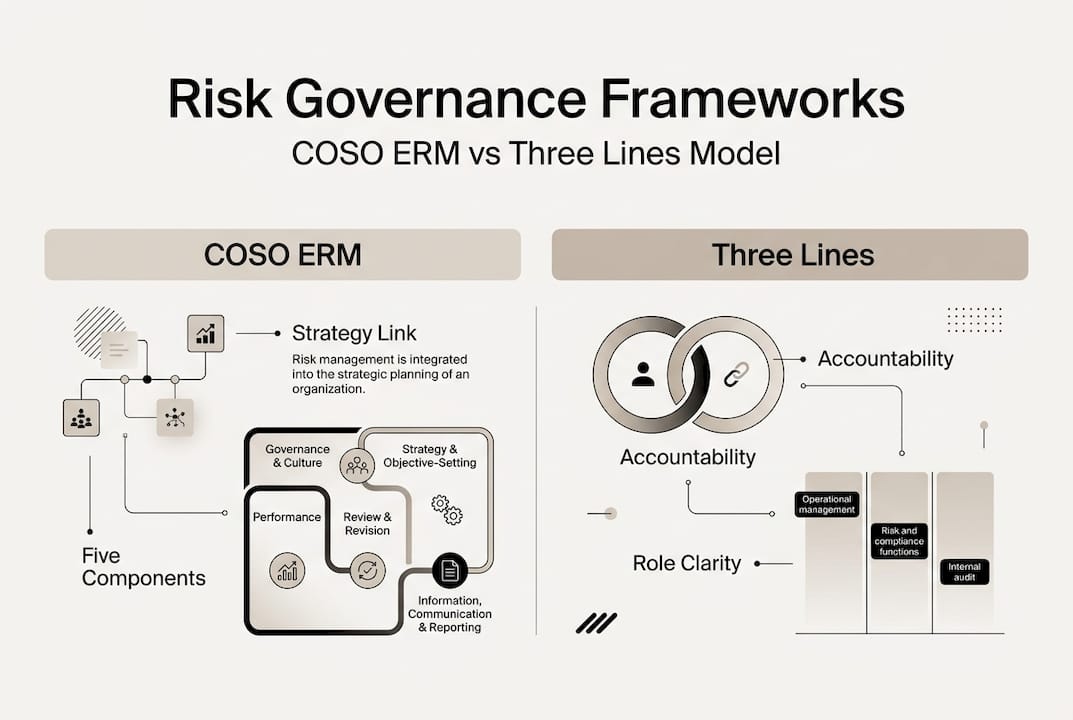
COSO ERM is the leading risk framework with five integrated components and 20 principles. It explicitly connects risk management to strategy and performance, treating risk not as a threat to be minimized but as a variable to be managed in pursuit of value. The five components are: Governance and Culture, Strategy and Objective-Setting, Performance, Review and Revision, and Information, Communication, and Reporting.
The Three Lines Model structures accountability across three distinct groups. The first line owns and manages risk day to day. The second line provides oversight, policy, and specialist guidance. The third line, typically internal audit, provides independent assurance to the board.
Here is a side-by-side comparison:
| Dimension | COSO ERM | Three Lines Model |
|---|---|---|
| Primary focus | Strategy and risk integration | Accountability and assurance |
| Key output | Risk-informed decisions | Clear ownership and oversight |
| Board role | Sets risk appetite and culture | Receives independent assurance |
| Best suited for | Strategic risk alignment | Governance structure clarity |
| Weakness | Can be complex to implement | Does not prescribe risk tools |
For financial risk reduction, the most effective approach pairs both frameworks. COSO ERM gives you the strategic architecture. The Three Lines Model gives you the accountability structure to execute it.
How to implement both frameworks together:
- Map your existing risk roles to the Three Lines Model to identify gaps in ownership.
- Use COSO ERM's Governance and Culture component to set tone from the top.
- Align risk appetite statements with strategic objectives using COSO's Strategy component.
- Assign second-line responsibility for FX and currency risk monitoring explicitly.
- Schedule regular board risk committee reviews using structured reporting from all three lines.
Mechanics of risk governance: Identification, assessment, and monitoring
Frameworks tell you what to build. Mechanics tell you how to operate it. The COSO ERM process breaks risk governance into six operational steps: identification, assessment, portfolio aggregation, appetite-setting, response selection, and monitoring with key risk indicators.
Here is how each step works in practice:
- Identification: Catalog risks across business units, geographies, and currencies. For multinationals, this includes transaction exposure, translation exposure, and economic exposure.
- Assessment: Score each risk on three dimensions: likelihood, severity, and velocity (how fast it could materialize). Velocity is often overlooked but critical for FX risks, which can move in hours.
- Portfolio aggregation: Combine individual risk scores into a portfolio view. This reveals correlations, such as when a single currency move affects both revenue and input costs simultaneously.
- Appetite-setting: Define how much risk the organization is willing to accept in pursuit of its objectives. Vague appetite statements like "we are risk-aware" are useless. Quantify them.
- Response selection: Choose from five responses: accept, avoid, pursue, reduce, or share. For currency risk, "reduce" via hedging and "share" via contractual clauses are most common.
- Monitoring with KRIs: Key risk indicators are metrics that signal when a risk is approaching its tolerance threshold. For FX, a KRI might be the percentage of unhedged revenue in a volatile currency.
Pro Tip: Set KRI thresholds at two levels: a warning level that triggers review and a limit level that triggers action. This prevents both overreaction and dangerous inaction.
Following risk management best practices means treating these six steps as a continuous cycle, not a one-time annual exercise.
Innovative approaches to managing currency risk
Once your governance mechanics are in place, the question becomes which hedging tools and strategies to deploy. Recent research on multinationals reveals a clear hierarchy of effectiveness.

A 2025 study on currency risk hedging compared four instruments across real multinational portfolios:
| Instrument | Key metric | Risk reduction |
|---|---|---|
| Futures | 5.9% basis risk | Moderate, predictable |
| Options | 68% premium reduction | High flexibility |
| Swaps | 41% volatility reduction | Strong for long-term exposure |
| Dynamic loans | 30.5% beta reduction | Effective for balance sheet risk |
The research is unambiguous: hybrid strategies outperform any single instrument. Combining options for short-term flexibility with swaps for long-term stability, for example, captures the benefits of both while reducing the weaknesses of each.
Beyond derivatives, natural hedges deserve more attention than they typically receive. A manufacturer that sources inputs and sells products in the same currency eliminates transaction exposure entirely for that portion of its business. Automotive and consumer goods companies have used this approach for decades, locating production in key markets to match revenue and cost currencies.
Key factors that shape which currency risk strategies work best for your organization:
- Liquidity: Derivatives markets for major currency pairs are deep. Emerging market currencies may require different tools.
- Risk aversion: More risk-averse boards favor options, which cap downside without eliminating upside.
- Competitive dynamics: If your competitors hedge aggressively, not hedging creates a cost disadvantage when rates move against you.
- ERM adoption: ERM adoption increases the use of currency derivatives, particularly in multinational firms with formal governance structures.
Pro Tip: Before selecting instruments, map your net currency exposure by currency pair and time horizon. A 12-month rolling hedge program with quarterly rebalancing suits most multinationals better than a static annual hedge.
For a deeper look at protecting cash flow, hedging forex risk requires both the right instruments and the governance structure to manage them consistently.
Implementation pitfalls and expert recommendations
Even organizations with strong frameworks and good intentions make implementation mistakes that undermine their risk governance programs. Knowing these pitfalls in advance saves significant time and credibility.
The most damaging implementation pitfalls include:
- Heat-map theater: Producing colorful risk matrices that look impressive in board presentations but do not drive decisions or actions.
- Vague risk appetite: Statements that describe risk philosophy without quantifiable thresholds give management no actionable guidance.
- Over-formalization: Building governance processes so complex that business units disengage, treating risk management as a compliance burden rather than a business tool.
- Poor escalation paths: Risks identified at the operational level never reach the people with authority to respond.
- Siloed frameworks: Using COSO ERM for strategic risk while ignoring IT and operational risk frameworks creates blind spots.
Expert guidance consistently points to the same remedies. Clarity beats complexity. A simple, well-understood risk appetite statement with three quantified thresholds outperforms a 20-page risk policy that nobody reads. Balance formality with usability. And critically, pair COSO ERM with NIST or COBIT for technology and operational controls, creating an integrated governance architecture rather than isolated frameworks.
"The best risk governance programs are the ones that business leaders actually use. If your framework lives only in the risk department, it is not governing anything."
For finance teams focused on reducing earnings volatility, the integration of FX risk governance into the broader ERM program is the single highest-leverage improvement available.
Explore advanced FX risk management solutions
Applying the frameworks and strategies covered here requires more than good intentions. It requires tools that give you real-time visibility into currency positions, automate KRI monitoring, and support structured hedging decisions at scale.
CorpHedge is built specifically for finance professionals managing FX risk at international companies. The platform aligns directly with COSO ERM principles, giving you live exposure data, Value at Risk analytics, and integration with execution platforms like Corpay. You can explore the full FX exposure management feature set, walk through a product tour to see how the tools fit your workflow, or review specific use cases that match your industry and exposure profile. When governance frameworks meet purpose-built technology, currency risk becomes a managed variable rather than an unpredictable threat.
Frequently asked questions
What is the COSO ERM framework and why is it important?
COSO ERM is a widely recognized structure for integrating risk management with business strategy, helping companies systematize risk oversight across five components and 20 principles. It is important because it connects risk decisions directly to strategic objectives and financial performance rather than treating risk as a standalone compliance function.
How do multinationals manage currency risk most effectively?
They use hybrid hedging strategies that combine derivatives such as options and swaps with natural hedges, tailoring the mix to their risk appetite, industry dynamics, and specific currency exposures. No single instrument outperforms a well-designed combination.
What are key risk indicators (KRIs) in risk governance?
KRIs are quantitative metrics that monitor whether a risk is approaching its tolerance threshold, alerting management before a breach occurs. In FX governance, a typical KRI tracks the percentage of unhedged revenue exposure in high-volatility currency pairs.
What are common pitfalls in risk governance implementation?
The most common pitfalls are vague risk appetite statements, over-formalized controls that disengage business units, and heat-map theater that produces reports without driving action. Pairing complementary frameworks and keeping processes usable are the most effective countermeasures.
How do executive profiles impact risk hedging?
Executive demographics affect hedging behavior meaningfully. Executives with longer tenure, finance backgrounds, and female CEOs tend to hedge currency risks more actively, suggesting that governance culture and leadership composition directly shape FX risk outcomes.