

Embed a rules-based, corridor-by-corridor hedging workflow into your payment rails and your treasury team can lock rates, reconcile automatically, and protect home-currency budgets from FX volatility. The core logic is simple: map your real exposures, pick one risk metric, and execute hedges before payments clear. Here are three actions you can run this week:
- Create a one-page exposure register covering all open payables, receivables, and forecast flows by corridor (start with your highest-volume currency pairs, typically EUR/PLN or EUR/SEK for Central Europe operations).
- Pick a risk lens — Cash Flow at Risk (CFaR) if your priority is budget predictability, Value at Risk (VaR) if you're managing a multi-currency portfolio — and apply it to your top two corridors first.
- Pilot one corridor between Poland and Sweden before scaling. Start corridor-by-corridor and require a clean paper trade that maps provider confirmations back to ERP entries before going live.
The expected outcome: predictable home-currency cash flows and materially reduced budget variance, without turning your treasury team into a trading desk.
Pro Tip: Keep the initial workflow to one page. Programs that require a 40-page manual before anyone executes a trade are abandoned within a quarter. Complexity is the enemy of adoption.

Table of Contents
- What does FX hedging actually do inside a payment workflow?
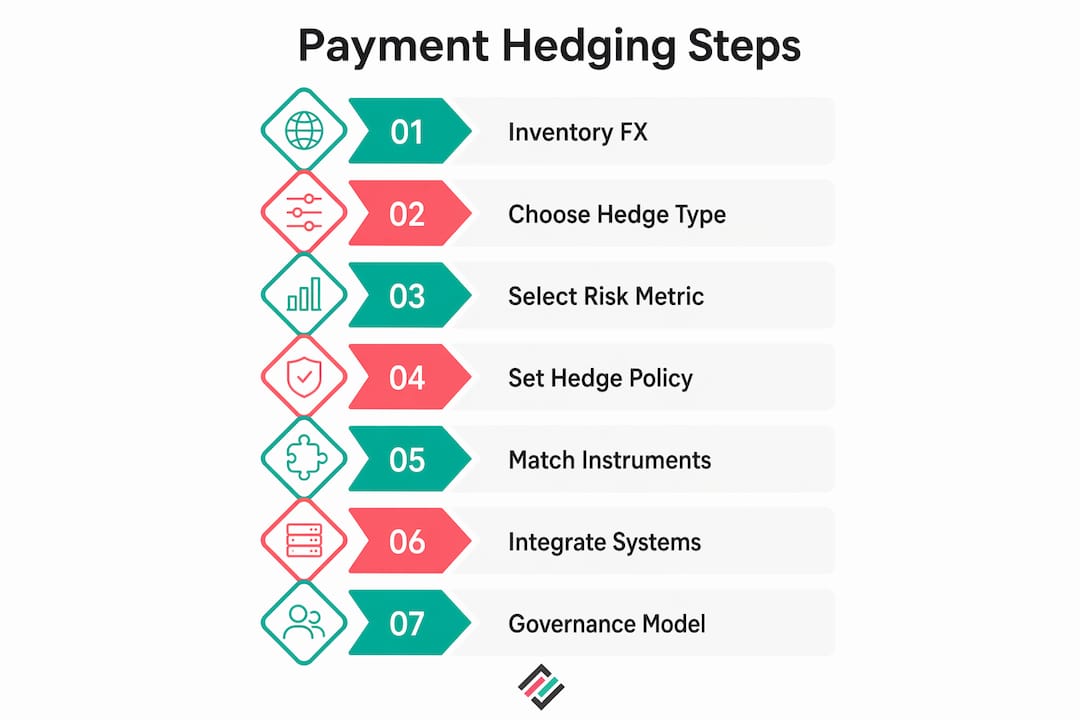
- Step 1: How do you inventory your FX exposures?
- Step 2: Should you use cash-flow hedging or balance-sheet hedging?
- Step 3: VaR or CFaR — which risk metric should you use?
- Step 4: How do you set hedging objectives and a hedge-ratio policy?
- Step 5: Which instruments match your payment exposures?
- Step 6: How do you integrate hedging into your payment operations?
- Step 7: What should your FX policy and governance model include?
- Sample monthly hedging workflow checklist you can copy and use
- How Corphedge implements this workflow in Central Europe
- Key Takeaways
- The part most treasury teams get wrong
- Corphedge makes your hedging workflow operational, not theoretical
- Useful sources and further reading
- FAQ
What does FX hedging actually do inside a payment workflow?
FX hedging, in the context of payment operations, means locking or bounding the exchange rate on a known or forecast cross-border payment before it settles. You're protecting the home-currency value of a specific cash flow, not speculating on where rates go. That distinction matters operationally: the success metric is reduced uncertainty in home-currency cash flows, not maximizing FX returns.

The goal is budget and cash-flow predictability. A Central European manufacturer paying EUR-denominated suppliers from a PLN account doesn't need to beat the market. It needs to know, within a tight band, what that invoice will cost in PLN when it clears. The same logic applies to a Swedish subsidiary collecting SEK receivables while reporting in EUR. Hedging converts a variable into something close to a constant, which makes FP&A forecasts and board-level budget commitments defensible.
For teams operating in Poland and Sweden, the practical starting point is the EUR/PLN and EUR/SEK corridors. Both are liquid, with active forward markets available through major Central European banks and multi-currency account providers. Local banking practice in Poland generally supports forward bookings through PKO BP, mBank, or via treasury management system (TMS) integrations. Swedish operations typically run through Swedbank or SEB for local settlement, with forwards booked centrally.
Pro Tip: Multi-currency accounts in EUR, PLN, and SEK let you net natural offsets before you ever touch a derivative. Reduce your gross exposure first; hedge only the net.
Step 1: How do you inventory your FX exposures?
Before any hedge is booked, you need an auditable record of what you actually owe or expect to receive in foreign currency. Without it, you're hedging guesses. The exposure register is the foundation of the entire foreign exchange workflow.
What to capture in the register
Every row should represent one discrete exposure. Capture these fields:
| Field | Description |
|---|---|
| Entity | Legal entity holding the exposure |
| Corridor | Currency pair (e.g., PLN/EUR, SEK/EUR) |
| Funding currency | Currency of the paying account |
| Payout currency | Currency the counterparty receives |
| Forecast date | Expected payment or receipt date |
| Notional amount | Gross amount in payout currency |
| Certainty band | Signed contract / firm forecast / pipeline |
| ERP reference | Invoice or batch ID from your AP/AR system |
Example row: Polish subsidiary, PLN/EUR corridor, funding in PLN, payout in EUR, forecast date March 15, EUR 120,000, certainty: signed contract, ERP reference: INV-2026-0312.
Exposure types to include:
- Third-party payables (supplier invoices in foreign currency)
- Third-party receivables (customer invoices you issued in foreign currency)
- Intercompany flows (loans, dividends, management fees between group entities)
- Forecasted payments with reasonable certainty (recurring procurement, payroll in a foreign currency)
- Balance-sheet FX items (foreign-currency loans, deposits, intercompany balances)
Cadence and ownership
The register needs a named owner, typically the treasury analyst or FP&A lead, and a defined update trigger. For most Central European multinationals, a weekly update on new signed contracts plus a monthly full refresh works well. Link ERP batch IDs directly so that when a payment batch runs, the hedge record can be matched automatically. That traceability is what makes reconciliation fast and auditable.
Step 2: Should you use cash-flow hedging or balance-sheet hedging?
Not every FX exposure belongs in the same hedging bucket. The two main categories serve different accounting and operational purposes, and mixing them up creates reconciliation headaches and potential IFRS misstatements.
Cash-flow hedging protects the home-currency value of a future transaction: a supplier payment, a customer receipt, a payroll run. The hedge is designated against a specific forecast or committed transaction. Under IFRS 9, effective cash-flow hedges defer the gain or loss on the hedging instrument in Other Comprehensive Income (OCI) until the hedged item affects profit or loss. This is the right model for most payment-level hedging.
Balance-sheet hedging (also called fair-value or translation hedging) addresses FX exposure on monetary items already on the balance sheet: foreign-currency loans, intercompany receivables, or cash balances in a non-functional currency. These hedges typically run through the income statement rather than OCI.
How to decide which applies
The decision comes down to four criteria:
- Forecast certainty: Is the cash flow contractually committed, or is it a forecast? Signed contracts qualify for cash-flow hedge accounting; pipeline estimates generally don't.
- Time to settlement: Short-dated exposures (under 30 days) often don't justify the documentation overhead of formal hedge accounting. A simple economic hedge suffices.
- Materiality: Set a minimum notional threshold below which you monitor but don't hedge. For most Central European mid-market companies, a minimum notional threshold per corridor per month is a reasonable floor.
- Accounting implications: If hedge accounting is desired, designation must happen at inception, with documented objective, strategy, and effectiveness assessment per IFRS 9.
A practical mini case: a Polish subsidiary has a recurring EUR 200,000 monthly supplier invoice, contractually fixed. That's a textbook cash-flow hedge candidate. The same subsidiary also holds an intercompany EUR loan from the German parent. That's a balance-sheet item and needs a separate hedge designation, typically a rolling forward matched to the loan maturity.
The G31 principles recommend centralizing FX trading with Parent Treasury and applying a three-tier separation of duties, which makes the decision about what to hedge a policy-level call, not an ad hoc one.
Pro Tip: When in doubt, start with cash-flow hedging on committed payables only. It's the easiest to document, the easiest to reconcile, and the hardest to misuse.
Step 3: VaR or CFaR — which risk metric should you use?
The metric you choose shapes how you size hedges and report to management. Pick the wrong one and your risk reports will answer questions nobody asked.
VaR (Value at Risk) measures the maximum loss on a portfolio of FX positions over a given horizon at a specified confidence level. It suits teams managing a multi-currency portfolio or balance-sheet exposures where the aggregate mark-to-market matters.
CFaR (Cash Flow at Risk) measures the worst-case shortfall in operating cash flow over a horizon at a given confidence level. It ties directly to budget protection, which is what most treasury teams at operating companies actually care about.
Simple numeric examples
VaR example: Your EUR/PLN portfolio has a notional of EUR 1,000,000. Historical daily volatility on EUR/PLN is approximately 0.6%. At a 95% confidence level over a 10-day horizon:
VaR ≈ Notional × Daily Vol × √10 × 1.645 VaR ≈ EUR 1,000,000 × 0.006 × 3.162 × 1.645 ≈ EUR 31,200
That figure tells you the portfolio could lose up to EUR 31,200 over 10 days, 95% of the time.
CFaR example: Your Swedish subsidiary forecasts SEK 5,000,000 in EUR-denominated payables over the next quarter. EUR/SEK annualized volatility is approximately 5%. For a 90-day horizon at 95% confidence:
CFaR ≈ Notional × Annual Vol × √(90/365) × 1.645 CFaR ≈ SEK 5,000,000 × 0.05 × 0.496 × 1.645 ≈ SEK 204,000
That's the worst-case cash-flow shortfall from FX moves, which you can then use to size your hedge.
Translating the metric into hedge sizing
Once you have CFaR or VaR, the hedge ratio follows logically. If your CFaR tolerance is SEK 100,000 and the unhedged CFaR is SEK 204,000, you need to hedge enough of the exposure to bring CFaR within tolerance. A moderate hedge ratio on the notional typically achieves that for moderate-volatility corridors.
Pro Tip: Pick one default metric for your operational cadence and stick with it. Teams that toggle between VaR and CFaR depending on the result they want are hedging their reporting, not their risk.
Step 4: How do you set hedging objectives and a hedge-ratio policy?
A hedging program without written objectives drifts into speculation. The policy doesn't need to be long, but it does need to answer three questions: what are we protecting, how much do we hedge, and who decides.
Common objectives and measurement targets
| Objective | Measurement target |
|---|---|
| Budget-rate protection | Keep realized rate within ±3% of budget rate |
| Margin protection | Limit FX-driven gross margin variance to ±3% |
| Cash runway | Ensure 90-day forward cash position is fully covered |
Hedge-ratio rules by certainty band
Tiered ratios by certainty are the most practical approach for operating companies:
- Signed contract / committed payable: a high hedge ratio
- Firm forecast (high confidence, recurring): a moderate hedge ratio
- Pipeline / early-stage forecast: a low hedge ratio
These bands reflect the G31 guidance on managing forecast error carefully — hedging uncertain exposures at high ratios creates the risk of over-hedging, which can generate P&L volatility when the underlying transaction doesn't materialize.
Tenor limits should match procurement visibility. For most Central European corridors, a 3–6 month maximum tenor on forwards is appropriate for operating payables. Longer tenors require committee approval.
Pro Tip: Document exceptions explicitly. An exception log that shows three approvals for the same corridor in one quarter is a signal that the policy bands need recalibrating, not that the policy should be ignored.
Step 5: Which instruments match your payment exposures?
For most operating companies, three instrument types cover the full range of payment scenarios. The right toolkit is forwards for known flows, options or collars for variable flows, and guaranteed rate windows for short settlement windows.
| Exposure type | Recommended instrument | Cost profile | Operational complexity |
|---|---|---|---|
| Committed payable, fixed date | Forward contract | Forward points only, no premium | Low |
| Forecast payable, variable timing | Vanilla option or collar | Option premium (collar reduces cost) | Medium |
| Short-dated payment (< 5 days) | Guaranteed rate window / limit order | Spread-based, no premium | Low |
| Long-dated intercompany flow | Cross-currency swap | Swap points, counterparty credit | High |
Forward points are the cost of locking a rate for a future date. They reflect the interest rate differential between the two currencies. For EUR/PLN, forward points are typically positive (PLN interest rates have historically been higher than EUR rates), meaning you pay a small premium to lock the rate. For EUR/SEK, the differential is narrower. Neither is a reason to avoid forwards; they're just the cost of certainty.
Options and collars make sense when the timing or size of a payment is uncertain. A collar (buying a put, selling a call) caps the option premium cost by giving up some upside. For a Polish importer with variable monthly procurement volumes, a collar on EUR/PLN with a 3-month tenor is a reasonable structure.
Before reaching for derivatives, check natural hedges first:
- Can you invoice customers in your functional currency, shifting FX risk to them?
- Do you have EUR receivables that offset EUR payables in the same month?
- Can you hold a multi-currency EUR account to settle EUR invoices without conversion?
Natural hedging reduces gross exposure and lowers the notional you need to hedge with instruments. For importers and exporters in Central Europe, netting EUR flows across entities before booking forwards can cut derivative costs significantly.
Pro Tip: For volatile corridors during pilot phases, a small option overlay on top of a forward position gives you a defined downside without abandoning the certainty of the forward. Size the option at 10–20% of the notional.
Step 6: How do you integrate hedging into your payment operations?
This is where most programs break down. The hedge gets booked, but nobody connects it to the actual payment batch, and reconciliation becomes a manual nightmare three months later.
The operating sequence for a hedged payment runs in this order:
- Exposure snapshot: Pull the open exposure from the register for the corridor and settlement date.
- Quote request: Request a forward rate or option quote from your bank or platform API.
- Quote acceptance: Accept the quote within the validity window; record the quote ID, accepted rate, notional, and expiry timestamp.
- Hedge booking: Confirm the hedge; receive provider confirmation with a unique trade reference.
- Conversion execution: On settlement date, the conversion executes at the locked rate.
- Payout release: The payment batch releases to the beneficiary.
- Reconciliation: Match the payout batch ID to the hedge trade reference and post the ledger entry.
Every conversion record should carry the quote ID and payout batch reference. That traceability is what makes the program auditable and what satisfies hedge accounting documentation requirements under IFRS 9.
System integration points
- Exposure register → TMS/ERP: Exposure data flows from AP/AR into the hedging engine, either via API or scheduled export.
- Hedging engine → payment rails: Confirmed hedge rates feed into the payment instruction so the conversion executes at the agreed rate.
- Payment confirmation → ledger: Payout confirmation triggers the accounting entry, with the hedge gain/loss posted to OCI (for designated cash-flow hedges) or P&L.
For hedge accounting under IFRS 9, you need documentation at designation: the hedged item, the hedging instrument, the risk being hedged, the effectiveness assessment method, and the hedge ratio. Monthly reconciliation of treasury hedging results to consolidated IFRS FX results is good policy practice and a requirement if you want clean audit sign-off.
Step 7: What should your FX policy and governance model include?
A one-page policy with corridor-specific appendices is more likely to be followed than a 30-page document nobody reads. The G31 governance model recommends a three-tier structure, and it's the right framework for any multinational operating in Central Europe.
Policy template: core elements
- Objectives: State what the program protects (budget rate, cash flow, margin) and what it does not do (no speculative positions).
- Scope: List entities and corridors in scope; name the pilot corridors (Poland EUR/PLN, Sweden EUR/SEK).
- Approved instruments: Forwards, vanilla options, collars. Any exotic structure requires committee approval.
- Hedge ratio bands: Tiered by certainty (see Step 4).
- Tenor limits: Maximum 6 months for operating payables; 12 months requires CFO sign-off.
- Documentation requirements: Designation memo at inception for hedge-accounting positions; monthly reconciliation report.
- Exception process: Named approver, 48-hour response window, logged in the exception register.
Three-tier governance
The separation of duties that prevents a treasury team from both setting policy and executing without oversight:
- Board / Finance Committee: Approves overall risk appetite and major policy changes. Reviews annually or when the business enters a new market.
- Risk / Treasury Committee: Reviews exposures against policy, approves strategy and exceptions, handles escalations. Meets monthly or when a threshold breach occurs.
- Treasury: Identifies exposures, recommends and executes hedges within approved limits, maintains the exposure register, and produces the monthly reconciliation report.
For the Poland and Sweden pilot, add a fourth touchpoint: Finance / Controllership validates accounting treatment and hedge accounting documentation before the first live trade.
Pro Tip: Keep the policy itself to one page. Put corridor-specific hedge ratio schedules, approved counterparties, and tenor limits in appendices. The core policy rarely changes; the appendices update quarterly.
Sample monthly hedging workflow checklist you can copy and use
Run this checklist on a monthly cadence. Assign a named owner to each step before the cycle starts.
Week 1 — Exposure update (Owner: FP&A / Treasury Analyst)
- Pull AP/AR aging reports from ERP; update exposure register with new invoices and forecast changes.
- Confirm certainty bands for all open items; escalate any forecast-to-contract changes.
- Net natural offsets (EUR receivables vs EUR payables) before calculating gross hedge requirement.
- Flag any new corridors or entities not yet in scope.
Week 2 — Risk review and hedge decisions (Owner: Treasury / Risk Committee)
- Calculate CFaR or VaR for each active corridor using updated notionals.
- Compare current hedge coverage to policy bands; identify gaps or over-hedges.
- Prepare hedge action list: new hedges to book, rolls to execute, positions to close.
- Escalate any exposure exceeding notional limits or unhedged exposure above policy threshold.
Week 3 — Execution and documentation (Owner: Treasury)
- Book approved hedges via platform API or bank portal; record quote ID, rate, notional, expiry.
- Issue designation memos for any new hedge-accounting positions.
- Confirm all hedge confirmations received and filed against ERP references.
- Monitor open positions daily; rebalance if exposures drift beyond ±10% of hedged notional.
Week 4 — Reconciliation and reporting (Owner: Treasury + Accounting)
- Match all settled hedges to payment batch IDs; post ledger entries.
- Prepare monthly hedge effectiveness report; confirm OCI movements for designated hedges.
- Submit reconciliation report to Risk Committee; flag any exceptions or breaches.
- Update corridor appendices if policy limits were approached or breached.
Quarterly tasks (Owner: Treasury + CFO)
- Review hedge ratio bands against actual forecast accuracy.
- Assess counterparty concentration; confirm credit limits are current.
- Update FX policy appendices for any new corridors or instrument approvals.
- Run a paper-trade simulation for any new corridor before live execution.
An automated program should monitor net exposure by currency and rebalance when exposures drift, operating across daily, weekly, and monthly horizons for control and review.
How Corphedge implements this workflow in Central Europe
Corphedge maps directly to the operational steps above. The platform's exposure register integration pulls data from ERP and AP systems, giving treasury a live view of open positions by corridor without manual re-entry. The VaR-based strategy module calculates risk metrics against the live exposure register, so hedge sizing decisions are driven by current data, not last month's spreadsheet.
The rule engine translates policy into executable logic: trigger rules (what starts a hedge), sizing rules (how much to hedge based on certainty band), instrument rules (forwards for committed flows, options for variable), and threshold alerts for escalation. That rule-based structure is what separates an automated program from a manual one that breaks under volume.
For Poland and Sweden pilot rollouts, the recommended sequence is:
- Map the corridor: Configure EUR/PLN or EUR/SEK in the exposure register; import the first month's AP data.
- Configure the rule engine: Set hedge ratio bands, tenor limits, and instrument preferences per the policy appendix.
- Run a paper trade: Execute a simulated hedge cycle, match confirmations to ERP entries, and verify reconciliation output before any live capital is committed.
- Go live: Execute the first live hedge; confirm the full chain from exposure snapshot to payout confirmation to ledger posting.
Success criteria for the pilot: full traceability from exposure to payout, hedge effectiveness within policy tolerance, and a reconciliation report that Finance can sign off without manual adjustments.
Corphedge also integrates with Corpay for payment execution, supports multi-currency account structures common in Central European banking, and produces the documentation outputs needed for IFRS 9 hedge accounting. The platform tour covers the full integration matrix.
Key Takeaways
A rules-based international payment hedging workflow, built on a live exposure register and tiered hedge ratios, is the most reliable way to protect home-currency budgets without turning treasury into a trading operation.
| Point | Details |
|---|---|
| Build the exposure register first | Capture every corridor, certainty band, and ERP reference before booking a single hedge. |
| Choose CFaR for budget protection | CFaR ties directly to operating cash flow; use VaR only when managing a multi-currency portfolio. |
| Apply tiered hedge ratios | Apply tiered hedge ratios by certainty band, with highest coverage on signed contracts and lower coverage on less certain forecasts and pipeline. |
| Pilot one corridor before scaling | Run a paper trade on EUR/PLN or EUR/SEK, verify full traceability, then go live. |
| Corphedge automates the workflow | The platform covers exposure tracking, VaR/CFaR sizing, rule-based execution, and reconciliation exports for Central Europe operations. |
The part most treasury teams get wrong
Most hedging programs that fail don't fail because the instruments were wrong or the market moved against them. They fail because the exposure definition was fuzzy, the reconciliation was manual, or someone decided the program should "make money" on FX. Those three failure modes are entirely avoidable, and they share a common root: the program was designed to look sophisticated rather than to be used.
The over-engineering trap is real. A treasury team that builds a 12-factor hedging model with dynamic hedge ratios updated daily will spend more time maintaining the model than managing actual risk. The sweet spot is a light, repeatable workflow tied to actual exposures and a simple policy that can be updated monthly or quarterly. Overly complex programs get abandoned, and an abandoned program leaves exposures completely unhedged.
Speculative drift is subtler. It starts when a treasury team notices that their forward rate was worse than spot on a few trades and starts delaying hedge bookings to "wait for a better rate." That's speculation, not hedging. The moment the program's success metric shifts from "did we protect the budget rate?" to "did we beat spot?", the governance model has broken down. The fix is a written policy with a clear objective and a Risk Committee that reviews exceptions.
For Central Europe specifically, local tax and accounting nuances matter. In Poland, FX gains and losses on hedging instruments may be treated differently for corporate income tax purposes depending on whether the instrument qualifies as a hedge under Polish tax law (which doesn't fully align with IFRS 9). In Sweden, similar questions arise around the deductibility of option premiums. Engage your local accounting team or a tax advisory specialist before booking the first hedge-accounting position in either market. Getting the accounting treatment wrong at inception is far more expensive than getting it right upfront.
One practical safeguard: require a clean paper-trade run and full reconciliation pass for each new corridor before production. It takes one week and catches integration gaps that would otherwise surface as live P&L errors.
Corphedge makes your hedging workflow operational, not theoretical
Most treasury teams know what they should be doing with FX risk. The gap is between knowing the steps and having a system that actually runs them. Corphedge closes that gap for Central European multinationals expanding into Poland and Sweden.
The platform gives you a live exposure register connected to your ERP, a VaR and CFaR calculation engine that sizes hedges against real positions, and a rule engine that executes within your policy limits without requiring a manual decision on every trade. Reconciliation exports map directly to your accounting system, so the monthly close doesn't require a spreadsheet marathon.
For teams ready to move from spreadsheet hedging to a repeatable, auditable workflow, the fastest path is a structured pilot. Map your first corridor, configure the rule engine, run a paper trade, and verify the reconciliation chain before committing live capital. The demo tour walks through exactly that sequence, with real corridor examples for EUR/PLN and EUR/SEK. Book a session and have a working pilot framework ready within two weeks.
Useful sources and further reading
- The Group of 31 Report: Core Principles for Managing Multinational FX Risk — The foundational governance reference for multinational FX programs; covers three-tier separation of duties, hedge ratio practice, and reconciliation standards.
- U.S. Department of Commerce: Foreign Exchange Risk — Practical overview of FX risk categories and hedging approaches for internationally active companies.
- BIS: Market Risk Framework — Authoritative reference on VaR methodology and market risk measurement standards.
- IFRS 9 Financial Instruments — The accounting standard governing hedge accounting designation, effectiveness testing, and OCI treatment.
- Corporate Hedging Program Governance Benchmark — Practical benchmark for governance structures, approval thresholds, and policy update triggers.
- Corphedge: Corporate Forex Strategy Guide — Covers common program design mistakes and how to avoid over-engineering a hedging workflow.
- Corphedge: Corporate Risk Governance — Overview of FX risk governance frameworks and formal policy structures for Central European teams.
FAQ
What are the main methods for hedging international payments?
The three core instruments are forward contracts (lock a rate for a known future payment), options or collars (protect against adverse moves while preserving some flexibility), and guaranteed rate windows for short-dated settlements. Natural hedges, such as matching currency inflows to outflows or invoicing in your functional currency, should be applied first to reduce the gross exposure before derivatives are used.
How do you hedge a foreign currency receivable?
Sell the foreign currency forward at the current forward rate for the expected receipt date, locking the home-currency value of the receivable. If the timing is uncertain, a put option gives you the right to sell at a floor rate without obligating you to a fixed settlement date. Designate the hedge at inception with documentation if you want cash-flow hedge accounting treatment under IFRS 9.
What is the difference between VaR and CFaR for treasury teams?
VaR measures the maximum loss on a portfolio of FX positions over a given horizon at a specified confidence level; it suits balance-sheet or multi-currency portfolio management. CFaR measures the worst-case shortfall in operating cash flow from FX moves; it ties directly to budget protection. For most operating companies managing payment exposures, CFaR is the more useful metric.
How does a foreign currency hedge work inside a payment workflow?
A hedge is booked before the payment settles, locking the conversion rate. When the payment executes, the conversion happens at the agreed rate rather than the prevailing spot rate. The hedge confirmation (quote ID, rate, notional, expiry) must be matched to the payment batch ID and posted to the ledger, creating a complete audit trail from exposure to payout. Corphedge automates this matching and produces the reconciliation exports needed for IFRS 9 compliance.
What is the right hedge ratio for forecast payables?
Tiered ratios by certainty work best: a high hedge ratio for signed contracts, a moderate hedge ratio for firm recurring forecasts, and a low hedge ratio for pipeline estimates. Hedging uncertain forecasts at high ratios creates over-hedge risk if the underlying transaction doesn't materialize, generating P&L volatility that defeats the purpose of the program.