

TL;DR:
- A corporate forex strategy is a formal plan that manages foreign exchange risk across a company's operations. It involves setting hedge ratios, governance, and compliance practices to prevent currency swings from harming profits. Regular reviews and proper technology support ensure the program remains effective in changing market conditions.
A corporate forex strategy is a structured plan that defines how a company identifies, measures, and mitigates foreign exchange risk across its operations. Without one, currency swings directly erode profit margins, distort cash flow forecasts, and create earnings volatility that investors and boards cannot plan around. Structured FX hedging reduces cash flow volatility by 23–45% and adds 30–50% earnings stability. That is not a marginal improvement. For international companies operating in markets like Poland and Sweden, where currency exposure is constant, a disciplined foreign exchange risk strategy is the difference between predictable results and quarterly surprises. Corphedge is built specifically to support that discipline at scale.
What does a corporate forex strategy guide actually require?
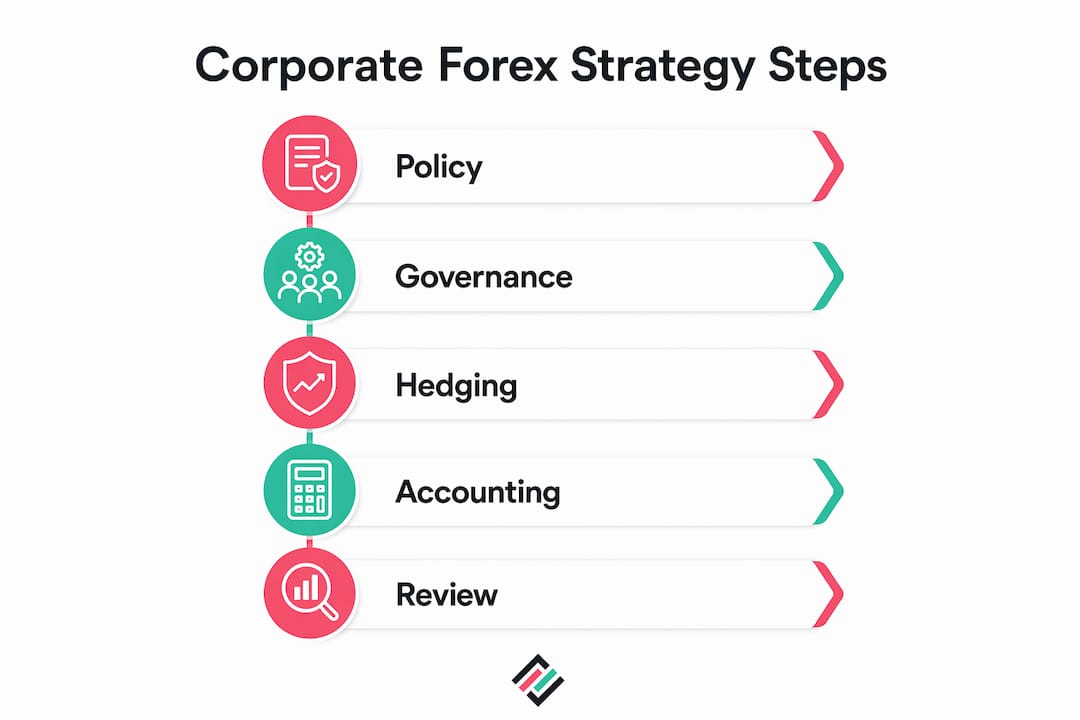
Corporate currency management, known formally as FX risk management, starts with a written hedging policy. That document defines exposure types, sets approved instruments, assigns accountability, and establishes hedge ratio targets. Without it, every decision becomes ad hoc.
Best-practice hedge ratios for committed exposures sit between 70% and 90%. That range reflects a deliberate balance: full coverage is rarely cost-effective, and zero coverage is reckless. The policy anchors your team to a defensible position within that range.
Governance matters as much as the policy itself. The team that sets hedging policy must be separate from the team that executes trades. This segregation of duties prevents conflicts of interest and keeps execution accountable to the strategy, not to individual judgment calls.
Accounting standards shape the entire framework. IFRS 9 and ASC 815 govern how hedging instruments appear in financial statements. Companies that design their strategy around these standards avoid P&L volatility from mark-to-market swings. Those that ignore them often discover the problem only at quarter-end.
| Prerequisite element | What it requires |
|---|---|
| Written hedging policy | Defines exposure scope, approved instruments, and ratio targets |
| Governance structure | Separates policy setters from trade executors |
| Exposure identification | Maps transaction, translation, and economic exposures |
| Accounting alignment | Designates hedges under IFRS 9 or ASC 815 from day one |
| Technology infrastructure | Treasury Management System replaces manual spreadsheets |
Pro Tip: Start your policy with a single currency pair that represents your largest exposure. Get the governance and documentation right for that pair before expanding to others. Complexity added too early is the most common reason FX programs stall.
Which core hedging strategies should corporates deploy?
Three strategy categories cover most corporate needs: static hedging, dynamic hedging, and natural hedging. Each fits a different risk profile and management bandwidth.

Static hedging locks in a fixed hedge ratio for a defined period, typically using forward contracts. It is simple to administer and easy to explain to boards. The limitation is rigidity. When market conditions shift, a static program cannot adapt without breaking its own structure.
Dynamic hedging adjusts hedge ratios and instrument mix as market volatility changes. Dynamic strategies consistently outperform static models over multi-year periods. The trade-off is complexity. Dynamic programs require real-time data, clear decision rules, and a team capable of acting on market signals without drifting into speculation.
Natural hedging is the most underused option in corporate finance. It aligns revenues and expenses in the same currency, reducing the net exposure that needs external hedging. A European exporter billing Polish clients in euros while paying Polish suppliers in euros carries far less PLN risk than one that invoices in PLN and pays in EUR. Natural hedging through contract negotiation and payment terms can be more effective and less costly than derivatives, particularly for mid-sized firms.
Instruments available across all three strategies include:
- Forward contracts: Lock in a rate for a future date. Low cost, no optionality.
- Currency options: Provide a floor or ceiling on exchange rates. Higher cost, but preserve upside.
- Cross-currency swaps: Exchange principal and interest in different currencies. Used for longer-dated exposures.
- FX collars: Combine a bought option and a sold option to cap the net premium cost.
Pro Tip: Options are worth their premium when your exposure is uncertain in timing or size. If you know exactly when and how much you will convert, a forward is almost always cheaper. Match the instrument to the certainty of the exposure, not to the complexity of the market.
For companies expanding into Sweden and Poland, cross-border payment structures also influence which instruments make sense, since payment timing directly affects when exposures crystallize.
How do you operationalize a forex risk program step by step?
Implementation follows a clear sequence. Skipping steps creates gaps that surface as losses or compliance failures later.
- Define the policy. Write the hedging policy before touching any instrument. Include scope, ratio targets, approved instruments, and review cadence.
- Map exposures. Identify transaction exposures (confirmed receivables and payables), translation exposures (foreign subsidiary balance sheets), and economic exposures (competitive pricing effects).
- Select instruments. Match each exposure type to the appropriate instrument based on certainty, duration, and cost tolerance.
- Execute and document. Place trades through approved counterparties and document hedge designations under IFRS 9 or ASC 815 at inception.
- Monitor continuously. Track open positions against policy limits. Flag breaches immediately.
- Review quarterly. Quarterly review cadence is best practice for reassessing hedge ratios, instruments, and exposure forecasts.
The quarterly review is where most programs either improve or decay. Markets change. Forecasts change. A hedge ratio that was appropriate in march may be wrong by june. The review forces the team to reconnect the strategy to current reality.
Cost management is a separate discipline within implementation. FX hedging costs include transaction costs, carry costs from interest rate differentials, opportunity costs when rates move favorably, and basis risk when the hedge does not perfectly match the exposure. Each cost must be weighed against the volatility it eliminates.
| Operational approach | Key consideration |
|---|---|
| Centralized treasury execution | Reduces counterparty fragmentation and improves pricing |
| Decentralized exposure reporting | Requires strong data feeds from business units |
| Automated rate imports | Eliminates manual entry errors in accounting systems |
| Cross-functional review meetings | Aligns treasury, accounting, and finance on exposure changes |
Internal coordination is the most underestimated operational challenge. Treasury cannot hedge what it does not know about. Business units that delay reporting new contracts or change payment terms without notice create unhedged gaps. A formal exposure reporting process, with defined deadlines and escalation paths, closes that gap.
Pro Tip: Build your exposure reporting template before you build your hedging model. If business units cannot easily report their exposures, your hedge ratios will always be based on incomplete data.
What accounting and reporting rules govern corporate FX hedging?
Hedge accounting under IFRS 9 and ASC 815 is not optional for companies that want clean financial statements. Proper hedge designation and effectiveness testing are prerequisites to avoid P&L volatility from derivative mark-to-market movements.
The core requirement is documentation at inception. You must designate the hedging instrument, identify the hedged item, define the risk being hedged, and describe how effectiveness will be assessed. Documentation created after the fact does not qualify.
Key accounting considerations include:
- Translation rates: Apply the correct spot rate at transaction date and the closing rate at period end for balance sheet items.
- Effectiveness testing: Demonstrate that the hedge offsets between 80% and 125% of the exposure's fair value change (under ASC 815) or meets the qualitative criteria under IFRS 9.
- Discontinuation rules: If a hedge fails effectiveness testing, gains and losses on the instrument flow immediately to P&L.
- Disclosure requirements: Both standards require detailed footnote disclosure of hedging objectives, instruments used, and fair values.
Manual processes fail at the documentation stage more than anywhere else. Manual spreadsheet management leads to data quality problems in 76% of teams. Automating exchange rate imports and hedge accounting entries removes the human error that regulators and auditors find most often.
Proper currency exchange accounting also affects tax reporting and investor confidence. Transparent, well-documented FX programs signal to investors that management controls financial risk. Programs that produce unexplained FX gains and losses quarter after quarter do the opposite.
Pro Tip: Run a mock effectiveness test on your first hedge before you go live. If you cannot pass it on paper, you will not pass it in your audit. Fix the designation before execution, not after.
Key Takeaways
A disciplined corporate forex strategy requires written policy, governance separation, accounting alignment, and quarterly recalibration to protect earnings from currency volatility.
| Point | Details |
|---|---|
| Set hedge ratios at 70–90% | Best-practice targets for committed exposures reduce volatility without eliminating all optionality. |
| Separate policy from execution | Segregation of duties prevents conflicts and keeps the program accountable to its own rules. |
| Match instruments to exposure certainty | Use forwards for known exposures and options when timing or size is uncertain. |
| Document hedges at inception | IFRS 9 and ASC 815 require designation before execution; retroactive documentation does not qualify. |
| Review quarterly | Recalibrate ratios and instruments every quarter to stay aligned with updated forecasts and market conditions. |
Why most FX programs fail before they start
The most common failure I see is not a bad strategy. It is a good strategy with no operational backbone. Finance teams spend weeks designing hedge ratios and instrument mixes, then discover that their exposure data arrives two weeks late from business units, their accounting system cannot handle hedge designation, and nobody owns the quarterly review process.
The second failure is treating the program as a one-time setup. Currency markets in 2026 are not the same as they were in 2024. The Swedish krona and Polish zloty both carry specific volatility patterns tied to European Central Bank policy and regional trade flows. A static program built on 2023 assumptions will underperform. Dynamic adjustment is not optional for companies with material exposure in these markets.
I have also watched firms underinvest in technology and then wonder why their corporate FX risk program produces inconsistent results. Spreadsheets cannot enforce policy limits, cannot automate documentation, and cannot flag breaches in real time. A Treasury Management System is not a luxury for large multinationals. It is the minimum infrastructure for any company running a disciplined program.
The firms that get this right share one trait: they treat FX strategy as a living process with clear ownership, regular reviews, and technology that enforces discipline automatically. That is not complicated. It just requires commitment before the next currency shock arrives.
— Bartas
How Corphedge supports your corporate FX program
Corporate finance teams that want to move from spreadsheet-based exposure tracking to a fully governed FX risk program need infrastructure that enforces policy, not just records it.
Corphedge provides real-time currency position visibility, value-at-risk based hedging, and automated hedge accounting documentation built for IFRS 9 and ASC 815 compliance. The platform supports both dynamic and static hedging approaches, with integration capabilities that connect treasury data directly to your accounting workflows. Finance teams in Poland and Sweden can access the full product tour to see how Corphedge maps to their specific exposure profiles. For teams ready to evaluate the platform against their current program, a live demo is available without a sales commitment.
FAQ
What is a corporate forex strategy?
A corporate forex strategy is a documented plan that defines how a company identifies, measures, and hedges its foreign exchange exposures. It sets hedge ratio targets, approved instruments, governance rules, and review cadence.
What hedge ratio should companies target?
Best-practice hedge ratios for committed exposures sit between 70% and 90%. That range balances cost efficiency with meaningful protection against adverse currency moves.
How does IFRS 9 affect corporate hedging programs?
IFRS 9 requires companies to designate and document hedging relationships at inception and test their effectiveness regularly. Failure to meet these requirements causes derivative gains and losses to flow directly to P&L rather than offsetting the hedged exposure.
When should a company use options instead of forwards?
Options are appropriate when the size or timing of an exposure is uncertain. Forwards are cheaper and more efficient when the exposure amount and settlement date are known with confidence.
How often should a corporate FX strategy be reviewed?
Quarterly review is the recognized best practice. Each review should reassess hedge ratios, instrument mix, and exposure forecasts to keep the program aligned with current market conditions and business reality.