

TL;DR:
- Effective FX risk governance depends on a board-approved strategy, independent oversight, and regular reporting. Strong risk culture and clear communication are essential to embed governance into daily decision-making, reducing losses. Technology platforms like Corphedge support compliance with limits and audit requirements, ensuring effective control over currency exposures.
Why governance determines how well you control FX risk
Governance in foreign exchange risk management is the system of policies, oversight structures, and accountability mechanisms that determine how an organization identifies, limits, and reports currency exposures. Get it right and your board knows exactly what FX risk the firm is carrying. Get it wrong and you find out about a blown limit after the loss has already hit the income statement.
The core components of a sound FX governance framework are:
- Written risk strategy approved by the governing body, specifying permissible transaction types and instruments
- Quantified risk limits, including Value at Risk (VaR) thresholds
- Formal reporting mechanisms delivering currency exposure data to the board or risk committee
- Independent oversight through an audit committee separate from executive management
- Periodic strategy review, at minimum annually, or whenever business scale or market conditions shift materially
Poland's 2023 financial governance standards set a clear benchmark: the governing body must approve a written FX risk management strategy, define permissible transactions, establish specific VaR limits, and mandate formal reporting. Strategy reviews must occur at minimum annually, with more frequent reviews required when exposure levels or market conditions change significantly.
Table of Contents
- How Central European regulatory frameworks shape oversight
- How risk culture either supports or undermines governance
- How governance structures interact with risk management functions
- How Corphedge operationalizes governance for FX risk management
- What governance in risk management actually means
- Why risk culture is the variable governance frameworks cannot codify
- Periodic review and reporting obligations under governance frameworks
- How to implement an effective FX governance framework
- Integrating governance with treasury and finance functions
- Governance failures and successes in Central European FX risk management
- Training and communication best practices for FX governance
- Tools and technologies that support FX governance oversight
- Key Takeaways
- Why governance is the wrong place to cut corners
- FAQ
How Central European regulatory frameworks shape oversight
Poland's 2023 standards under Rekomendacja I require banks and financial institutions to document FX risk governance structures, set internal limits, and report regularly to supervisory boards. The supervisory board approves the overall risk tolerance level and monitors compliance with the risk management strategy. Risk management responsibilities are formally divided between first and second levels of defense to preserve independent oversight.
The European Central Bank and the Federation of European Risk Management Associations (FERMA) reinforce this structure. Audit committees operate independently from executive management, protecting stakeholder interests by monitoring how risk appetite is applied across the organization. The ECB's supervisory framework treats internal governance as a core element of the Supervisory Review and Evaluation Process, meaning governance weaknesses can directly trigger supervisory action.
Key regulatory components across Central Europe include:
- Board approval of the FX risk strategy on an annual basis or more frequent as necessary
- Independent audit committee oversight of risk and internal control functions
- Defined reporting frequency adapted to the scale and complexity of exposures
- Documented compliance with legal and prudential requirements
Pro Tip: When building your governance structure for Polish or broader Central European markets, document not just the limits themselves but the escalation procedures for limit breaches. Regulators look for evidence that the process works under stress, not just in normal conditions.
How risk culture either supports or undermines governance
Policy documents do not manage risk. People do. Risk culture, as emphasized by the ECB and FERMA, is the shared set of values, attitudes, and behaviors around risk-taking that either reinforces or quietly erodes formal governance structures. When risk culture is weak, risk management becomes siloed rather than embedded in daily decision-making.
The consequences are predictable. Business units hedge without coordinating with treasury. Limit breaches sometimes fail to be escalated appropriately; reports may not fully reflect real exposure. The ECB has identified weak board oversight and inadequate risk culture as contributing factors in past financial crises, where management bodies failed to understand the complexity of risks they were carrying.
Practices that build a durable risk culture:
- Board-level discussions that actively debate FX exposures, not just receive reports
- Regular training for staff involved in currency transactions, with written acknowledgment of policies
- Clear accountability lines so limit breaches surface immediately
- Communication that connects individual hedging decisions to firm-wide risk appetite
How governance structures interact with risk management functions
The three lines of defense model gives governance its operational shape. Business units (first line) identify and manage FX exposures day to day. The risk function (second line) provides independent oversight, challenges assumptions, and monitors limits. Internal audit (third line) independently reviews whether the whole system works.

The critical point is empowerment. The risk function must be able to challenge business units on their hedging assumptions before decisions are made. Without board-level backing for that challenge function, governance frameworks remain formal but ineffective. Non-financial corporations with cross-border activities increasingly establish board-level risk committees specifically to give the risk function the authority it needs to push back on executive management.
Roles and interactions under a sound governance structure:
- Board/supervisory body: approves strategy, sets risk appetite, monitors compliance
- Risk committee: provides ongoing oversight, receives regular FX exposure reports
- Risk function (second line): challenges first-line assumptions, monitors VaR limits
- Internal audit (third line): independently reviews governance effectiveness
- Business units (first line): execute transactions within approved limits
Pro Tip: Define reporting lines in writing before a crisis, not during one. Ambiguity about who escalates a limit breach to whom is how small FX losses become large ones.
How Corphedge operationalizes governance for FX risk management
Corphedge translates governance requirements into operational controls that finance teams can actually use. The platform provides real-time currency exposure monitoring, VaR-based hedging limit enforcement, and transaction approval workflows that align directly with board-approved risk strategies.
Key platform capabilities relevant to governance fulfillment:
- Real-time visibility into currency positions across all exposures
- VaR-based hedging aligned to board-approved thresholds
- Automated limit monitoring with breach alerts
- Audit trails supporting regulatory review and internal audit
- Reporting workflows structured for board and risk committee delivery
| Governance checkpoint | Reporting cadence | Risk metric tracked |
|---|---|---|
| Board strategy review | Annual (minimum) | FX risk strategy alignment |
| Risk committee oversight | Quarterly | VaR utilization, limit adherence |
| Management reporting | Monthly | Open positions, hedge ratios |
| Operational monitoring | Daily/weekly | FX VaR, position limits, stress tests |
Corphedge also supports coordination between treasury, finance, and risk functions, which is where governance and risk management frameworks most often break down in practice.
What governance in risk management actually means
Governance in risk management is the integrated system through which an organization directs and controls its risk-taking. It covers the structures, processes, and accountability mechanisms that connect strategy to execution. The OECD's peer review of corporate governance frameworks found that the cost of risk management failures is routinely underestimated, including the management time required to correct them.
Governance is not a compliance checkbox. It is the mechanism that ensures risks are understood before they are taken, managed while they are open, and communicated accurately to those responsible for oversight.
Why risk culture is the variable governance frameworks cannot codify
Risk culture operates below the level of policy. Two organizations can have identical written governance frameworks and produce completely different risk outcomes depending on whether their people actually use those frameworks under pressure. The ECB's supervisory work consistently finds that a well-developed risk appetite framework, combined with strong risk culture, is the cornerstone of sound governance. Culture determines whether limit breaches get escalated or buried.
Periodic review and reporting obligations under governance frameworks
PKO Bank Polski's reports illustrate governance-driven FX reporting produced at varying intervals appropriate to exposure scale, covering exposure levels, VaR utilization, and internal limit adherence. Recipients include the risk committee, management board, and supervisory board. The governing body conducts an annual assessment of the risk management system's adequacy and effectiveness.
The frequency of measurement and reporting must match the scale and complexity of the institution's FX activity, not a generic schedule.
How to implement an effective FX governance framework
Implementation follows a logical sequence. Start with a gap assessment against applicable regulatory standards (Rekomendacja I in Poland, EBA guidelines across the EU). Then:
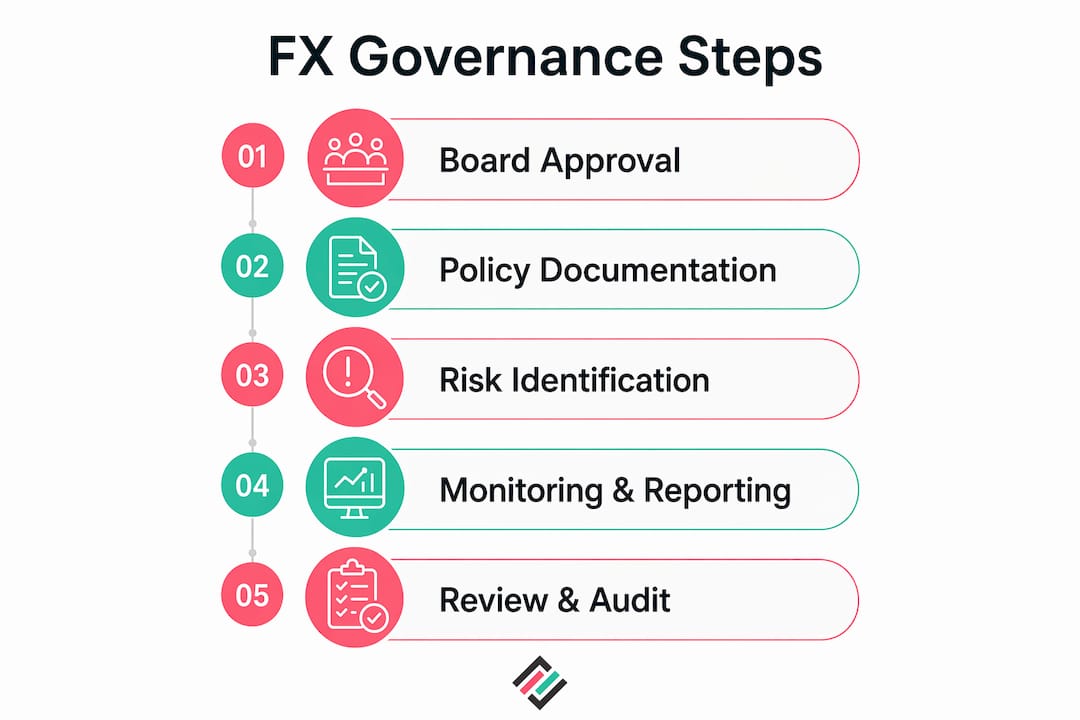
- Draft a written FX risk strategy with board approval, specifying permissible instruments and VaR limits
- Establish or formalize the audit committee with independence from executive management
- Define the three lines of defense with clear mandates and reporting lines
- Build reporting templates for each governance level (operational, management, board)
- Set a review calendar with annual strategy approval as the minimum cadence
- Train all staff involved in FX transactions and document their acknowledgment of policies
The board-level approval process for FX strategy is not a formality. It is the mechanism that makes the risk appetite real.
Integrating governance with treasury and finance functions
Information flow between treasury and finance is where governance either connects or fractures. Governance succeeds when finance fully understands the business drivers behind currency risks, not just the hedging positions. Treasury needs to know which revenue streams are exposed; finance needs to understand how hedges affect reported earnings.
Practically, this means shared dashboards, joint limit reviews, and regular cross-functional reporting that gives both functions a common picture of FX exposure.
Governance failures and successes in Central European FX risk management
The 2008 financial crisis produced instructive failures across Central Europe. Institutions that lacked effective board oversight of FX exposures found themselves carrying positions that management had not adequately disclosed. Supervisory boards that relied on summarized reports without challenging underlying assumptions missed concentration risks in foreign currency lending.
On the success side, institutions that embedded FX governance into their risk appetite frameworks and maintained independent challenge functions navigated currency volatility with materially lower losses. The pattern is consistent: governance failures in FX risk trace back to weak oversight, not bad markets.
Training and communication best practices for FX governance
Written policies only work if the people executing transactions understand them. Polish regulations require that staff involved in FX operations know the risk management principles and confirm this in writing. Beyond compliance, effective training connects individual transaction decisions to firm-level risk appetite, so traders and treasury staff understand why limits exist, not just what they are.
Communication should flow in all directions: downward from the board on strategy and appetite, upward from operations on exposures and breaches, and laterally between treasury, finance, and risk functions on shared positions.
Tools and technologies that support FX governance oversight
Technology platforms support governance by making exposure data visible, limits enforceable, and reporting consistent. Corphedge's VaR-based hedging capabilities align directly with governance requirements for quantified risk limits. For broader risk management best practices in high-risk sectors, the governance infrastructure around any platform matters as much as the platform itself.
Audit trail functionality is particularly important. Regulators and internal auditors need to reconstruct decision sequences, and manual records rarely survive that scrutiny intact.
Key Takeaways
Effective FX risk governance requires board-approved written strategies, independent audit oversight, quantified VaR limits, and regular reporting cycles aligned to regulatory standards like Poland's 2023 Rekomendacja I.
| Point | Details |
|---|---|
| Board approval is mandatory | Poland's 2023 standards require annual governing body approval of the written FX risk strategy. |
| Three lines of defense | Business units manage exposures; the risk function challenges assumptions; internal audit reviews the system. |
| Risk culture drives outcomes | Governance frameworks fail when risk management is siloed rather than embedded in daily decisions. |
| Reporting cadence matters | FX risk reports should be produced at intervals appropriate to the institution’s FX activity scale—ranging from daily operational monitoring to quarterly risk committee oversight and annual board-level strategy review. |
| Technology enforces limits | Platforms like Corphedge automate VaR limit monitoring and provide audit trails that support regulatory review. |
Why governance is the wrong place to cut corners
The conventional view treats governance as overhead: documentation, committee meetings, and reporting that slows down execution. That framing gets it exactly backward. The European Commission's analysis of governance failures notes that the cost of rectifying poor risk management, in management time alone, consistently exceeds what sound governance would have cost to maintain. FX markets move fast. A governance framework that surfaces a limit breach in real time costs far less than one that surfaces it in the quarterly board pack.
The subtler point is about organizational behavior. Governance aligns what people do with what the firm has decided it can afford to lose. Without that alignment, risk appetite statements are fiction. The firms that navigate currency volatility well are not necessarily the ones with the most sophisticated hedging models. They are the ones where the board actually understands the exposures, the risk function has genuine authority to challenge, and the reporting tells the truth.
For finance professionals expanding into Central European markets, particularly Poland, the governance infrastructure needs to be built before the hedging program, not after.
FAQ
What is the role of governance in FX risk management?
Governance establishes the policies, oversight structures, and accountability mechanisms that control how an organization takes and manages foreign exchange risk, including board-approved strategies, VaR limits, and formal reporting obligations.
What does Poland's 2023 governance standard require for FX risk?
Poland's Rekomendacja I requires the governing body to approve a written FX risk management strategy at least annually, defining permissible transactions, specific VaR limits, and formal reporting mechanisms to the board or risk committee.
How does risk culture affect governance effectiveness?
Risk culture determines whether governance frameworks function in practice. When risk management is siloed rather than embedded across decision-making, formal policies fail to prevent excessive FX exposures even when the documentation is complete.
What is the three lines of defense model in FX governance?
Business units (first line) manage currency exposures operationally; the risk function (second line) provides independent oversight and challenges assumptions; internal audit (third line) reviews whether the entire governance system operates effectively.
How does Corphedge support FX governance requirements?
Corphedge provides real-time currency exposure monitoring, VaR-based hedging limit enforcement, transaction approval workflows, and structured reporting aligned to board and risk committee governance requirements.