
TL;DR:
- Currency swings of just a few percent can eliminate entire profit margins for cross-border companies.
- Effective hedging tools and a strategic approach are essential to managing unpredictable foreign exchange risks.
Picture this: you close a deal to import a container of goods priced in euros, lock in a supplier, and build a 6% margin into the contract. By the time settlement arrives six weeks later, the dollar has slipped, and that margin has vanished entirely. No operational failure. No bad product. Just a currency move of a few percentage points. For companies trading across borders, 3-5% FX swings can wipe out the profit on an entire shipment. This article lays out a practical playbook for identifying your exposure, selecting the right hedging tools, and building a strategy that actually holds up under real market pressure.

Table of Contents
- Understanding forex risk for importers and exporters
- Essential tools and techniques for hedging forex exposure
- A step-by-step approach: Choosing and applying the right strategy
- Troubleshooting: Common pitfalls and advanced risk factors
- What most companies overlook about forex hedging
- Protect your profits with tailored FX risk solutions
- Frequently asked questions
Key Takeaways
| Point | Details |
|---|---|
| Currency swings hit margins | Even modest forex movements can quickly erode importers’ and exporters’ profits. |
| Diversify your hedging | Combining multiple hedging instruments achieves better protection than relying on one method. |
| Align strategy to needs | Choose hedging strategies based on your specific exposures, cash flow timing, and risk appetite. |
| Common hedging pitfalls | Avoid over-hedging or neglecting costs that can turn precautions into risks. |
| Continuous monitoring wins | Regularly review and adjust your program as trade conditions, markets, and exposures evolve. |
Understanding forex risk for importers and exporters
Forex risk, sometimes called currency risk or exchange rate risk, is the possibility that a change in currency values will reduce the value of a cross-border transaction. For an importer, a stronger foreign currency means higher costs. For an exporter, a stronger domestic currency means lower revenue when foreign sales are converted home. Either way, a move of just a few percent can make the difference between a profitable quarter and a loss.
The problem is not just the size of potential swings. It is also the unpredictability. Exchange rates respond to central bank policy decisions, geopolitical events, commodity price shocks, and investor sentiment. A trade deal announcement in the morning can move a currency pair by 1% before lunch. Multiply that across millions of dollars in receivables or payables, and the dollar impact becomes hard to ignore.
What makes this riskier than most finance teams expect:
- Timing mismatches: The gap between invoice date and payment date can stretch weeks or months, leaving exposure open.
- Volume uncertainty: Order quantities sometimes change, meaning the hedged amount no longer matches actual exposure.
- Multiple currency pairs: Companies dealing with several counterparties across different countries face layered, correlated risks.
- Seasonal peaks: Agricultural exporters, for example, face concentrated exposure windows where even a short move is devastating.
The scale of the problem has pushed many corporate treasurers toward systematic hedging. Australian corporates, for instance, hedge around 80% to 86% of their forex exposures, with importers at the lower end and exporters slightly higher. That level of coverage reflects just how seriously large trading companies treat currency risk.
A concrete example brings this home. An importer bringing in $2 million worth of goods priced in a foreign currency carries a 5% depreciation scenario that would cost them $100,000. If their net margin is 5%, that single currency move wipes out the entire profit on that shipment. Understanding transaction hedging fundamentals is not optional for any company running those kinds of numbers.
"Currency risk is not a theoretical concern for trade finance teams. It is a direct line to the bottom line."
The stakes are especially high for businesses with thin margins and high invoice volumes, including food importers, electronics distributors, and commodity traders. These companies live and die by basis points, and an unhedged currency position can turn a winning trade into a money-losing one before anyone touches the goods. Staying current on currency management best practices is the foundation of sound cross-border operations.
Essential tools and techniques for hedging forex exposure
Knowing the risk exists is not enough. You need tools that actually neutralize it. The good news is that there are several proven instruments, each suited to different risk profiles, deal structures, and cost tolerances.
| Instrument | How it works | Best for | Key trade-off |
|---|---|---|---|
| Forward contract | Locks in an exchange rate for a future date | Known payment amounts and dates | No upside if rates improve |
| Futures contract | Standardized exchange-traded forward | Liquid hedging with price transparency | Basis risk from standardized lot sizes |
| Currency option | Right, not obligation, to exchange at a set rate | Uncertain cash flows or upside desire | Premium cost |
| Money market hedge | Borrow/lend in matching currencies to create synthetic forward | Firms with direct capital market access | Requires balance sheet capacity |
| Currency swap | Exchange of principal and interest in different currencies | Long-term financing across currencies | Complexity, counterparty risk |
Breaking each down for practical use:
Forward contracts are the most common tool for a reason. They are simple, customizable, and easy to execute through a bank or broker. You agree today on a rate for a transaction that settles in 30, 60, or 90 days. The certainty is valuable, but you give up any benefit if rates move in your favor.
Currency options are powerful but often misunderstood. They protect against adverse moves while retaining upside if rates shift in your favor. You pay a premium for this flexibility, similar to insurance. For companies with variable shipment volumes or uncertain receivable timing, options provide coverage without locking in a one-way bet.
Money market hedges create a synthetic forward by using lending and borrowing in the two currencies involved. If you owe euros in 90 days, you borrow euros today, convert them to dollars, invest the dollars, and use the euro investment proceeds to pay the invoice. It is elegant but requires balance sheet headroom.
Swaps are best for companies with ongoing, long-term currency needs. Exporters who consistently generate foreign currency revenue might use a cross-currency swap to convert that cash flow into domestic currency on a recurring basis, reducing administrative burden.
Pro Tip: For companies just starting to hedge, begin with forward contracts on your largest single exposures. Add options when you face uncertainty in timing or volume. Layer in swaps only once you understand your baseline exposure over a rolling 12-month horizon.
Exploring the full range of FX hedging instruments before committing to any single approach pays dividends. Each tool carries cost, complexity, and suitability trade-offs that only make sense once you map them against your actual exposure profile. For companies with more complex needs, advanced money market hedges can unlock a level of precision that standard forwards cannot achieve.
A step-by-step approach: Choosing and applying the right strategy
Theory is worthless without execution. Here is a structured process for selecting and implementing a hedging program that fits your business.
Step 1: Map your exposures List every currency pair you deal in, the notional value, and the settlement timeline. Separate confirmed exposures (signed contracts) from forecast exposures (anticipated orders). The certainty level of each exposure should guide your hedging ratio and instrument choice.
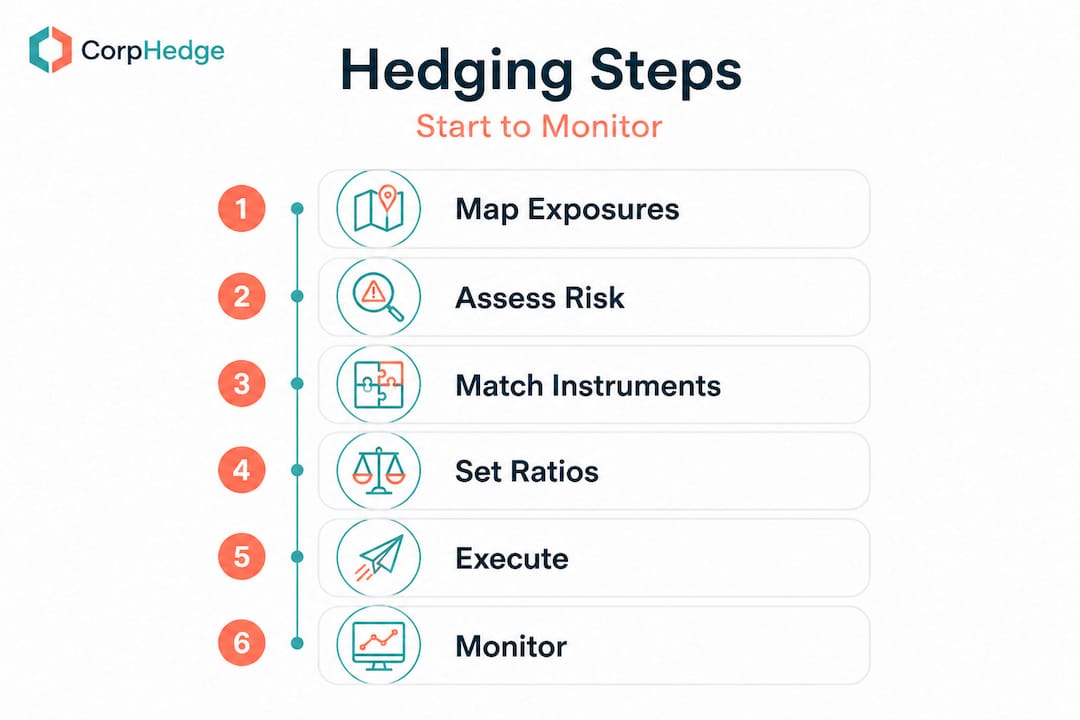
Step 2: Assess your risk tolerance Talk with senior leadership about the maximum acceptable loss from a currency move on any given quarter or shipment. This becomes your hedging floor. If a 3% adverse move is tolerable but 7% is not, your hedging program should protect against moves beyond 3%.
Step 3: Match instruments to exposure type Use forwards for confirmed, date-specific payables or receivables. Use options where timing or volume is uncertain. Use swaps for recurring, long-term currency flows. Do not apply a one-size-fits-all instrument across all exposure types.
Step 4: Set hedge ratios Most companies do not hedge 100% of exposure. A 70-80% hedge ratio on confirmed exposures leaves room for favorable rate movements while capping downside. For forecast exposures, a 50% ratio is common.
Step 5: Execute and document Execute trades through your bank, broker, or digital platform. Document the rationale, instrument, rate, and intended accounting treatment. Hedge accounting (under IFRS 9 or ASC 815) requires documentation at inception.
Step 6: Monitor and rebalance Hedges do not run themselves. Review monthly. If underlying exposures change (cancelled orders, delayed shipments), adjust the hedge position to avoid over-hedging.
Research from a SolarTech case study in the ICEMED-25 Proceedings shows compelling results: futures hedges carried 5.9% basis risk, while options reduced net premium costs by 68%, and swaps cut cash flow volatility by 41%. The right combination depends on your specific exposure profile, but the data confirms that structured programs meaningfully reduce risk compared to unhedged positions.
| Outcome metric | Futures | Options | Swaps |
|---|---|---|---|
| Basis risk | 5.9% | Low | Very low |
| Net premium cost | None | Reduced 68% | Moderate |
| Volatility reduction | Moderate | High | 41% cut |
| Flexibility | Low | High | Low |
Pro Tip: Prioritize options or structured forwards when cash flows are uncertain. Locking in a fixed obligation with a forward when your underlying exposure might not materialize creates its own risk. Exploring risk reduction strategies with a specialist before finalizing your approach can save significant cost.
Troubleshooting: Common pitfalls and advanced risk factors
Even well-designed hedging programs fail when edge cases are ignored. The most costly mistakes tend to fall into a few recurring categories.
Common mistakes to watch for:
- Over-hedging: Hedging more than your actual exposure creates a speculative position in the opposite direction. If the underlying trade falls through, you are left with an open currency position you never intended to hold.
- Ignoring transaction costs: Bid-ask spreads, option premiums, and rollover costs add up. A hedging strategy that is theoretically perfect may be economically marginal once costs are included.
- Misjudging timing: Hedge maturity must match settlement date. A forward maturing 10 days before your invoice payment date leaves you exposed for those 10 days.
- Neglecting documentation: Without proper documentation, hedge accounting treatment may not be available, creating P&L volatility that defeats the purpose.
Advanced risks that trip up even experienced teams:
Smaller firms face amplified impacts from timing mismatches and opportunity costs compared to large corporates with treasury departments and dedicated risk systems. A mid-size exporter missing a settlement by a week can face spot rate exposure at the worst possible moment.
"Smaller firms are more vulnerable to timing mismatches and opportunity costs because they lack the systems and headcount to actively monitor and adjust hedge positions in real time."
Additional risk factors:
- Basis risk: Particularly relevant for futures. Because futures contracts are standardized, the rate you lock in may not precisely match the spot rate at settlement, leaving a residual gain or loss.
- Counterparty risk: Over-the-counter (OTC) instruments like forwards and swaps expose you to the counterparty's credit risk. If your bank or broker defaults, your hedge may not be honored.
- Regulatory risk: Cross-border derivatives may fall under EMIR, Dodd-Frank, or local equivalent reporting requirements. Ignoring these creates compliance exposure.
- Operational risk: Manual processes for hedge booking, confirmation, and settlement create error risk. A missed confirmation or wrong lot size can leave you worse off than unhedged.
Reviewing risk management best practices before rolling out any program helps identify gaps. Understanding the difference between protection and speculation by referencing hedging vs speculation principles keeps strategy on the right side of that critical line.
What most companies overlook about forex hedging
Here is an uncomfortable truth: most companies treat hedging as a one-time task. They set up a forward contract, lock in a rate, and forget about it until settlement. That approach works in calm markets. It quietly destroys value in volatile ones.
The real lesson from working with international trade businesses across multiple market cycles is that static hedges are a liability disguised as a policy. Market conditions shift. Trade volumes change. Central banks surprise. A hedge that was well-calibrated in January may be dangerously misaligned by April if exposure patterns have shifted and no one has reviewed the position.
The companies that genuinely protect their margins run adaptive, scenario-based programs. They stress-test hedge portfolios against multiple rate scenarios every quarter. They adjust ratios when forecast confidence changes. They use Value at Risk (VaR) modeling to quantify the expected loss range across outcomes, not just the base case. This is not complexity for its own sake. It is the difference between a hedging program that works and one that only appears to work.
Smaller firms actually have the most to gain here. Large corporates have built-in buffers: diversified revenue streams, large balance sheets, and dedicated treasury teams. For a mid-size importer or exporter, one badly calibrated hedge in a bad quarter can materially impair the business. Agile, scenario-driven frameworks protect exactly those firms the most. Tools focused on cutting earnings volatility through disciplined review cycles make this level of rigor achievable without a 10-person treasury team.
Pro Tip: Reassess your hedge book every quarter, not just at deal inception. Review changes in trade volume, currency correlation shifts, and any macroeconomic developments affecting your key pairs. Fifteen minutes of quarterly review can prevent months of damage control.
Protect your profits with tailored FX risk solutions
Managing currency risk at this level of precision requires more than spreadsheets and ad-hoc bank calls. CorpHedge is purpose-built for exactly this challenge.
CorpHedge gives finance teams real-time visibility into their currency positions, supports hedging based on Value at Risk methodologies, and integrates with platforms like Corpay to reduce execution friction. The platform's FX risk management features bring institutional-grade analytics to companies that do not have institutional-sized treasury teams. Whether you are evaluating your first hedge program or refining an existing one, the FX risk solution tour is a fast, practical way to see how it all fits together for your specific trade flows and currency pairs.
Frequently asked questions
What is the most cost-effective forex hedging strategy for small businesses?
Currency options provide protection with retained upside, making them particularly cost-effective for small businesses that cannot afford to miss favorable rate moves while still needing downside coverage.
How much of their exposure do most importers and exporters hedge?
Australian importers hedge around 80% and exporters up to 86% of their forex exposures, reflecting high awareness of currency risk in active trading markets.
What are the risks if I over-hedge my currency exposure?
Over-hedging carries opportunity costs and can generate unintended gains or losses if the underlying trade exposure does not materialize as expected, effectively turning a hedge into a speculative position.
Do agricultural exporters face unique forex risks?
Yes. Even 3-5% FX volatility can eliminate margins on shipments for fruit and agricultural exporters, where margins are already thin and exposure windows are concentrated seasonally.
How much can swaps or options reduce FX risk exposure?
According to case study data, swaps cut volatility by 41% while options reduce net premium costs by up to 68%, demonstrating that structured hedging programs deliver measurable, quantifiable risk reduction.