
TL;DR:
- Most CFOs fail at FX risk management not due to technology, but because of poor process ownership and documentation. Implementing a tailored, integrated accounting platform supported by clear workflows and accountability is essential for compliance and reducing earnings volatility. Continuous monitoring and a culture of responsibility ensure effective hedge recognition, testing, and regulation adherence over time.
Foreign exchange volatility is not an abstract threat. For CFOs running international operations, a single quarter of unhedged currency exposure can wipe out months of carefully built margin, triggering earnings surprises that rattle investors and strain cash flow forecasts. Yet most companies that struggle with FX risk do not fail because of bad hedging strategies. They fail because they selected the wrong accounting service to support those strategies, or they selected the right one and implemented it poorly. This guide gives you a clear, step-by-step framework for choosing, deploying, and continuously improving an accounting service that genuinely hardens your FX risk control.
Table of Contents
- Understanding the stakes: Why FX risk demands more from accounting services
- What you need: Prerequisites and process standards for FX risk accounting
- Execution: How to select and operationalize the right accounting service
- Verification and continuous improvement: Monitoring effectiveness and compliance
- The real challenge: Why most FX risk accounting solutions fail global CFOs
- Ready to transform FX risk control? Explore tailored solutions
- Frequently asked questions
Key Takeaways
| Point | Details |
|---|---|
| FX risk needs specialized controls | Generic accounting platforms often fail to prevent earnings shocks from currency volatility in global companies. |
| Standardized process is essential | Well-documented workflows and clear roles shrink errors and make regulatory compliance sustainable. |
| Provider selection shapes outcomes | Only services with robust hedge designation, effectiveness testing, and evidence support deliver effective FX risk management. |
| Continuous monitoring delivers results | Ongoing testing and process refinement help adapt to new regulations and market conditions, preserving gains. |
Understanding the stakes: Why FX risk demands more from accounting services
The foreign exchange market moves constantly, and its impact on corporate earnings is direct and measurable. A European manufacturer selling into the U.S. market, for example, faces a completely different profit picture when the euro strengthens by 8% against the dollar over a single fiscal quarter. Revenue in dollar terms stays flat, but when translated back to euros, it shrinks. That kind of earnings volatility is not just uncomfortable. It can trigger covenant breaches, reduce dividend capacity, and signal financial instability to analysts.
The problem is compounded when companies rely on accounting services that were designed for domestic operations. Generic accounting platforms handle invoicing, payroll, and tax compliance with reasonable competence. But they rarely have the infrastructure to manage hedge designation workflows, track derivative fair values, or produce the contemporaneous documentation that regulators require. This gap is where accounting service earnings volatility becomes a serious financial risk rather than a theoretical concern.
Regulations raise the bar significantly. Both ASC 815 under U.S. GAAP and IFRS 9 under international standards require companies to document hedge relationships at inception, test effectiveness on an ongoing basis, and maintain audit-ready evidence trails. These are not checkbox exercises. They require structured workflows, role-based accountability, and often dedicated technology.
"Without hedge accounting, hedge effectiveness and documentation gaps can drive income-statement volatility that would otherwise be avoidable with proper designation and process."
The core limitations of generic accounting services in this context include:
- No native hedge designation workflow: Most general-purpose platforms cannot capture the formal documentation required at hedge inception under ASC 815 or IFRS 9.
- Limited derivative valuation support: Fair value measurement of forwards, options, and cross-currency swaps requires mark-to-market capabilities that standard accounting tools lack.
- Weak audit trail functionality: Regulators and auditors expect timestamped, role-attributed records. Spreadsheet-based systems cannot reliably provide this.
- No effectiveness testing automation: Periodic effectiveness testing is a compliance requirement, not optional. Generic tools do not automate this process.
Understanding how to hedge forex risk and protect profits starts with recognizing that the accounting infrastructure supporting your hedging program is just as important as the hedging strategy itself.
What you need: Prerequisites and process standards for FX risk accounting
Before you evaluate a single vendor, you need to define what your organization actually requires. This is the step most CFOs skip, and it is the reason so many implementations underdeliver. The prerequisites fall into three categories: documentation standards, workflow structure, and technology readiness.
Documentation standards are non-negotiable under both ASC 815 and IFRS 9. You need written hedge designation memos at the start of every hedge relationship, specifying the hedged item, the hedging instrument, the risk being hedged, and the effectiveness testing methodology. These memos must exist before the hedge begins, not after the fact. Manual hedge tracking is operationally intensive and prone to errors, and standardized, documented procedures are emphasized for hedge accounting compliance, including audit readiness and role clarity.
Workflow structure means assigning clear ownership across your finance team. Who designates hedges? Who runs effectiveness tests? Who reviews and approves the documentation? Without defined roles, even the best software becomes a liability because no one is accountable for the process.
Technology readiness involves understanding your current ERP and treasury management system landscape. An accounting service that cannot integrate with your existing systems will create data silos and manual reconciliation work that defeats the purpose of automation.

Pro Tip: Before issuing any RFP to accounting service vendors, map your current FX exposure categories: transactional, translational, and economic. This mapping becomes the foundation for every capability requirement you write into your vendor evaluation criteria. It also helps you apply the right transaction hedging strategies to each exposure type.
Here is a practical comparison of your three main operational options:
| Approach | Strengths | Weaknesses | Best for |
|---|---|---|---|
| Automated platform | Speed, audit trail, integration | Upfront cost, change management | Mid to large global companies |
| Manual process | Low cost, flexibility | Error-prone, not audit-ready | Very small FX exposures only |
| Partial outsourcing | Expertise on demand | Coordination gaps, slower response | Companies in transition |
The risk management best practices for currency fluctuations consistently point toward automation as the standard for companies with meaningful FX exposure. The operational risk of manual tracking simply does not scale. For companies with finance team compliance safeguards already in place, integrating an FX-capable accounting service becomes a matter of connecting existing controls to a more capable platform.
Execution: How to select and operationalize the right accounting service
With your requirements defined, the selection and implementation process becomes much more structured. Here is the step-by-step approach that consistently produces better outcomes:
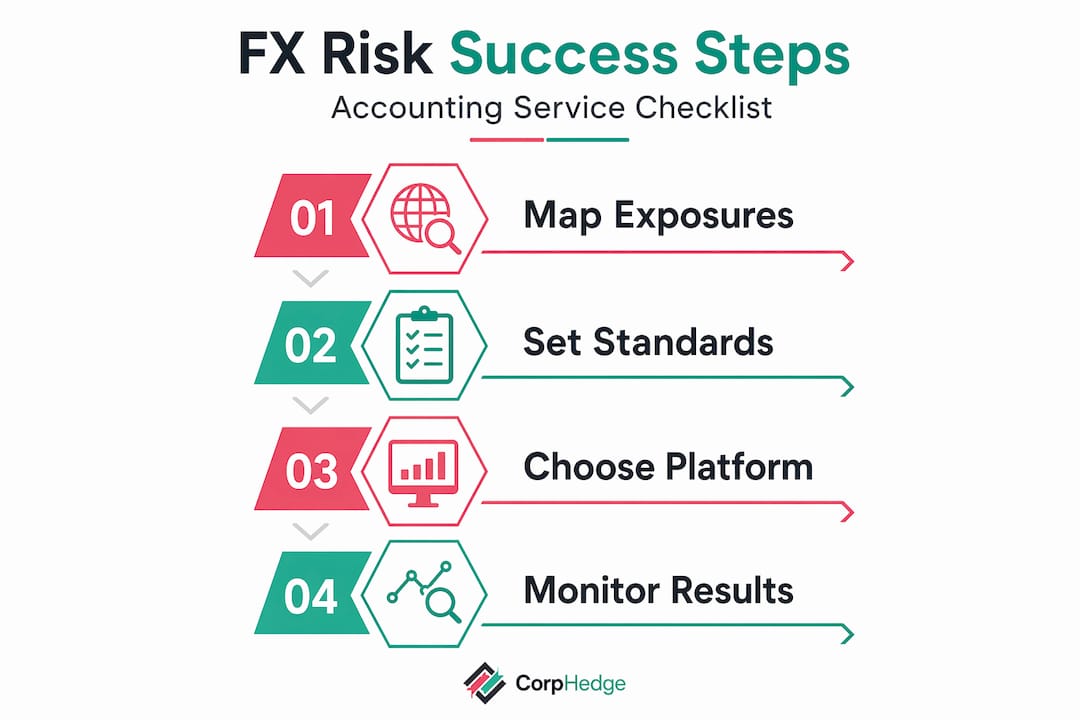
- Define your exposure universe. List every currency pair, transaction type, and balance sheet item that creates FX risk. Include intercompany loans, forecasted revenues, and payables in foreign currencies. This list drives every subsequent decision.
- Map required documentation capabilities. Your shortlist of vendors must support contemporaneous hedge designation, effectiveness testing workflows, and audit-ready evidence generation. These are the recurring failure points that create earnings volatility when they are missing.
- Evaluate integration with your ERP and treasury systems. A platform that cannot pull live data from your ERP will require manual data entry, which reintroduces the error risk you are trying to eliminate.
- Assess role-based access and approval workflows. The system must enforce segregation of duties. The person who designates a hedge should not be the same person who approves the effectiveness test result.
- Run a proof-of-concept with real data. Do not rely on demo environments. Test the platform with actual historical hedge data from your company to see how it handles your specific exposure types and accounting elections.
- Verify reporting output against regulatory requirements. Ask your external auditors to review sample outputs before you go live. This step alone prevents most post-implementation compliance surprises.
Pro Tip: When evaluating vendors, ask specifically about their support for both ASC 815 and IFRS 9. Many platforms support one standard well and the other superficially. If your company operates across multiple jurisdictions, you need genuine dual-standard capability, not a workaround.
Here is a practical scoring framework for vendor evaluation:
| Capability | Weight | Why it matters |
|---|---|---|
| Hedge designation workflow | 25% | Core compliance requirement |
| Effectiveness testing automation | 20% | Prevents manual errors and gaps |
| Audit trail and evidence generation | 20% | Directly supports regulatory review |
| ERP and treasury integration | 15% | Eliminates reconciliation risk |
| Role-based access controls | 10% | Enforces accountability and segregation |
| Reporting flexibility | 10% | Supports management and external reporting |
A well-structured FX risk workflow is the operational backbone of your hedging program. The accounting service you select either supports that workflow or undermines it. There is very little middle ground. Following financial control steps tailored to your organization's complexity level helps ensure the implementation does not stall during rollout. The goal is strategic risk management that runs as a continuous process, not a quarterly scramble.
Verification and continuous improvement: Monitoring effectiveness and compliance
Selecting and implementing the right accounting service is not the end of the process. It is the beginning of an ongoing monitoring obligation. FX risk changes as your business evolves, and your accounting service needs to keep pace.
Regular effectiveness testing is required under both ASC 815 and IFRS 9. Under IFRS 9 specifically, the standard shifted from a bright-line 80 to 125 percent effectiveness threshold to a more principles-based approach, but the testing obligation remains. You need a documented testing schedule, clear pass/fail criteria, and a defined escalation path when a hedge fails effectiveness.
Compliance checks should be built into your monthly close process, not treated as a separate annual exercise. Key items to verify each period include:
- All active hedge relationships have current designation documentation
- Effectiveness tests have been completed and results are documented
- Any hedge discontinuations have been properly accounted for
- Derivative fair values are reconciled to counterparty confirmations
- OCI balances are being released to P&L at the correct timing
Adapting to regulatory changes is an ongoing requirement. Under IFRS 9, the ability to designate forward or spot rates is not restricted to foreign currency risk, and both approaches may continue, while forward fair value is influenced by spot and forward points from interest rate differentials. This flexibility is valuable, but it also means your accounting service must support both elections and track the different P&L and OCI impacts correctly.
Tracking the impact of forward versus spot rate choices on your financial statements is one of the more nuanced ongoing tasks. When you exclude forward points from a hedge designation and account for them separately, those costs flow through OCI rather than directly to P&L. This can smooth reported earnings but requires careful tracking. Your accounting service must handle this distinction automatically, not through manual journal entries.
Reviewing effective hedging strategies periodically ensures that your program stays aligned with your actual business exposures as they evolve. A hedging program designed for one revenue mix may be misaligned after an acquisition or a market shift into new geographies.
The real challenge: Why most FX risk accounting solutions fail global CFOs
Here is the uncomfortable truth that most vendors will not tell you: the technology almost never fails. What fails is the human process around the technology.
We have seen companies implement sophisticated, well-configured accounting platforms and still end up with hedge accounting failures at audit time. The reason is almost always the same. The system was set up correctly, but no one owned the ongoing process. Hedge designation memos were created at inception and then never updated when the underlying exposure changed. Effectiveness tests were scheduled but not actually reviewed by anyone with authority to act on the results. Documentation existed in the system but no one had verified it was complete before the auditors arrived.
The conventional approach to FX risk accounting focuses heavily on controls and systems. That focus is necessary but not sufficient. What actually turns things around is building a culture of documentation accountability across the treasury, accounting, and FX trading functions. This means assigning named owners to every hedge relationship, not just a team or a department. It means building documentation review into the weekly rhythm of the finance team, not just the quarterly close.
Reducing earnings volatility through better accounting service selection is ultimately about closing the gap between what the system can do and what your team actually does every day. The companies that get this right are not necessarily using the most expensive platforms. They are using platforms that fit their workflow and then building genuine accountability around those platforms. Technology is the enabler. Process ownership is the differentiator.
The contrarian lesson here is that adding more technology to a broken process just creates a more expensive broken process. Fix the process first, then select the technology that supports it.
Ready to transform FX risk control? Explore tailored solutions
Managing FX risk with the right accounting service is one of the highest-leverage decisions a CFO can make for financial stability and earnings predictability.
CorpHedge was built specifically for this challenge. The platform gives finance teams real-time visibility into currency positions, structured workflows for hedge designation and effectiveness testing, and audit-ready documentation that satisfies both ASC 815 and IFRS 9 requirements. Whether you are building a hedging program from scratch or upgrading from a manual process, CorpHedge provides the infrastructure your team needs. Explore hedging based on value at risk to see how the platform quantifies and manages exposure, review the full FX exposure management features to evaluate fit for your organization, or start with the FX hedging course to build your team's capability before implementation.
Frequently asked questions
What is hedge accounting and why is it critical for FX risk?
Hedge accounting aligns derivative results with underlying exposures, deferring gains and losses to OCI when properly designed and tested, which stabilizes reported earnings and reduces income-statement noise from FX movements.
How does process documentation reduce FX exposure errors?
Standardized, documented procedures reduce operational and error risk in hedge accounting by creating clear role assignments, repeatable workflows, and audit-ready evidence that prevents gaps from appearing at review time.
What are the main compliance challenges for global CFOs managing FX risk?
Regulations like ASC 815 and IFRS 9 require contemporaneous designation, ongoing effectiveness testing, and robust evidence trails, all of which demand structured workflows rather than ad hoc documentation practices.
How do forward rate and spot rate choices affect hedge accounting results?
IFRS 9 permits use of either forward or spot rates for hedges, and the choice directly affects whether forward points flow through P&L or OCI, changing the appearance of reported earnings across periods.