

Currency risk reporting is the consistent translation of open FX exposures, hedging positions, and rate sensitivities into business metrics — revenue, EBITDA, cash flow — that management and auditors can act on. The deliverable is a repeatable, board-ready report showing net exposure by currency, hedge coverage ratios, sensitivity scenarios, and recommended actions, produced on a defined cadence and signed off by named owners.

The FX market turns over several trillion dollars every single day. Even a modest currency move against an unhedged receivable can wipe out a quarter's margin. For Central European companies trading across EUR, PLN, CZK, HUF, SEK, and USD, that exposure is very real. A well-structured FX risk report, built to satisfy IFRS 9 audit requirements and formatted for board consumption, is what separates a finance team that manages currency from one that merely watches it.
Key outputs every FX risk report must deliver:
- Net exposure by currency — gross receivables and payables netted against natural offsets and intercompany positions
- Hedge coverage summary — notional, instrument type, maturity, and hedge ratio per currency
- Sensitivity outputs — 1% rate-move impact on EBITDA and cash, plus a VaR or Cash-flow-at-Risk figure with stated assumptions
- Realized vs. forecast FX P&L — actual versus budget rate, with variance explained
- Recommended actions — per currency or business line, with owner and deadline
Corphedge is built specifically to produce these outputs from ERP and bank-feed data, with integrated VaR analysis and exportable audit packs.
Table of Contents
- What is currency (FX) risk, and what types must your report cover?
- Why does a dedicated FX risk report matter for planning and audit readiness?
- What should a currency risk report actually contain?
- Which metrics should you measure and how do you calculate them?
- How do you build and deliver the report reliably?
- How do hedging instruments appear in reports, and what do you disclose?
- What are the IFRS 9 and audit requirements for Central Europe?
- What systems and integrations does reliable FX reporting require?
- How does Corphedge support currency risk reporting in practice?
- Minimum fields and checklist for your first FX risk report
- What does the roadmap from spreadsheets to audit-ready reporting look like?
- Key Takeaways
- A treasurer's honest take on what actually matters
- Corphedge gives your team a faster path to board-ready FX reports
- Useful sources and references
- FAQ
What is currency (FX) risk, and what types must your report cover?
Currency risk is the potential for exchange rate movements to change the value of cash flows, assets, or liabilities denominated in a foreign currency. Three distinct exposure types show up differently in reports, and conflating them is one of the most common mistakes mid-market finance teams make.
Transaction exposure arises from the timing gap between a commercial commitment and its cash settlement. A Polish exporter invoicing a German customer in EUR carries transaction exposure from invoice date to payment date. The gain or loss lands directly in the income statement.
Translation exposure (also called accounting exposure) appears when a parent company consolidates subsidiaries that report in different currencies. The balance sheet and income statement are remeasured at closing or average rates, creating FX differences that flow through other comprehensive income or the P&L depending on the accounting treatment.
Economic exposure (competitive exposure) is subtler. It describes how sustained exchange rate shifts change a company's competitive position — pricing power, cost base relative to foreign rivals, and long-run cash generation. It rarely appears in statutory accounts but belongs in any serious strategic FX report.
| Risk type | Primary data source | Reporting frequency | Typical mitigation |
|---|---|---|---|
| Transaction | ERP AR/AP, bank statements, contracts | Monthly (weekly for high volume) | Forwards, options |
| Translation | Consolidation ledger, subsidiary trial balances | Quarterly, year-end | Net investment hedges, cross-currency swaps |
| Economic | Budget models, competitor pricing data, macro forecasts | Quarterly / strategic review | Natural hedges, pricing strategy, product mix |
Each type demands a different data source and a different section in the report. Mixing them without labeling produces numbers that neither management nor auditors can interpret cleanly.
Why does a dedicated FX risk report matter for planning and audit readiness?
Three business reasons drive the need for a repeatable FX reporting cadence, and none of them is optional for a company with material cross-border flows.

Operational clarity. FX gains and losses embedded in reported revenue distort the picture of underlying business performance. Constant-currency reporting isolates operational performance from rate movements, so management can see whether a revenue miss is a commercial problem or a currency problem. Without that separation, the wrong lever gets pulled.
Planning predictability. Budget rates set at the start of the year diverge from spot rates within weeks. A monthly FX report that tracks actual rates against budget rates, and quantifies the cash impact of that gap, lets FP&A teams reforecast accurately and avoid surprises at year-end. For companies with thin EBITDA margins, a moderate EUR/PLN move can be the difference between hitting guidance and missing it.
Audit and hedge-accounting readiness. IFRS 9 hedge accounting requires contemporaneous documentation: designation at inception, ongoing effectiveness testing, and a clear audit trail. Documented roles and standardized procedures are as important as the analytics themselves. A finance team that cannot produce a timestamped exposure register and a prospective effectiveness test will fail an audit review, regardless of how good the hedges actually performed.
Governance questions the board report must answer:
- What is our net open exposure by currency this month, and how does it compare to policy limits?
- What percentage of forecast cash flows are hedged, and for how long?
- What is the P&L impact if EUR/PLN moves 5% against us?
- Did our hedges perform as expected, and are they still effective under IFRS 9?
- What action is recommended, and who has approved it?
For a deeper look at corporate risk governance and how board sign-off processes work in practice, the governance framework article covers the approval chain in detail.
What should a currency risk report actually contain?
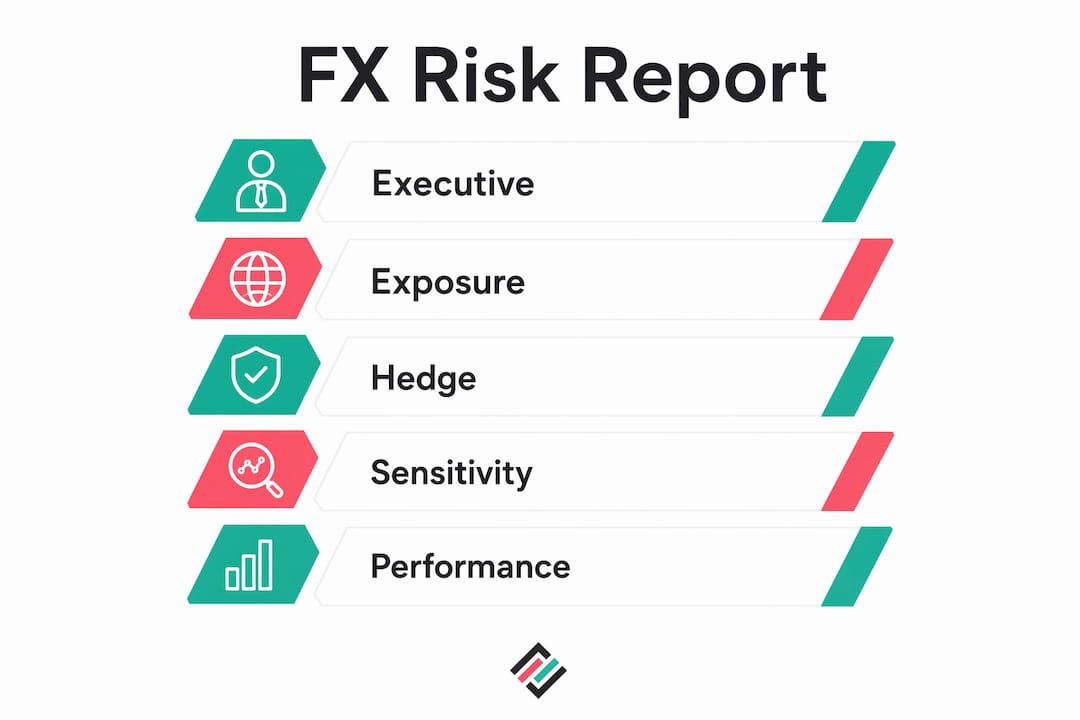
A board-ready FX risk report has five canonical sections. The structure below is a minimum viable template — add detail for complexity, but never strip these out.
Executive summary
One page. Net exposure by currency, a two-sentence impact statement against guidance, and the decisions management needs to make this cycle. Boards want impacts on revenue, EBITDA, and cash — not instrument-level detail.
Exposure register
| Currency | Receivables | Payables | Intercompany | Committed orders | Net exposure | Maturity bucket |
|---|---|---|---|---|---|---|
| EUR | 4,200,000 | (1,—) | (500,000) | — | — | — |
| USD | — | — | — | — | — | 3–6 months |
| SEK | — | (200,000) | — | — | 500,000 | — |
Catalogue every foreign-currency cash flow — receivables, payables, loans, and committed orders — then net off natural offsets before deciding what to hedge.
Hedge positions
| Currency | Instrument | Notional | Maturity | Hedge ratio | Fair value | Accounting treatment |
|---|---|---|---|---|---|---|
| EUR | Forward | 1,— | 3 months | — | — | Cash-flow hedge / OCI |
| USD | Option (call) | — | 6 months | — | — | Fair-value hedge / P&L |
Sensitivity and scenario outputs
Report a 1% spot-rate move impact per currency on EBITDA and cash. Add a VaR figure (95% confidence, 1-month horizon) with stated assumptions. Include at least one stress scenario — for example, a 10% EUR/PLN depreciation — tied directly to guidance impact.
Performance and effectiveness
Realized FX P&L versus budget rate, forecast versus actual settlement, and a hedge effectiveness summary. Add a short recommendation callout per currency: "EUR — maintain current hedge ratio; USD — consider extending coverage to Q3 given forecast receivables growth."
Which metrics should you measure and how do you calculate them?
Net exposure
Net exposure = gross receivables (foreign currency) minus gross payables (same currency) minus natural hedges (e.g., costs denominated in the same currency as revenues) minus existing hedge notionals.
Example: EUR receivables of 4,200,000 minus EUR payables of 1,— minus intercompany of 500,000 = net exposure of 1,900,000 EUR before hedging.
Constant-currency reporting
Recalculate prior-period revenues at the current period's average rate, then compare to current-period revenues at the same rate. The difference between the two is pure operational movement; the gap between current-period reported revenue and the constant-currency figure is the FX effect.
Example: Q1 revenue reported at 4.25 PLN/EUR = PLN 8,500,000. Recalculated at Q2 average rate of 4.35 PLN/EUR = PLN 8,700,000. The PLN 200,000 difference is FX, not commercial performance. Using a single rate for the full P&L is one of the most common mid-market reporting errors.
VaR and Cash-flow-at-Risk
VaR answers the question "what is the most I could lose over a given period at a chosen confidence level?" — but it does not show tail losses beyond that threshold. Always pair VaR with scenario stress tests.
Minimum assumptions disclosure the report must state:
- Confidence level (typically 95% or 99%)
- Time horizon (1 day, 1 week, 1 month)
- Volatility window used (e.g., 252-day historical)
- Rate source (ECB reference rates, Bloomberg, Reuters)
- Whether parametric, historical simulation, or Monte Carlo method was applied
EVE / NPV impact
Economic Value of Equity (EVE) or net present value impact is used for balance-sheet exposures with long maturities — intercompany loans, lease liabilities in foreign currency, or long-dated payables. It shows the present-value change in equity if rates shift by a defined amount. Use EVE when the exposure horizon extends beyond 12 months and cash-flow timing matters.
Pro Tip: Always version your rate table. If the ECB reference rate used on day one of the month differs from the rate used on day five, your exposure figures will not reconcile. Lock the rate source and snapshot date at the start of every reporting cycle.
How do you build and deliver the report reliably?
1. Assemble your data sources
Map each field in the exposure register to its source system:
- ERP (SAP, Oracle, Microsoft Dynamics): AR/AP balances, intercompany, committed purchase orders
- Bank portals or bank feeds: cash positions, FX settlements, loan balances
- Treasury management system (TMS): hedge ledger, instrument valuations, maturity schedules
- Planning system (Anaplan, Adaptive): forecast revenues and costs by currency
- Market-data vendor (Bloomberg, Refinitiv, ECB): rate tables, volatility surfaces
2. Set reporting cadence by materiality
Monthly reporting for companies with material FX exposure (generally, foreign-currency revenues or costs exceeding 10% of total). Quarterly or event-driven reporting for lower-exposure businesses. Board escalation triggers: net exposure exceeds policy limit, hedge ratio falls below minimum, or a rate move of more than 5% occurs intra-month.
3. Assign ownership with a RACI
| Task | Responsible | Accountable | Consulted | Informed |
|---|---|---|---|---|
| Exposure inventory | FP&A analyst | Treasury manager | Business unit finance | CFO |
| Hedge approval | Treasury manager | CFO / board | Legal, risk | Audit committee |
| Report sign-off | Finance director | CFO | External auditor | Board |
| Audit documentation | Treasury manager | Finance director | External auditor | Compliance |
4. Run the production sequence
- Extract AR/AP and bank positions from ERP
- Apply versioned rate table (ECB closing rate, stated date)
- Apply netting rules per policy (natural hedges, intercompany offsets)
- Compute net exposure, sensitivity, and VaR
- Generate visualizations and narrative
- Governance sign-off per RACI before distribution
Pro Tip: A single source of truth for rate tables — one versioned file or system field that every downstream calculation reads from — eliminates the most common month-end reconciliation failure. Teams that maintain parallel rate tables in separate spreadsheets spend more time reconciling than analyzing.
For a detailed walkthrough of how to manage currency risk across the full process, including governance embedding, the step-by-step guide covers each stage.
How do hedging instruments appear in reports, and what do you disclose?
| Instrument | Purpose | Reporting column | P&L / OCI treatment |
|---|---|---|---|
| FX forward | Lock in a future rate for a known cash flow | Hedge positions table, fair value | OCI (cash-flow hedge) or P&L (fair-value hedge) |
| FX option | Cap downside while retaining upside | Hedge positions table, premium cost | Intrinsic value to OCI; time value to P&L or OCI |
| FX swap | Exchange principal and interest in two currencies | Hedge positions table, net settlement | P&L or OCI depending on designation |
| Cross-currency swap | Hedge long-dated foreign-currency debt | Balance-sheet hedge section | Net investment hedge / OCI |
Hedge accounting changes how gains and losses flow through the financial statements. Under a cash-flow hedge designation, the effective portion of a forward's fair-value change sits in OCI until the hedged transaction affects P&L. Under fair-value hedge accounting, both the hedging instrument and the hedged item are marked to market through P&L. Net investment hedges protect the translation of a foreign subsidiary's net assets, with gains and losses in OCI until disposal.
Hedging exists to preserve predictability, not to outperform the market. Reports should frame hedge performance in terms of variance reduction against forecast, not comparative returns against spot. That framing matters for board conversations — a hedge that "cost" money when rates moved favorably still did its job if it kept cash flow within the planned range.
Disclosure checklist for each instrument in the report:
- Notional amount and currency pair
- Maturity date and settlement terms
- Counterparty (high-level — bank name, not individual trader)
- Hedge ratio and designated hedged item
- Fair-value measurement approach (Level 1/2/3 under IFRS 13)
- Accounting designation (cash-flow, fair-value, or net investment)
For a clear distinction between hedging and speculation and why the policy boundary between them matters for reporting, the dedicated article covers the governance angle.
What are the IFRS 9 and audit requirements for Central Europe?
IFRS 9 hedge accounting operates under three models: cash-flow hedge, fair-value hedge, and net investment hedge. Each requires documentation at inception — before the hedge is designated — covering the risk management objective, the hedged item, the hedging instrument, and the effectiveness testing methodology. Without that contemporaneous documentation, hedge accounting is unavailable and all fair-value movements go directly to P&L.
Effectiveness testing must be prospective (at designation and each reporting date) and retrospective (at each reporting date). IFRS 9 replaced the 80–125% bright-line test with an economic relationship requirement, but auditors still expect quantitative evidence. A regression analysis or dollar-offset method, documented in the hedge file, satisfies that requirement.
Audit documentation checklist:
- Exposure register snapshot at designation date (timestamped)
- Hedge designation document (risk objective, hedged item, instrument, ratio)
- Prospective effectiveness test at designation and each reporting date
- Retrospective effectiveness test at each reporting date
- Model inputs: rate source, volatility window, valuation date
- Trade confirmations and counterparty agreements
- Board or CFO approval of hedging policy and individual trades above threshold
For Central European companies, the EBA has published Regulatory Technical Standards and reporting templates covering structural FX positions under the Capital Requirements Regulation (CRR). Banks and financial institutions operating in Poland, Czech Republic, Hungary, or Sweden that hold structural FX positions must report quarterly via COREP alongside standard own-funds reporting. Non-financial corporates are not subject to COREP, but their banking counterparties are — which affects how banks price and document hedging transactions with corporate clients.
Practical checklist to reduce audit queries at year-end:
- Confirm all hedge designations are documented before trade date
- Verify rate sources match between the exposure register and the hedge valuation
- Reconcile hedge notionals to the exposure register at each reporting date
- Retain effectiveness test workpapers with version control
- Confirm OCI balances reconcile to the hedge ledger
- Pre-brief external auditors on any new hedge types or methodology changes
Regulatory transparency in FX reporting also has a direct link to equity valuation — companies with cleaner disclosure tend to attract lower risk premiums from investors and analysts.
What systems and integrations does reliable FX reporting require?
The minimum technical architecture for repeatable FX risk reporting has four layers:
- Rate table — a versioned, centrally maintained exchange rate file sourced from ECB, Bloomberg, or Refinitiv, with a stated snapshot date and a single owner
- Exposure master — a consolidated position file aggregating AR/AP, intercompany, loans, and committed orders from all source systems
- Hedge ledger — a record of all active hedging instruments with notional, maturity, fair value, and accounting designation
- Visualization and reporting layer — dashboards, scenario outputs, and exportable board packs, with role-based access and an audit trail
Integration checklist:
- ERP (SAP S/4HANA, Oracle Fusion, Microsoft Dynamics 365): AR/AP balances, intercompany transactions, purchase orders — map currency fields and entity codes carefully; mismatched entity hierarchies are the most common data-quality failure
- Bank feeds: cash positions, FX settlements, loan balances — use ISO 20022 XML format where available for standardized field mapping
- TMS: hedge ledger, instrument valuations, maturity schedules — confirm the TMS valuation date matches the reporting date
- Market-data vendors: ECB reference rates are free and sufficient for most corporates; Bloomberg or Refinitiv add volatility surfaces for VaR calculations
- Contract management systems: committed orders and long-term supply agreements that create future FX exposure
Must-have platform features for a finance team moving beyond spreadsheets:
- Automated rate table ingestion with version control
- Position reconciliation between ERP and hedge ledger
- Scenario engine for stress testing (parallel shift, historical scenario, custom shock)
- Role-based approvals matching the RACI
- Exportable audit trail with timestamps and user IDs
For a comparison of treasury reporting software approaches and what to look for when evaluating platforms, the comparison article covers the key feature categories.
How does Corphedge support currency risk reporting in practice?
Corphedge maps directly to the report structure described above. The platform ingests ERP and bank-feed data, applies configurable netting rules, and produces exposure registers, hedge ledgers, VaR outputs, and board-ready visualizations from a single data model.
Feature map:
- Exposure register: automated aggregation from ERP AR/AP and bank feeds, with currency, maturity bucket, and entity breakdown
- Hedge ledger: instrument entry, fair-value tracking, and accounting designation flags (cash-flow, fair-value, net investment)
- VaR analysis: parametric and historical simulation, configurable confidence level and horizon, with stated assumptions exported alongside the figure
- Board-ready exports: one-click PDF and Excel packs formatted for management and audit, with version control and sign-off capture
- Live market data: integrated rate feeds for exposure valuation and scenario modeling
Example workflow with approximate step durations:
- ERP/bank feed ingestion and field mapping — initial setup: 2–3 days; ongoing: automated
- Netting rules applied and exposure master generated — first run: 4 hours; ongoing: automated
- Scenario outputs (1% sensitivity, VaR, stress scenarios) — 30 minutes per reporting cycle
- Report generation and governance sign-off — 1–2 hours per cycle
Implementation milestones:
- Week 1–2: data model setup, ERP connection, rate table configuration
- Week 3–4: first exposure register produced and validated against ERP
- Month 2: first monthly board report delivered; first hedge-effectiveness check run
- Month 3: full audit pack delivered, including designation docs and effectiveness workpapers
Pro Tip: For companies in Poland and Sweden, Corphedge supports PLN and SEK rate sources natively, with local bank integration options and report outputs that align with the documentation expectations of Polish and Swedish auditors. The platform's expansion to these markets means the rate feeds, entity structures, and language settings are already configured — no custom development required.
Minimum fields and checklist for your first FX risk report
Use this as a printable starting point. Every field listed here is the minimum for an audit-ready first deliverable.
Minimum field list:
| Field | Description | Source |
|---|---|---|
| Currency | ISO currency codes (EUR, USD, PLN, CZK, SEK…) | ERP / bank feed |
| Net exposure | Gross receivables minus payables minus natural hedges | ERP, netting model |
| Maturity bucket | —, 3–6 months, 6–12 months, 12+ months | ERP, contracts |
| Hedge coverage % | Hedge notional as % of net exposure | Hedge ledger |
| Instrument summary | Type, notional, maturity, counterparty | Hedge ledger |
| 1% sensitivity | P&L / cash impact of 1% spot move | Scenario engine |
| VaR | 95% confidence, 1-month horizon, stated assumptions | VaR model |
| Action recommendation | Per currency: maintain, increase, reduce, review | Treasury manager |
Production checklist:
- Source data validated against ERP and bank statements
- Rate table versioned and snapshot date recorded
- Hedge designation documents attached to report file
- Sign-offs captured per RACI (preparer, reviewer, approver)
- Backtesting note included (prior-period VaR vs. actual loss)
- Effectiveness test workpapers attached for all designated hedges
- Report distributed to named recipients on schedule
For a fuller risk reporting checklist covering additional governance items, the finance executives' checklist article expands on each control point.
What does the roadmap from spreadsheets to audit-ready reporting look like?
Most Central European mid-market finance teams start with a combination of ERP exports and manual Excel models. The path to repeatable, audit-ready reporting typically runs across three phases.
1. Days 1–90: data mapping and first report
- Inventory all foreign-currency exposures across entities and currencies
- Map ERP fields to the exposure register template
- Establish a versioned rate table with a named owner
- Produce the first monthly exposure register and board summary
- Document the netting methodology and get CFO sign-off
Milestone: first board-ready FX report delivered; exposure register reconciled to ERP.
2. Months 3–6: automation and governance embedding
- Connect ERP and bank feeds to the reporting platform
- Automate rate table ingestion and netting calculations
- Implement the RACI and capture sign-offs in the system
- Run first hedge-effectiveness tests and document results
- Deliver first IFRS 9 audit pack to external auditors
Milestone: manual reconciliation steps reduced; audit queries answered within 24 hours.
3. Months 6–12: continuous, audit-ready reporting
- Embed scenario engine outputs into the monthly board pack
- Establish backtesting cadence (quarterly VaR vs. actual)
- Integrate planning system for forecast exposure data
- Achieve full IFRS 9 documentation compliance
- Conduct annual hedging policy review with board approval
| Phase | Key milestone | KPI |
|---|---|---|
| —–90 days | First board report delivered | Report produced within 5 business days of month-end |
| 3–6 months | Automation live, audit pack delivered | Manual reconciliation steps reduced by at least half |
| 6–12 months | Continuous reporting, full IFRS 9 compliance | Audit queries at year-end: zero unresolved |
Typical cost drivers: ERP integration effort (usually the largest variable), market-data subscription (ECB rates are free; Bloomberg/Refinitiv add cost for volatility data), internal resource time for data mapping and governance setup, and change management for business units that need to report exposures upstream.
Key Takeaways
Effective FX risk reporting requires net exposure by currency, stated VaR assumptions, IFRS 9 documentation, and a named RACI — none of these elements is optional for audit readiness.
| Point | Details |
|---|---|
| Net exposure first | Calculate gross receivables minus payables minus natural hedges before deciding what to hedge. |
| VaR needs context | Always pair VaR with scenario stress tests and disclose confidence level, horizon, and rate source. |
| IFRS 9 documentation | Hedge designation docs must be completed before trade date; retrospective tests must be retained. |
| Layered hedge ratios | A practical framework: approximately 80% coverage within 6 months, and decreasing coverage thereafter. |
| Corphedge for Central Europe | Corphedge automates exposure registers, VaR outputs, and audit packs, with native PLN and SEK support for Poland and Sweden. |
A treasurer's honest take on what actually matters
The biggest gap between a technically correct FX report and a useful one is not the math. It is the framing. Finance teams spend weeks perfecting VaR calculations and then present them to a board that has no idea what a 95% confidence interval means in business terms. The number that lands is the one that says "if EUR/PLN moves 5% against us, we miss EBITDA guidance by PLN 1.2 million." That sentence takes 30 seconds to write and does more work than three pages of methodology.
The second thing most teams get wrong is over-hedging distant forecasts. Locking in 80% of a 12-month revenue forecast that carries significant commercial uncertainty is not risk management — it is speculation in the opposite direction. The layered approach — higher ratios for near-term, confirmed cash flows; lower ratios for distant, uncertain ones — matches hedge coverage to forecast reliability. It also produces a cleaner report, because the hedge ratios make intuitive sense to a non-technical reader.
One more thing: separate FX from operational performance in every management pack, every time. Not just in the annual report. A business unit that missed its margin target because of EUR/PLN moves needs a different conversation than one that missed because of pricing or volume. Conflating the two leads to the wrong decisions. The constant-currency line is not a disclosure nicety — it is the number that tells you whether the business is actually working.
Corphedge gives your team a faster path to board-ready FX reports
Finance teams that have mapped their exposures and built their first report manually know exactly where the friction is: rate tables that drift, hedge ledgers that live in a separate spreadsheet, and an audit pack assembled under pressure at year-end. Corphedge removes that friction by connecting directly to your ERP and bank feeds, maintaining a single versioned rate table, and generating exposure registers, VaR-based hedging outputs, and board-ready exports from one platform.
The platform is available now for companies in Central Europe, including Poland and Sweden, with native support for PLN and SEK rate sources and local bank integrations already configured. Three features finance teams use most:
- Automated exposure register — aggregated from ERP and bank feeds, reconciled and ready for sign-off
- Integrated VaR and scenario engine — with stated assumptions exported alongside every figure
- Audit-ready exports — timestamped, version-controlled, and formatted for IFRS 9 documentation
Take the product tour to see how the platform maps to the report templates in this article, or book a demo to walk through your specific currency pairs and data sources with the Corphedge team.
Useful sources and references
The sources below are the primary references for standards, regulatory templates, and methodology covered in this article. Use them as audit evidence, implementation checklist inputs, or deeper reading.
| Source | What it covers | How to use it |
|---|---|---|
| EBA — Technical Standards on Structural FX under CRR | EBA RTS and COREP reporting templates for structural FX positions | Reference for banks and financial institutions in Central Europe; relevant for audit documentation |
| Investopedia — Currency Risk Explained | Plain-language definitions of transaction, translation, and economic exposure | Use as a primer for non-technical stakeholders |
| LegalClarity — Currency Risk Management | Practical hedging frameworks including layered hedge ratios and VaR guidance | Use for hedging policy design and board presentation framing |
| Getmonetizely — Board-Ready Risk Report | Board report format guidance and the $7.5 trillion BIS daily volume figure | Use for report design and materiality arguments |
| InsightSoftware — FX Operational Framework | Operational discipline, RACI design, and IFRS 9 audit readiness | Use for governance setup and audit preparation |
| Onetribe Advisory — Multi-Currency Reporting | Constant-currency reporting methodology and common mid-market errors | Use for FP&A reporting design and period-on-period analysis |
| Corphedge Platform | Platform proof points, VaR-based hedging, and board-ready export features | Use for implementation and tooling decisions |
How to use these sources: the EBA and EUR-Lex documents are primary regulatory sources — cite them in audit files and hedge accounting documentation. The practitioner guides (LegalClarity, InsightSoftware, Onetribe) support internal policy design and board presentation. Corphedge resources provide implementation templates and platform-specific guidance.
FAQ
What is currency risk in simple words?
Currency risk is the chance that a change in exchange rates will reduce the value of a payment, asset, or investment denominated in a foreign currency. For a company that invoices in EUR but reports in PLN, a weakening EUR means less PLN received than planned.
What are the three types of currency risk?
The three types are transaction exposure (cash-flow timing risk on specific trades), translation exposure (remeasurement of foreign-subsidiary financials at consolidation), and economic exposure (long-run competitive impact of sustained rate shifts). Each requires a different measurement approach and appears in a different section of the FX risk report.
How do you avoid or reduce currency risk?
You reduce it by first mapping net exposures across all currencies, then applying hedging instruments — forwards for known cash flows, options where upside matters, swaps for longer-dated balance-sheet exposures. A layered hedge ratio framework (higher coverage for near-term confirmed flows, lower for distant forecasts) avoids over-hedging uncertain positions.
Is a large multinational like Coca-Cola exposed to currency risk?
Yes. Any company with revenues, costs, or assets in multiple currencies carries FX exposure. For multinationals, translation exposure from consolidating dozens of functional currencies is often the largest reported FX effect, alongside transaction exposure on cross-border intercompany flows and third-party contracts.
How does Corphedge help with FX risk reporting?
Corphedge automates the exposure register, hedge ledger, and VaR outputs from ERP and bank-feed data, and produces exportable audit packs with version control and sign-off capture. The platform supports PLN and SEK natively, making it directly applicable for companies operating in Poland and Sweden.