

TL;DR:
- Hedging reduces currency risk by offsetting real exposure, whereas speculation aims to profit from market moves without underlying risk.
- Mixing speculation with hedging increases volatility and undermines effective risk management, requiring strict policies and separation.
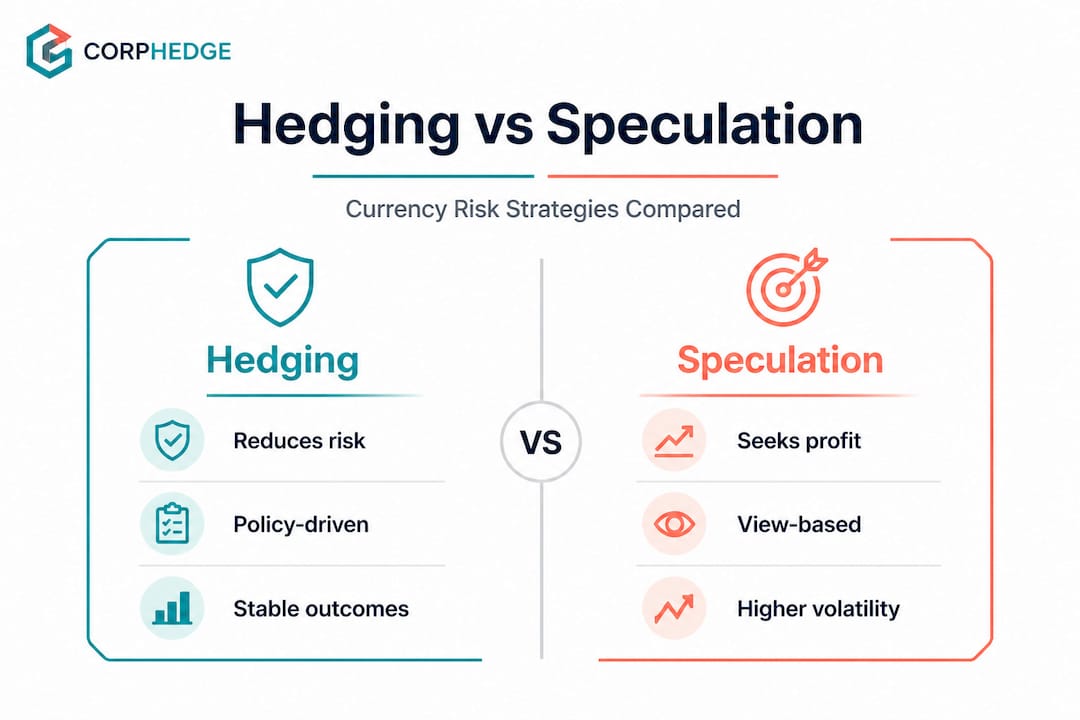
Most financial leaders know the terms. Few draw the line correctly. Hedging and speculation both use the same FX instruments, operate in the same markets, and show up in the same risk reports, yet confusing one for the other is one of the most costly mistakes an international finance team can make. Hedging reduces risk by taking offsetting positions against existing exposures, while speculation seeks profit by taking on additional risk without any underlying exposure. That single distinction shapes every decision about how you protect margins, manage cash flows, and report results to the board.
Table of Contents
- Understanding hedging: Purpose and practical application
- What is speculation? Tools, motives, and risks
- Hedging vs speculation: Key differences and when to use each
- Pitfalls, edge cases, and advanced tactics
- Why mixing hedging and speculation undermines true risk management
- How CorpHedge supports disciplined, proven FX risk management
- Frequently asked questions
Key Takeaways
| Point | Details |
|---|---|
| Hedging reduces risk | True hedging protects companies from currency volatility and supports financial stability. |
| Speculation increases volatility | Speculation seeks profit but brings added risk and can undermine corporate stability. |
| Strategy choice matters | Empirical data favors pure hedging over blending speculative elements for better risk-adjusted outcomes. |
| Separate risk from profit bets | Maintain distinct approaches and budgets for genuine risk mitigation versus speculative trading. |
| Disciplined frameworks excel | Companies with structured, evidence-based currency policies outperform those with ad hoc or mixed strategies. |
Understanding hedging: Purpose and practical application
Hedging is not about making money. That bears repeating, because the temptation to treat a hedge as a profit center is exactly where corporate FX programs start to unravel. At its core, a hedge offsets an existing business exposure. If your company earns revenue in euros but reports in dollars, a falling euro directly cuts your reported income. A forward contract that locks in an exchange rate removes that uncertainty and lets your operations team plan with confidence.
The most common corporate hedging instruments are:
- Forward contracts: Lock in a future exchange rate for a specific amount and date, eliminating rate uncertainty for predictable cash flows.
- Currency options: Give the right, but not the obligation, to exchange at a set rate, providing a floor on losses while preserving upside.
- Cross-currency swaps: Exchange principal and interest payments in different currencies, often used to hedge long-term debt or intercompany funding.
A practical scenario helps illustrate the point. A U.S. manufacturer signs a contract to sell equipment to a German buyer for €5 million, payable in six months. At today's rate of 1.08, that's $5.4 million. If the euro weakens to 1.02 by settlement, the company collects only $5.1 million, a $300,000 shortfall that wipes out most of the project margin. A six-month forward contract at 1.07 guarantees $5.35 million, preserving the budget with certainty. No profit was sought. Risk was removed.
The empirical case for hedging is strong. Research shows a positive correlation with stability of r=0.72 between hedging activity and financial stability, giving companies a measurable pathway to manage unpredictable FX swings without sacrificing operational continuity. That correlation is not trivial. It translates directly into tighter earnings guidance, lower cost of capital, and fewer surprises for investors.
Geographic and cultural nuances also shape how companies approach currency risk management strategies. European multinationals, for instance, often hedge a rolling 12 to 18 months of forecast exposure using layered forward programs. Some Asian exporters prefer option collars that cap both losses and gains. The instrument matters less than the discipline behind it, and that discipline starts with written policy.
"Hedging is not a view on where currencies go. It is a deliberate decision to remove the distraction of currency movements from your core business performance."
Pro Tip: Build a formal risk budget before you execute any hedge. Define your acceptable loss threshold in dollar or percentage terms, specify which exposures qualify for hedging, and require sign-off from the CFO for any deviation. Without this structure, good intentions become ad hoc bets. Explore financial risk reduction strategies to see how policy-driven frameworks look in practice.
What is speculation? Tools, motives, and risks
Speculation uses the same instruments as hedging but with a completely different motive. A speculator has no underlying business exposure to offset. Instead, they take positions based on a view about where a currency will move, hoping to profit from that movement. In corporate FX, this can appear in subtle ways: a treasurer who delays hedging because they "expect the dollar to weaken," or a CFO who buys extra option positions beyond the underlying exposure.
Common speculative strategies in FX markets include:
- Directional bets: Buying or selling a currency pair outright based on a macroeconomic view, such as a long position in the Japanese yen ahead of a Bank of Japan rate decision.
- Volatility plays: Buying straddles or strangles on expected price swings, profiting if a currency moves sharply in either direction after a major economic event.
- Carry trades: Borrowing in a low-interest currency and investing in a high-yield one, capturing the interest differential while accepting exchange rate risk.
- Options speculation: Long calls on expected appreciation, buying call options with no offsetting short exposure, purely to profit from anticipated currency gains.
The risk profile of speculation is fundamentally different from hedging. Leverage amplifies both gains and losses. Time decay erodes option premium every day a position is held without the anticipated move. Unlimited loss is theoretically possible in short positions. And critically, speculation negatively correlates with financial stability at r=0.58, with regression analysis confirming greater risk when speculation is the primary motive driving an FX program.
"The market has no obligation to move where your forecast points. When speculation enters a corporate treasury, it introduces a second business: currency trading. Most companies are not equipped to run both."
For most international corporations, speculation has no place in the core FX risk program. That does not mean finance teams can never take a view. Some companies maintain a small, separately funded speculative budget, strictly ring-fenced from hedging activity. But it requires separate reporting, separate risk limits, and total transparency with the board. Without those guardrails, speculative motives quietly seep into hedging decisions, and the results are predictably bad. Review enterprise FX risk strategies to understand how sophisticated organizations keep these activities clearly separated.
Pro Tip: If anyone on your treasury team ever says "let's wait to hedge because we think the rate will improve," that is speculation dressed in hedging language. Call it out by name and enforce your policy.
Hedging vs speculation: Key differences and when to use each
Here is how the two strategies compare across the criteria that matter most to corporate decision-makers:
| Criteria | Hedging | Speculation |
|---|---|---|
| Primary goal | Reduce existing risk | Generate profit from price movement |
| Underlying exposure | Required | Not required |
| Risk profile | Risk-reducing | Risk-increasing |
| Common instruments | Forwards, options, swaps | Futures, options, spot positions |
| Time horizon | Aligned with business cycle | Short to medium, market-driven |
| Impact on stability | Positive (r=0.72) | Negative (r=0.58) |
| Board transparency | Typically mandatory | Requires separate disclosure |
| Suitable for most corporations | Yes | Only with strict ring-fencing |
When hedging makes sense:
- You have confirmed foreign currency receivables or payables within the next 6 to 24 months.
- Your margins are thin enough that a 5% currency move would materially affect profitability.
- Investors and analysts value earnings predictability over potential FX windfalls.
- Your reporting currency differs from the currencies in which you operate most heavily.
When speculation might be considered (with caution):
- A separately funded and strictly limited portfolio exists for tactical FX views.
- The potential loss is fully tolerable and disclosed to leadership and the board.
- Your risk team has genuine trading expertise, not just hedging experience.
- All speculative activity is reported separately from the core hedging program.
Research confirms that blending hedging and speculation reduces the effectiveness of both, adding volatility without improving risk-adjusted returns. Furthermore, traditional minimum-variance hedging consistently outperforms selective or speculative hedging approaches when measured by utility and risk reduction. These are not theoretical conclusions. They reflect the actual outcomes of corporate FX programs studied across industries and market cycles.

Review currency fluctuation best practices and FX hedging strategies to see how leading companies structure programs that stay firmly in the hedging lane.
Pitfalls, edge cases, and advanced tactics
Even a well-intentioned hedging program can fail in practice. The most common traps are not about strategy selection. They are about execution, governance, and the slow drift from hedging to speculation.
Hidden costs that erode hedge value:
- Option premiums can run 1 to 3% of notional value per year, a real drag on returns if the hedge is not carefully sized.
- Opportunity cost: a forward contract locks out upside just as effectively as it blocks downside, which can frustrate operational teams when rates move favorably.
- Complexity costs: multi-leg strategies and exotic instruments require specialist expertise to manage, and errors in modeling can create unintended exposures.
Edge cases that trip up experienced teams:
- Over-hedging: Hedging more than the actual underlying exposure means the excess becomes a naked speculative position by definition. If your forecast was $10 million in euro receivables but actual billings come in at $7 million, the extra $3 million hedge is speculation.
- Imperfect hedges: A proxy hedge, using a correlated currency when the exact currency is illiquid, introduces basis risk. The hedge and the exposure may not move in lockstep, leaving residual exposure.
- Speculative creep: This is the most dangerous pitfall. Teams that consistently adjust hedge timing, ratios, or instruments based on market forecasts are gradually shifting from hedging to speculation without realizing it.
Hedging costs including premiums and opportunity drag are well-documented, and incomplete or excessive hedges meaningfully reduce program effectiveness. The data on cross-country hedging behavior also reveals a striking pattern: U.S. firms tend toward more aggressive hedging but achieve lower efficiency scores, while Chinese firms using more cautious, selective methods deliver higher effectiveness relative to their hedge ratios.
| Region | Typical approach | Efficiency outcome |
|---|---|---|
| United States | Aggressive, high ratio | Lower efficiency |
| China | Cautious, targeted | Higher effectiveness |
| European Union | Layered, rolling programs | Consistent, stable |
Pro Tip: Audit your hedging program quarterly against your original policy. Measure three things: hedge ratio vs. policy limits, actual vs. forecast underlying exposure, and instrument mix vs. approved list. If any of the three has drifted, investigate the reason before the next execution window. Resources like top strategies to cut currency risk and global risk reduction strategies can sharpen your audit framework.
Why mixing hedging and speculation undermines true risk management
Here is a view that not enough finance leaders hear plainly: the biggest risk in most corporate FX programs is not market volatility. It is the team's own decision-making when the lines between hedging and speculation blur.
Every time a hedge ratio is adjusted because someone has a view on rates, every time execution is delayed to "see where the market goes," and every time an option is oversized to capture potential upside, a speculative motive has entered what should be a mechanical risk offset. The cost is not always visible immediately. It shows up in earnings surprises, restatements, and the occasional catastrophic loss that forces an explanation to shareholders.
Selective hedging with a speculative element increases risk without delivering superior returns compared to traditional hedging. That finding should be read as a warning about institutional behavior, not just strategy selection. When your team believes it can time the hedge better than a systematic policy would, you are no longer running a risk management program. You are running an FX desk inside a company that was never built to absorb that risk.
The solution is not zero tolerance for judgment. It is separating the judgment from the policy. Your hedging program should be rules-based and auditable. Any market view your team holds can live in a separate, bounded budget with its own risk limits, its own reporting line, and full board visibility. That separation protects both the core hedging program and the company's credibility with investors.
Firms that mitigate FX volatility most effectively are not the ones with the cleverest traders. They are the ones with the clearest policies and the most consistent execution. Discipline beats forecasting accuracy over any meaningful time horizon.
How CorpHedge supports disciplined, proven FX risk management
The principles above demand more than good intentions. They require systems that enforce policy, quantify risk in real time, and make speculative drift visible before it becomes a problem.
CorpHedge is built specifically for this challenge. The platform gives financial leaders automated tools for hedging based on Value at Risk, so hedge sizing is grounded in quantified exposure rather than gut feel. Real-time position monitoring keeps your team aligned with policy limits at all times. And clear separation between hedging and any tactical positions means your board always sees an accurate picture of where the company's FX risk actually stands. Explore all FX exposure management features and see how CorpHedge can bring structure, transparency, and measurable efficiency to your currency risk program.
Frequently asked questions
What is the main difference between hedging and speculation?
Hedging aims to reduce existing business risk by taking offsetting positions, while speculation seeks profit by taking on additional risk without any underlying exposure to offset.
Can companies blend hedging and speculation effectively?
Empirical evidence shows that blending the two increases risk without improving returns, making pure, policy-driven hedging the more reliable approach for most corporations.
Why does speculation increase financial volatility?
Speculation adds unhedged risk to the company's balance sheet, and speculation increases volatility and potential for material losses, especially when speculative motives quietly enter what should be a hedging decision.
What costs or pitfalls do companies face when hedging?
Hedging costs including premiums and missed upside opportunities are the most common drags, while over-hedging and imperfect proxy hedges can leave residual exposure that negates the hedge's value.
Do all regions hedge currency risk the same way?
No. Research shows that Chinese firms' cautious approach delivers higher hedging effectiveness compared to U.S. firms' typically more aggressive strategies, which often generate lower efficiency relative to hedge size.