

Comparing foreign exchange risk and treasury reporting software is difficult when FX needs, real time analytics, and modular deployments all compete against legacy tools. Most solutions require custom quotes only after a sales call, which delays real cost and feature comparisons. CFOs and treasury teams can weigh integration depth, expert guidance, and deployment speed across four platforms to pick the best fit for current requirements.
Table of Contents
corpHedge

At a Glance
Offers integration with Corpay for trading and analytics. The platform delivers real time FX risk analysis, portfolio valuations, and support for value at risk based strategies. The vendor advertises recognition as one of the top risk management services in 2023.
Core Features
corpHedge provides real time FX risk analysis, portfolio tracking, and valuations accessible from any device. It supports customizable hedging policies, notifications for market levels, and backtesting with historical data for stress testing. The platform also includes live expert support, educational courses, operational risk mitigation tools, and bank and broker connectivity for execution and analytics.
Key Differentiator
The key differentiator is lowering the technical barrier for SMEs to run value at risk based hedging. That mix of simple interfaces, policy templates, and live advisory helps smaller treasury teams apply the same models larger firms use.
Pros
A user friendly interface and guided workflows let nonexperts apply hedging templates and run backtests without hiring quant resources. Personalized expert guidance and live support reduce onboarding time and help CFOs translate stress tests into clear policy decisions. Integrations with banks and brokers plus educational courses shorten the path from insight to execution. The vendor emphasizes security, lower operational costs, and continuous availability to support international companies and cross currency operations.
Cons
- Pricing is not publicly listed and appears to be customized, which requires direct contact for quotes and slows procurement.
Who It's For
CFOs, treasury teams, and accountants at SMEs that need practical FX tools without internal quant teams. Large companies that want a cloud based front end to broker and bank connectivity will also find it useful. Banks and brokers can use corpHedge components to add hedging analytics to client offerings.
Unique Value Proposition
Policy templates combined with live expert support let small treasury teams implement value at risk based hedges without hiring quant staff. That reduces operational cost and shortens the time between exposure identification and trade execution. For boards and auditors, built in reporting and consistent portfolio valuations produce records that simplify compliance and management review.
Real World Use Case
A manufacturing company uses corpHedge to monitor FX exposures across currencies and subsidiaries. Treasury runs backtests, sets policy templates, and uses live advisory to choose hedge sizes and tenors. Automated reports feed compliance workflows and help management track currency volatility impact on profit margins and cash flows.
Pricing
Pricing is not publicly specified and appears to be customized by account size or selected features. Prospective customers should request a demo and a tailored quote to understand total cost, onboarding fees, and any integration work required.
Website: https://corphedge.com
Ripple Treasury
At a Glance
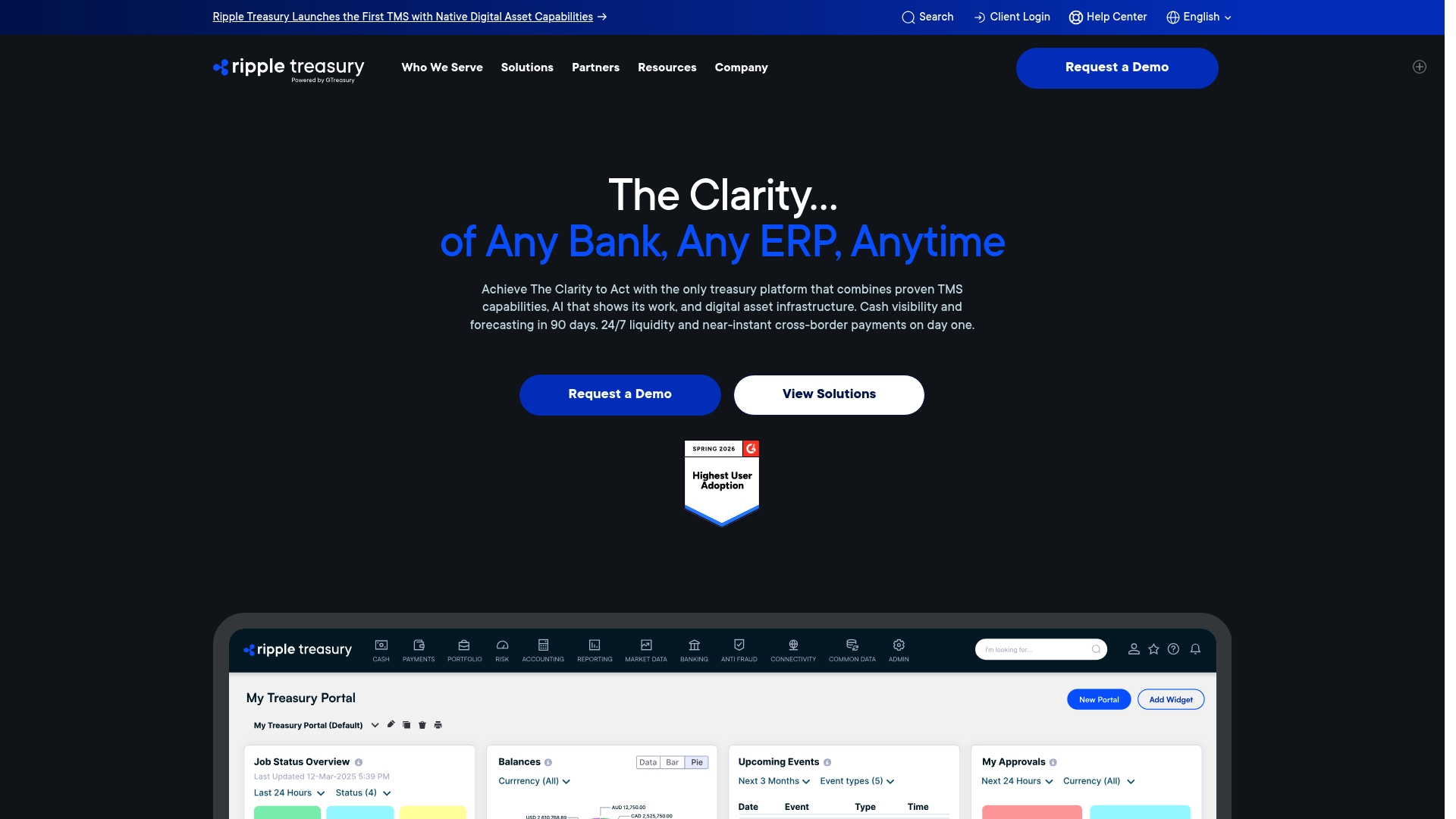
According to the company, Ripple Treasury can be deployed in about 90 days. The platform reports unified visibility across fiat and digital asset holdings in real time. That combination aims to cut the time finance teams spend assembling positions and exposures.
Core Features
Ripple Treasury centralizes cash and crypto positions, links bank connectivity, and offers liquidity controls alongside bank account management. The platform includes institutional-grade digital asset wallets and a cash forecasting engine for scenario analysis and automated forecasts. It also exposes GSmart AI driven insights for exposure monitoring, advanced FX workflows, and data-driven decision automation.
Key Differentiator
Ripple Treasury combines traditional treasury controls with native digital asset infrastructure and machine learning driven guidance. This alignment gives treasuries simultaneous fiat and token visibility, automated forecasting, and decision support inside one system. That approach suits organizations that plan to hold or settle value in both bank money and crypto rails.
Pros
The product adapts to complex multinational requirements while consolidating liquidity across cash and digital assets. According to the vendor, implementation completes in roughly 90 days, which can speed transition projects and reduce parallel run time. It delivers AI-assisted risk signals and automated FX workflows, and the vendor advertises adoption by prominent global companies as part of its market positioning.
Cons
- The platform’s sophistication may require a steep learning curve for new treasury staff. Training and change management will take time.
- Feature depth can be excessive for small companies with simple bank-only cash flows. Smaller teams may prefer lighter tools.
- Integration with some legacy ERPs or bank portals may require custom work. The vendor does not publish detailed customization timelines.
Who It's For
CFOs and treasury teams at multinational corporations or financial institutions managing both fiat and crypto exposure will find this platform relevant. Teams with cross-border payments, frequent FX trading, and centralized treasury operations gain the most. Small domestic treasuries with limited integration needs are less likely to benefit.
Real World Use Case
A global manufacturing group used Ripple Treasury to centralize cash visibility across five regions and add a digital asset corridor for rapid settlement. The treasury automated cash flow forecasting and ran FX scenario analysis before major invoice windows. That reduced manual reconciliation and shortened decision cycles for intercompany funding.
Pricing
Pricing is not publicly disclosed and appears to be customized to client requirements. Expect enterprise licensing and services fees tied to deployment scope, connectivity, and any bespoke integration work. Prospective buyers should request a tailored quote and an implementation plan that reflects their ERP and bank landscape.
Website: https://treasury.ripple.com
Treasury Systems
At a Glance
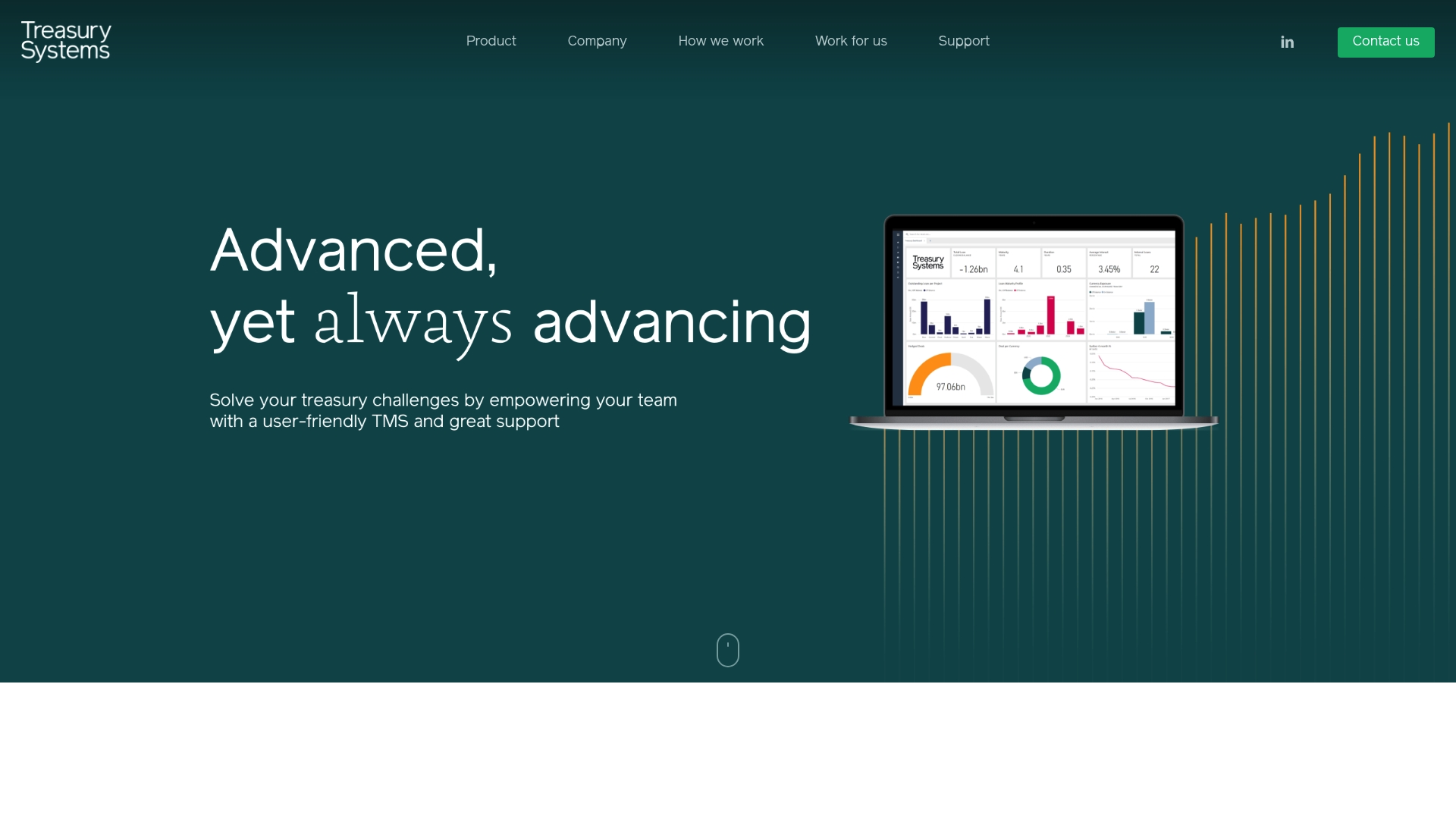
Treasury Systems reports bank connectivity to over 10,000 financial institutions. The product traces its origins to 1984 and targets full treasury operations across front office, middle office, and back office functions. The vendor also reports use by treasurers in more than 90 international companies, highlighting its global footprint.
Core Features
The platform provides an easy to use treasury management interface with rule based automation called Autopilot for routine tasks and real time risk monitoring with configurable alerts. Reporting and visualization tie into Power BI and native dashboards for position, exposure, and P&L analysis. The system includes deal templates, market data feeds such as Millistream, modules for deal input, accounting reconciliation, and cloud based architecture with continuous updates.
Key Differentiator
Treasury Systems positions itself as a full TMS that combines wide instrument support with task automation and live risk monitoring. That focus makes it a match for teams that need many treasury functions in one product rather than a single execution or analytics tool. The platform emphasizes regular product updates and integrations with market data providers.
Pros
The feature set covers cash management, FX, interest rate swaps, bonds, loans, commodities, and energy contracts in one platform, which reduces the need for multiple point solutions. Automation tools reduce manual entry and speed month end processes, while market data connectivity and reporting tools simplify reconciliation and audit trails. The vendor advertises ongoing product updates and strong third party integration options, which helps keep the system current with market sources.
Cons
- Setup and customization can be complex for first time implementers, according to third party reviews.
- The broad feature set may overwhelm small treasury teams or newcomers to treasury management.
- Pricing is not publicly listed, which can delay internal budget approval and vendor comparison.
When It May Not Fit
Teams that need a lightweight tool for a narrow workflow will find the product too feature rich and require more configuration. Small companies without dedicated treasury staff may struggle during implementation and ongoing maintenance. Organizations that require fixed public pricing for procurement will find the vendor model inconvenient.
Who It's For
Large and mid sized corporate treasury departments, treasury centers, and financial institutions that run multi instrument exposures will get the most value. The product fits teams that manage cross border banking relationships and require bank connectivity and consolidated reporting. It also suits groups prepared to invest in setup and change control to unlock automation.
Real World Use Case
A multinational implemented Treasury Systems to consolidate FX and derivatives workflows into one system. The company automated month end reconciliation with Autopilot and reduced manual deal linking across trading and accounting. Dashboards and alerts improved visibility for treasury managers during volatile market events.
Pricing
Pricing is not publicly specified and typically follows a custom enterprise model. Expect vendor quotes to vary by modules, number of entities, and level of integration work. Contact Treasury Systems for a tailored proposal and implementation estimate.
Website: https://treasurysystems.com
TreasuryMetrics

At a Glance
Veldsink Groep improved liquidity control and daily cash management across over 300 bank accounts using TreasuryMetrics. That case shows the platform handles complex multisite cash setups and high account counts. It signals the product can consolidate many bank feeds for faster visibility and fewer manual reconciliations.
Core Features
TreasuryMetrics bundles automated cash flow forecasting, contract level risk analysis, and an in house bank module that centralizes internal transactions and controls. Reporting ties into ERP, ESG, and accounting systems to produce regulator ready outputs and internal dashboards. Specialized modules cover derivatives and options plus complex funding and foreign exchange administration.
Key Differentiator
The platform sells itself on a modular approach that brings cash, risk, in house banking, and reporting under one roof while leaning on treasury subject matter expertise. That structure lets teams adopt only the modules they need and extend functionality as complexity grows. The vendor frames this combination as a way to support strategic decisions from the treasury desk.
Pros
Modular design lets you deploy cash, risk, or in house bank capabilities independently and scale by adding modules. Integrations with major ERP and accounting systems reduce manual data entry and shorten report preparation cycles. The vendor pairs software with treasury professionals, which helps translate technical outputs into actionable hedging and funding choices for treasury teams.
Cons
-
Public third party reviews and independent user feedback are not explicitly available. This limits independent validation of long term reliability.
-
Suitability depends on company size and treasury complexity. Smaller treasuries may not need the full modular stack.
-
Pricing is not published and appears to be customized by modules and organization size. Procurement will need to request a tailored proposal.
When It May Not Fit
If your organization needs transparent, out of the box pricing, this product may not match your buying process. Small treasury teams with a handful of bank accounts will likely find the modular approach more than they need. Companies that require abundant public user reviews for vendor selection will face limited third party evidence.
Notable Integrations
-
ERP systems
-
ESG systems
-
Accounting systems
Who It's For
Treasury teams at medium to large enterprises that run multiple bank accounts and complex funding structures will find this product relevant. Teams that need modular deployment and ERP level integrations will get the most from the offering. Organizations that prefer vendor backed treasury expertise alongside software will also benefit.
Real World Use Case
Veldsink Groep used the system to centralize liquidity and speed daily cash management across its account base. That change reduced manual effort and allowed quick liquidity adjustments. Treasury staff gained consolidated visibility for intraday decisions.
Pricing
Pricing is not explicitly specified and appears to be customized by module selection and organization size. Expect quotes to reflect the modules you require and the scale of your treasury. You will need to contact the vendor for a tailored proposal.
Website: https://treasurymetrics.eu
Comparison of alternatives
corpHedge provides an excellent solution for small to medium enterprises, offering accessible tools tailored for simplified FX risk management workflows. However, depending on the size, complexity, and specific needs of a treasury team, alternative platforms bring different strengths to the table.
Comparing product rootedness and customization
Among the candidates, Treasury Systems demonstrates strength in its extensive global bank connectivity and modular offerings, accommodating intricate setups across multinational corporate treasuries and financial institutions. This characteristic makes it a suitable choice for larger treasuries prioritizing integration with existing systems and achieving a high level of instrument sophistication. On the other hand, Ripple Treasury appeals to teams requiring fiat and digital asset visibility combined with AI-driven insights, making it efficient for corporations operating across global digital and traditional rails.
Training and onboarding criteria
corpHedge addresses onboarding effectively with user-friendly workflows and expert guidance, allowing SMEs to quickly adapt FX risk techniques. Ripple Treasury requires a longer learning curve but compensates with features that are geared toward institutional needs, suitable for organizations planning a transition into digital assets. TreasuryMetrics focuses on scalability within its modular design, providing a route for growing treasury teams looking to expand capabilities over time.
Best fit
- SMEs implementing FX hedging strategies without internal quant teams should choose corpHedge for its straightforward interface and policy assistance.
- Treasuries managing international operations with extensive instrument portfolios and global bank connectivity will benefit from Treasury Systems’ wide coverage.
- Organizations including crypto assets within their treasury landscapes should utilize Ripple Treasury for its unified visibility and AI functionalities.
- Enterprises requiring modular treasury implementations to complement existing ERP, ESG, or accounting systems may find TreasuryMetrics an adaptable choice.
Our pick
For CFOs and treasury teams within small and medium-sized enterprises aiming to enhance their FX risk management capabilities effectively, corpHedge provides the most suitable solution. With its easy-to-use interface and live support, it empowers smaller teams to implement hedging strategies without the need for specialized quant staff. Large entities with distinct requirements may prefer one of the alternative platforms better aligned with their operational scale and technology investments.
Choosing the best treasury reporting service entails evaluating features such as usability, integration capacity, and targeted user scenarios.
| Product | Core Features | Key Differentiator | Best For | Notable Limitation |
|---|---|---|---|---|
| Corphedge | Real-time FX risk analysis, portfolio tracking, customizable hedging, expert support | Simple interfaces for SMEs to apply value at risk hedging models | CFOs, treasury teams, SMEs needing FX tools without quant teams | Pricing requires a contact for quotes |
| Ripple Treasury | Crypto and fiat visibility, cash forecasting, AI risk insights, automates FX workflows | Combines fiat and cryptocurrency treasury management | Multinationals managing fiat and digital asset exposures | Sophistication may require training for treasury staff |
| Treasury Systems | Comprehensive treasury management, rule-based automation, market data integration | Full TMS with automation and wide instrument support | Large corporate treasury departments managing multi-instrumental | Broad feature set may overwhelm smaller treasury teams |
| TreasuryMetrics | Cash forecasting, risk analysis, modular in-house banking and reporting capabilities | Modular design for tailored deployment and scaling | Medium to large enterprises running multi-bank structures | Limited public feedback restricts independent validation |
Addressing Key Challenges in Treasury Reporting Services with Corphedge
Managing treasury reporting services often involves challenges like real-time FX risk analysis, portfolio valuations, and applying value at risk strategies without extensive quant resources. Treasury teams at SMEs and large companies need a platform that lowers technical barriers while providing expert guidance to make timely decisions.
Corphedge offers an easy-to-use interface combined with live expert support and customizable policy templates to help treasury teams implement effective hedging strategies promptly. It delivers real-time insights, supports integration with banks and brokers, and emphasizes security and lower operational costs for global operations.
Discover how Corphedge supports treasury teams to reduce FX risk and speed trade execution. Visit the site and request a demo tailored to your company’s needs.
Corphedge is also actively expanding in Poland and Sweden, making it a timely choice for companies in these markets.
FAQ
What features does Corphedge offer for real-time FX risk analysis?
Corphedge provides real-time FX risk analysis and portfolio valuations accessible from any device. The platform's capabilities include customizable hedging policies and notifications for market levels. Users can expect detailed insights to manage their foreign exchange risks effectively.
How does Corphedge compare to Ripple Treasury regarding deployment time?
Ripple Treasury can be deployed in about 90 days, making it a strong choice for organizations needing rapid implementation. Corphedge excels in supporting smaller treasury teams with simple interfaces and live advisory, focusing on helping them apply complex hedging strategies without extensive customization.
Can Corphedge support backtesting for FX risk management?
Yes, Corphedge supports backtesting with historical data for stress testing, allowing treasury teams to evaluate hedging strategies. This feature enables users to gain confidence in their risk management decisions before executing trades.
What types of organizations benefit most from using Corphedge?
Corphedge primarily serves CFOs, treasury teams, and accountants at SMEs that require practical FX tools. Larger companies seeking a cloud-based front end for broker and bank connectivity will also find the platform useful.
Is pricing for Corphedge publicly available?
No, pricing for Corphedge is not publicly listed and appears to be customized based on account size or selected features. Prospective customers should request a demo to receive a tailored quote and understand the total cost involved.