

The most effective ways to monitor cross-currency transactions combine real-time market data feeds, transaction-level tagging, centralized TMS/ERP integration, automated payment routing controls, and alert-driven exception management. Treasury teams that get this right don't just see their FX exposure more clearly — they act on it faster and with fewer errors.
Here are the core elements every treasury needs in place:
- Real-time FX rate feeds connected directly to the transaction ledger
- Transaction-level tagging using standardized fields (ISO 20022 or custom) for full traceability
- Centralized bank statement ingestion (MT940) into the TMS for daily position reconciliation
- ERP and TMS integration so exposure data flows automatically, not via spreadsheet exports
- Automated payment routing controls that distinguish native currency rails from on-the-fly conversion
- Value at Risk (VaR) measurement to prioritize hedges where volatility threatens margin most
- Exception queues and approval gates with documented audit trails
- Compliance-ready record keeping aligned with local regulatory requirements
Pro Tip: If your team is just starting, connect your bank statement feed first. Automated daily MT940 imports give you a live position baseline without touching your ERP configuration.
Table of Contents
- What are the most practical ways to monitor cross-currency transactions day-to-day?
- What technology stack does reliable cross-currency monitoring actually require?
- What should you actually measure? Exposures, P&L, and KPIs explained
- How do you build the processes and controls that make monitoring stick?
- Why does automation reduce operational risk in FX workflows?
- How does Corphedge implement this monitoring playbook in practice?
- When and how should you involve banks, FX providers, and payment vendors?
- What are the most common pitfalls, and how do you prevent them?
- Key Takeaways
- The gap between monitoring and actually managing FX risk
- Corphedge gives Central European treasuries a practical starting point
- Useful sources and further reading
- FAQ
What are the most practical ways to monitor cross-currency transactions day-to-day?
The foundation is transaction-level data discipline. Every cross-currency payment, receipt, or intercompany transfer needs a structured tag at the point of origination: currency pair, entity, counterparty, trade date, value date, and the applicable rate. Without those fields populated consistently, reconciliation becomes a manual hunt.
ISO 20022 message formats make this tractable at scale. The structured XML fields in ISO 20022 carry far more FX-relevant metadata than the older SWIFT MT formats, which means downstream systems can parse currency, amount, and purpose automatically rather than relying on free-text remittance fields. For teams still on legacy formats, custom tagging conventions in the ERP work as a bridge until full migration.
Real-time FX rate feeds belong in the transaction ledger, not just the trading desk. When a payment is initiated, the mid-rate, spot rate, and any applicable forward rate should be stamped on the record. That single discipline eliminates the "which rate did we use?" question that derails month-end reconciliation.
For daily position management, the workflow looks like this:
- Morning bank statement import: Pull MT940 or camt.053 files from all banking relationships into the TMS. Daily automated imports of these statements, mapped to cash-flow categories, enable daily liquidity and FX hedging plans.
- Position refresh: Net gross exposures by currency and entity. Flag any position that breaches a pre-set limit.
- Exception queue review: Treasury reviews flagged items, approves or escalates, and logs the decision.
- Rate comparison: Compare booked rates against mid-market benchmarks. Persistent slippage signals a routing or provider problem.
- Reconciliation sign-off: Match settled transactions to the general ledger. Unmatched items go into a dedicated suspense queue with a resolution SLA.
Pro Tip: Automate the exception queue first. Routing flagged items to a shared inbox with a 24-hour SLA cuts the average resolution time and creates a natural audit trail without any custom development.
For teams managing currency exchange accounting, consistent tagging at origination is what separates a clean month-end from a three-day reconciliation scramble.
What technology stack does reliable cross-currency monitoring actually require?
The data flow has four layers, and gaps between any two of them are where exposure goes dark.
Layer 1: Source systems. ERP platforms (SAP, Oracle, Microsoft Dynamics), bank portals, and payment hubs generate the raw transaction data. The problem most treasury teams face is that this data lives in separate silos. Manual aggregation from those silos typically compresses accurate forecasting horizons to less than half a year, well short of the rolling horizon that meaningful hedging requires.
Layer 2: Integration middleware. An API or file-based integration layer pulls data from source systems on a defined schedule (daily minimum, intraday for high-volume operations) and normalizes it into a consistent data model. Bank connectivity here includes MT940 file feeds, Open Banking APIs where available, and direct host-to-host connections for major banking relationships. OAuth 2.0 or certificate-based authentication is the baseline security requirement for any live API connection.
Layer 3: TMS / treasury dashboard. The TMS is where normalized data becomes a position. It nets exposures by currency and entity, applies market rates, and surfaces KPIs. Platforms with broad bank connectivity can surface live positions without manual exports, which is the practical difference between knowing your EUR/PLN exposure at 9 AM versus finding out at 3 PM after someone runs a spreadsheet.
Layer 4: Reconciliation and reporting. Automated matching of settled transactions to the general ledger, with exception handling for unmatched items. A case study from Stahr Treasury showed that automated data integration from SAP and Coupa produced monthly net balance sheet exposures by currency and delivered measurable reductions in earnings volatility.
Integration readiness checklist:
| Requirement | Standard | Status check |
|---|---|---|
| Bank statement format | MT940 | Confirm with each banking partner |
| API authentication | OAuth 2.0 / certificates | Review IT security policy |
| ERP field mapping | ISO 20022 or custom tags | Map currency, entity, value date |
| TMS ingestion frequency | Daily minimum | Define SLA with vendor |
| Market data source | Primary + fallback feed | Test failover scenario |
| Rate latency tolerance | Intraday for hedging decisions | Specify in vendor SLA |
Pro Tip: Before signing any TMS or integration contract, run a test payload with real transaction data from your three largest banking relationships. Format mismatches surface immediately and are far cheaper to fix before go-live than after.
For a deeper look at cross-border payment systems and IBAN validation requirements, the Vopify guide covers the payment-rail layer in practical detail.
What should you actually measure? Exposures, P&L, and KPIs explained
Monitoring without measurement targets is just data collection. Treasury teams need a defined set of metrics that connect FX activity to business outcomes.
Core position metrics:
- Gross exposure by currency: Total receivables and payables in each foreign currency, before netting
- Net exposure per entity: Gross long minus gross short positions for each legal entity
- Consolidated group exposure: Aggregated net position across all entities, revealing natural hedges that offset each other
P&L metrics split into realized and unrealized. Realized FX gains and losses are booked at settlement; unrealized gains and losses reflect mark-to-market movements on open positions. Both need separate tags in the general ledger so finance can distinguish trading performance from translation effects.
Risk metrics are where VaR becomes the practical tool. VaR can be used as a hedging benchmark to prioritize hedges where volatility would cause the largest profit or cash-flow swing. A rolling 10-day VaR at 95% confidence, calculated on the net open position in each currency pair, gives treasury a single number that answers: "How much could we lose in a bad week?" Hedge ratio (hedged exposure divided by total exposure) and delta exposure (sensitivity of portfolio value to a 1% move in the FX rate) round out the standard risk dashboard.
Example dashboard layout:
| KPI | Update frequency | Primary user |
|---|---|---|
| Net open position by currency | Real-time / intraday | Treasurer |
| Gross exposure by entity | Daily | CFO, risk manager |
| Realized FX P&L (MTD) | Daily | Accounting |
| Unrealized mark-to-market | Real-time | Treasurer |
| Rolling VaR (10-day, 95%) | Daily | Risk manager |
| Hedge ratio | Weekly | CFO |
| Reconciliation exception count | Daily | Treasury ops |
For cross-rate calculations between two currencies, the standard formula is: Cross Rate = (Rate of Currency A / Rate of Common Currency) × Rate of Currency B. In practice, most TMS platforms handle this automatically, but understanding the arithmetic matters when validating system outputs or building manual checks.
How do you build the processes and controls that make monitoring stick?
A monitoring framework without clear ownership fails within weeks. The process needs defined roles, documented controls, and an implementation timeline that finance teams can actually execute.
Process flow from initiation to reconciliation:
- Transaction initiated in ERP or payment hub, tagged with required fields
- Pre-payment FX rate stamped; routing rule applied (native rail vs. conversion)
- Payment released through approval gate (single or dual authorization depending on amount)
- Bank confirmation received; MT940 imported into TMS
- TMS matches confirmation to original transaction; position updated
- Exception queue populated with unmatched or limit-breaching items
- Daily reconciliation sign-off by treasury operations
- Monthly exposure report generated for CFO and risk committee
Roles and responsibilities:
| Role | Responsibility |
|---|---|
| Treasury | Position monitoring, hedging decisions, limit management |
| AP / AR | Transaction tagging, payment initiation, invoice matching |
| Accounting | GL reconciliation, realized P&L booking, audit support |
| IT | Integration maintenance, API monitoring, security certificates |
| Internal audit | Control testing, audit trail review, exception sampling |
Controls that matter most:
- Mandatory field validation at payment initiation (reject incomplete tags)
- Dual authorization for transactions above defined thresholds
- Daily automated reconciliation with exception SLA (24-hour resolution target)
- Segregation of duties between payment initiation and approval
- Immutable audit trail for all position changes and hedging decisions
For Polish entities, document retention requirements under Polish foreign exchange law specify a five-year retention period for FX-related documents, with obligations to cooperate with banks on transaction reporting.
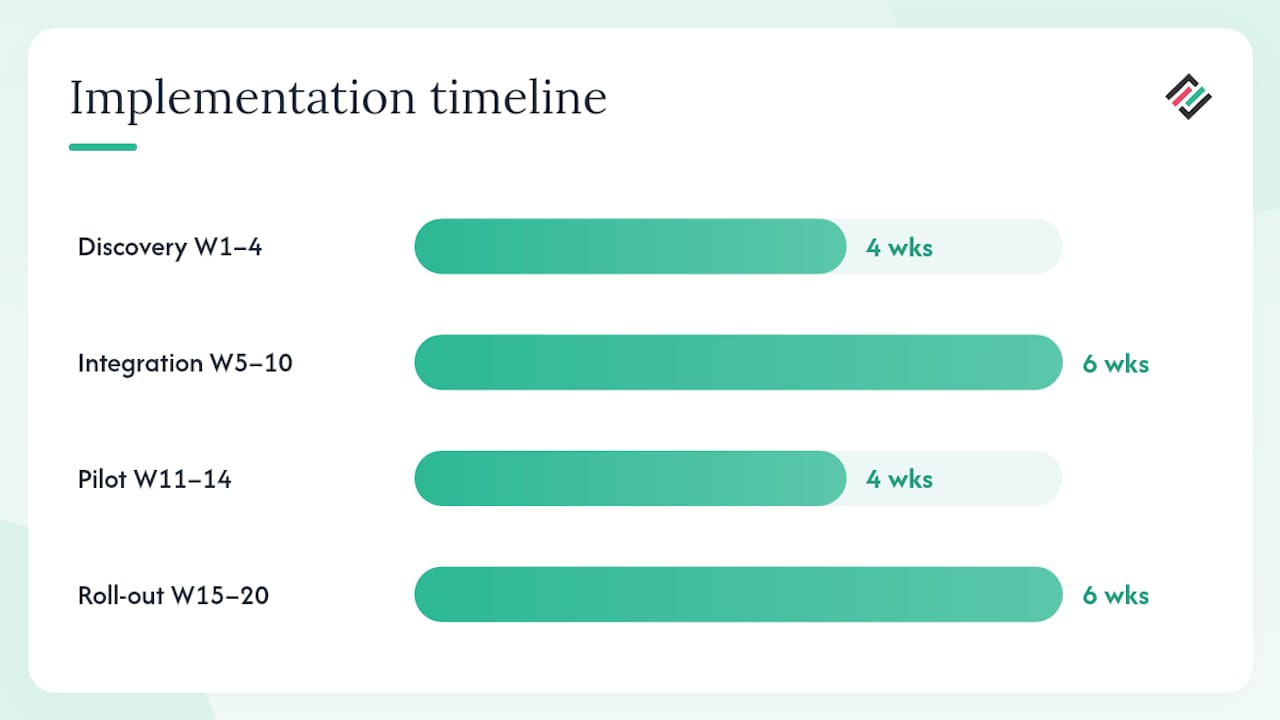
High-level implementation timeline:
- Weeks 1–4 (Discovery): Audit current data sources, map integration gaps, define KPIs and limits
- Weeks 5–10 (Integration): Connect bank feeds, configure ERP field mapping, set up TMS ingestion
- Weeks 11–14 (Pilot): Run with one currency pair or one business unit; validate outputs against manual records
- Weeks 15–20 (Roll-out): Expand to full currency portfolio; train AP/AR and accounting teams
Cost drivers are integration complexity (number of banking relationships and ERP instances), TMS licensing, and internal IT resource for API maintenance. For a practical international payment hedging workflow, the pilot phase is where most teams discover their data quality gaps before they become production problems.
Why does automation reduce operational risk in FX workflows?
Manual spreadsheet processes are the single largest source of operational risk in FX monitoring. The Association of Corporate Treasurers documents that automated hedging solutions allow uploading exposures at varying aggregation levels, translate exposures into hedges, and support frequent uploads from monthly down to hourly. That frequency shift alone changes the quality of hedging decisions: a treasury acting on hourly exposure data hedges differently than one working from last month's spreadsheet.
The automation steps with the largest risk-reduction impact, in order:
- Exposure upload automation: Eliminates manual copy-paste from ERP to TMS; removes the most common source of input errors
- Execution automation: Straight-through processing for routine hedges within pre-approved parameters
- Reconciliation automation: Daily automated matching replaces end-of-month manual reconciliation marathons
The same ACT research shows that segmented rollout works best: start with accounts receivable for a high-volume client, validate the hedging calculations and approval workflow, then extend to AP, intercompany flows, and cash positions before automating settlement rules. Teams that try to automate everything simultaneously typically stall on data quality issues.
For a detailed look at automation's role in risk management, the practical case for phased automation is well-documented across treasury functions.
Pro Tip: Run your first automated pilot in parallel with the existing manual process for 30 days. Discrepancies between the two outputs tell you exactly where your data model needs fixing before you decommission the spreadsheet.
How does Corphedge implement this monitoring playbook in practice?
Corphedge maps directly to the monitoring components described above, covering the full stack from live market data to hedging execution.
Feature map:
- Live position reporting: Real-time currency positions updated as bank feeds and transactions flow in, without manual exports
- VaR-based hedging tools: Prioritizes hedges using Value at Risk methodology, so treasury focuses resources where volatility threatens margin most
- ERP and TMS integrations: Connects to existing source systems and bank feeds, normalizing data into a single exposure view
- Automated alerts: Limit breaches and exception conditions trigger notifications before they become P&L events
- Audit trail: Every position change, hedging decision, and approval is logged immutably
Implementation workflow example:
- Connect bank statement feeds (MT940) from your primary banking relationships
- Map ERP transaction fields to Corphedge's data model (currency, entity, value date, counterparty)
- Set exposure limits and VaR thresholds for each currency pair
- Run the first daily position report and compare against your existing manual calculation
- Activate alert rules for limit breaches and reconciliation exceptions
- Review the exception queue daily for the first two weeks; adjust thresholds based on actual transaction patterns
Regional relevance for Poland and Sweden: Corphedge is actively expanding into both markets. For Polish entities, the platform's audit trail and document retention capabilities support compliance with the National Bank of Poland's balance-of-payments reporting requirements, which require electronic submission with appropriate authentication. For Swedish operations, the Riksbank's daily money market reporting requirements mean that transaction-level data quality and timeliness are regulatory requirements, not just operational preferences.
Pro Tip: Start your Corphedge pilot with your highest-volume currency pair — typically EUR/PLN for Polish entities or EUR/SEK for Swedish operations. Validating the workflow on a familiar pair gives your team confidence before expanding to more complex cross-currency positions.
When and how should you involve banks, FX providers, and payment vendors?
Banks and FX providers are not interchangeable. The decision to route a trade through a banking relationship versus executing via an internal platform depends on four factors: transaction size, data format compatibility, pricing transparency, and counterparty risk appetite.
Decision criteria checklist:
- Connectivity: Does the provider support MT940 or Open Banking APIs? Manual portal downloads are a data quality risk.
- Data formats: Can the provider deliver structured transaction data with ISO 20022 fields, or only legacy MT formats?
- SLAs: What are the cut-off times for same-day settlement? Mismatched cut-offs between your TMS and the bank create unintended overnight positions.
- Pricing: Is the FX spread disclosed explicitly, or embedded in the rate? Transparent pricing is a prerequisite for meaningful rate benchmarking.
- Counterparty risk: For larger hedging positions, credit limits and ISDA documentation requirements apply.
Vendor onboarding steps:
- Request API documentation and test environment credentials
- Run test transaction payloads covering your standard currency pairs and transaction types
- Validate that incoming data fields map correctly to your TMS data model
- Agree on a data ownership and governance model (who owns the transaction record in a dispute?)
- Obtain and install security certificates or configure OAuth credentials
- Run a parallel period (two to four weeks) before switching live transaction flow
For a comprehensive overview of cross-border payment best practices, including payment rail selection and compliance considerations, the Vopify guide covers the vendor integration layer in practical terms.
Route trades through a bank when the transaction size triggers credit facility requirements or when the counterparty relationship carries strategic value beyond the transaction itself. Use an internal platform for routine hedging within pre-approved parameters, where execution speed and audit trail quality matter more than relationship management.
What are the most common pitfalls, and how do you prevent them?
Most monitoring failures trace back to four root causes, and all four are fixable with process discipline rather than technology investment.
Top pitfalls:
- Incomplete data tagging: Payments released without currency pair, entity, or value date fields populated. Downstream reconciliation becomes manual.
- Reconciliation lag: Bank statements imported weekly instead of daily, creating a multi-day blind spot in the position.
- Unmanaged FX conversion at payment time: Payment hubs set to auto-convert at the bank's rate, with no visibility into the spread applied or the rate booked.
- Single data source dependency: Relying on one bank feed or one market data provider with no fallback. A feed outage creates a position gap.
Controls checklist:
- Mandatory field validation at payment initiation — reject any transaction missing required tags
- Daily bank statement import with a documented SLA (import by 8 AM, position refreshed by 9 AM)
- Exception SLA: all flagged items resolved or escalated within 24 hours
- Segregation of duties: payment initiator and payment approver are different individuals
- Immutable audit trail: no position record can be deleted, only amended with a logged reason
- Dual market data sources: primary feed plus a fallback for rate validation
- Monthly control testing by internal audit: sample 20 transactions and trace from initiation to GL booking
Quick fixes for the first 30–60 days:
- Audit the last 90 days of payments for missing tags; use findings to build the mandatory field list
- Set up daily MT940 imports if not already running; this single change improves position accuracy more than any other quick action
- Review your payment hub's auto-conversion settings and document the rate source for every currency pair
For teams building out their FX risk reduction strategies, the controls checklist above is the operational foundation that makes hedging decisions meaningful rather than speculative.
Key Takeaways
Effective cross-currency monitoring requires real-time data, structured tagging, integrated systems, and automated controls working together — no single element is sufficient on its own.
| Point | Details |
|---|---|
| Tag every transaction at origination | ISO 20022 fields or custom tags for currency, entity, value date, and counterparty are non-negotiable for clean reconciliation. |
| Automate bank statement imports daily | MT940 daily imports give treasury a live position baseline and compress the reconciliation cycle from weeks to hours. |
| Measure VaR alongside gross exposure | Rolling VaR at 95% confidence prioritizes hedging resources toward positions that threaten margin most, not just the largest by volume. |
| Pilot before scaling | Start with one currency pair or business unit, validate outputs against manual records for 30 days, then expand. |
| Corphedge covers the full stack | Live positions, VaR-based hedging tools, ERP/TMS integrations, and automated alerts in one platform, with active expansion into Poland and Sweden. |
60–90 day action plan: In the first 30 days, audit your current data sources, map integration gaps, and activate daily bank statement imports. Days 31–60: connect your ERP to the TMS, configure mandatory field validation, and run the first automated position report in parallel with your existing process. Days 61–90: expand to your full currency portfolio, activate VaR monitoring, and hand the exception queue to treasury operations with a documented SLA. By day 90, the monitoring framework is operational and the team has 60 days of validated data to inform the first hedging decisions.
The gap between monitoring and actually managing FX risk
Most treasury teams I see in Central Europe have more data than they use. The bank feeds are connected, the TMS is running, and the position report lands in someone's inbox every morning. The problem is that the report gets read, not acted on. Monitoring becomes a compliance exercise rather than a decision tool.
The shift happens when VaR is tied to a hedging trigger rather than just a reporting line. When a position breaches a VaR threshold, the workflow should automatically surface a hedging recommendation, not just a red number on a dashboard. That connection between measurement and action is what separates a treasury that monitors FX exposure from one that manages it.
The other lesson worth stating plainly: data quality problems don't fix themselves after go-live. The first 60 days of any new monitoring setup will surface tagging gaps, format mismatches, and reconciliation exceptions that nobody anticipated. Teams that treat those exceptions as bugs to fix rather than noise to ignore end up with a system that actually works six months later. Teams that suppress the exceptions to make the dashboard look clean are back to spreadsheets within a year.
If resources are limited, put them into the data layer first. A clean, complete transaction record is worth more than a sophisticated analytics layer built on incomplete data. Get the tagging right, get the daily imports running, and the reporting almost builds itself.
Corphedge gives Central European treasuries a practical starting point
For treasury teams in Poland and Sweden looking to implement this monitoring playbook without building a custom data stack, Corphedge offers a direct path. The platform combines live currency position reporting, VaR-based hedging prioritization, ERP and bank feed integrations, and automated limit alerts in a single subscription. That means the monitoring framework described in this article — from daily MT940 imports to exception queues to audit trails — is available without a multi-year IT project.

The recommended starting point for Polish and Swedish entities is a single-currency pilot: connect your primary banking relationship, map your highest-volume currency pair, and run the position report for 30 days alongside your existing process. The discrepancies between the two tell you exactly where your current process has gaps. From there, expanding to the full currency portfolio is a configuration change, not a new implementation.
To see how the platform handles your specific currency pairs and transaction volumes, the Corphedge product tour walks through the full monitoring and hedging workflow with live data examples. Book a demo to discuss your regional setup and pilot scope.
Useful sources and further reading
These sources provide authoritative detail on the regulatory, technical, and operational dimensions of cross-currency monitoring, with particular relevance for Central European operations.
- Association of Corporate Treasurers: How to implement an automated hedging solution — Practical guidance on automation design, approval workflows, and pilot-first deployment; the most authoritative practitioner source on this topic.
- Stahr Treasury: FX Risk Reporting — Case study showing how SAP and Coupa integration produced daily net balance sheet exposures and reduced earnings volatility; directly applicable to Central European ERP environments.
- National Bank of Poland balance-of-payments reporting regulation (INFORLEX) — Electronic reporting requirements for Polish residents conducting FX operations; mandatory reading for Polish treasury teams.
- Polish Foreign Exchange Law: Document retention obligations (Lexlege) — Five-year retention requirements for FX-related documents in Poland; relevant for audit trail design.
- Riksbank: Daily reporting instructions for money market data — Sweden's central bank reporting requirements for money market transactions; essential for Swedish entities subject to SWESTR reporting.
- Corphedge: Hedging based on Value at Risk — Explains VaR methodology as a practical hedging benchmark for corporate treasuries.
FAQ
What is an example of a cross-currency transaction?
A Polish company invoicing a Swedish client in EUR, when neither party uses EUR as their domestic currency, is a classic cross-currency transaction. Settlement involves converting between PLN, EUR, and SEK, often with USD as the intermediary pricing currency.
How do you calculate the cross rate between two currencies?
The cross rate formula is: Cross Rate = (Exchange Rate of Currency A / Exchange Rate of Common Currency) × Exchange Rate of Currency B. In practice, most TMS platforms calculate this automatically using a common reference currency such as USD.
What is the best way to monitor FX transactions in real time?
Daily automated imports of MT940 bank statements into a TMS, combined with live market data feeds, give treasury the most accurate real-time position. Platforms like Corphedge surface live positions and trigger alerts without manual exports.
What does VaR measure in cross-currency monitoring?
Value at Risk (VaR) estimates the maximum loss a currency position could sustain over a defined period at a given confidence level, typically 10 days at 95%. It helps treasury teams prioritize which exposures to hedge first based on potential P&L impact.
What compliance requirements apply to FX monitoring in Poland?
Polish entities conducting FX operations must report data to the National Bank of Poland electronically and retain FX-related documents for five years. The reporting must use appropriate certificates or authentication, and entities must cooperate with banks on transaction-level reporting when requested.