

TL;DR:
- Automation in risk management leverages AI, machine learning, and advanced analytics to enable continuous, data-driven risk monitoring and mitigation without manual intervention. It shifts organizations from reactive reporting to real-time forecasting, improving accuracy, speed, and risk coverage. Success depends on unified data infrastructure, phased implementation, and strong human oversight to manage governance and operational challenges.
Automation in risk management is defined as the use of AI, machine learning, and advanced analytics to identify, assess, monitor, and mitigate risks without relying on manual, human-driven processes at every step. The role of automation in risk management has shifted from a competitive advantage to a baseline expectation. According to a KPMG Future of Risk study, 98% of executives report that digital acceleration technologies, including AI and advanced analytics, have improved their risk identification, monitoring, and mitigation. That figure signals a near-universal consensus: organizations that delay automation are not maintaining the status quo. They are falling behind.
How does automation improve risk assessment accuracy and efficiency?
Automation transforms risk assessment by replacing periodic, manual reviews with continuous, data-driven monitoring. Traditional risk teams spent significant time collecting data, reconciling spreadsheets, and producing static reports. Automated systems ingest data from multiple sources in real time, flag anomalies, and surface prioritized risk signals before they escalate into material losses.
The shift matters most in three specific areas:
- Real-time data processing. Automated platforms pull live data from ERP systems, market feeds, and third-party databases simultaneously. This gives risk teams a current picture of exposure rather than a snapshot that is already outdated by the time it reaches a decision-maker.
- Anomaly detection. AI models trained on historical transaction data can identify unusual patterns, such as a sudden spike in counterparty credit exposure or an unexpected deviation in FX positions, far faster than any analyst reviewing a dashboard manually.
- Consistent prioritization. Human analysts apply judgment inconsistently under pressure. Automated scoring models apply the same criteria to every risk event, reducing the cognitive bias that causes teams to underweight low-probability, high-impact scenarios.
The evolution from manual workflows to integrated AI-driven systems enables real-time insights and genuine foresight rather than backward-looking reporting. Risk managers who have made this shift describe it as moving from firefighting to forecasting. That is not a minor operational improvement. It is a fundamental change in how risk functions create value for the business.
Pro Tip: Avoid building automation on top of siloed data architectures. If your credit risk data, market risk data, and operational risk data live in separate systems that do not communicate, your automation layer will produce fragmented outputs. Unify your data infrastructure first, then automate on top of it.

What technologies are driving automation in risk management?
400 global executives ranked AI and Generative AI as their primary technology priorities for managing increased risk responsibilities over the next three to five years. Understanding what each technology actually does, and where it falls short, is what separates organizations that deploy automation effectively from those that spend budget on tools that underdeliver.
The table below summarizes the core technologies, their primary use cases, and where they deliver the most measurable impact.
| Technology | Primary use case | Key strength | Limitation |
|---|---|---|---|
| Machine Learning | Anomaly detection, credit scoring | Learns from historical patterns at scale | Requires large, clean datasets to perform reliably |
| Generative AI | Report drafting, scenario narration | Speeds up documentation and communication | Can hallucinate; needs human review on outputs |
| Advanced analytics | Risk quantification, stress testing | Handles complex statistical modeling | Point-in-time unless connected to live data feeds |
| Agentic AI | Workflow orchestration, decision execution | Operates autonomously across systems | Governance and oversight requirements are high |
| Traditional software | Simulation, aggregation, capital calculation | Deterministic and auditable | Cannot adapt to novel data patterns |
Research published in the Journal of Risk and Financial Management confirms that hybrid systems combining AI with traditional software produce the best results. AI handles data preparation and monitoring at the input and output stages, while hard-coded software manages simulation and aggregation where auditability is non-negotiable. Moody's Maxsight platform illustrates this in practice: embedded AI agents configure risk models and automate analysis within a governed workflow, with human oversight at defined checkpoints.
One architecture detail that separates successful deployments from failed ones is the data layer. Without unified, governed data infrastructure, such as a lakehouse architecture, automation systems struggle to deliver reliable risk assessments. The AI is only as good as the data it consumes. Organizations in Poland and Sweden expanding into new markets face this challenge acutely, since cross-border data flows and regulatory fragmentation make unified data governance both harder and more critical.
What are the measurable benefits and challenges of risk automation?
The benefits of automation in risk management are well-documented, but the challenges are underreported. Both deserve honest treatment.
Documented benefits include:
- Faster reporting cycles. Automated risk reporting reduces the time from data collection to board-ready output from days to hours. This speed matters when market conditions shift rapidly, as they did during the 2022 currency volatility spike that affected European exporters.
- Broader risk coverage. Manual processes force teams to prioritize which risks to monitor closely. Automation removes that constraint by monitoring all defined risk categories simultaneously.
- Reduced compliance costs. Automation enhances compliance workflows by reducing manual steps, increasing speed, and improving monitoring accuracy. Fewer manual touchpoints mean fewer errors and lower remediation costs.
- Improved decision speed. Technology governance frameworks combined with automation drive real-time intelligence and centralized risk oversight, which directly improves response agility when a risk event materializes.
The challenges organizations consistently underestimate:
- AI risk oversight. Automated systems introduce their own risk category. Model drift, data poisoning, and opaque decision logic all require active governance. You cannot automate your way out of needing human judgment.
- Integration complexity. Most organizations run legacy GRC systems that were not designed to accept AI-generated inputs. Integration projects routinely take longer and cost more than initial estimates.
- Data quality debt. Automation amplifies whatever is in your data. If your underlying data contains errors, inconsistencies, or gaps, automated outputs will reflect and scale those problems.
Pro Tip: Adopt automation in phases rather than attempting an enterprise-wide deployment in a single program. Start with one high-volume, low-complexity risk process, such as third-party vendor screening or FX exposure monitoring. Measure the outcome, refine the model, then expand. Phased adoption reduces integration risk and builds internal confidence in the technology.
How can you integrate automation into existing risk workflows?
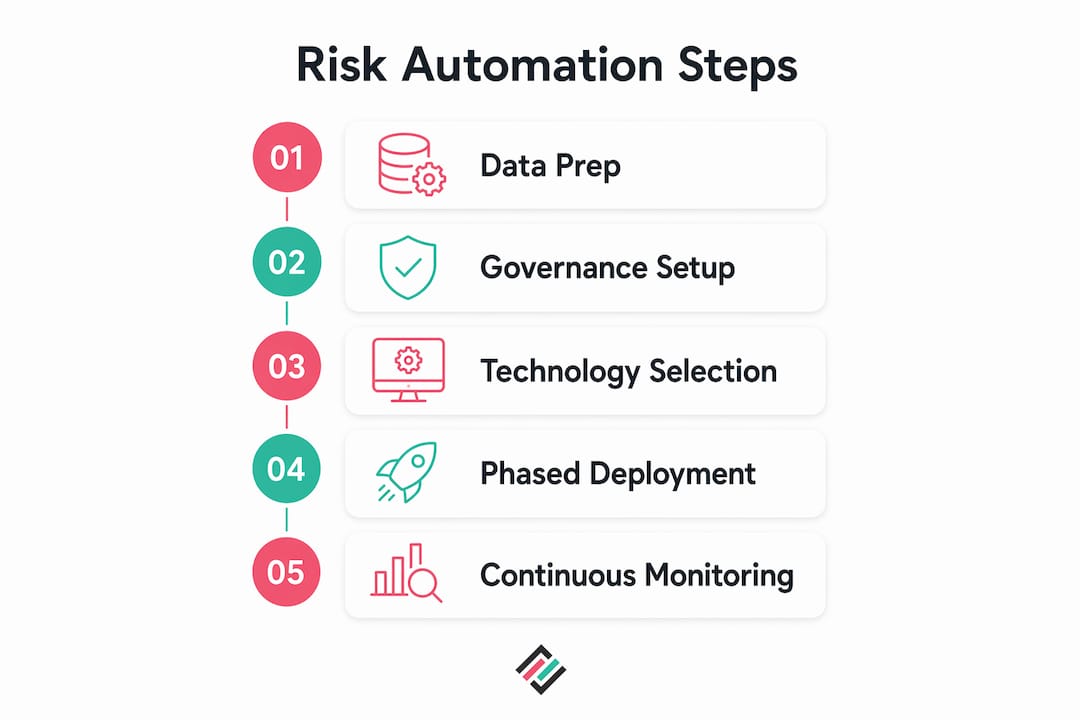
Practical integration requires more than selecting a tool and connecting it to your data. It requires a structured approach that accounts for your current process maturity, data infrastructure, and governance requirements.
- Assess your automation readiness. Map your current risk workflows and identify which processes are high-volume, rule-based, and data-rich. These are your best candidates for early automation. Processes that rely heavily on qualitative judgment are harder to automate and should come later.
- Audit your data infrastructure. Before deploying any AI-based tool, confirm that your risk data is centralized, consistently formatted, and governed. Fragmented data is the single most common reason automation projects fail to deliver expected results.
- Embed automation into your GRC system. Governance, risk, and compliance platforms are the natural home for automated risk workflows. Connecting AI-driven monitoring to your GRC system means risk signals automatically trigger the right workflows, escalations, and documentation without manual intervention.
- Link automation to ERM and third-party risk processes. Enterprise risk management frameworks benefit most when automation connects internal risk data with external signals, such as supplier financial health, geopolitical indicators, or currency volatility data. Real-time currency data is a practical starting point for organizations with significant FX exposure.
- Automate control testing and reporting. Continuous control monitoring, where automated systems test whether risk controls are operating as designed, replaces annual or quarterly manual testing cycles. This shift from point-in-time to continuous risk monitoring is one of the most significant operational improvements automation delivers.
- Define ROI metrics before you deploy. Measure baseline performance on the process you are automating: time per task, error rate, coverage percentage. After deployment, compare against those baselines at 30, 90, and 180 days. Without defined metrics, you cannot demonstrate value or justify further investment.
AI-driven scenario modeling also improves crisis preparedness beyond what traditional stress testing achieves. When you combine that capability with risk analytics tools built for currency exposure, you create a risk function that responds to events rather than reacting to them after the fact.
Key takeaways
Automation in risk management delivers the greatest value when it combines AI-driven monitoring with governed data infrastructure, human oversight, and phased implementation across GRC, ERM, and compliance workflows.
| Point | Details |
|---|---|
| Hybrid systems outperform pure AI | Combine AI for monitoring with traditional software for aggregation and simulation to get auditable, reliable outputs. |
| Data infrastructure comes first | Unified, governed data lakes are a prerequisite for reliable automation. Fix data silos before deploying AI tools. |
| Phased adoption reduces risk | Start with high-volume, rule-based processes and expand after measuring results at 30, 90, and 180 days. |
| Human oversight is non-negotiable | Agentic AI and automated workflows still require defined human checkpoints to manage model drift and governance gaps. |
| Continuous monitoring beats point-in-time | Automation shifts risk functions from periodic reporting to real-time detection, which directly improves response speed. |
Why I think most risk teams are automating in the wrong order
Most organizations I observe start their automation programs by purchasing a tool and then figuring out what to do with it. That sequence is backwards, and it explains why so many automation projects produce dashboards that nobody trusts and reports that still require manual correction before they reach the board.
The right sequence is: fix your data, define your governance model, then select your technology. The technology is the easiest part of this equation. Moody's, IBM OpenPages, and a dozen other platforms will sell you capable software. What they cannot sell you is clean, unified data or an internal culture that trusts automated outputs enough to act on them.
The deeper shift I find underappreciated is the change in what risk managers actually do. Risk managers are evolving into AI strategists who oversee intelligent systems rather than analysts who perform manual checks. That transition requires a different skill set, and most organizations are not investing in it. You need people who understand model behavior, data governance, and how to design human-in-the-loop workflows. That is a harder hire than a traditional risk analyst, and the talent gap is real.
The organizations getting this right, particularly in financial services, are the ones treating automation as an operating model change rather than a technology purchase. They are redesigning workflows, retraining teams, and building governance frameworks before they go live. That takes longer upfront. It also produces results that hold up under regulatory scrutiny and actually improve decision-making quality.
For risk professionals in markets like Poland and Sweden, where regulatory environments are evolving alongside digital transformation, this operating model approach is not optional. It is the only way to build automation that scales.
— Bartas
How Corphedge automates FX risk management for your business
Corphedge applies the automation principles covered in this article directly to foreign exchange risk management. The platform delivers real-time visibility into currency positions, automates hedging workflows based on Value at Risk calculations, and integrates with platforms like Corpay to reduce manual intervention in FX exposure management. For companies operating across multiple currencies, particularly those expanding into markets like Poland and Sweden, Corphedge replaces the manual spreadsheet-and-email hedging process with a governed, automated workflow that responds to market movements as they happen. Explore the full platform capabilities to see how automated risk controls translate into measurable protection for your margins and cash flows.
FAQ
What is the role of automation in risk management?
Automation in risk management is the application of AI, machine learning, and advanced analytics to identify, monitor, and mitigate risks continuously and without manual intervention at every step. It replaces periodic, human-driven reviews with real-time, data-driven processes that improve accuracy and response speed.
How does automation reduce risk in financial organizations?
Automation reduces risk by removing manual bottlenecks, applying consistent scoring criteria across all risk events, and enabling continuous monitoring rather than point-in-time reporting. Automated compliance workflows specifically reduce errors and remediation costs by cutting the number of manual touchpoints in the process.
What are the biggest challenges of automating risk management?
The three most common challenges are data quality issues, integration complexity with legacy GRC systems, and AI governance gaps. Automation amplifies whatever is in your underlying data, so organizations with fragmented or inconsistent data infrastructure will see those problems scale rather than disappear.
Which automation tools are most effective for risk management?
Hybrid systems that combine AI tools for monitoring and anomaly detection with traditional software for simulation and aggregation deliver the most reliable results. Platforms like Moody's Maxsight embed AI agents within governed workflows, while Value at Risk workflow tools automate quantification for specific exposure categories like FX risk.
How do you measure ROI on risk management automation?
Define baseline metrics before deployment: time per task, error rate, and risk coverage percentage. Measure against those baselines at 30, 90, and 180 days post-deployment. Organizations that skip baseline measurement cannot demonstrate value to leadership or justify expanding automation to additional risk processes.