

TL;DR:
- Treasury accounting services manage cash flow, payments, reconciliations, and reporting across all entities. Centralized and integrated data improve forecast accuracy, FX risk management, and operational efficiency. Managed services reduce costs by up to 40% and provide continuous, expert support for multinational corporations.
Treasury accounting services are defined as the specialized financial functions that manage an organization's cash flow, execute payments, reconcile accounts, and produce accurate financial reporting across all operating entities. For multinational corporations, these services sit at the intersection of liquidity management, regulatory compliance, and FX risk control. The industry term covering this discipline is corporate treasury management, and the two phrases are used interchangeably throughout this guide. Getting these functions right determines whether a company's capital works efficiently or sits idle, exposed to currency swings and reporting gaps.
What are the typical services included in treasury accounting?
Core treasury accounting tasks include accounts payable management, bank and stock reconciliations, wire transfers, distribution checks, investor reporting, and cash management. Each task connects directly to a company's ability to meet obligations on time and report its financial position accurately.
The full scope of services typically covers:
- Accounts payable integration: Matching invoices to purchase orders and routing payments through treasury-approved channels.
- Bank and stock reconciliations: Comparing internal ledger balances against bank statements and custodian records daily or weekly.
- Wire transfers and distribution checks: Executing high-value payments with dual authorization controls to reduce fraud risk.
- Batched payment processing: Grouping vendor payments by currency and settlement date to reduce transaction costs.
- Investor and regulatory reporting: Producing cash flow statements, liquidity reports, and disclosures required by regulators in each jurisdiction.
- Cash management and liquidity forecasting: Projecting short-term cash needs across subsidiaries to avoid overdrafts and optimize short-term investments.
For a company operating in markets like Poland and Sweden, each of these tasks multiplies in complexity. Local banking relationships, currency settlement cycles, and statutory reporting deadlines all vary. A single missed reconciliation in a subsidiary can distort the group's consolidated cash position by millions.
How do treasury management systems enhance treasury accounting?

A treasury management system (TMS) is specialized software that automates cash positioning, payment execution, liquidity forecasting, and risk reporting in a single platform. The TMS market is growing at a projected CAGR of 8–16% through 2030. That growth reflects how urgently finance teams need to replace manual spreadsheet workflows with automated, audit-ready processes.
Modern TMS platforms integrate directly with procurement, accounts payable, and risk management modules. This integration matters because procurement, AP, and treasury workflows are converging into unified, end-to-end financial systems. When a purchase order is raised in procurement, a well-integrated TMS can immediately update the cash forecast and flag any FX exposure created by a cross-currency transaction.
| Feature | Modern TMS | Legacy ERP financial module |
|---|---|---|
| Cash positioning | Real-time, automated | Manual batch updates |
| FX exposure tracking | Integrated, position-level | Limited or manual |
| Liquidity forecasting | AI-driven, multi-entity | Static, single-entity |
| Payment automation | Rule-based with compliance checks | Basic payment runs |
| Reporting | Configurable dashboards | Fixed report templates |
| API connectivity | Open, pre-built connectors | Custom development required |
AI-powered platforms add another layer by detecting anomalies in payment patterns, flagging reconciliation mismatches before they escalate, and generating cash forecasts that update as new data arrives. The accuracy gains from AI-driven automation are material for teams managing hundreds of bank accounts across multiple currencies.
Pro Tip: Before selecting a TMS, map every bank account, currency, and payment type your treasury team handles. Vendors price implementations based on entity count and integration complexity, so an accurate scope prevents budget overruns.
What are the benefits and cost considerations of managed treasury accounting services?
Managed treasury accounting services deliver the full treasury function through an external provider on a fixed-fee or outcome-based contract. Managed solutions reduce operational run and maintenance fees by 20–40% compared to in-house or fragmented approaches. That saving comes from shared infrastructure, pre-built integrations, and specialized staff who work across multiple clients.
The pricing model matters as much as the cost level. Fixed-fee, outcome-based pricing removes the scope creep risk common in advisory engagements billed by the hour. Finance teams know exactly what they are paying and what they receive, which simplifies budget planning and vendor accountability.
Key benefits of the managed services model include:
- Specialized expertise on demand: Access to treasury professionals and software engineers without the cost of full-time hires.
- Continuous upgrades: Providers maintain and upgrade the platform, so the client always runs current software without internal IT projects.
- Compliance support: Providers track regulatory changes in each jurisdiction and update reporting templates accordingly.
- Operational continuity: Always-on operational support with clear escalation rules for high-risk transactions means no coverage gaps during holidays or staff turnover.
The main challenge is data migration. Legacy ERP systems often require custom API connectors and extensive data validation before a managed provider can take over. Implementation timelines stretch when historical data is inconsistent or stored across disconnected systems. Companies that underestimate this phase face delays of months, not weeks.
Pro Tip: Negotiate a parallel-run period of at least 60 days when transitioning to a managed treasury provider. Running both systems simultaneously catches data gaps before the old system is decommissioned.
How does centralized treasury accounting improve risk mitigation and reporting?
Centralized visibility is the single most critical factor in accurate forecasting and risk control for multinational treasuries. Fragmented international data directly undermines forecasting quality and the ability to respond to market risk in real time. When cash balances, FX positions, and payment obligations sit in separate systems across subsidiaries, the group treasury team is always working with incomplete information.
A centralized treasury accounting structure consolidates multi-entity cash, FX exposure, and market risk data into one reporting layer. Finance teams in Poland and Sweden, for example, feed their daily bank balances and open FX positions into the group platform. The group treasury then sees a single, accurate picture of net exposure and available liquidity.
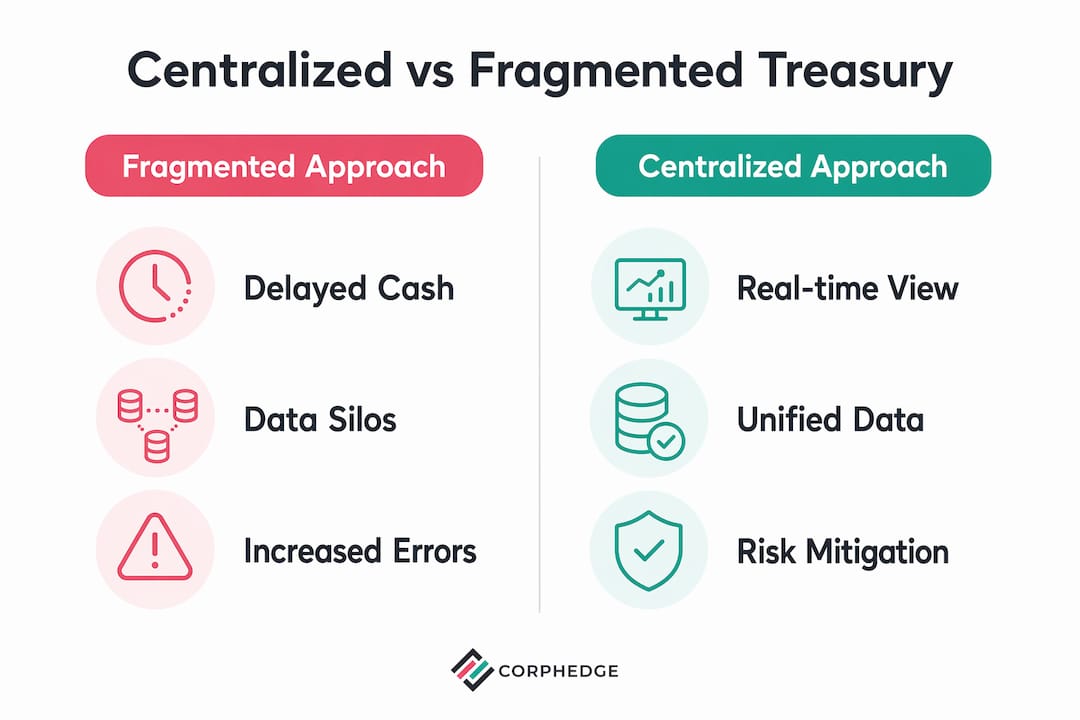
| Reporting area | Fragmented approach | Centralized approach |
|---|---|---|
| Cash visibility | Delayed, incomplete | Real-time, consolidated |
| FX exposure | Estimated, entity-level | Net group position |
| Audit readiness | Manual reconciliation | Automated audit trail |
| Regulatory reporting | Separate per entity | Unified with local overlays |
Real-time dashboards and AI analytics accelerate this process further. Automated alerts flag when a subsidiary's cash balance drops below a threshold, when an FX position exceeds a risk limit, or when a payment fails compliance screening. These alerts replace the daily email chains that slow down manual treasury operations.
Linking treasury accounting with corporate finance and procurement workflows also improves audit readiness. When every payment traces back to an approved purchase order and every FX hedge links to an underlying exposure, auditors can verify the full chain without requesting additional documentation. For a guide on building this control structure, the treasury risk control list from Corphedge covers the key components in detail.
What are best practices for implementing treasury accounting services?
Implementing corporate treasury solutions in a multinational requires a structured approach. Skipping steps in the planning phase creates problems that are expensive to fix after go-live.
- Assess your current state. Catalog every bank account, payment type, currency, and reporting obligation across all entities. This baseline reveals gaps and sets realistic scope for any new system or provider.
- Choose the right operating model. In-house TMS ownership suits large treasury teams with dedicated IT support. Managed services fit companies that want to reduce internal headcount or lack specialized treasury expertise. Hybrid models, where the company owns the TMS but a provider handles daily operations, work well for mid-size multinationals.
- Plan data migration carefully. Custom API connectors and data validation are standard requirements when moving from legacy ERP systems. Assign a dedicated migration lead and set clear acceptance criteria before any data moves to the new environment.
- Define rules of engagement. Clear escalation protocols determine when the in-house team intervenes versus when the provider acts autonomously. High-risk transactions, such as large FX trades or cross-border wire transfers above a set threshold, should always require internal sign-off.
- Train the treasury team. New systems change daily workflows. Schedule hands-on training before go-live and build a knowledge base that covers common exceptions and escalation paths.
- Monitor KPIs from day one. Track cash forecast accuracy, reconciliation cycle time, payment error rate, and FX hedge effectiveness. These metrics show whether the new setup is delivering the expected improvements and where to focus next.
For teams evaluating treasury reporting software as part of this process, comparing automation capabilities and integration depth across platforms is a practical starting point.
Key Takeaways
Effective treasury accounting services require centralized data, integrated technology, and a clearly defined operating model to deliver accurate reporting and real-time risk control across all entities.
| Point | Details |
|---|---|
| Core service scope | Treasury accounting covers AP, reconciliations, wire transfers, investor reporting, and cash management. |
| TMS market growth | The TMS market grows at 8–16% CAGR through 2030, driven by automation demand in cash and liquidity functions. |
| Managed services savings | Outsourced treasury providers reduce run and maintenance costs by 20–40% versus in-house operations. |
| Centralized visibility | Consolidating multi-entity cash and FX data is the foundation of accurate forecasting and audit readiness. |
| Implementation discipline | Data migration from legacy ERPs requires custom APIs and a parallel-run period to prevent go-live failures. |
Why unified data is the real differentiator in treasury accounting
The conversation about treasury accounting services too often centers on software features or cost comparisons. After working closely with multinational finance teams, I find the real differentiator is almost always data unification, not the platform itself.
I have seen companies invest in a top-tier TMS and still produce unreliable cash forecasts because three subsidiaries were still sending daily balance reports by email. The system was only as good as the data feeding it. The teams that get the most value from their treasury setup are the ones that treated data governance as a first-class project, not an afterthought.
The shift toward integrated Source-to-Pay workflows is the most significant structural change I see in treasury right now. When procurement, AP, and treasury share a single data layer, working capital decisions happen faster and with better information. The companies still running these functions in silos are leaving real money on the table.
AI-driven automation is genuinely useful for anomaly detection and cash forecasting, but it amplifies whatever data quality you already have. Fix the data first, then add AI. The fixed-fee managed service model also deserves more attention than it gets. Predictable costs and embedded expertise make it far easier to scale treasury operations into new markets like Poland and Sweden without building a local team from scratch.
— Bartas
How Corphedge supports treasury accounting for multinationals
Corphedge builds FX risk management technology specifically for companies running treasury operations across multiple currencies and jurisdictions. For finance teams that have centralized their treasury accounting and now need to manage the FX exposure that comes with it, Corphedge provides real-time currency position tracking and hedging based on Value at Risk models that connect directly to underlying treasury data.
The platform integrates with treasury workflows and supports companies expanding into markets like Poland and Sweden, where currency volatility adds a measurable layer of risk to cash management. Corphedge's approach keeps FX hedging costs lower than traditional bank channels while maintaining continuous availability. Finance teams can explore the full product tour to see how FX risk management fits into a broader treasury accounting framework.
FAQ
What are treasury accounting services?
Treasury accounting services are the financial processes that manage an organization's cash flow, payments, reconciliations, and reporting. They cover accounts payable, bank reconciliations, wire transfers, and investor reporting as core components of daily treasury operations.
How much can managed treasury services reduce costs?
Managed treasury accounting providers reduce run and maintenance fees by 20–40% compared to in-house operations. The savings come from shared infrastructure, pre-built integrations, and specialized staff working across multiple clients.
What is the biggest risk when implementing a new TMS?
Data migration is the highest-risk phase. Legacy ERP systems require custom API connectors and extensive validation, which extends timelines significantly if not planned in advance.
Why does centralized treasury data matter for multinationals?
Fragmented international data directly undermines cash forecasting accuracy and FX risk control. Centralizing data across all entities gives group treasury a single, real-time view of liquidity and exposure.
How does FX risk connect to treasury accounting services?
FX exposure is generated by every cross-currency payment, receivable, and intercompany transaction that treasury accounting processes. Managing that exposure through FX risk mitigation strategies is a direct extension of the treasury accounting function for any multinational company.