

TL;DR:
- Most corporates rely on informal methods for FX risk management, risking costly gaps. VaR provides a quantitative and structured way to measure, communicate, and act on currency risk. Proper use of VaR enhances risk limits, governance, and hedging decisions across the organization.
Most multinationals running significant FX exposures still rely on gut instinct, spreadsheet rules of thumb, or loosely defined hedging policies to manage currency risk. That approach might feel comfortable, but it leaves serious gaps. When a currency moves 15% in a quarter, those gaps become very expensive. Value at Risk (VaR) gives corporate treasury and finance teams a structured, quantitative framework to measure, communicate, and act on FX risk with precision. This guide breaks down what VaR actually means for corporates, how to choose the right methodology, where the model falls short, and how to translate VaR outputs into stronger hedging decisions and governance.
Table of Contents
- What is Value at Risk and why does it matter for corporates?
- Exploring VaR methodologies: Parametric, historical, and Monte Carlo
- Limitations and stress points: What VaR misses in corporate contexts
- Applying VaR: Building risk limits, governance, and better hedging decisions
- A new perspective: Moving beyond the numbers — what most corporates miss with VaR
- How CorpHedge helps corporates harness VaR for smarter FX risk management
- Frequently asked questions
Key Takeaways
| Point | Details |
|---|---|
| VaR demystified | Value at Risk helps corporates quantify potential losses from currency movements. |
| Method matters | Choosing the right VaR method depends on your data, exposure complexity, and governance needs. |
| Know the limits | VaR has critical blind spots—supplement it with stress testing for complete coverage. |
| Practical governance | Use VaR to set risk limits, trigger action on breaches, and enhance board confidence. |
What is Value at Risk and why does it matter for corporates?
VaR sounds like a banking term. It gets thrown around in investment bank risk reports and regulatory filings, so many corporate treasury teams assume it does not apply to them. That assumption is wrong, and it costs companies money.
VaR is a statistical measure used to quantify the risk of loss on a portfolio over a defined time period at a given confidence level. In plain English: VaR answers the question, "What is the most we could lose on our FX positions over the next month, 95 times out of 100?" That single number is powerful. It turns vague anxiety about currency moves into a concrete figure your CFO and board can actually use.
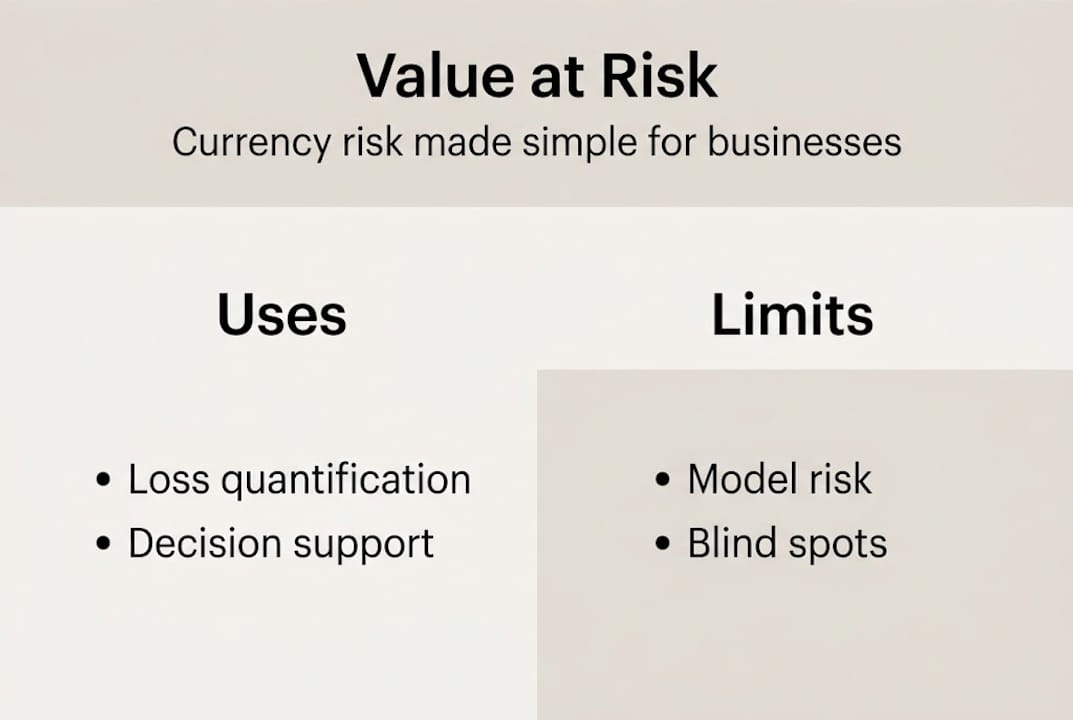
For corporates, VaR applies directly to FX exposures across receivables, payables, intercompany loans, and hedging instruments. A manufacturing company with EUR receivables and USD costs faces real currency risk every quarter. VaR quantifies that risk in dollar terms, making it actionable.
Here is where VaR adds direct value for corporate treasury teams:
- Setting board-level risk limits tied to actual exposure size rather than arbitrary percentages
- Improving financial reporting by disclosing quantified FX risk in a format auditors and investors recognize
- Supporting hedge ratio decisions by showing how much risk remains after hedging
- Comparing exposure across business units using a single consistent metric
- Justifying hedging costs to senior leadership by showing the downside being avoided
Good currency risk management best practices always start with measurement. You cannot manage what you cannot quantify.
"The shift from heuristics to data-driven risk limits is not a technical upgrade. It is a governance upgrade. When treasury can say 'our 95% one-month VaR is $4.2 million,' the board conversation changes entirely."
Pro Tip: Align your VaR confidence level and time horizon directly with your board's stated risk appetite. If the board thinks in quarterly earnings terms, run a 90-day VaR at 95% confidence. That alignment makes risk reporting far more strategic and far less technical.
Looking at FX risk management strategies through a VaR lens also helps you prioritize which currency pairs deserve the most attention and hedging budget. With a foundation of why VaR is critical, let's clarify the methodologies available and how they fit corporate needs.
Exploring VaR methodologies: Parametric, historical, and Monte Carlo
There are three main VaR methodologies: parametric, historical simulation, and Monte Carlo. Each has a distinct logic, and choosing the wrong one for your exposure type leads to misleading risk numbers.
Parametric (variance-covariance) is the fastest and simplest method. It assumes currency returns follow a normal distribution and uses the standard deviation of historical returns to calculate VaR. The formula is: VaR = Portfolio Value x Z-score x Standard Deviation. For a $10 million EUR/USD exposure with a monthly standard deviation of 2.5% and a 95% confidence Z-score of 1.65, VaR equals roughly $412,500. This method works well for straightforward linear exposures but breaks down when your portfolio includes options or when markets are behaving abnormally.
Historical simulation replays actual past returns against your current portfolio. If you have two years of daily EUR/USD returns, you apply each of those 500 days to your current position and rank the outcomes. The 95th percentile loss becomes your VaR. It is intuitive and does not assume normality, but it is entirely backward-looking. A currency crisis that has not happened before will not appear in your historical data.
Monte Carlo simulation generates thousands of hypothetical return scenarios using statistical modeling. It handles options, non-linear payoffs, and complex multi-currency portfolios with ease. The tradeoff is computational intensity and the need for skilled model inputs.
When to use each method:
- Use parametric when your FX book is simple (spot forwards on major currency pairs, stable volatility environment, no options).
- Use historical simulation when you have rich historical data and want a model that does not rely on distribution assumptions.
- Use Monte Carlo when your portfolio includes FX options, structured products, or exposures across many correlated currency pairs.
| Method | Speed | Data needs | Complexity | Best for |
|---|---|---|---|---|
| Parametric | Fast | Low | Low | Simple linear FX exposures |
| Historical | Moderate | High | Moderate | Standard portfolios with good data history |
| Monte Carlo | Slow | High | High | Complex, options-heavy, multi-currency portfolios |
For most mid-size multinationals, historical simulation hits the sweet spot. Explore the detailed VaR guide to go deeper on model mechanics. Understanding each calculation method enables better tool selection, but it is equally vital to recognize VaR's blind spots and what they do not capture.
Limitations and stress points: What VaR misses in corporate contexts
VaR is useful. It is also incomplete. Treating it as the final word on FX risk is one of the most common mistakes corporate treasury teams make.

The core problem is that VaR ignores tail losses, assumes normality, and can underestimate crises. When markets move in extreme ways, like during a currency peg collapse or a sovereign debt shock, VaR based on normal conditions will dramatically understate your actual exposure.
Here are the major pitfalls when using VaR for corporate FX portfolios:
- Tail risk blindness: VaR tells you nothing about losses beyond the confidence threshold. A 95% VaR says nothing about what happens in the worst 5% of outcomes.
- Normality assumptions: Real currency returns have fat tails. Extreme moves happen far more often than a normal distribution predicts.
- Correlation breakdown: During crises, currency correlations shift sharply. A diversified multi-currency book can suddenly behave like a single concentrated bet.
- Static snapshots: VaR reflects a point-in-time view. Intraday or intra-month exposure changes are invisible unless you rerun the model frequently.
- Liquidity illusion: VaR does not account for the cost or difficulty of unwinding positions in stressed markets.
The role of risk analytics in corporate treasury goes beyond a single metric. Expected shortfall (also called CVaR) addresses the tail risk gap by averaging losses in the worst scenarios beyond the VaR threshold. It gives a richer picture of downside severity when tail risk is a real concern for your business.
Pro Tip: Run a stress scenario alongside your standard VaR. Model a sudden 20% move in your top two currency exposures simultaneously. If that scenario would breach your hedging budget or trigger covenant issues, you need to adjust your hedge ratios now, not after the move happens.
With these limitations in mind, let's move from theory to application, exploring how corporates can use VaR-driven insights to strengthen FX risk management and performance.
Applying VaR: Building risk limits, governance, and better hedging decisions
Knowing your VaR number is only valuable if it drives action. The real payoff comes from embedding VaR into your governance framework and hedging process.
Start by establishing a three-tier limit structure. Board-level limits define the maximum acceptable VaR for the entire FX book. Policy-level limits translate that into currency-pair or business-unit sub-limits. Operational limits trigger escalation and hedging action before board limits are reached.
Follow these steps to build a VaR-based FX risk governance process:
- Quantify exposures across all currency pairs, including forecasted cash flows, balance sheet items, and existing hedges.
- Calculate VaR using your chosen methodology at the agreed confidence level and time horizon.
- Report results to treasury, CFO, and risk committee on a monthly basis using a standardized format.
- Monitor breaches against established limits and document each occurrence with context.
- Escalate and act when operational limits are breached, triggering a hedging review or position adjustment.
Here is an example of a monthly VaR limit monitoring report:
| Currency pair | Notional exposure | Monthly VaR (95%) | Limit | Breach? | Action |
|---|---|---|---|---|---|
| EUR/USD | $18M | $620,000 | $750,000 | No | Monitor |
| GBP/USD | $9M | $480,000 | $400,000 | Yes | Hedge review |
| JPY/USD | $5M | $210,000 | $300,000 | No | Monitor |
Backtesting is non-negotiable. Backtesting is essential because at 95% confidence you should expect real losses to exceed VaR roughly 1 to 5 times per 100 observations. If breaches happen far more often, your model is underestimating risk. If they never happen, your limits may be too conservative and your hedging costs too high.
Good currency risk governance built around VaR produces three measurable outcomes: fewer earnings surprises from FX, stronger auditor confidence in your risk disclosures, and a clearer mandate for advanced forex risk strategies when exposures grow.
A new perspective: Moving beyond the numbers — what most corporates miss with VaR
Here is an uncomfortable truth: most corporates that adopt VaR use it as a reporting checkbox rather than a strategic tool. They run the number, file the report, and move on. That is a missed opportunity.
VaR is a snapshot, not a strategy. Its real value emerges when you use it to start conversations, not end them. Bring your VaR outputs into a room with the CFO, business unit heads, and treasury together. Ask what a $5 million loss quarter would mean for the operating budget. Ask which business units are generating the most FX risk relative to their revenue contribution. Those conversations change behavior.
Over-reliance on VaR can also create false confidence. A multinational we are aware of ran tight VaR limits for years, then faced a currency peg break that their model had never seen. Their VaR said they were safe. Their P&L said otherwise. The teams that survived similar events were those who had run stress scenarios alongside VaR and had pre-approved response playbooks ready.
Use VaR as a dialogue tool. Pair it with scenario planning. Explore risk reduction strategies that go beyond the model and address the unknowns your data cannot capture.
How CorpHedge helps corporates harness VaR for smarter FX risk management
Putting VaR into practice requires more than a spreadsheet formula. It requires real-time exposure data, automated calculation, clean reporting, and stress testing tools that your treasury team can actually use without a quant on staff.
CorpHedge automates VaR calculation, visualizes your FX exposures in real time, and generates the governance reports your board and auditors expect. The platform supports parametric and scenario-based approaches, lets you set and monitor risk limits, and flags breaches before they become problems. You can explore the full range of FX exposure management capabilities on the platform, or take a guided walkthrough through the FX risk management solutions to see how VaR fits into your existing treasury workflow. Getting started is straightforward, and the impact on your risk reporting is immediate.
Frequently asked questions
How do corporates choose the right VaR method for their FX exposures?
Corporates select a VaR method based on portfolio complexity: parametric for simple linear exposures, historical for portfolios with ample past data, and Monte Carlo for books with options or non-linear features.
How often should corporates update and backtest their VaR models?
VaR models should be updated monthly or whenever exposures change significantly. Backtesting should be frequent, with an expected breach rate of 1 to 5 times per 100 observations at 95 to 99% confidence.
What are the main pitfalls to avoid when using VaR for currency risk?
The biggest pitfalls are ignoring tail risks beyond the confidence threshold, relying on normality assumptions that underestimate extreme moves, and skipping scenario-based stress testing alongside the standard VaR calculation.
How can VaR results improve FX hedging and governance decisions?
VaR enables corporates to set quantitative risk limits, monitor exposures against those limits, and escalate breaches systematically, which leads to smarter hedging decisions and more credible risk governance.