

Many financial executives believe traditional variance-covariance models adequately capture currency risk exposure, yet multi-dimensional exposure measurement reveals these methods miss critical tail risks and nonlinear interactions during market stress. Advanced risk analytics combines exposure aggregation, Value at Risk calculations, stress testing, and machine learning forecasts to provide comprehensive forex risk management. This guide explores methodological innovations, practical challenges, and strategic applications that elevate currency risk management from tactical hedging to strategic asset allocation.
Table of Contents
- Key takeaways
- Understanding core risk analytics methodologies in forex
- Leveraging advanced models and machine learning for forex risk forecasting
- Navigating nuances, edge cases, and practical challenges in risk analytics
- Applying risk analytics insights for strategic forex risk management
- Explore advanced foreign exchange risk management solutions
- What is the role of Value at Risk (VaR) in currency risk management?
- How can machine learning improve forex risk analytics, and what are its limitations?
- What are common barriers financial executives face in implementing advanced risk analytics?
- How should companies strategically incorporate currency risk analytics into overall risk management?
Key Takeaways
| Point | Details |
|---|---|
| Exposure aggregation across dimensions | Aggregate exposures by currency pair, date, and instrument to reveal concentration risks that single dimension analysis misses. |
| VaR remains baseline | Value at Risk continues to be the standard measure for potential losses under normal market conditions and can be calculated with parametric, historical, or Monte Carlo methods. |
| Stress testing complements VaR | Stress testing and scenario analysis examine extreme moves outside normal VaR confidence intervals to reveal hedging vulnerabilities. |
| Bayesian and ML forecasting | Bayesian dynamic models update volatility forecasts in real time, while machine learning ensembles improve accuracy by capturing nonlinear relationships. |
| Hybrid forecasting approach | A hybrid approach that combines Bayesian updating with machine learning ensembles tends to outperform either method alone. |
Understanding core risk analytics methodologies in forex
Effective currency risk management starts with precise exposure measurement across multiple dimensions. You need to aggregate exposures by currency pair, value date, and instrument type simultaneously to understand your true risk profile. This multi-dimensional aggregation reveals concentration risks that single-dimension analysis misses entirely.
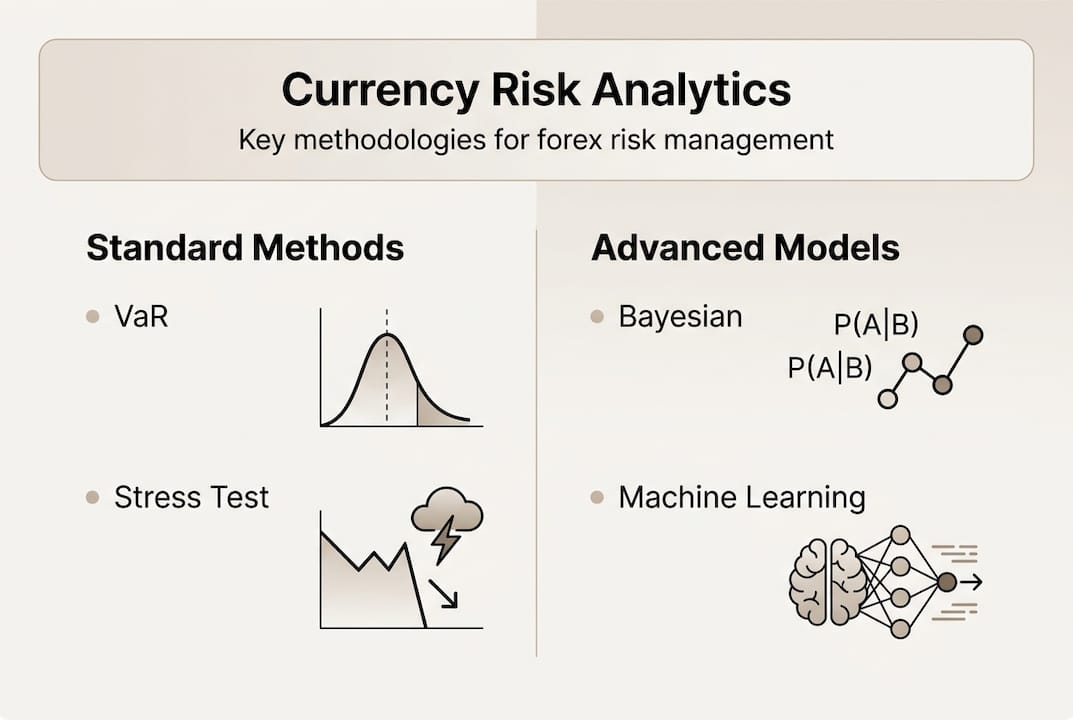
Value at Risk remains the industry standard for quantifying potential losses under normal market conditions. Three primary VaR calculation methods dominate corporate treasury applications. Parametric variance-covariance assumes normal distribution and uses correlation matrices to estimate portfolio risk. Historical simulation replays actual past price movements without distributional assumptions. Monte Carlo simulation generates thousands of random price paths based on statistical parameters you define.
| VaR Method | Calculation Approach | Best Scenario | Key Limitation |
|---|---|---|---|
| Parametric | Correlation matrices, normal distribution | Stable markets, liquid pairs | Underestimates tail risk |
| Historical | Actual past returns, no assumptions | Recent volatility patterns relevant | Backward-looking, misses new risks |
| Monte Carlo | Random simulation, flexible distributions | Complex portfolios, nonlinear instruments | Computationally intensive |
Stress testing and scenario analysis complement VaR by examining extreme but plausible market moves. You should model currency crashes, central bank interventions, and geopolitical shocks that fall outside normal VaR confidence intervals. These exercises reveal vulnerabilities in hedging strategies before crises materialize.
Pro Tip: Use daily VaR calculations as your baseline, but scale carefully for longer horizons. Simple square-root-of-time scaling assumes independent returns and underestimates risk during volatile periods. Consider decay-weighted methods that give recent observations more influence.
Integrating these methodologies with fx exposure management platforms automates calculations and provides real-time risk dashboards. You gain immediate visibility into how new transactions affect portfolio risk metrics without manual spreadsheet updates.
Leveraging advanced models and machine learning for forex risk forecasting
Bayesian dynamic models represent a significant advancement over static VaR approaches. These frameworks use skew-normal distributions to capture asymmetric return patterns common in forex markets. You update volatility forecasts continuously as new price data arrives, allowing your risk estimates to adapt to changing market conditions in real time.

Machine learning ensemble methods combine multiple algorithms to improve prediction accuracy. Bagging techniques train multiple models on random data subsets and average their predictions, reducing variance. Boosting methods train models sequentially, with each new model focusing on errors from previous iterations. These ensemble approaches detect nonlinear relationships between currency pairs that traditional correlation analysis misses.
| Model Type | Key Strength | Primary Limitation | Best Application |
|---|---|---|---|
| Traditional VaR | Simple, transparent | Assumes normal distribution | Stable market periods |
| Bayesian Dynamic | Real-time updating, captures asymmetry | Requires sophisticated implementation | Volatile markets |
| ML Ensembles | Detects nonlinear patterns | Black box, fails tail events | Complex multi-currency portfolios |
| Hybrid Approach | Combines strengths of multiple methods | Higher implementation cost | Strategic risk management |
The NICER indicator provides firm-specific exchange rate measures for companies with complex invoicing structures. Unlike broad currency indexes, NICER weights currencies by your actual invoice exposure across subsidiaries. This precision matters when your operational footprint differs significantly from standard trade-weighted indexes.
Pro Tip: Combine Bayesian updating with machine learning ensembles for superior forecasting accuracy. Use Bayesian models to capture real-time volatility shifts, then apply ensemble methods to identify cross-currency relationships that inform hedging decisions. This hybrid approach outperforms either method alone.
Implementing these advanced techniques through forex risk management solutions eliminates the technical barriers that prevent many treasury teams from adopting sophisticated analytics. Automated model selection and validation ensure you always use the most appropriate methodology for current market conditions.
Navigating nuances, edge cases, and practical challenges in risk analytics
Poor data quality creates the single largest obstacle to effective risk analytics implementation. Inconsistent position reporting, delayed trade confirmations, and incomplete historical records undermine model accuracy regardless of methodological sophistication. You must establish rigorous data governance before investing in advanced analytics infrastructure.
Machine learning models excel at pattern recognition but fail to predict tail risk events with acceptable accuracy. Directional ML models show higher VaR violation rates during extreme market moves compared to traditional methods. This limitation stems from training data that rarely includes crisis scenarios, leaving algorithms unprepared for unprecedented events.
"Poor data quality is the top barrier for 76% of treasury teams implementing advanced risk analytics. Machine learning directional models fail tail risk prediction with higher violation rates than traditional approaches during extreme market stress."
Intraday asymmetry in forex moves creates additional modeling challenges. Currency pairs often exhibit different volatility patterns during Asian, European, and American trading sessions. Your risk models must account for these time-zone effects, especially when managing exposures across multiple geographic regions simultaneously.
Volatility connectedness between currency pairs changes dramatically during crisis periods. Correlations that appear stable during normal markets break down precisely when you need them most. Long-horizon VaR methods using decay-weighted nonparametric approaches reduce estimation errors by 97% compared to standard models by adapting to these structural shifts.
Practical steps to mitigate these challenges:
- Implement automated data validation rules that flag inconsistencies before they enter risk calculations
- Use decay-weighted historical simulation that emphasizes recent observations during volatile periods
- Combine ML forecasts with traditional stress testing to cover both normal and extreme scenarios
- Validate model performance continuously using backtesting across multiple market regimes
- Maintain manual override capabilities for situations where automated models produce questionable outputs
Stress testing remains essential regardless of your primary modeling approach. You should run monthly scenarios covering currency crashes, interest rate shocks, and geopolitical events that fall outside your VaR confidence intervals. These exercises reveal portfolio vulnerabilities that statistical models alone cannot identify.
Exploring corporate fx risk management case studies shows how leading organizations address these challenges through hybrid analytics frameworks. You gain practical insights into implementation strategies that balance sophistication with operational feasibility.
Applying risk analytics insights for strategic forex risk management
Translating analytics capabilities into strategic value requires elevating currency risk from tactical hedging to portfolio-level decision making. You must integrate FX considerations into asset allocation frameworks rather than treating currency exposure as an afterthought to underlying investments.
Strategic steps to integrate advanced risk analytics:
- Establish a formal FX risk policy that defines acceptable exposure limits based on VaR and stress test outputs
- Create a cross-functional risk committee including treasury, finance, and business unit leaders to review analytics insights quarterly
- Link hedging decisions explicitly to risk metrics rather than relying on subjective market views
- Implement rolling hedge ratio adjustments informed by Bayesian volatility forecasts and ML correlation predictions
- Develop contingency plans triggered by specific risk threshold breaches identified through scenario analysis
- Invest in continuous model validation processes that test analytics accuracy across different market regimes
Technology investments that enable strategic risk management:
- Enterprise currency management platforms integrating position aggregation, analytics, and execution workflows
- AI-powered scenario modeling tools that generate customized stress tests based on your specific exposure profile
- Real-time risk dashboards providing executive visibility into portfolio metrics without technical complexity
- Automated hedge recommendation engines that suggest optimal strategies based on current analytics outputs
- Integration APIs connecting risk analytics with ERP, treasury management, and trading systems
Data quality investments pay the highest returns in analytics effectiveness. You should allocate resources to master data management, automated reconciliation, and historical database construction before pursuing sophisticated modeling techniques. Clean, comprehensive data enables even simple models to outperform advanced methods applied to poor inputs.
Hybrid models combining Bayesian and ensemble ML approaches deliver superior forecasting accuracy. You update volatility estimates continuously while detecting nonlinear cross-currency relationships that inform diversification decisions. This combination provides both responsiveness and pattern recognition capabilities.
Hedge ratio insights from advanced analytics favor CHF and JPY exposures for portfolio diversification. These currencies exhibit negative correlation with risk assets during stress periods, providing natural hedges that reduce overall portfolio volatility. Your analytics should quantify these diversification benefits explicitly when evaluating hedging strategies.
Strategic elevation of FX risk includes aligning risk analytics with asset allocation decisions, leveraging hybrid models, and investing in ECM platforms. You treat currency exposure as an active risk management opportunity rather than a passive byproduct of international operations.
Reviewing forex risk management use cases demonstrates how organizations at different sophistication levels implement these strategic principles. You identify implementation pathways appropriate for your current capabilities while understanding the evolution toward more advanced practices.
Scheduling a forex risk management demo tour provides hands-on experience with analytics platforms that operationalize these strategic concepts. You evaluate specific features against your requirements before committing to implementation investments.
Explore advanced foreign exchange risk management solutions
Implementing the risk analytics methodologies covered requires specialized technology infrastructure that most treasury teams cannot build internally. CorpHedge provides a comprehensive platform designed specifically for sophisticated foreign exchange risk management solutions that international corporations require. The system integrates real-time exposure aggregation, automated VaR calculations across multiple methodologies, and scenario modeling capabilities into unified workflows.

You gain immediate visibility into portfolio risk metrics through executive dashboards that translate complex analytics into actionable insights. The platform supports Bayesian dynamic models, machine learning forecasts, and traditional VaR approaches within a single interface. Automated hedging workflows connect analytics outputs directly to execution, ensuring your risk management decisions reflect current market conditions. Explore detailed fx exposure management features and review corporate fx risk management use cases to see how leading organizations leverage these capabilities for competitive advantage.
What is the role of Value at Risk (VaR) in currency risk management?
VaR quantifies the maximum potential loss your portfolio might experience under normal market conditions at a specified confidence level over a defined time horizon. It provides a single number that executives can use to understand and communicate forex risk exposure across the organization. However, VaR only captures losses within the confidence interval and misses tail risk events that fall outside normal market behavior.
Advanced alternatives include conditional VaR (CVaR) that measures average loss beyond the VaR threshold, providing better insight into tail risk severity. Stress testing and scenario analysis complement VaR by examining specific extreme events that probability-based methods underestimate. You should use VaR as your primary metric for normal market conditions while maintaining separate tail risk measures for crisis scenarios.
How can machine learning improve forex risk analytics, and what are its limitations?
Machine learning enhances forecasting accuracy by detecting nonlinear relationships between currency pairs that traditional correlation analysis misses. Ensemble methods combine multiple algorithms to reduce prediction variance and capture complex market dynamics. These capabilities prove especially valuable for portfolios with many currency exposures where manual analysis becomes impractical.
However, ML models fail to predict tail risk events reliably because training data rarely includes sufficient crisis examples. Directional ML approaches show higher VaR violation rates during extreme market moves compared to traditional methods. You must combine machine learning forecasts with traditional stress testing to achieve robust risk management that performs across both normal and crisis conditions.
What are common barriers financial executives face in implementing advanced risk analytics?
Poor data quality represents the top barrier for over three-quarters of treasury teams attempting to implement sophisticated risk analytics. Inconsistent position reporting, incomplete historical records, and delayed trade confirmations undermine model accuracy regardless of methodological sophistication. Organizations must invest in data governance infrastructure before pursuing advanced analytics capabilities.
Lack of system configurability and inadequate integration with existing treasury workflows create additional implementation obstacles. Off-the-shelf analytics tools often require extensive customization to match specific corporate hedging policies and reporting requirements. Successful implementations prioritize platforms designed specifically for corporate treasury needs rather than adapting generic financial analytics software.
How should companies strategically incorporate currency risk analytics into overall risk management?
Integrate FX risk as part of strategic asset allocation decisions rather than treating currency exposure as a tactical hedging afterthought. Your risk analytics should inform portfolio construction by quantifying how currency exposures affect overall return distributions and diversification benefits. This elevation transforms forex from an operational concern into a strategic value driver.
Adopt hybrid models combining Bayesian updating with machine learning ensembles to capture both real-time volatility shifts and nonlinear cross-currency relationships. Invest in scenario planning tools that generate customized stress tests based on your specific exposure profile rather than relying on generic market scenarios. Establish formal governance processes that link hedging decisions explicitly to analytics outputs, ensuring risk management actions reflect quantitative insights rather than subjective market views.