

TL;DR:
- Currency risk affects all companies through transaction, translation, and economic exposures.
- Effective management combines multiple hedging instruments, structured frameworks, and real-time technology.
- Organizational discipline, data quality, and agility are crucial for successful enterprise FX risk mitigation.
Currency risk does not discriminate by company size or industry. Even well-established multinationals with sophisticated finance teams have watched exchange rate swings quietly erode margins, distort earnings, and blindside cash flow projections. UK and US corporations lost £6.71M/$9.85M from unhedged FX positions, a stark reminder that exposure without a plan is exposure by choice. This guide walks through the frameworks, instruments, and execution steps that leading treasury teams use to identify, measure, and reduce currency risk, so you can protect profitability and make smarter capital allocation decisions across every market you operate in.
Table of Contents
- Understanding enterprise currency risk and its business impact
- Core methodologies: Hedging instruments and strategic frameworks
- Implementation: From policy to real-world execution
- Case studies and advanced approaches: Innovation under volatility
- What most enterprises get wrong about currency risk management
- Optimize your enterprise currency risk management strategy with CorpHedge
- Frequently asked questions
Key Takeaways
| Point | Details |
|---|---|
| Multi-pronged approach | Top enterprises blend financial and natural hedging for robust FX risk management. |
| Data and technology | Investing in automation and accurate data drives better decisions and resilience. |
| Governance matters | Clear policies and active oversight ensure currency risk controls remain effective. |
| Continuous improvement | Dynamic hedging and scenario planning help finance teams stay ahead of market changes. |
Understanding enterprise currency risk and its business impact
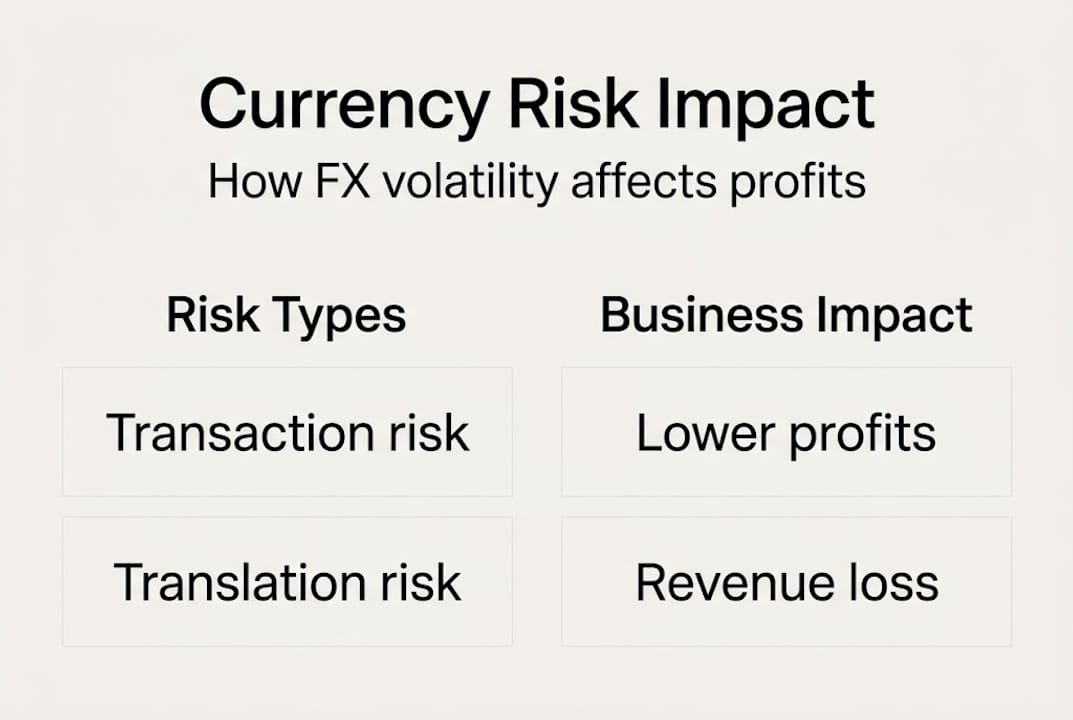
Currency risk is not a single problem. It shows up in three distinct forms, and confusing them leads to mismatched solutions. Transaction exposure affects cash flows from existing contracts denominated in foreign currencies. Translation exposure hits the balance sheet when consolidating subsidiary financials across currencies. Economic exposure is the broadest and most overlooked: it reflects how exchange rate shifts affect a company's long-term competitive position, pricing power, and market share.
The business impact is real and measurable. 62% of companies reported that FX volatility directly hurt profitability in recent periods. That is not a rounding error. It represents billions in value destruction across global enterprises that assumed their natural diversification or conservative treasury approach was enough.
Common misconceptions make the problem worse. Many international firms believe that operating in multiple regions provides automatic protection. It does not. Revenue in euros and costs in dollars still creates net exposure. Others assume that FX risk only matters during extreme volatility events. In reality, even moderate, sustained currency moves can compound over quarters into significant P&L damage.
Key drivers of enterprise FX risk in 2026 include:
- Geopolitical instability and shifting trade alliances
- Tariff changes and new import/export restrictions
- Central bank divergence and interest rate differentials
- Emerging market currency fragility
- Supply chain restructuring across currency zones
Traditional approaches, such as ad hoc hedging or relying solely on natural offsets, often fall short because they lack systematic coverage and real-time responsiveness. Understanding the full spectrum of FX risk types is the first step toward building a policy that actually works. Without that foundation, even the best instruments will be applied to the wrong problems.
"FX volatility is no longer a tail risk. It is a recurring operational challenge that demands a structured, ongoing response."
Core methodologies: Hedging instruments and strategic frameworks
Once you understand your exposure profile, the next step is selecting the right combination of instruments and building a framework that governs their use. Core methodologies include financial hedging through forwards, options, and swaps, as well as natural hedging, netting, and diversification. Each has a role, and the best programs use several in combination.
Here is a quick comparison of the primary instruments:
| Instrument | Key benefit | Key limitation |
|---|---|---|
| Forward contracts | Lock in rate, cost certainty | No upside if rates move favorably |
| Options | Flexibility, downside protection | Premium cost can be significant |
| Cross-currency swaps | Long-term rate and interest management | Complexity, counterparty risk |
| Natural hedging | No instrument cost | Rarely sufficient at scale |
| Netting | Reduces gross exposure | Requires centralized treasury |
A well-structured framework follows a clear sequence:
- Identify and quantify all currency exposures across entities
- Define risk tolerance and set policy hurdle ratios
- Select instruments aligned with exposure type and duration
- Establish governance: who approves, who executes, who monitors
- Review and rebalance on a defined schedule
Hybrid strategies are increasingly common. Pairing short-term forward contracts with longer-dated cross-currency swaps allows treasury teams to manage near-term transaction risk while protecting against structural economic exposure. Combining this with ERM currency risk frameworks gives you a governance layer that ties FX decisions to enterprise-wide risk appetite.
Technology plays a critical role here. Treasury management systems like Kyriba and Bloomberg FX modules enable real-time position tracking, automated hedge execution, and policy compliance monitoring. These tools are not luxuries. They are infrastructure for any team managing exposures across multiple currencies and jurisdictions.

Pro Tip: Centralizing treasury operations for netting purposes can reduce gross FX exposure by up to 30% before a single hedge instrument is placed. It is one of the highest-return, lowest-cost steps available to large multinationals.
For a deeper look at risk reduction strategies, the combination of netting, natural hedging, and instrument overlays consistently outperforms single-method approaches.
Implementation: From policy to real-world execution
Strategy without execution is just documentation. The gap between enterprises that manage FX risk well and those that do not usually comes down to implementation discipline. Effective implementation involves policy setting, hedge ratios typically in the 70 to 90% range for committed exposures, TMS deployment, and dynamic optimization over time.
Setting hedge ratios is not arbitrary. Most leading treasury teams target 70 to 90% coverage on committed exposures, with lower ratios on forecast exposures where uncertainty is higher. Effectiveness is measured using a standard 80 to 125% range, meaning the hedge should offset between 80% and 125% of the underlying exposure movement to qualify for hedge accounting treatment.
Governance structures matter as much as the instruments themselves. High-performing teams use:
- A formal hedge committee with defined approval authority
- Centralized policy documentation reviewed at least quarterly
- Clear segregation between those who set policy and those who execute
- Audit trails for every hedge decision and instrument placement
Automation is a genuine differentiator. Modern FX technology can reduce manual processing time by up to 60%, freeing treasury professionals to focus on strategy rather than spreadsheet reconciliation. Automated systems also reduce human error, which is a leading cause of hedge mismatches and accounting restatements.
Pro Tip: Align your FX program KPIs directly to earnings per share and P&L impact. When the CFO and board can see a direct line between hedge effectiveness and reported earnings stability, budget and executive support for the program become much easier to secure.
Common pitfalls to avoid include over-hedging forecast exposures that do not materialize, using static ratios that ignore changing market conditions, and failing to integrate currency risk governance into broader enterprise risk management. Dynamic programs that adjust ratios based on market signals consistently outperform static ones over multi-year periods. Reviewing current best practices can help your team avoid the most costly mistakes.
Case studies and advanced approaches: Innovation under volatility
Seeing these strategies in action makes the ROI concrete. Coca-Cola's digitization program cut treasury workload by 14% and significantly improved decision-making quality through automation and real-time data integration. The same study found that 100% of enterprises surveyed were actively exploring AI for real-time exposure tracking. That is not a future trend. It is the current competitive baseline.
Key innovations reshaping enterprise FX programs right now:
- AI-driven exposure aggregation: Automatically consolidates exposures across subsidiaries, eliminating manual data pulls
- Scenario planning and stress testing: Simulates the P&L impact of 10%, 20%, or 30% currency moves before they happen
- Dynamic hedge ratio adjustment: Algorithms shift coverage levels based on volatility signals and forecast confidence
- Outsourced FX execution: Some enterprises are partnering with specialist providers to access better pricing and execution quality
Geopolitical shifts and new tariff regimes in 2026 have pushed many treasury teams to run monthly scenario analyses rather than quarterly ones. The speed of policy change means that a hedging program calibrated in January may need significant adjustment by March. Agility is now a core competency, not a nice-to-have.
"The firms winning on FX are not necessarily the ones with the biggest hedging budgets. They are the ones with the fastest feedback loops between market data and hedge decisions."
For teams focused on hedging for cash flow protection, real-time visibility into net positions is the single biggest operational improvement available today. Reviewing currency risk best practices from leading FX innovation trends confirms that technology adoption is the clearest separator between high and low performers.
What most enterprises get wrong about currency risk management
Here is the uncomfortable truth: most FX programs fail not because of bad instruments, but because of bad data and organizational silos. 76% of finance teams cite data quality as their number one barrier to effective FX management. Yet most treasury technology investments focus on execution tools rather than the data pipelines feeding them.
Static hedge ratios are another chronic underperformer. A ratio set once a year based on last year's exposure profile will miss the signals that matter most: rising volatility, shifting trade patterns, and changing forecast accuracy. The best teams treat their hedge ratios as living parameters, not annual checkboxes.
Cross-functional alignment is also underrated. When FX policy lives only in treasury, it gets disconnected from sales pricing, procurement contracts, and capital allocation decisions. Bringing in commercial finance, procurement, and even sales leadership into the FX conversation produces dramatically better outcomes.
Natural hedging is real, but it is rarely enough at scale. Matching revenues and costs in the same currency helps, but it cannot fully offset translation exposure or economic exposure in competitive markets. It should be a complement to financial hedging, not a substitute.
Pro Tip: Review your FX policy quarterly, not annually. Markets move faster than annual review cycles can track, and a quarterly cadence keeps your program calibrated to current conditions. Strong governance best practices make this cadence sustainable without adding excessive overhead.
Optimize your enterprise currency risk management strategy with CorpHedge
Taking your FX risk management to the next level is easier with the right partners and technology.
CorpHedge gives finance and treasury teams a purpose-built platform to centralize, automate, and optimize their entire FX risk program. From real-time exposure monitoring and Value at Risk analytics to seamless policy governance and instrument execution, everything your team needs is in one place.
Whether you are building your first structured hedging program or upgrading from manual processes, the FX risk management platform at CorpHedge is designed to reduce costs, improve accuracy, and give your leadership team the visibility they need. Explore the full range of key features and see how leading enterprises are turning FX risk into a managed, measurable part of their financial strategy.
Frequently asked questions
What is enterprise currency risk management?
Enterprise currency risk management refers to the strategies and tools multinational companies use to identify, measure, and mitigate the financial impact of exchange rate volatility on their profits and cash flow. It covers transaction, translation, and economic exposures across all business units.
Which instruments are most effective for hedging currency risk?
Forwards, options, swaps, and natural hedging are all widely used, and most enterprises combine instruments to balance cost and protection. The right mix depends on exposure type, duration, and the company's risk tolerance as defined in its hedging instruments overview.
How do leading companies measure hedge effectiveness?
Enterprises track hedge ratios and effectiveness metrics, typically targeting the 80 to 125% range, and use automated TMS tools for real-time reporting. Hedge ratio measurement and continuous adjustment are standard practice among high-performing treasury teams.
What are the main pitfalls in currency risk management?
The most common pitfalls are manual processes, static policies, over-hedging, and poor data quality. 76% of teams report data challenges as their top barrier, making technology adoption essential for consistent program performance.
How are AI and automation shaping currency risk management?
AI and automation enable real-time exposure tracking, reduce manual workload by up to 60%, and support faster, more accurate hedging decisions. 100% of enterprises are now actively exploring AI tools for FX exposure management, signaling a clear shift in how programs are built and operated.