

TL;DR:
- FX risk management is essential for companies operating across currencies to protect margins and cash flow.
- Combining quantitative tools like VaR with operational policies and real-time monitoring improves risk resilience.
- Adopting a hybrid-dynamic approach with flexible instruments and policy adjustments is key in volatile markets.
Unmanaged foreign exchange exposure cost US and UK firms millions in 2025, and the pattern is repeating in 2026. Yet many financial leaders still treat FX risk as a secondary concern, something to address after forecasting or budgeting cycles. That assumption is expensive. The reality is that structured FX risk management is not reserved for banks or hedge funds. It is a core competency for any company operating across currencies. This article walks you through the foundational concepts, quantitative methods, advanced pitfalls, and policy frameworks you need to protect your margins and stabilize cash flow regardless of what the market throws at you.
Table of Contents
- The fundamentals of forex risk and its business impact
- Core methods: From Value at Risk (VaR) to natural hedging-to-natural-hedging)
- Beyond basics: The nuance of tail risk, selective hedging, and correlation breakdowns
- Proven frameworks: Building and benchmarking effective FX risk programs
- Our take: Why a hybrid-dynamic approach is the future of forex risk management
- Take your forex risk management to the next level
- Frequently asked questions
Key Takeaways
| Point | Details |
|---|---|
| FX risk impacts profits | Poorly managed foreign exchange risk can wipe out millions in profits and destabilize cash flow. |
| Structured methods work | Frameworks like VaR, policy-driven hedging, and regular stress tests significantly reduce volatility. |
| Dynamic strategies outperform | Hybrid approaches using both static and dynamic hedging outperform traditional methods in volatile markets. |
| Formal policies matter | Companies with formal risk frameworks see measurable reductions in earnings volatility and exposure. |
| Benchmark for success | Compare your program's hedge ratios and volatility reduction to industry benchmarks for best results. |
The fundamentals of forex risk and its business impact
FX risk, also called currency risk, is the potential for your company's financial results to be affected by changes in exchange rates. It is not abstract. When a US manufacturer invoices a European client in euros and the euro weakens before payment clears, the dollar value of that receivable shrinks. That is a direct hit to margin, and it happens without any operational failure on your part.
There are three types of FX risk every international finance team must understand. Transaction risk arises from the time gap between committing to a deal and settling it. Translation risk affects multinationals when consolidating foreign subsidiary financials into the parent currency. Economic risk is broader: it reflects how exchange rate shifts alter your competitive position over time, affecting pricing power and long-term revenue.
The business impact is measurable. Companies with formal FX hedging policies see 23% less earnings volatility compared to unhedged peers. The average US firm absorbed $9.85 million in FX-related losses in 2025 alone. These are not edge cases.
FX exposure varies significantly by sector. Here is a quick breakdown:
- Manufacturing: High transaction and economic risk due to cross-border supply chains and commodity pricing in foreign currencies
- Services and SaaS: Translation risk is significant when billing clients in local currencies across multiple regions
- Multinationals: All three risk types apply, often simultaneously, making governance frameworks non-negotiable
- Export-heavy firms: Revenue is highly sensitive to bilateral exchange rate moves, especially in emerging markets
If your company falls into any of these categories, unstructured exposure is not a strategy. It is a liability. Exploring currency risk strategies early in your planning cycle is far less costly than absorbing losses after the fact.
Core methods: From Value at Risk (VaR) to natural hedging
Once you understand your exposure, you need the right tools to measure and manage it. The global standard for quantifying FX risk is Value at Risk, or VaR. It estimates the maximum potential loss over a defined period at a given confidence level. There are three main approaches to calculating forex VaR: historical simulation, variance-covariance, and Monte Carlo simulation.
Here is a simplified numbered process for basic VaR calculation:
- Identify all FX positions and their notional values
- Gather historical exchange rate data for the relevant currency pairs
- Calculate daily returns and their standard deviation
- Apply your chosen confidence level (typically 95% or 99%)
- Multiply the standard deviation by the position size and the confidence factor
- Interpret the result as your maximum expected loss over the chosen time horizon
Beyond VaR, companies use a range of instruments and techniques. The table below compares the most widely used methods:
| Method | Primary tool | Strength | Limitation | Best for |
|---|---|---|---|---|
| Historical VaR | Past rate data | Simple, intuitive | Assumes past predicts future | Stable currency pairs |
| Monte Carlo VaR | Simulated scenarios | Handles complexity | Computationally intensive | Complex portfolios |
| Forward contracts | FX forwards | Locks in rates | No upside participation | Known future cash flows |
| Options | FX options | Flexible, upside retained | Premium cost | Uncertain exposures |
| Natural hedging | Operational matching | No instrument cost | Requires operational alignment | Multinationals |
| Scenario/stress tests | Hypothetical shocks | Captures extremes | Subjective assumptions | Risk governance reviews |
For firms that want to go further, CVaR/Expected Shortfall improves on standard VaR by measuring the average loss in worst-case scenarios, not just the threshold. This is increasingly relevant given recent market volatility.
Good risk analytics methods combine quantitative outputs with policy guardrails. Governance matters as much as the math.

Pro Tip: Do not rely on a single method. Blend VaR-based monitoring with forward contracts and natural hedging to build a layered defense that holds up across different market conditions. Review your risk management best practices regularly as your exposure profile changes.
Beyond basics: The nuance of tail risk, selective hedging, and correlation breakdowns
Standard VaR models have a well-documented blind spot: they assume normal distributions and historical patterns hold. They do not. During the 2008 financial crisis and the 2015 Swiss franc shock, VaR underestimated tail risk by orders of magnitude. Extreme events, the ones that actually destroy balance sheets, fall outside the model's assumptions.
The hard truth about VaR: It tells you what a bad day looks like. It does not tell you what a catastrophic week looks like. During the CHF shock of January 2015, EUR/CHF moved more than 15% in minutes. No standard VaR model predicted that. Companies relying solely on VaR for risk governance were exposed in ways their risk reports never flagged.
This is why understanding VaR limitations is not optional for serious risk managers. CVaR techniques address some of this by averaging losses beyond the VaR threshold, giving you a more honest picture of tail exposure.
Selective hedging, where companies hedge only when they expect unfavorable rate moves, introduces a different problem. Research shows that selective hedging increases volatility for most firms, particularly smaller or financially distressed ones. It turns a risk management function into a speculative one. Unless you have a genuine informational edge, which almost no corporate treasury does, selective hedging is likely to hurt more than it helps.
Key pitfalls to avoid in selective or speculative hedging:
- Treating treasury as a profit center rather than a risk control function
- Hedging based on market forecasts rather than documented exposure
- Leaving hedges in place beyond their original risk rationale
- Ignoring correlation breakdowns between currency pairs during stress events
Correlation breakdowns are particularly dangerous. In normal markets, certain currency pairs move predictably relative to each other. During liquidity shocks, those correlations collapse. A portfolio that appeared diversified suddenly behaves as a single concentrated bet. Dynamic hedging strategies, which adjust positions as market conditions change, are more resilient to these breakdowns than static programs. VaR for corporates must account for this reality.
Proven frameworks: Building and benchmarking effective FX risk programs
Knowing the risks and methods is not enough. High-performing companies operationalize their FX risk management through formal policy frameworks that define who does what, with what tools, and within what limits.
Here is a stepwise guide to building your own FX risk framework:
- Map your exposure: Identify all currency pairs, transaction sizes, and timing across your business
- Define risk tolerance: Establish acceptable loss thresholds tied to earnings and cash flow targets
- Select instruments: Choose hedging tools appropriate to your exposure type and treasury capability
- Set hedge ratios: Determine what percentage of exposure to hedge by currency and time horizon
- Assign governance: Clarify decision rights, approval levels, and reporting lines
- Implement monitoring: Use real-time dashboards and periodic VaR/CVaR reporting
- Review annually: Adjust policy to reflect market shifts, business changes, and program performance
Companies with formal policies reduced earnings volatility by 23% on average. The industry average hedge ratio sits around 49%, but it varies significantly by sector and company size.
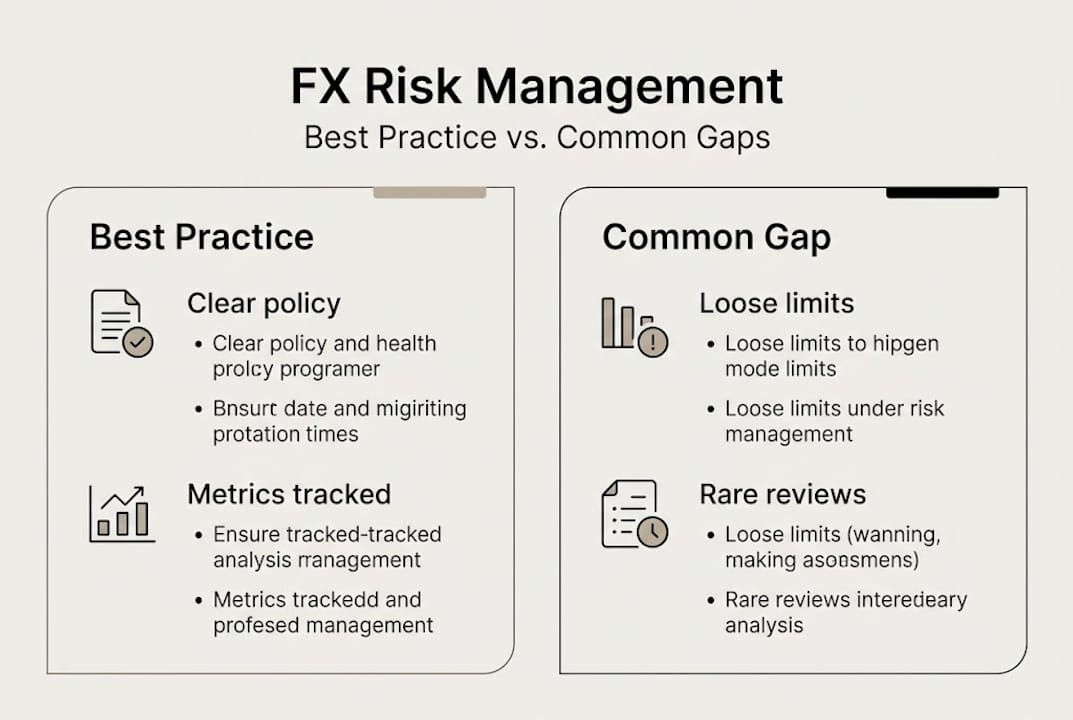
| Policy component | Best-in-class standard | Common gap |
|---|---|---|
| Risk limits | Defined per currency pair | Aggregate-only limits |
| Governance | Board-level oversight | Treasury-only decisions |
| Reporting frequency | Weekly or real-time | Monthly or ad hoc |
| Instrument diversity | Forwards, options, natural hedging | Forwards only |
| Benchmark review | Annual with triggers | Set-and-forget |
For companies benchmarking their programs, the metrics that matter most are earnings volatility reduction, cash flow variance, and hedge effectiveness ratios. Risk governance frameworks that tie these metrics to board-level reporting consistently outperform those that keep FX risk siloed in treasury. Reviewing currency risk strategy examples from peers in your sector can accelerate your program design considerably.
Pro Tip: Build a policy review trigger into your calendar, not just an annual date. If a currency pair moves more than 10% in a quarter, that is a signal to reassess your hedge ratios and instrument mix immediately.
Our take: Why a hybrid-dynamic approach is the future of forex risk management
Conventional models served a purpose when markets moved slowly and predictably. That era is over. The volatility cycles of 2024 and 2025 exposed a clear divide: companies running static, rule-based hedging programs absorbed losses that their more adaptive peers avoided.
Our view is that the future belongs to hybrid-dynamic strategies. These combine VaR and CVaR-based monitoring for ongoing measurement, forward contracts and options for instrument flexibility, and real-time treasury technology for execution speed. Static hedge ratios set once a year are not a strategy in a market where central bank pivots can reprice major currency pairs by 5% in a week.
The currency volatility prevention methods that consistently deliver results share three traits: they are formalized in policy, they use multiple instruments, and they adapt to changing conditions rather than waiting for an annual review cycle.
Formalized frameworks matter more in volatile cycles, not less. The companies that treat FX risk as a dynamic, ongoing management function rather than a compliance checkbox are the ones protecting margin. Explore best practices for hedging that reflect current market realities, not just textbook theory.
Take your forex risk management to the next level
The frameworks above are only as effective as the tools you use to implement them. CorpHedge is built specifically for financial decision-makers at international companies who need more than spreadsheets and static reports.
With CorpHedge, you get integrated FX exposure management features that connect policy, analytics, and execution in one platform. Real-time position monitoring, VaR-based strategy tools, and dynamic hedging workflows give your treasury team the visibility and speed to act before losses materialize. Take a product tour to see how the platform maps to the frameworks covered here, or request a demo to explore a solution tailored to your company's specific exposure profile and risk tolerance.
Frequently asked questions
What is the most effective way to measure forex risk?
The most effective approach combines multiple VaR methods with scenario analysis and stress testing, since no single method captures both normal and extreme market conditions adequately.
Why is selective hedging considered risky?
Selective hedging increases volatility for most firms and functions more like speculation than risk control, which is value-destructive unless the company has a genuine and consistent informational edge.
How often should FX risk policies be reviewed?
At minimum annually, but policy benchmarks suggest that best-in-class programs also build in trigger-based reviews when currency pairs move significantly outside expected ranges.
What benchmarks help compare my company's FX risk program?
The most useful benchmarks are industry hedge ratios (the average sits near 49%) and the measurable reduction in earnings and cash flow volatility attributable to your hedging program.