

TL;DR:
- Unmanaged FX exposure can lead to significant financial losses during currency moves.
- Risk management tools enable real-time exposure visibility and automated hedging, improving stability.
- AI enhancements in FX tools increase forecasting accuracy and reduce regulatory capital requirements.
FX volatility is not just a treasury inconvenience. For international companies, a single adverse currency move can quietly erase months of operating margin before anyone notices the damage. Many CFOs still rely on spreadsheets, periodic manual reviews, and informal hedging decisions, assuming their exposure is manageable. It rarely is. The evidence is clear: firms that invest in structured risk management tools consistently outperform those that do not, across stability, profitability, and forecast accuracy. This guide breaks down exactly why those tools matter, what they deliver in practice, and where even advanced platforms have real limits.
Table of Contents
- Why unmanaged FX exposure puts your business at risk
- How risk management tools transform FX risk mitigation
- The impact on financial stability and business performance
- Modern advances: AI, big data, and the limits of risk management tools
- Why the right risk management tools drive real advantage—if you avoid common pitfalls
- Unlock next-level FX risk management with CorpHedge
- Frequently asked questions
Key Takeaways
| Point | Details |
|---|---|
| Unmanaged FX risk is costly | Failing to address currency exposure can erode profits and destabilize financial planning for international companies. |
| Tools drive measurable gains | Structured platforms and TMS solutions reduce effort, lower fees, and improve earnings stability. |
| AI offers new advantages | Modern tools featuring AI and big data boost forecasting accuracy and regulatory efficiency, though require careful adoption. |
| Implementation quality matters | The best outcomes come from pairing technology with strong governance, not tech alone. |
Why unmanaged FX exposure puts your business at risk
Foreign exchange risk is not a niche problem for exotic markets. Any company that invoices in a foreign currency, sources materials abroad, or consolidates multi-currency subsidiaries carries FX exposure. The danger is that this exposure often sits quietly in the background until a sharp rate move forces it into the income statement.
Unmanaged exposure typically shows up in predictable patterns. Common vulnerabilities include:
- Currency mismatches between revenue and cost currencies that widen when rates shift
- Unhedged contracts locked at rates that no longer reflect market reality by settlement date
- Overlooked subsidiaries whose local currency positions are never consolidated into group-level risk reporting
- Delayed recognition of translation losses that distort reported earnings without warning
The financial consequences are not theoretical. Global events impacting currency rates such as central bank policy shifts, geopolitical shocks, and commodity price swings can move major pairs by 5 to 15 percent within weeks. For a company with $50 million in unhedged receivables, that is a $2.5 to $7.5 million exposure sitting unprotected.
Research confirms that firms using structured FX hedging and forecasting tools report higher financial stability, stronger return on assets, and reduced earnings volatility, while unhedged SMEs suffer measurable performance deterioration.
Manual approaches compound the problem. Spreadsheet-based tracking cannot update in real time, cannot model correlated exposures across currencies, and depends entirely on the discipline of whoever maintains the file. When FX markets move fast, manual processes move slow. Understanding market risk for CFOs is the first step, but understanding it without the tools to act on it quickly is only half the solution.
The practical result is that companies without structured tools tend to react rather than plan. They hedge after a loss, not before one. They discover exposure during close, not during origination. Effective risk management for global companies requires systems that surface exposure continuously, not quarterly.
Now that we have exposed the problems, it is clear why finance leaders are searching for more reliable solutions.
How risk management tools transform FX risk mitigation
With the stakes established, let us evaluate how these tools actually improve FX risk management.
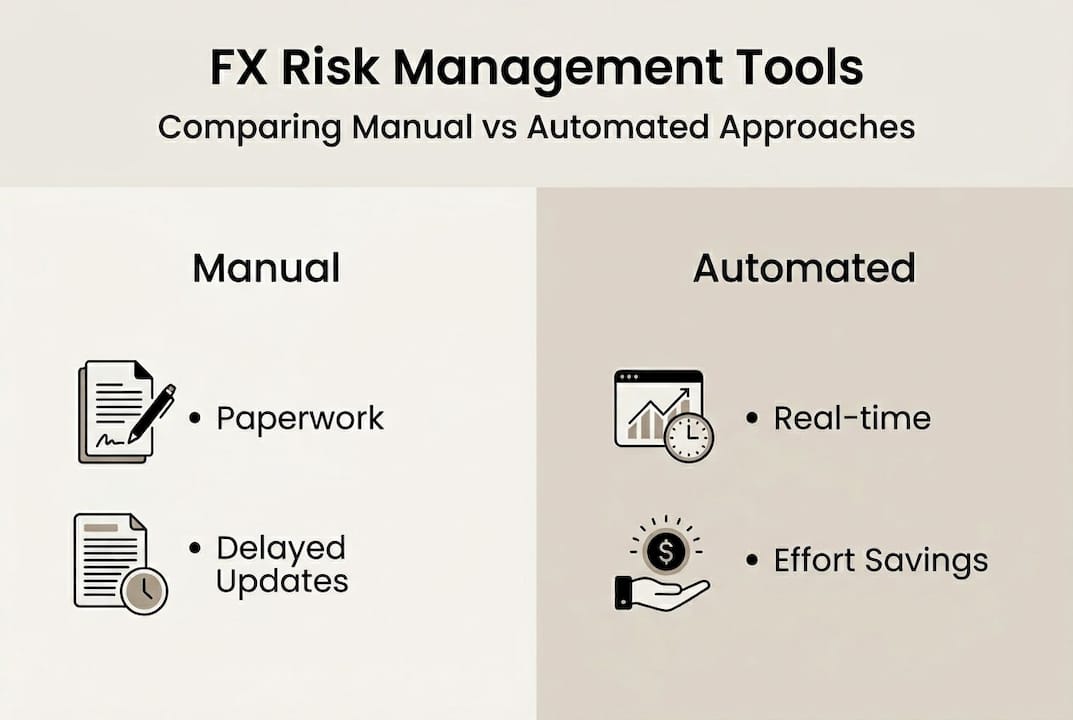
The contrast between manual and tool-driven workflows is stark. Consider what a treasury team does without dedicated software: they pull bank statements, build exposure estimates in Excel, email counterparties for quotes, and update hedge logs manually. Each step introduces lag and error. A Treasury Management System (TMS) compresses that entire cycle into a real-time dashboard.
| Dimension | Manual approach | Tool-driven approach |
|---|---|---|
| Exposure visibility | Periodic, often weekly | Real-time, continuous |
| Hedging execution | Manual calls or emails | Automated or one-click |
| Scenario modeling | Static spreadsheet | Dynamic, multi-variable |
| FX fee costs | Unoptimized, higher | Up to 60% lower |
| Team effort | High, repetitive | 30 to 40% reduced |
TMS platforms provide real-time visibility, automated hedging, exposure tracking, and scenario modeling, transforming reactive FX management into proactive strategy. That shift from reactive to proactive is where the real value lives.

Practical TMS functions that matter most include automated hedge ratio calculations, pre-configured policy rules that trigger hedges at defined thresholds, and integration with ERP systems so exposure data flows without manual entry. Scenario modeling lets your team stress-test a 10% EUR/USD move against current positions before it happens, not after.
Case studies show TMS implementation leads to 30 to 40% effort reduction, cost savings up to 60% in FX fees, and improved visibility across currency positions. Those are not marginal gains. They represent a fundamental shift in how treasury operates.
For companies actively working on mitigating FX volatility, the right platform eliminates the guesswork and replaces it with structured, auditable decision-making.
Pro Tip: When evaluating a TMS or hedging platform, prioritize automation scope over feature count. A system that automates 80% of routine hedge execution will deliver more ROI than one with dozens of features you configure manually. Start with the workflows that consume the most team hours and automate those first. You can explore the FX risk tools tour to see how automation scope maps to real treasury workflows.
The impact on financial stability and business performance
Adopting technology is one thing, but do the numbers really stack up? Here is what the data shows.
The business case for risk management tools is not built on soft benefits. It is built on measurable outcomes across stability, cost, and performance. Firms that implement structured hedging and forecasting platforms report consistent improvements across several dimensions.
Up to 60% reduction in FX fees following TMS implementation, based on documented case studies.
Here are the specific changes companies experience after implementation:
- Improved financial stability through continuous exposure monitoring that prevents surprise losses from reaching the income statement
- Higher return on assets because capital is not tied up in unplanned loss provisions or emergency hedges placed at unfavorable rates
- Lower earnings volatility which directly supports better credit ratings, lower cost of capital, and stronger stakeholder confidence
- Better forecasting accuracy because exposure data feeds directly into cash flow models rather than being estimated manually
- Capital efficiency gains from optimized hedge ratios that reduce over-hedging and the associated opportunity costs
Structured FX hedging tools consistently produce higher financial stability, stronger ROA, and reduced earnings volatility across firms that adopt them properly. The contrast with non-users is equally important. Companies that skip structured tools face not just higher FX costs but also missed growth opportunities, because unpredictable earnings make it harder to commit to long-term contracts, expansion plans, or acquisitions.
Understanding FX risk management basics is the foundation, but the tools are what convert that understanding into financial outcomes. For companies managing multi-currency complexity, the accounting service for FX volatility layer also matters, since accurate reporting of hedged positions is itself a governance requirement in many jurisdictions.
The bottom line: the cost of not acting compounds every quarter.
Modern advances: AI, big data, and the limits of risk management tools
Beyond the basics, what is the frontier of FX risk tools, and what should leaders realistically expect?
AI-driven FX platforms add capabilities that traditional TMS systems cannot match. The most significant advances are in forecasting precision, anomaly detection, and hedge ratio optimization. Where a rule-based system applies fixed thresholds, a machine learning model continuously recalibrates based on incoming market data, historical patterns, and correlated risk signals.
| Capability | Traditional tools | AI-augmented systems |
|---|---|---|
| Forecast error rate | ~18% | ~6% |
| Anomaly detection | Rule-based alerts | Continuous ML monitoring |
| Hedge ratio optimization | Manual or static | Dynamic, data-driven |
| Regulatory capital impact | Baseline | Up to 7.5% reduction |
| Explainability | High | Often limited |
AI and big data enhance forecasting accuracy by reducing error rates from approximately 18% to 6%, improve anomaly detection, and optimize hedge ratios, reducing regulatory capital requirements by 7.5%. Those numbers represent real balance sheet impact for companies operating at scale.
However, AI tools carry genuine limitations that CFOs must factor in. The explainability problem is real. When a model recommends a hedge ratio adjustment, it may not produce a clear audit trail that satisfies internal controls or regulatory review. ML models outperform traditional FX models on accuracy metrics but lack the transparency that governance frameworks often require.
Model risk also increases with complexity. An AI system trained on recent data may perform poorly during structural market breaks, exactly when accurate forecasting matters most. Reviewing hedging best practices alongside AI adoption ensures you are not replacing one blind spot with another.
Pro Tip: Before deploying an AI-augmented FX platform, run it in parallel with your existing process for at least one quarter. Track where its recommendations diverge from your current approach, and investigate each divergence. This surfaces model risk early and builds the internal confidence needed for governance sign-off. Reviewing FX hedging strategies in parallel helps you set the right policy guardrails before you automate.
Why the right risk management tools drive real advantage—if you avoid common pitfalls
So what really separates successful tool adoption from disappointment? Here is the ground-level truth.
Many companies invest in a TMS or hedging platform and see underwhelming results. The tool gets blamed. Usually, the tool is not the problem. The real failure points are almost always process and governance gaps that existed before the software arrived.
The most common failure pattern: a company implements a platform but retains informal hedging decisions made by individual managers without clear policy mandates. The tool tracks exposure accurately, but the hedges placed against it are inconsistent, sometimes speculative, and rarely reviewed against a defined risk appetite. Technology cannot fix a policy vacuum.
Research confirms that hedging reduces risk but can fail when used speculatively, and is most effective in firms with strong internal controls and clear governance structures.
The CFOs who get the best outcomes from risk management tools share three habits. They define a written FX policy before implementation. They assign clear ownership of hedging decisions with documented rationale. And they use the tool's reporting layer to create transparency for the board, not just the treasury team.
AI-driven tools add another layer of complexity here. A black-box recommendation that treasury cannot explain to the audit committee is a governance liability, regardless of its accuracy. The best approach is to use AI for signal generation and human judgment for final execution, especially for large or unusual positions. A practical real-world hedging guide can help you map that decision boundary clearly before you go live.
Unlock next-level FX risk management with CorpHedge
If you are ready to move past theory and uncertainty, here is your next step.
Every quarter you operate without structured FX risk tools is a quarter where exposure compounds silently and fees stay higher than they need to be. CorpHedge is built specifically for finance teams that need real-time visibility, automated hedging, and Value at Risk modeling without the complexity of enterprise-only platforms.
You can explore FX risk tools through our product tour to see exactly how exposure tracking and automated hedging work in practice. If you want a guided walkthrough tailored to your company's currency profile, request a demo and our team will map CorpHedge's capabilities to your specific risk landscape. You can also see tool features to review the full platform before committing to a conversation.
Frequently asked questions
What are the main types of risk management tools for FX?
The primary tools include Treasury Management Systems (TMS), structured hedging platforms, AI-powered forecasting, and exposure tracking dashboards. TMS platforms provide real-time visibility, automated hedging, exposure tracking, and scenario modeling as core functions.
Does using risk management tools always guarantee better performance?
Tools significantly improve outcomes, but success also depends on effective policies and governance. Hedging can fail when speculative or when internal controls are weak, regardless of the platform used.
How do AI and big data tools enhance FX risk management?
They improve forecasting accuracy and detect anomalies faster than rule-based systems. AI tools reduce regulatory capital by up to 7.5% and cut forecast error rates from roughly 18% to 6%.
What evidence supports investing in risk management tools?
Research and case studies both point to strong returns. TMS implementation cuts FX fees by up to 60%, reduces team effort by 30 to 40%, and lowers earnings volatility for firms that adopt structured hedging programs.