

TL;DR:
- Unhedged FX exposure causes significant profit and cash flow losses, averaging nearly $10 million in 2025.
- Effective FX risk mitigation protects margins, ensures business continuity, and enhances investor confidence.
- Continuous monitoring and adaptive strategies using tools like forwards, options, and natural hedging are essential for resilience.
Unhedged foreign exchange exposure is not a passive cost of doing business. It is an active drain on profitability that many organizations discover too late. Unhedged FX exposure caused average losses of $9.85M for US corporates in 2025, while UK firms absorbed £6.71M on average. These are not outliers. They reflect a widespread assumption that FX volatility would self-correct, that stability was the default state. This guide cuts through that assumption and walks finance professionals through the real drivers of market risk, proven mitigation methodologies, and the adaptive mindset that separates resilient firms from reactive ones.
Table of Contents
- The true cost of market risk: What recent data shows
- Why mitigate market risk? Strategic imperatives for finance leaders
- Mitigation methodologies: Practical tools and approaches
- Practical challenges, edge cases, and evolving best practices
- The uncomfortable truth: No single strategy fits all market risks
- Build resilience: Automate and optimize your FX risk mitigation
- Frequently asked questions
Key Takeaways
| Point | Details |
|---|---|
| Unhedged risk is costly | Ignoring FX market risk exposes firms to substantial losses and cash flow disruptions. |
| Strategic mitigation is essential | Protecting profits, ensuring continuity, and meeting investor/regulatory expectations all demand active mitigation. |
| Multiple tools required | Combine financial instruments and operational methods for robust risk reduction. |
| No universal solution | Tailor and regularly review strategies to fit evolving exposures and market dynamics. |
The true cost of market risk: What recent data shows
The 2025 numbers are striking. Average FX losses of $9.85M for US corporates and £6.71M for UK firms are not abstract figures. They represent eroded margins, disrupted cash flow projections, and in some cases, renegotiated credit facilities. For mid-sized multinationals operating across several currency zones, the compounding effect is severe.
Beyond the headline numbers, market risk produces a cascade of secondary consequences that finance teams often underestimate:
- Margin compression: Currency swings can eliminate entire profit layers on cross-border contracts priced months in advance.
- Funding pressure: FX volatility forces firms to hold larger cash reserves as buffers, reducing capital available for investment.
- Credit impact: Repeated FX losses signal instability to lenders and rating agencies, tightening borrowing conditions.
- Forecasting breakdown: Unpredictable currency movements make reliable financial planning nearly impossible across multiple quarters.
- Operational disruption: Budget shortfalls triggered by FX losses ripple into hiring, procurement, and expansion decisions.
| Region | Average FX loss (2025) | Hedge ratio increase |
|---|---|---|
| United States | $9.85M per firm | Up to 49% |
| United Kingdom | £6.71M per firm | 64% plan to increase |
The IMF's Global Financial Stability Report reinforces this picture: FX market stress raises funding costs, impairs liquidity, and amplifies volatility, particularly in countries with currency-mismatched balance sheets. This is not a regional problem. It is a structural vulnerability that scales with the complexity of your operations.
Proper risk management tools exist precisely to interrupt this cascade before it starts. Understanding your key FX risk exposures is the prerequisite for any effective mitigation plan. And when firms implement financial risk reduction strategies proactively, they retain the predictability that boards and investors demand.
Statistic callout: 64% of firms intend to increase hedging activity in 2026. That shift reflects not just recent losses, but a growing recognition that FX risk is a strategic lever, not an accounting footnote.
Why mitigate market risk? Strategic imperatives for finance leaders
The conversation around market risk mitigation too often stops at compliance. Regulatory requirements matter, but they are the floor, not the ceiling. The most compelling case for active mitigation is entirely strategic.
According to core market risk principles, the primary drivers of effective mitigation span five interconnected imperatives:
- Profit margin protection: FX exposure on unhedged receivables or payables translates directly into realized losses. Protecting those margins is not conservative; it is operationally sound.
- Business continuity: Currency crises in key markets have derailed otherwise profitable operations. Mitigation builds the buffer that keeps operations stable through volatile cycles.
- Reduced financial distress costs: Firms that experience sharp FX losses face rising refinancing costs and strained banking relationships. Active mitigation reduces that risk premium.
- Regulatory compliance: Basel III and IFRS 9 frameworks require firms to demonstrate measurable risk controls. Compliance is necessary, but it is a byproduct of good practice, not the goal itself.
- Investor confidence: Institutional investors scrutinize FX risk disclosures. A disciplined, documented mitigation strategy signals management quality and reduces cost of capital.
"The firms that treat FX mitigation as a strategic function rather than a compliance checkbox are the ones that maintain pricing power through volatility."
Dynamic market environments add another layer of complexity. Firms with operations in high-volatility emerging markets face asymmetric risks that a static policy simply cannot address. Your firm's risk appetite should inform how aggressively you hedge, not the other way around.
Pro Tip: Mitigating FX risk is not just about buying forwards. Over-hedging against exposures you do not actually carry creates its own drag on profitability. Align your hedge ratio with your actual net exposure across currencies before selecting instruments. Revisit profit protection strategies regularly as your business mix shifts.
Mitigation methodologies: Practical tools and approaches
Knowing why to mitigate is the easy part. The harder question is how. Finance professionals have a broad toolkit available, and the right combination depends on your firm's exposure profile, cost tolerance, and operational structure.
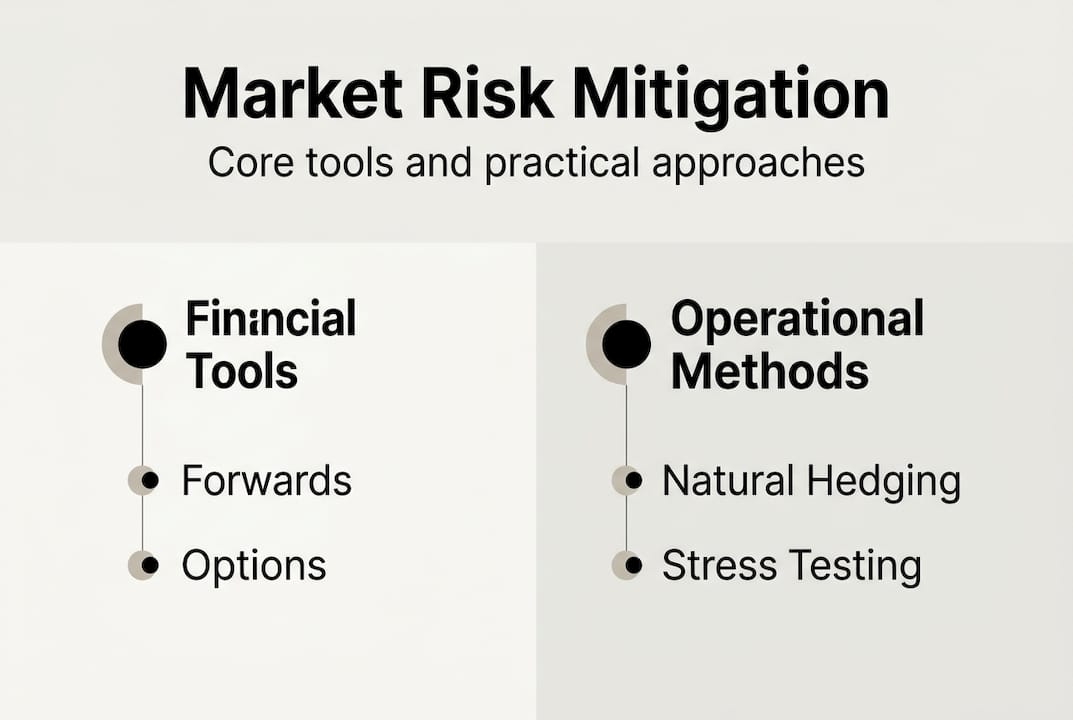
Core mitigation methodologies include forwards, options, swaps, natural hedging, Value at Risk modeling, stress testing, and scenario analysis. Each serves a different function within a coherent risk framework.
| Method | Cost | Flexibility | Effectiveness |
|---|---|---|---|
| Forward contracts | Low to moderate | Low (locks in rate) | High for known exposures |
| FX options | Higher (premium) | High | High for uncertain timing |
| Currency swaps | Moderate | Moderate | High for long-duration debt |
| Natural hedging | Minimal | Moderate | Medium, depends on structure |
For firms evaluating FX hedging strategies, the process of selecting and implementing the right mix follows a clear sequence:
- Map your exposures: Identify transaction, translation, and economic exposures across all currency pairs and time horizons.
- Quantify risk: Apply Value at Risk (VaR) models and scenario analysis to estimate potential loss ranges under adverse conditions.
- Set hedge objectives: Define target hedge ratios by currency and time period, aligned with your board-approved risk appetite.
- Select instruments: Match instruments to exposure type. Forward contracts suit known future payables; options work better for contingent exposures.
- Execute and document: Establish clear documentation for hedge accounting treatment under IFRS 9 or ASC 815, as applicable.
- Review and rebalance: Schedule periodic reviews, not just at year-end, to catch exposure drift before it becomes costly.
Operational approaches like natural hedging, where a firm matches revenue and cost currencies by geography, reduce the need for financial instruments. This is a particularly effective tactic for enterprise risk management at scale.

Pro Tip: Run scenario analysis against your hedge book at least quarterly. Market conditions shift faster than annual review cycles can track, and a hedge that made sense six months ago may now be misaligned with your actual exposure.
Practical challenges, edge cases, and evolving best practices
Textbook strategies rarely survive first contact with implementation reality. Understanding where hedging programs break down is as important as understanding how they work.
The most common challenges finance teams encounter include:
- Incomplete hedging: Many firms hedge their largest exposures but leave smaller currency pairs unprotected, creating cumulative vulnerability.
- Cost versus coverage trade-offs: Options premiums can be prohibitive, especially for emerging market currencies with high implied volatility.
- Emerging market volatility: Currency pairs in developing economies experience larger swings and incomplete hedging, making standard approaches insufficient.
- Counterparty risk: Especially in extended forward contracts, the creditworthiness of your hedging counterparty becomes a risk in itself.
- Internal alignment gaps: Treasury decisions often outpace what ERP systems can capture, creating documentation and reporting lags.
Research published in Hedging Currency Exposure confirms that dynamic strategies outperform static approaches over time. Robust hedging programs that adjust to market signals consistently outperform those locked into fixed policies, while natural hedging can substitute financial instruments for multinationals with diversified operational structures.
"Emerging market economies face disproportionate FX risk. The combination of larger currency swings and structurally incomplete hedging markets makes standard corporate approaches inadequate for firms with meaningful EME exposure."
A frequent mistake is treating all markets with the same methodology. A forward contract strategy calibrated for EUR/USD cannot simply be transplanted to a position in BRL or TRY. Adaptive approaches that adjust instrument selection and hedge ratios by market context outperform uniform policies in back-tested scenarios.
In 2026, best practice is moving toward continuous monitoring and automated rebalancing. Platforms that support reducing earnings volatility through real-time position tracking are replacing quarterly spreadsheet reviews as the baseline expectation for sophisticated treasury functions.
The uncomfortable truth: No single strategy fits all market risks
Most published frameworks on market risk mitigation present a clean decision tree: assess exposure, select instrument, execute hedge, review annually. The firms that follow this to the letter often discover its limits during a genuine FX shock.
The reality is messier. Every firm carries a unique combination of transaction, translation, and economic exposures. Their risk appetite evolves with leadership changes and strategic pivots. Their counterparty relationships constrain instrument choice. And their internal systems often lag their ambitions.
Static policies fail not because the instruments are wrong, but because the policies are not built to adapt. The firms we see navigate volatility most effectively are not those with the most sophisticated models. They are the ones that manage volatility proactively and treat their risk framework as a living document.
Pro Tip: Conduct a risk audit at least quarterly, not as a compliance exercise, but as a genuine stress test of your current positions against updated exposure data. Compliance alone does not equal resilience. It means you met yesterday's standards. Effective risk management means being ready for tomorrow's market.
Build resilience: Automate and optimize your FX risk mitigation
Understanding the theory is one thing. Operationalizing it across a live portfolio of currency exposures, under real-time market pressure, is where most treasury teams find the gap between strategy and execution.
CorpHedge is built to close that gap. Our market risk management solutions give finance teams real-time visibility into currency positions, automated VaR-based strategy recommendations, and seamless integration with platforms like Corpay. Whether you are refining your hedge ratio or building a mitigation program from the ground up, you can request a demo to see exactly how it fits your workflow. Explore the full range of FX exposure management features designed for professionals who need precision, not guesswork.
Frequently asked questions
What are the main risks if market risk is not mitigated?
Ignoring market risk can result in major profit margin erosion, elevated financing costs, and severe cash flow disruption. Unhedged FX losses averaged $9.85M for US firms and £6.71M for UK firms in 2025 alone.
What is the most effective tool for mitigating FX market risk?
There is no single best tool. Forward contracts, options, and natural hedging each serve distinct roles depending on your exposure type, timing certainty, and cost tolerance.
How often should market risk strategies be reviewed?
Best practice is to review and adjust risk strategies at least quarterly, or immediately when exposures shift materially due to new contracts, acquisitions, or market disruptions.
Does regulatory compliance mean market risk is properly managed?
Not necessarily. Compliance supports risk reduction, but effective management requires continuously adapting strategies to actual exposures, not just satisfying the regulatory minimum.