

TL;DR:
- Market risk involves losses from adverse market price or rate movements, while credit risk stems from borrower default.
- Measurement tools differ: VaR, stress tests, and sensitivities are used for market risk; PD, LGD, and EAD are used for credit risk.
- Misclassifying risks leads to ineffective hedging and underestimated exposures, especially in hybrid cases like credit spreads.
Many financial professionals treat market risk and credit risk as two sides of the same coin, managing them with similar tools and expecting similar outcomes. That assumption is costly. Market risk is the risk of losses from adverse movements in market prices or rates, while credit risk operates through an entirely different mechanism. Getting this distinction right determines how you structure hedges, allocate capital, set risk appetite, and stay ahead of regulators. This article breaks down both risk types, their measurement frameworks, and where they dangerously overlap.
Table of Contents
- Market risk and credit risk: Core definitions and impacts
- Methodologies for assessing and managing market risk
- Methodologies for assessing and managing credit risk
- Nuances and overlaps: Credit spread risk, IRRBB, and hybrid cases
- Why risk boundaries matter and what most professionals overlook
- Enhance your risk management with CorpHedge solutions
- Frequently asked questions
Key Takeaways
| Point | Details |
|---|---|
| Clear risk distinctions | Market and credit risks are fundamentally different in scope, sources, and management. |
| Frameworks and models | VaR, stress testing, and provisioning models offer robust ways to measure and control risks. |
| Nuances and hybrids | Some risks, like credit spreads and IRRBB, blur traditional boundaries and require nuanced handling. |
| Regulatory evolution | FRTB and Basel IV demand new approaches for capital and risk modeling in international firms. |
| Strategic application | Understanding and leveraging these distinctions enhances profitability and financial stability. |
Market risk and credit risk: Core definitions and impacts
To build a solid foundation, you need precise definitions, not textbook summaries but working definitions that hold up under real trading conditions.
Market risk is the risk of losses from adverse movements in market prices or rates. For international companies, this shows up in FX positions, interest rate exposure on floating-rate debt, equity holdings, and commodity price sensitivity. It lives primarily in the trading book, where positions are marked to market daily. A sharp move in EUR/USD, a spike in oil prices, or a sudden shift in yield curves all generate immediate, measurable P&L impact.
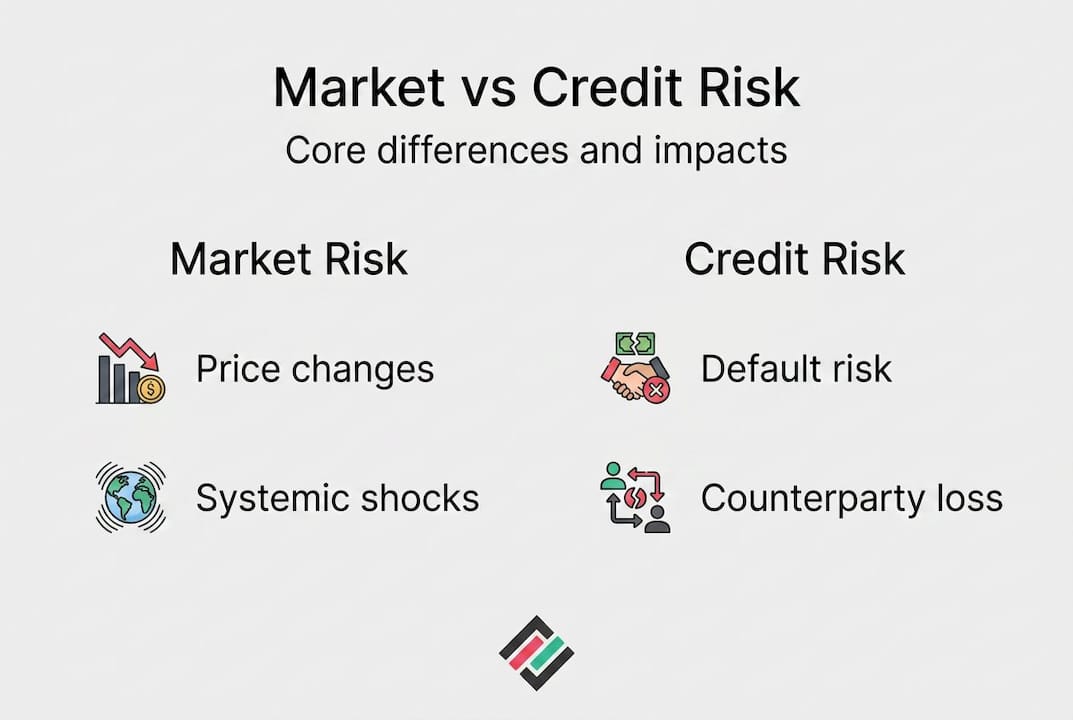
Credit risk is the risk of loss from a counterparty's failure to meet obligations. It sits mainly in the banking book, tied to loans, bonds held to maturity, trade receivables, and derivative counterparty exposures. Unlike market risk, credit risk often plays out slowly. A borrower's creditworthiness deteriorates over months before default actually occurs.
Here is a direct comparison to make the distinction concrete:
| Dimension | Market risk | Credit risk |
|---|---|---|
| Primary source | Price/rate movements | Counterparty default or downgrade |
| Book location | Trading book | Banking book |
| Time horizon | Short-term (daily VaR) | Medium to long-term |
| Measurement | VaR, Greeks, stress tests | PD, LGD, EAD, ECL |
| Regulatory framework | FRTB, Basel market risk | Basel IRB, IFRS 9, CECL |
| P&L impact | Immediate mark-to-market | Gradual through provisioning |
Both risk types affect profitability and financial stability, but through different channels. Market risk hits the income statement fast and hard. Credit risk erodes it slowly, often masked by provisioning smoothing until a wave of defaults forces a reckoning.

It is also worth distinguishing systemic from idiosyncratic risk. Systemic market risk affects all participants simultaneously, like a global rate shock. Idiosyncratic credit risk is specific to one borrower or counterparty. Understanding this distinction shapes how you diversify and hedge.
Methodologies for assessing and managing market risk
Now that definitions are clear, let's look at how you actually measure and control market risk in practice.
The key methodologies for market risk include Value at Risk (VaR), stress testing, sensitivities (Greeks), FRTB standardized approaches, and internal models. Each serves a different purpose, and the most robust risk programs use all of them together.
Value at Risk (VaR) answers a specific question: what is the maximum loss your portfolio could suffer over a given time horizon at a given confidence level? A 1-day 99% VaR of $5 million means you expect losses to exceed $5 million only 1% of the time. VaR is fast, intuitive, and widely embedded in regulatory capital calculations. You can apply hedging based on VaR to set hedge ratios directly tied to your portfolio's statistical loss profile, which is far more precise than rule-of-thumb approaches.
However, VaR has a well-known weakness: it tells you nothing about what happens in the worst 1% of scenarios. That is where stress testing fills the gap.
Stress testing simulates extreme but plausible market scenarios, such as a 2008-style credit crunch, a sudden 20% currency devaluation, or a 300-basis-point rate spike. It reveals tail risks that VaR models systematically underestimate. For a deeper technical walkthrough of how these models interact, the value at risk guide from CorpHedge covers the mechanics in practical detail.
Sensitivities (Greeks) are most relevant for derivatives portfolios. Delta measures exposure to the underlying price, vega to volatility, and so on. These granular measures let traders hedge specific risk dimensions rather than relying solely on portfolio-level VaR.
The regulatory landscape is shifting significantly. The Fundamental Review of the Trading Book (FRTB) introduces stricter boundaries between trading and banking books, limits the use of internal models, and increases capital requirements for many institutions. Here is a summary of the main market risk tools and their use cases:
- VaR (historical or Monte Carlo): Daily capital calculation and position limits
- Expected Shortfall (ES): Replaces VaR under FRTB for regulatory capital, capturing tail risk better
- Stress testing: Scenario analysis for extreme events and board-level risk reporting
- Sensitivity analysis (Greeks): Derivatives hedging and desk-level risk management
- Backtesting: Validates model accuracy by comparing VaR predictions against actual P&L
For teams building or refining their measurement infrastructure, the VaR calculation workflow resource provides a step-by-step framework specifically designed for FX risk contexts.
Pro Tip: Never rely on VaR alone for risk oversight. Run VaR and stress testing in parallel. VaR anchors your daily limits; stress tests reveal what breaks your portfolio under conditions VaR never anticipates. Boards and regulators increasingly expect both.
Methodologies for assessing and managing credit risk
Having covered market risk tools, let's turn to credit risk frameworks, which operate on a fundamentally different logic.
Credit risk measurement centers on three core variables:
- Probability of Default (PD): The likelihood that a counterparty will default within a given period, typically one year. PD is estimated using internal rating models, external credit ratings, or market-implied signals like CDS spreads.
- Loss Given Default (LGD): The fraction of exposure you actually lose if default occurs, after accounting for collateral recovery and seniority. A secured loan may have an LGD of 20%; an unsecured subordinated bond could be 70% or higher.
- Exposure at Default (EAD): The total value at risk at the moment of default. For revolving credit facilities, EAD is not fixed because drawdown behavior changes as borrowers approach distress.
These three variables feed into expected loss calculations: Expected Loss = PD × LGD × EAD. This formula underpins both regulatory capital requirements and internal pricing decisions.
The key methodologies for credit risk include Expected Credit Loss (ECL) under IFRS 9 and CECL, PD/LGD/EAD modeling, Internal Ratings-Based (IRB) approaches, and standardized risk weights under Basel. Each approach has specific regulatory contexts and practical trade-offs.
ECL provisioning under IFRS 9 and CECL replaced the older incurred loss model. The difference matters enormously. ECL forward-looking provisioning improves credit risk timeliness compared to historical incurred loss methods. Rather than waiting for a loss to occur, ECL requires you to provision based on expected future deterioration, using macroeconomic forecasts and borrower-specific signals.
Under Basel's IRB approach, sophisticated institutions estimate their own PD, LGD, and EAD inputs for regulatory capital, subject to supervisory floors. Basel IV tightens these floors significantly, particularly for large corporate exposures, pushing many banks toward standardized risk weights. This shift has real capital implications for international lending portfolios.
The key credit risk methodologies in practice include:
- Foundation IRB (F-IRB): Banks estimate PD; regulators set LGD and EAD
- Advanced IRB (A-IRB): Banks estimate all three inputs, subject to floors
- Standardized approach: Fixed risk weights by asset class, simpler but less risk-sensitive
- ECL staging: IFRS 9 classifies exposures into Stage 1 (performing), Stage 2 (significant deterioration), and Stage 3 (credit-impaired), with provisioning increasing at each stage
Pro Tip: Watch for procyclicality in ECL provisioning. During economic downturns, forward-looking models demand higher provisions exactly when capital is scarce, amplifying stress. Build countercyclical capital buffers in good times specifically to absorb this dynamic.
Nuances and overlaps: Credit spread risk, IRRBB, and hybrid cases
After outlining credit risk methods, let's clarify where the boundaries between market and credit risk become genuinely blurry. This is where many practitioners make expensive classification errors.
Credit spread risk is the clearest example of a hybrid. When credit spreads widen, the mark-to-market value of a corporate bond in your trading book falls immediately. That is a market risk loss, captured by VaR and stress testing. But the same spread widening also signals rising default probability, which is a credit risk concern. As one authoritative source puts it, credit spread risk is a hybrid: market risk for trading book mark-to-market losses from spread widening, and pure credit risk for default probability assessment.
The practical implication: a corporate bond held in the trading book requires both market risk capital (for spread volatility) and credit risk assessment (for default probability). Misclassifying it as purely one or the other leaves you underhedged on one dimension.
"A single corporate bond can simultaneously generate a market risk loss through spread widening and a credit risk event through issuer downgrade. Treating these as separate, independent risks leads to double-counting in some firms and blind spots in others."
Interest Rate Risk in the Banking Book (IRRBB) is another area that confuses practitioners. IRRBB is measured via Net Interest Income (NII) and economic value, distinct from trading book market risk. It captures how changes in interest rates affect the banking book's long-term value and earnings, not just short-term mark-to-market positions. IRRBB sits between market and credit risk conceptually but is governed by its own regulatory framework under Basel's Pillar 2.
Additional hybrid cases worth knowing:
- Counterparty Credit Risk (CCR) on derivatives: A derivative's market value fluctuates (market risk), but if the counterparty defaults when the derivative is in-the-money, you face a credit loss
- Settlement risk: Short-term credit risk that arises during the settlement window of FX transactions
- Wrong-way risk: When counterparty credit quality deteriorates exactly as your exposure to them increases, a correlation that standard models often miss
For a broader view of how market risk strategies connect to FX management, and how FX risk management basics apply across these hybrid scenarios, these resources offer practical frameworks for CFOs and treasury teams. Understanding the full spectrum of FX risk types and mitigation approaches is especially relevant when managing cross-border portfolios where multiple risk types interact.
Why risk boundaries matter and what most professionals overlook
Here is a perspective you won't find in most textbooks or regulatory guides.
The biggest risk management failures we observe are not caused by bad models. They are caused by misclassification. When a firm treats credit spread risk as purely a market risk problem, it hedges the spread volatility but ignores the underlying credit deterioration. When it treats IRRBB as a simple interest rate hedge, it misses the behavioral complexity of deposit repricing. These are not edge cases. They are common errors in organizations that silo their risk functions too rigidly.
There is also a concentration problem that standard frameworks underestimate. Credit risk models assume idiosyncratic defaults are uncorrelated, so diversification reduces portfolio risk. But in practice, industry concentrations, geographic clusters, and supply chain dependencies create hidden correlations. When one large counterparty defaults, it often signals stress across an entire sector. The idiosyncratic assumption breaks down precisely when you need it most.
Regulatory shifts compound this. FRTB and Basel IV are not just compliance exercises. They reshape which risks are expensive to hold and which are not. Firms that proactively restructure their books ahead of regulatory deadlines gain a real competitive advantage. Those that wait for final rules often scramble to shed exposures at unfavorable prices. The essential market risk strategies that matter most in 2026 are the ones built with regulatory trajectory in mind, not just current requirements.
Our view: risk boundaries are not bureaucratic labels. They determine which desk owns the hedge, which model generates the capital number, and which regulator reviews your methodology. Getting them right is a strategic decision, not a technical one.
Enhance your risk management with CorpHedge solutions
Understanding the distinction between market and credit risk is the first step. Operationalizing that understanding across live portfolios is where most teams need support.

CorpHedge provides a platform built specifically for international companies managing FX and market risk in real time. Our tools support hedging based on VaR, giving treasury and risk teams a data-driven foundation for hedge decisions rather than relying on intuition or static rules. With real-time visibility into currency positions, integration with platforms like Corpay, and analytics aligned with current regulatory standards, CorpHedge helps you move from risk awareness to risk control. If you want to see how these capabilities apply to your specific portfolio, reach out to the CorpHedge team for a consultation or platform demo.
Frequently asked questions
What is the main difference between market risk and credit risk?
Market risk arises from adverse movements in market prices or rates, while credit risk stems from a counterparty's failure to fulfill financial obligations. The key distinction is the trigger: price movement versus counterparty behavior.
How are market risk and credit risk measured?
Market risk is measured using VaR, stress testing, and sensitivities; credit risk relies on PD, LGD, and EAD models, ECL provisioning, and Basel standardized or IRB risk weights.
Can credit spread risk belong to both market and credit risk?
Yes. Credit spread risk is market risk for trading book mark-to-market valuation when spreads widen, but it is credit risk when assessing the underlying default probability of the issuer.
How do FRTB and Basel IV affect risk measurement?
FRTB raises market risk capital requirements and tightens internal model eligibility; Basel IV limits credit IRB modeling for large corporates, pushing many institutions toward standardized approaches with higher capital floors.
Why is ECL provisioning more timely than traditional methods?
ECL forward-looking provisioning anticipates losses using macroeconomic forecasts rather than waiting for a loss event to occur, improving timeliness significantly, though it introduces procyclicality risk during economic downturns.