

TL;DR:
- A well-defined FX policy with documented hedge ratios and controls helps companies protect margins from currency volatility.
- Implementing a clear 30-60-90 action plan ensures exposure inventory, policy drafting, and operational systems are completed efficiently.
A board-approved FX policy with a defined exposure inventory, documented hedge ratios, and an operational desk book is the fastest way to protect margins and cash flow from currency volatility. Get those four elements in place first, and everything else follows.
The three protections your plan must deliver:
- Cash-flow certainty: lock in enough of your forecast receivables and payables to budget with confidence
- Margin protection: prevent exchange-rate moves from eroding EBIT on contracts already signed
- Governance: board sign-off, segregation of duties, and documented procedures that survive staff turnover
30/60/90 action plan:
- 30 days (Treasury): Complete a full exposure inventory by currency, entity, and tenor. Identify the top three currency pairs by notional volume.
- 60 days (CFO): Draft the board-level FX policy. Define hedge ratios, approved instruments, and materiality thresholds. Circulate for board approval.
- 90 days (Treasury + BUs): Publish the desk book, run a pilot hedge program on the largest exposure, and confirm system connectivity.
Table of Contents
- What are the 10 priority factors every currency plan must cover?
- What goes into the board-approved FX policy and the desk book?
- How do you choose the right hedging approach and instruments?
- What governance and controls prevent unauthorized FX positions?
- What operational systems and controls reduce errors and cost?
- What should you report to the CFO and board, and how often?
- Six steps to implement your currency plan this quarter
- Key Takeaways
- What leading Central European CFOs do differently
- Corphedge maps directly to your FX policy requirements
- FAQ
What are the 10 priority factors every currency plan must cover?
The key considerations in currency planning below form a completeness checklist. If any item is missing from your current policy, that gap is where your next FX loss will come from.
- Board-approved FX policy — with stated objectives and risk appetite
- Hedging horizon and triggers — (when to open, roll, or close a hedge)
| Factor | Lives in Policy | Lives in Desk Book | Lives in Systems |
|---|---|---|---|
| Objectives and risk appetite | ✓ | ||
| Hedge ratios and limits | ✓ | ||
| Instrument eligibility | ✓ | ||
| Transaction procedures | ✓ | ||
| Trade documentation checklist | ✓ | ||
| Exposure capture and MTM | ✓ | ||
| VaR and stress testing | ✓ |
A currency hedging policy checklist covering objective, scope, materiality, instruments, authority, limits, controls, and review schedule is the fastest way to audit your current policy for gaps.
Pro Tip: For Central European companies with PLN or SEK exposure, prioritize EUR/PLN and EUR/SEK as your first hedged pairs. Both currencies carry meaningful rate differentials versus EUR, and local market expertise in CEE reduces legal and transactional friction when selecting bank counterparties.
What goes into the board-approved FX policy and the desk book?
A formal FX policy defines objectives, risk appetite, roles, measurement methods, and compliance monitoring. The desk book translates that into daily tasks.
Policy must include:
- Objective (cash-flow protection, margin protection, or both)
- Scope (which entities, currencies, and exposure types are covered)
- Materiality threshold (minimum notional below which hedging is not required)
- Permitted instruments and any explicit prohibitions
- Hedge ratio ranges (minimum and maximum by exposure type)
- Review cadence and board reapproval requirement
- Explicit no-speculation statement
Desk book must include:
- Step-by-step transaction procedures (request, approval, execution, confirmation)
- Trade documentation checklist (term sheet, ISDA confirmation, system entry)
- Valuation and accounting steps (MTM source, IFRS 9 designation, effectiveness test schedule)
- Exception handling (what triggers escalation, who approves overrides)
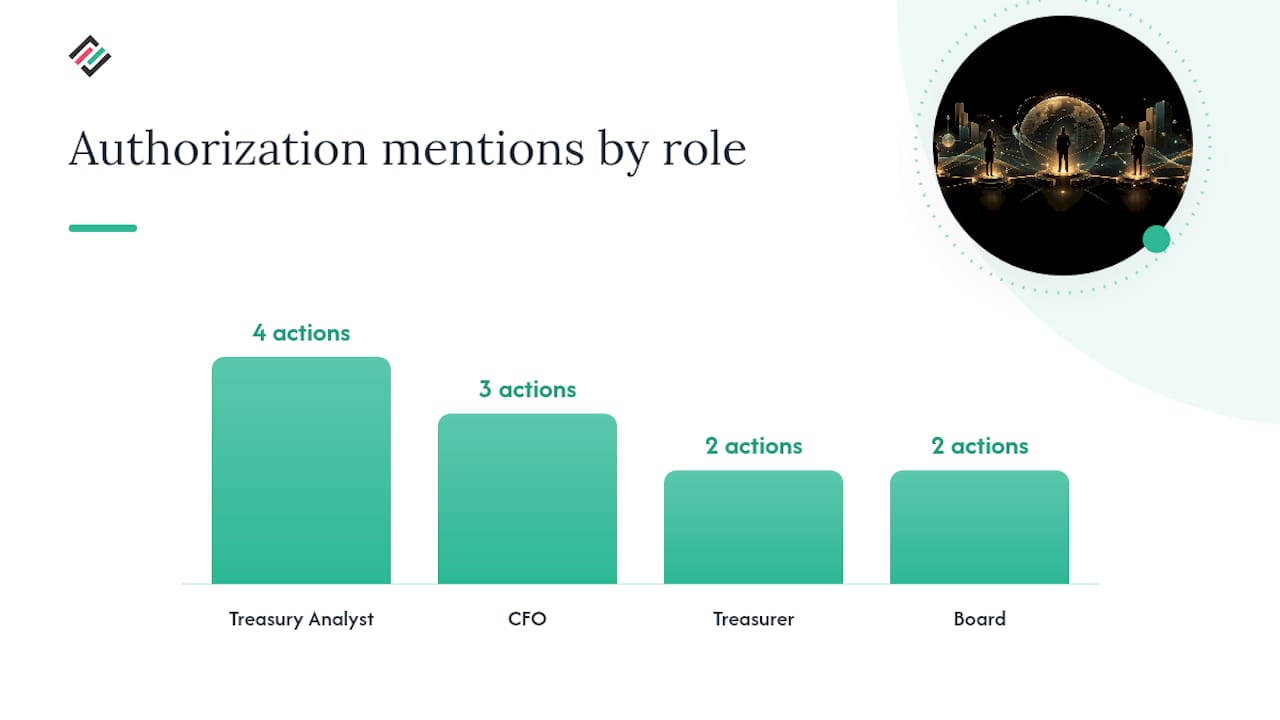
Authorization matrix:
| Action | Treasury Analyst | Treasurer | CFO | Board |
|---|---|---|---|---|
| Execute hedge up to €1M | Propose | Approve | ||
| Execute hedge €1M–€10M | Propose | Approve | ||
| Execute hedge above €10M | Propose | Recommend | Approve | |
| Policy amendment | Draft | Review | Recommend | Approve |
How do you choose the right hedging approach and instruments?
The decision comes down to four variables: exposure certainty, premium budget, IFRS 9 accounting objectives, and whether you need a guaranteed rate or want to retain upside. Dynamic hedging strategies adapt continuously and suit companies with variable forecast accuracy; static hedges suit predictable, contractual cash flows.
Instrument decision matrix:
| Instrument | Best for | Accounting | Premium |
|---|---|---|---|
| Forward | Contractual payables/receivables | IFRS 9 cash-flow hedge | None |
| Vanilla option | Contingent or low-confidence forecast | IFRS 9 or cost-of-hedging | Upfront |
| Collar/participating forward | Forecast exposure with upside appetite | IFRS 9 cash-flow hedge | Reduced/zero |
| Cross-currency swap | Long-dated structural or balance-sheet | Net investment hedge | Embedded |
Three scenario examples:
- Firm payable in 90 days: Use a forward. Certainty is high, no premium, and IFRS 9 designation is straightforward.
- Seasonal revenue forecast (medium confidence): Layer forwards over 3–6 months at 50–70% of forecast, adding a collar for the remainder to retain upside if the forecast misses.
- Long-dated structural exposure (3+ years): Consider a cross-currency swap or a rolling forward program reviewed quarterly against updated VaR limits.
For advanced instrument selection and structured hedging ideas, match the tenor of the hedge to the tenor of the underlying exposure.
Pro Tip: In high rate-differential environments like PLN or SEK versus EUR, forward points can be significant. Price the carry cost explicitly before committing to long-dated forwards, and consider whether a shorter rolling program reduces total cost.
What governance and controls prevent unauthorized FX positions?
Segregation of duties is non-negotiable. The person who executes a trade must not be the same person who confirms, values, or reconciles it. Best-practice FX governance requires documented policy, qualified staff, uniform accounting procedures, and scheduled policy reviews every two to three years or after a material event.
Control checklist:
- Segregation of dealing, confirmation, and reconciliation functions
- Counterparty onboarding process with credit limit approval
- Signed ISDA Master Agreement and CSA before any derivative trade
- Independent valuation source (not the executing bank's mid-rate alone)
- Daily reconciliation of open positions to the TMS or ledger
- Quarterly reconciliation of treasury results to GAAP/IFRS financials
Speculation statement (recommended board wording): "The company enters derivative transactions solely to reduce identified FX exposures. No transaction may be entered for speculative purposes. Any exception requires CFO and board approval and must be reported to the audit committee."
What operational systems and controls reduce errors and cost?
Reliable execution depends on the infrastructure underneath the policy. For global payment scheduling and operational controls, the minimum viable setup includes multi-currency subledgers, a netting process, and automated exposure feeds.
System capabilities by impact:
| Capability | Impact | Priority |
|---|---|---|
| Automated exposure capture from ERP | Eliminates manual data gaps | High |
| Real-time MTM and VaR calculation | Enables limit monitoring | High |
| Automated hedge execution and confirmation | Reduces operational error | High |
| TMS/bank connectivity | Speeds settlement and reconciliation | Medium |
| Rate grid and payment instruction controls | Prevents unauthorized rates | Medium |
Integrated treasury systems that combine cash-flow analysis, exposure tracking, and accounting impact reporting give CFOs a single source of truth across currency and interest-rate risk.
What should you report to the CFO and board, and how often?
Reporting template:
| KPI | Threshold | Frequency |
|---|---|---|
| Hedge ratio by currency/tenor | Within policy min/max | Monthly |
| MTM of open positions | Within VaR limit | Weekly |
| Hedge effectiveness (IFRS 9) | — | Quarterly |
| FX impact on EBIT vs. forecast | Variance explained | Monthly |
| Forecast error rate by BU | — | Monthly |
Policy review cadence: Quarterly monitoring by treasury. Annual reapproval by the board. Event-driven review triggers include M&A activity, a material FX loss, a new market entry (Poland and Sweden, for example), or a significant shift in revenue currency mix.
Six steps to implement your currency plan this quarter
| Step | Owner | Acceptance Criteria |
|---|---|---|
| 1. Board sign-off on FX policy | CFO | Signed policy document, minutes recorded |
| 2. Exposure inventory and data cleanup | Treasury + FP&A | All entities mapped; top 5 pairs identified |
| 3. Desk book and authorization matrix published | Treasurer | Procedures signed off by CFO and legal |
| 4. Pilot hedge program on largest exposure | Treasury | First trade executed, confirmed, and reconciled |
| 5. Systems and bank connectivity confirmed | Treasury + IT | ERP feed live; MTM and VaR calculating |
| 6. Full rollout and first quarterly review | CFO | Board report delivered; KPIs within policy limits |
The pilot in step 4 is your go/no-go checkpoint. If the trade cannot be executed, confirmed, and reconciled cleanly within 48 hours, fix the system gap before expanding the program. Embedding FX risk into pricing and procurement decisions at step 6 is what converts the plan from a compliance exercise into a margin-protection tool.
Key Takeaways
A board-approved FX policy with a documented desk book, defined hedge ratios, and segregated controls is the foundation every corporate currency plan requires to protect margins and satisfy audit.
| Point | Details |
|---|---|
| Policy before instruments | Board approval, scope, and materiality thresholds must exist before any hedge is executed. |
| Exposure classification drives ratios | Map hedge ratios to forecast confidence tiers; high-certainty exposures warrant higher coverage. |
| Segregation of duties | Dealing, confirmation, and reconciliation must be performed by separate individuals. |
| Review cadence | Quarterly monitoring, annual reapproval, and event-driven reviews after M&A or material losses. |
| Corphedge for automation | Corphedge automates exposure capture, VaR-based hedge sizing, and reporting for Central European treasury teams. |
What leading Central European CFOs do differently
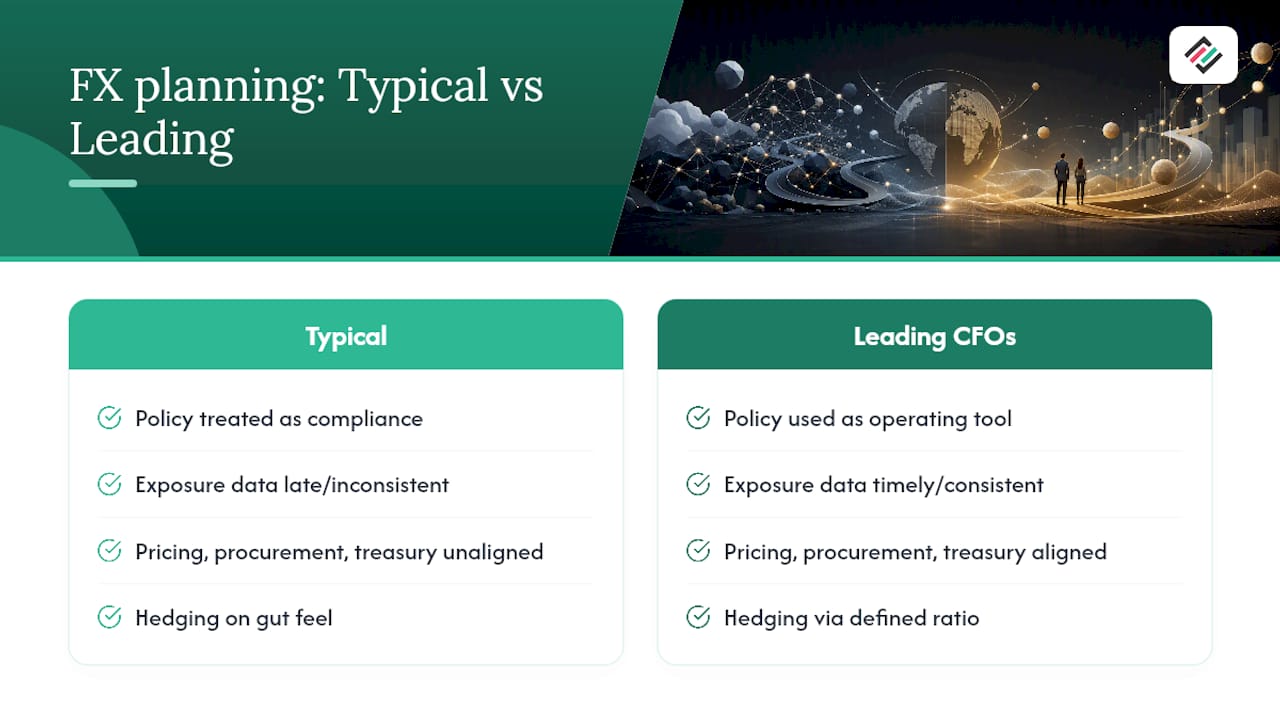
The most common mistake in corporate currency planning is treating the FX policy as a compliance document rather than an operating tool. Finance teams draft a policy, get board sign-off, then file it. The desk book never gets written. Business units keep submitting exposure data late or in inconsistent formats. Treasury ends up hedging on gut feel rather than a defined ratio.
What separates the better-run treasury functions in Central Europe is alignment between pricing, procurement, and treasury. When the procurement team knows the reference rate embedded in a supplier contract, and the sales team prices in the functional currency wherever possible, the residual FX exposure that treasury needs to hedge shrinks. That is the point FX risk management best practices make about embedding currency planning into strategy: it reduces the cost of hedging, not just the risk.
For companies entering Poland or Sweden, two practical notes. In Poland, EUR/PLN liquidity is deep and local bank counterparties are well-established, but regulatory reporting requirements for derivative transactions require attention from day one. In Sweden, EUR/SEK is similarly liquid, but the SEK tends to move sharply on global risk sentiment, which makes a layered, rolling hedge program more appropriate than a single large forward.
The other underrated factor is staff. A policy is only as good as the people executing it. Qualified treasury personnel who understand both the instruments and the accounting implications of IFRS 9 hedge designation are not optional. Invest in training before the first live trade, not after the first reconciliation error.
Corphedge maps directly to your FX policy requirements
CFOs who have built the policy framework above need a platform that executes it without adding manual overhead. Corphedge delivers exactly that: automated exposure capture from your ERP, VaR-based hedge sizing that ties directly to your policy limits, real-time MTM reporting, and IFRS 9 documentation support.
The six-step implementation roadmap above maps cleanly onto a Corphedge pilot: exposure inventory feeds directly into the platform, the first pilot hedge runs through the execution module, and the quarterly board report pulls from live data rather than a spreadsheet. For treasury teams in Poland and Sweden, Corphedge's bank connectivity and multi-currency ledger support are already configured for local market requirements.
Take a product tour to see how the exposure tracking and VaR modules align with your policy, or contact the team to scope a pilot against your largest currency pair.
FAQ
What are the most important factors in corporate currency planning?
The most important factors are a board-approved FX policy, a complete exposure inventory, defined hedge ratios by confidence tier, approved instruments, and segregated operational controls. Without all five, the plan has an exploitable gap.
How often should a company review its FX hedging policy?
Quarterly monitoring is standard, with a full board reapproval annually. Event-driven reviews are required after M&A activity, a material FX loss, or a significant change in revenue currency mix.
What is the difference between static and dynamic hedging?
Static hedging locks in a hedge at a single point in time and suits predictable, contractual cash flows. Dynamic (layered or rolling) hedging adjusts continuously and suits companies with variable forecast accuracy or sensitivity to carry costs.
Does Corphedge support IFRS 9 hedge accounting documentation?
Yes. Corphedge includes compliance integrations and documentation support designed to meet IFRS 9 hedge designation and effectiveness-testing requirements, reducing the manual burden on treasury teams.
How should Central European companies handle PLN or SEK exposure?
Prioritize EUR/PLN and EUR/SEK as your first hedged pairs, use local bank counterparties familiar with CEE regulatory requirements, and price forward carry costs explicitly before committing to tenors beyond six months.