

An FX adjustment clause resets a contract's price or payments when exchange rates move past an agreed threshold, using a named baseline rate, a defined reference-rate source, and a fixed formula to calculate the change. Use one in any multi-month B2B contract where currency swings could meaningfully erode margin. The rule of thumb: never leave the rate source, baseline date, threshold, formula, or settlement mechanics open to interpretation. Every one of those five elements has to be spelled out in the contract text, not implied.
TL;DR:
- FX adjustment clauses must explicitly specify the reference currency, baseline rate, source, valuation window, and threshold to be enforceable.
- Using an averaging window helps smooth out short-term volatility and prevent gaming of single-day rates.
- Caps, collars, and asymmetric thresholds should be negotiated carefully to balance risk sharing and avoid unfair exposure.
- Automating rate feeds and calculations reduces disputes and ensures consistent, auditable evidence for threshold breaches.
- Operational processes for logging rates and issuing adjustments should be clear and executable to avoid reliance on vague or subjective language.
Table of Contents
- What FX Adjustment Clauses Are and When You Need One
- The Elements Every Drafter Must Name
- Writing the Formula: A Worked Example
- Choosing Between Splits, Collars, and Caps
- Making the Clause Work Day to Day
- What This Means for Your Accounting Close
- Drafting Pitfalls to Catch Before You Sign
- How Automation Turns FX Clauses Into Enforceable Terms
- Negotiating Priorities: What Actually Matters
- Sources
- FAQ
What FX Adjustment Clauses Are and When You Need One
A currency adjustment clause exists to keep the original deal intact when exchange rates drift. It specifies the reference currency, the calculation method, and the timing of any change, so neither party quietly absorbs a loss it never agreed to carry, according to sample clause language collected by LawInsider.
Without one, contract law defaults to the nominal-value principle: the debtor pays the stated amount regardless of currency movement, leaving the payee to bear any depreciation risk, as Travers Smith explains. That default makes these clauses standard in multi-year supply agreements, cross-border licensing deals, and large service contracts priced in one currency but delivered in another.
Clauses and hedging aren't substitutes. Forwards and options cover known, scheduled payments; a clause covers the residual exposure on amounts you can't fully hedge, particularly on long-dated or renewable contracts.
The Elements Every Drafter Must Name
Vague FX language is the single biggest source of post-signing disputes. Precedent drafting from LexisNexis and Practical Law point to the same short list of variables that must appear explicitly:
- Reference currency and baseline rate, tied to a specific baseline date (usually the contract signing or effective date).
- Reference-rate source, named precisely (Bank of England, European Central Bank, a Reuters or Bloomberg fix) with the exact publication time. "Market rate" is not a source.
- Valuation or averaging window, since a single-day snapshot invites gaming around a spike.
- Trigger threshold, the percentage move that activates the adjustment.
- Pass-through share, caps, floors, and rounding convention, so both sides can calculate the same number independently.
- Notice, evidence, and invoice mechanics, covering how and when the adjustment gets billed.
Miss any one of these and you've written a clause that sounds precise but is functionally unenforceable, because there's nothing objective to point to when the parties disagree.
Writing the Formula: A Worked Example
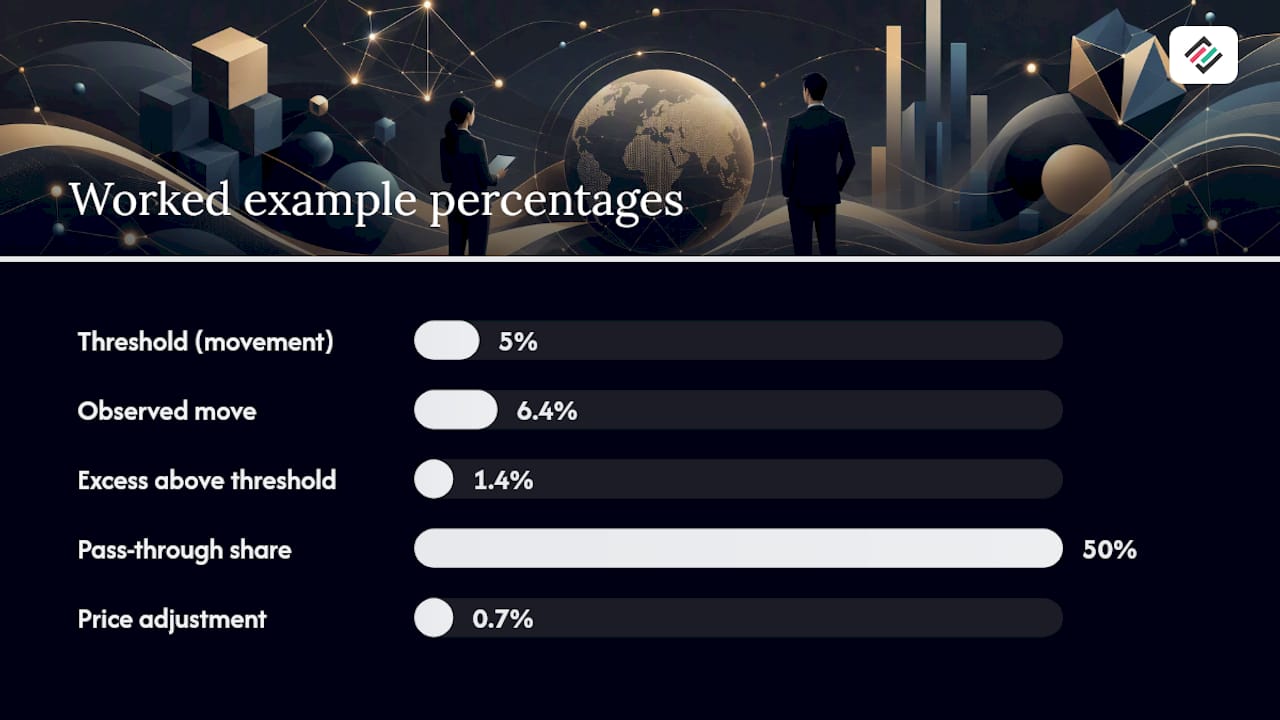
The formula itself should fit in one sentence. A common structure: Adjustment = (Observed Rate − Baseline Rate) / Baseline Rate × Contract Value × Pass-Through Share, applied only once the percentage move exceeds the threshold, following the structuring approach outlined by LegalClarity.
Here's how that plays out in practice:
- Set the baseline. Contract signed with GBP/USD at 1.2500 as the baseline rate.
- Define the threshold. Adjustment triggers only if the rate moves more than 5% from baseline.
- Observe the rate. At the quarterly valuation date, the Bank of England's 4:00 PM fix shows GBP/USD at 1.3300, a 6.4% move.
- Apply pass-through. With a 50/50 split, the buyer absorbs half the excess above the 5% threshold, so the price adjusts by roughly 0.7% of contract value.
- Round and invoice. Round to the nearest $0.01 and issue a supplemental invoice line item referencing the clause number.
An averaging window (commonly 20 to 30 trading days) is often preferable to a single snapshot rate, since it smooths out one-day volatility that doesn't reflect a genuine shift in currency value.
Choosing Between Splits, Collars, and Caps
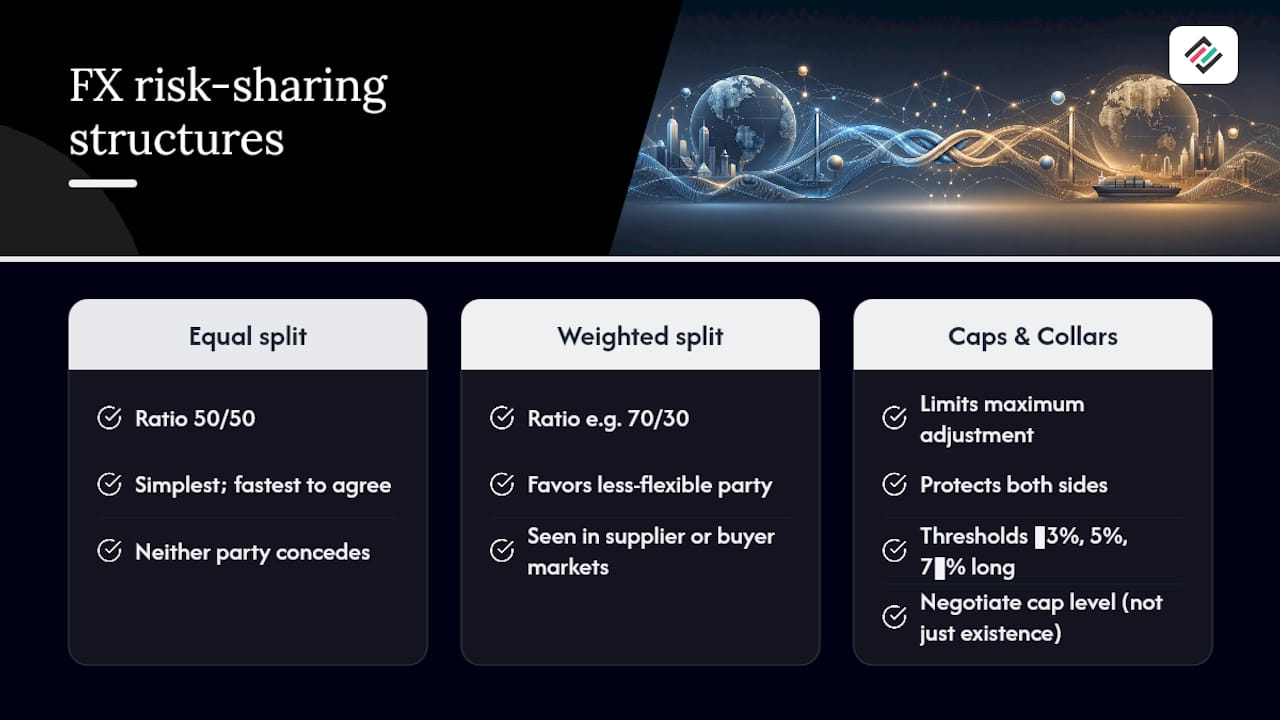
Most negotiated clauses fall into one of three risk-sharing structures. An equal split (50/50) is the simplest and often the fastest to agree, since neither party feels they've conceded more ground. A weighted split (70/30, favoring whichever party has less pricing flexibility) shows up more often in supplier-favorable or buyer-favorable markets.
On thresholds, practitioner guidance from Cambridge Currencies suggests roughly 3% for short-dated contracts, 5% as the most common middle ground, and 7% to 10% for long-dated agreements where you expect more natural drift. Caps and collars limit the maximum adjustment in either direction. They protect both sides from a worst-case currency event but can leave one party exposed beyond the cap if a currency crisis runs deeper than anyone modeled. Negotiate the cap level, not just its existence.
Making the Clause Work Day to Day
A clause is only as good as the process behind it. Set your valuation cadence up front, whether that's quarterly, annual, or per-invoice, and match the observation timing exactly to what the clause names (same source, same time of day, every time).
Build in a notice window of 10 to 15 business days for the party seeking the adjustment to submit supporting evidence, and a verification window of 5 to 7 business days for the other side to confirm or challenge the calculation, an approach consistent with Practical Law's drafting guidance. If the parties can't agree, name a fallback: expert determination, a short mediation window, or a defined arithmetic default that applies automatically if no objection is raised in time. On the invoicing side, present the adjustment as a distinct line item referencing the clause, not folded silently into a revised unit price, so both accounting teams can trace it.
What This Means for Your Accounting Close
Contractual settlement dates and accounting remeasurement dates rarely line up, and that gap creates real reporting friction. Finance teams must remeasure foreign-currency receivables and payables at each reporting date, while the actual contractual adjustment only happens on the valuation date the clause names, according to clause commentary from LawInsider. That mismatch can create earnings volatility that doesn't match the eventual cash settlement.
Three controls limit the damage: monthly remeasurement of open FX-denominated balances, an accrual for likely adjustments once a threshold looks close to breach, and clear disclosure of the methodology in financial statement notes. For a deeper look at reconciling these timing gaps, see Corphedge's guide to currency exchange accounting.
Drafting Pitfalls to Catch Before You Sign
Most disputes trace back to a handful of repeatable mistakes:
- A rate source described generically ("prevailing market rate") instead of named precisely.
- No observation time specified, so both sides can point to a different rate on the same day.
- No rounding convention, leaving room for pennies-level disagreements to become principle-level fights.
- Asymmetric triggers, where the clause protects one party against depreciation but not the other against appreciation.
Pro Tip: Redline any FX clause that uses the word "reasonable" near a rate or threshold. "Reasonable" has no arithmetic value, and it's the word that ends up in front of an expert determiner.
How Automation Turns FX Clauses Into Enforceable Terms
A clause is only as reliable as the data feeding it. Manually tracking baseline rates, watching for threshold breaches, and reconciling invoice adjustments across a portfolio of contracts is where most disputes actually originate, not in the drafting itself.
Corphedge's FX risk management platform pulls automated rate feeds from named sources, records the baseline rate at contract signing, and generates scheduled valuation reports with a built-in audit trail, so both counterparties are working from the same numbers when a threshold is breached. That audit trail shortens the verification window considerably, because the evidence a counterparty would otherwise have to assemble by hand is already timestamped and exportable. Teams building out a broader hedging program alongside their clause strategy can also work through the mechanics in Corphedge's FX hedging course, and Corphedge is currently expanding its platform into the Poland and Sweden markets as demand for structured FX risk tools grows across the region.
Negotiating Priorities: What Actually Matters
Clever formulas lose to clear ones every time a dispute lands in front of a third party. The clauses that hold up are the ones where a junior analyst on either side could redo the math from scratch and get the same number. Push for symmetric bands, not one-sided protection dressed up as balance. And treat operational readiness (can you actually pull the rate, log the baseline, and issue the adjustment on time) as part of the drafting exercise, not an afterthought for someone else to solve later. A clause nobody can execute is worse than no clause at all, because it creates false confidence.
— Bartas
Sources
- Currency Adjustment Clause Samples — LawInsider
- Pricing and payment clauses: who bears the risk of currency fluctuation? — Travers Smith
- Currency exchange risk clause — LexisNexis UK
- How to structure currency adjustment clauses in contracts — LegalClarity
FAQ
What are the key clauses of an international sales contract?
Beyond payment terms, delivery, and warranties, international sales contracts typically include a currency or FX adjustment clause, a governing law clause, a force majeure clause, and a dispute resolution mechanism, since cross-border deals carry risks domestic contracts don't face.
How can I avoid a foreign exchange rate adjustment fee?
You generally can't avoid the fee once a clause's threshold is triggered by contract design, but you can minimize surprise by negotiating a wider threshold, an averaging window, or a cap that limits the adjustment's size.
Why did I get a foreign exchange rate adjustment fee?
You likely received one because the reference rate named in your contract moved past the agreed threshold between the baseline date and the valuation date, triggering the pass-through formula specified in the clause.
What are foreign currency translation adjustments?
These are accounting entries that arise when a company remeasures foreign-currency assets, liabilities, or subsidiary financials into its reporting currency at each period end, distinct from a contractual FX adjustment clause, though the two can create timing mismatches on the same underlying exposure.