

A complete currency impact assessment runs six sequential steps: (1) identify and classify every FX exposure, (2) build the net transaction exposure (NTE) by currency and maturity, (3) quantify using sensitivity analysis, simulation, and VaR, (4) aggregate results into dashboards, (5) convert findings into hedging decisions, and (6) embed governance and monitoring. Run all six and your risk committee gets costed scenarios, not guesses.
If the number exceeds your materiality threshold, steps 4 through 6 become urgent, not optional.
Key trust signals woven through each step: sensitivity analysis for fast checks, Monte Carlo simulation for distributional views, Value at Risk (VaR) for horizon-specific loss estimates, stress testing for tail scenarios, and Corphedge as the platform that ties all of it together.
- Step 1: Classify every exposure as transaction, translation, or economic.
- Step 2: Aggregate into a net position register by currency and maturity bucket.
- Step 3: Run sensitivity, simulation, VaR, and stress tests.
- Step 4: Build dashboards and report by audience.
- Step 5: Set hedge ratios, choose instruments, and document IFRS designations.
- Step 6: Govern, backtest, and recalibrate quarterly.
That is your Tier 1 exposure and it needs a hedge decision before the next board meeting.*
Key Takeaways
A complete FX exposure assessment requires six sequential steps, from exposure classification through governance, with VaR and stress testing as the quantitative core and IFRS 9 documentation as the accounting anchor.
| Point | Details |
|---|---|
| Classify exposures first | Separate transaction, translation, and economic exposure before measuring anything. |
| Build the NTE register | Aggregate net positions by currency and maturity bucket; treat confirmed and unconfirmed flows separately. |
| Use multiple metrics | Combine sensitivity (±10%), Monte Carlo VaR, and stress tests; backtest VaR monthly against actual P&L. |
| Report by audience | Daily currency ladder for treasury, weekly summary for CFO, monthly risk committee packet with scenario analysis. |
| Document hedges at inception | IFRS 9 designation must be completed before the hedge is executed, not after. |
| Corphedge for operations | Corphedge connects the exposure register, VaR engine, and hedge documentation in one platform, available for Polish and Swedish entities. |
Table of Contents
- What are the currency impact assessment steps for identifying FX exposures?
- How do you build the net transaction exposure by currency and maturity?
- Which quantitative methods should you use to measure currency risk?
- How should you aggregate and report FX results to stakeholders?
- How do you convert the assessment into a hedging decision?
- What governance model keeps the assessment reliable over time?
- Worked example: EUR-based firm with a USD receivable
- What tools and data inputs does your treasury team need?
- Implementation checklist and suggested timeline
- What I would prioritize this week
- Corphedge fits directly into this six-step process
- Sources
- FAQ
What are the currency impact assessment steps for identifying FX exposures?
McKinsey's currency risk framework divides exposures into three types, each needing a different measurement approach.
Transaction exposure covers cash flows already contracted: invoices, purchase orders, intercompany loans, and lease payments in a foreign currency. These are the most urgent to hedge because the amounts and dates are known.
Translation exposure arises when you consolidate foreign subsidiaries into your EUR reporting currency. The P&L and balance sheet move with spot rates at period-end, but the cash impact is often zero. Financial statements frequently obscure true FX effects, which is why leading firms build an exposure register rather than reading the income statement and calling it done.
Economic exposure is the hardest to measure: how a sustained rate shift changes your competitive position, pricing power, and long-run margins. A Polish manufacturer selling into Germany faces economic exposure even if every invoice is EUR-denominated, because its cost base is in PLN.
Classify before you measure. Mixing transaction and economic exposure in one number produces a figure that is too large to hedge and too vague to act on. Separate them at the source-system level — AR/AP for transaction, consolidation pack for translation, and budget/strategic plan for economic — and assign a named owner to each bucket.
Source systems to consult: ERP (SAP, Oracle, Microsoft Dynamics), AR/AP subledgers, intercompany loan schedules, FP&A forecast files, and the treasury management system (TMS). Tag each row with maturity date, confidence level (confirmed vs. unconfirmed), and the entity's functional currency.
How do you build the net transaction exposure by currency and maturity?
The NTE formula is straightforward: NTE = Foreign-currency receivables − Foreign-currency payables − Existing forward contracts, aggregated per currency per maturity bucket.
Identifying revenue streams by currency and selecting the right exchange-rate convention (spot, average, or forward) is the first concrete action before any conversion or variance analysis.
| Field | Description |
|---|---|
| Entity | Legal entity holding the exposure |
| Functional currency | Entity's base currency (e.g., EUR, PLN) |
| Exposure type | Transaction / translation / economic |
| Foreign currency | USD, GBP, SEK, etc. |
| Gross amount (FC) | Face value in foreign currency |
| Maturity date | Expected settlement date |
| Confidence | Confirmed (contracted) or unconfirmed (forecast) |
| Existing hedge | Forward or option already in place |
| Net amount (FC) | Gross minus existing hedge |
Aggregate net amounts into maturity buckets: spot, 0–3 months, 3–6 months, 6–12 months, and beyond 12 months. Treat confirmed and unconfirmed flows separately — unconfirmed forecasts carry higher uncertainty and typically warrant lower hedge ratios.
- Offset local receipts against payables in the same currency before hedging the residual.
- Net intercompany positions across entities before going to market.
- Exclude forwards already designated as hedges from the gross exposure to avoid double-counting.
Which quantitative methods should you use to measure currency risk?
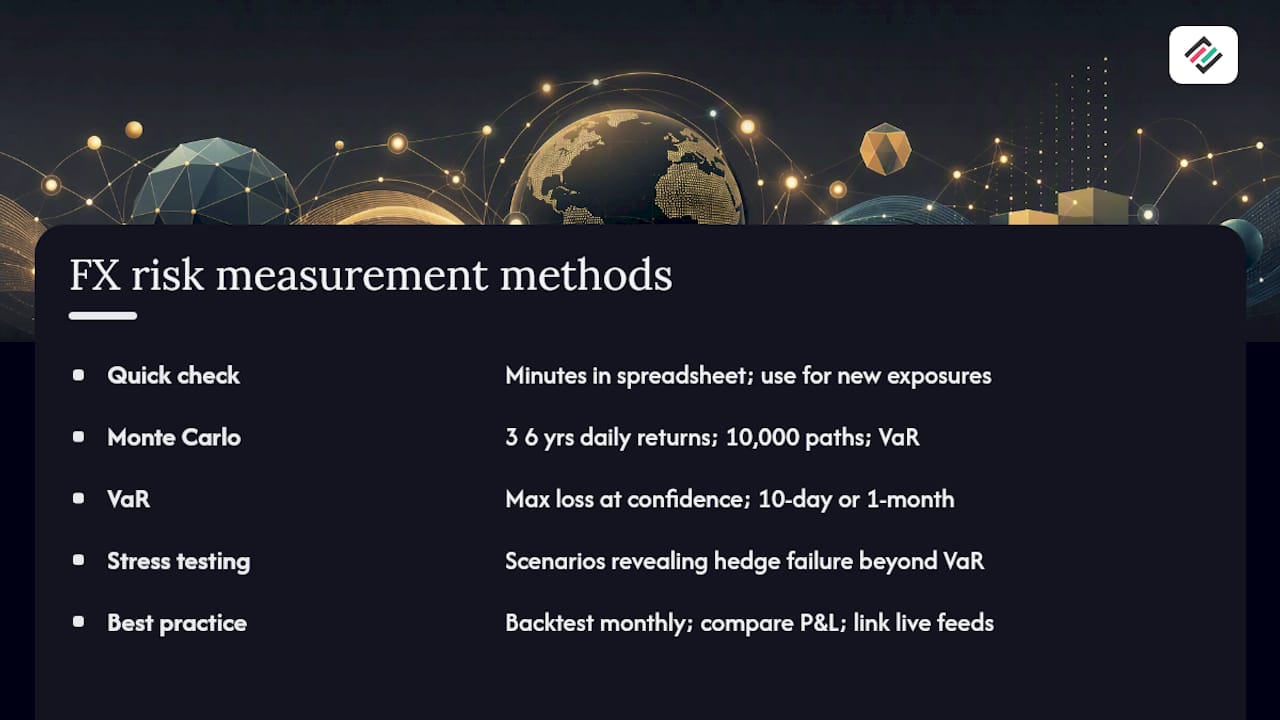
Three methods cover the full range from fast materiality check to board-level risk disclosure.
It takes minutes in a spreadsheet and immediately answers the materiality question. Use it every time a new exposure is added or a rate moves sharply.
Empirical simulation and Monte Carlo go further. Transaction exposure ranges can be estimated by ad-hoc percentage rules, empirical simulation, or distributional assumptions; Monte Carlo produces a simulated distribution for range and VaR interpretation..pdf) Feed three to five years of daily FX returns into a Monte Carlo engine, run 10,000 paths, and read the loss at the 95th or 99th percentile. That figure is your VaR.
VaR gives a single number: the maximum loss at a chosen confidence level over a chosen horizon (typically 10-day or 1-month for treasury). It is useful for limit-setting and board reporting, but it understates tail risk during correlation breakdowns.
Backtest VaR regularly. Best practice is to use multiple risk measures — mark-to-market, VaR, and stress testing — and to backtest VaR models periodically rather than relying on a single metric. Compare predicted losses against actual P&L monthly and recalibrate when breach rates exceed your confidence-level expectation.
Stress testing fills the gap VaR leaves. These scenarios reveal whether your hedge portfolio holds up when markets stop behaving normally.
Pro Tip: Link your risk analytics dashboard to live rate feeds so sensitivity outputs update automatically when spot moves more than 1% intraday. Manual refreshes miss the window for same-day hedging decisions.
How should you aggregate and report FX results to stakeholders?
Effective FX risk management rests on three operational pillars: exposure management (data quality), standardized processes, and treasury execution linked to reporting cadence. The dashboard is where those pillars become visible to decision-makers.
Core dashboard fields:
- NTE by currency and maturity bucket (the currency ladder)
- VaR by horizon (10-day, 1-month) at 95% and 99% confidence
- Stress loss vs. budget tolerance for each scenario
- Hedge coverage ratio by currency and bucket
- Mark-to-market on existing hedges
Tailor the view to the audience. Treasury operations needs the full currency ladder daily. The CFO and CEO want a one-page summary: total NTE, VaR, hedge coverage, and any breach of policy limits. The risk committee packet adds scenario analysis, backtesting results, and a recommendation on any open positions exceeding the materiality threshold.
Suggested cadence: daily position update for treasury, weekly summary for the CFO, monthly risk committee packet, and a quarterly strategic review that recalibrates the model.
How do you convert the assessment into a hedging decision?
The decision framework has three tiers based on materiality and policy:
- Accept: NTE below the materiality threshold; monitor but do not hedge.
- Monitor: NTE above threshold but within policy tolerance; review at next cycle.
- Hedge: NTE above threshold and outside policy tolerance; act before the next reporting date.
| Instrument | Primary use case | Key consideration |
|---|---|---|
| Forward contract | Lock in rate for confirmed receivables/payables | Simple, zero premium, limits upside |
| Vanilla option | Protect against adverse moves, retain upside | Premium cost; useful for unconfirmed flows |
| Cross-currency swap | Hedge long-dated intercompany loans | Basis risk; requires ISDA documentation |
| Collar | Cap premium cost while limiting upside | Useful when forward rate is unattractive |
Cost estimation: compare the forward rate against the budget rate. If the forward is better than budget, the hedge locks in a gain. If worse, quantify the cost as a percentage of gross margin before approving.
IFRS 9 hedge accounting requires formal designation at inception: document the hedging relationship, the risk management objective, and the effectiveness test method. Failure to designate means P&L volatility from mark-to-market movements on the hedge instrument, even when the economic hedge works perfectly. VaR-based hedging workflows on Corphedge support this documentation process.
What governance model keeps the assessment reliable over time?
Governance is what separates a one-time exercise from a repeatable process.
- Define roles: Treasury executes; FP&A owns forecast inputs; accounting owns hedge designation and effectiveness testing; the risk committee approves policy changes and limit breaches.
- Set KPIs: hedge coverage ratio vs. policy target, VaR breach frequency, forecast error by currency, and hedge effectiveness test pass rate.
- Calibrate monthly: refresh the exposure register, update VaR parameters if market volatility has shifted, and check that existing hedges still align with the underlying exposure.
- Review quarterly: reassess materiality thresholds, policy limits, and instrument choices in light of the strategic plan.
- Escalate immediately when a single currency position breaches the policy limit or when a stress scenario produces a loss exceeding the board-approved tolerance.
Pro Tip: Segregate duties so the person executing trades cannot also approve the hedge designation. Auditors and regulators in Central Europe increasingly expect this separation, particularly for entities reporting under IFRS.
Worked example: EUR-based firm with a USD receivable
A Central European firm (EUR functional currency) has a confirmed USD 2,000,000 receivable due in 90 days. Spot rate: EUR/USD 1.0800.

| Metric | Calculation | Result |
|---|---|---|
| EUR equivalent at spot | USD 2,000,000 / 1.0800 | EUR 1,851,852 |
| ±10% sensitivity (adverse) | Rate moves to 1.188 | EUR 1,683,502 |
| P&L impact (adverse) | 1,851,852 minus 1,683,502 | EUR 168,350 loss |
| ±10% sensitivity (favorable) | Rate moves to 0.972 | EUR 2,057,613 |
| 95% VaR (Monte Carlo, 90-day) | Simulated 95th percentile loss | approximately EUR 95,000 to EUR 120,000 |
The EUR 168,350 adverse sensitivity likely exceeds a materiality threshold for most mid-market firms. Leave unconfirmed pipeline unhedged or use options.
For Polish (PLN) or Swedish (SEK) entities running the same template, replace the functional currency and spot rate. The column structure and decision logic stay identical. Quantitative FX assessment tips from Corphedge cover model configuration for multi-entity setups.
- Spreadsheet columns: Entity | Currency pair | Gross FC amount | Spot rate | EUR equivalent | ±10% adverse EUR | ±10% favorable EUR | VaR (95%) | Hedge recommendation
- Add a "confidence" column to weight unconfirmed flows at 50% for hedge-ratio purposes.
What tools and data inputs does your treasury team need?
The three non-negotiables for a repeatable assessment are clean exposure data, standardized rate sources, and a treasury execution engine that converts decisions into trades and accounting designations. Without all three, the assessment is a one-time spreadsheet exercise rather than an operational control.
Rate sources: European Central Bank (ECB) daily reference rates for EUR pairs; National Bank of Poland (NBP) for PLN; Sveriges Riksbank for SEK. For forward curves, use interbank mid-market rates from your banking counterparties or a market data provider.
Required ERP/TMS fields: entity, currency, amount, maturity, document type (invoice, PO, loan), and confidence flag. FP&A forecast files should export at the same granularity. Machine learning approaches for scenario generation can supplement historical rate series when building Monte Carlo inputs for longer horizons.
Minimum output set: NTE register (Excel or TMS), scenario pack (sensitivity + stress tables), VaR dashboard (live or weekly refresh), and a two-page board slide summarizing net position, hedge coverage, and open risk.
Implementation checklist and suggested timeline
- Weeks 1–2 (data capture): Pull AR/AP, intercompany, and forecast data from ERP. Assign exposure owners. Agree on materiality threshold with CFO.
- Weeks 3–4 (exposure register): Build the NTE register by currency and maturity. Validate against GL balances. Identify Tier 1 currencies.
- Weeks 5–6 (modelling): Run sensitivity and Monte Carlo for Tier 1 currencies. Configure VaR parameters (horizon, confidence level). Document stress scenarios.
- Weeks 7–8 (dashboard): Build the currency ladder and VaR dashboard. Connect to live rate feed. Produce first risk committee packet.
- Weeks 9–10 (governance): Draft or update the FX policy. Define roles, limits, and escalation triggers. Schedule monthly and quarterly review cadence.
- Weeks 11–12 (first hedge cycle): Execute hedges on Tier 1 positions. Complete IFRS 9 designation documentation. Run first backtest against prior-period actuals.
That alone moves you from reactive to informed.
What I would prioritize this week
The most common mistake Central European CFOs make is treating the annual budget FX rate as a risk management tool. It is a planning assumption, not a hedge. Three things I would commission immediately:
First, ask treasury to produce the NTE register for the top three currencies by gross exposure. If it takes more than two days, the data infrastructure is the first problem to fix. Numbers in euros get decisions; percentages get deferred. Third, check whether existing forwards are properly designated under IFRS 9. Undesignated hedges create P&L noise that obscures the real risk picture.
For Central European operations with Polish or Swedish entities, prioritize PLN and SEK exposures separately from EUR. Both currencies can move independently of EUR/USD, and correlation assumptions that hold in normal markets break down during regional stress events. Build the currency ladder to show PLN and SEK as distinct lines, not rolled into a catch-all "other."
If coverage is below your policy target, that is the agenda item.
Corphedge fits directly into this six-step process
Corphedge gives treasury teams a single platform to run every step of this assessment without stitching together spreadsheets and disconnected rate feeds. The exposure register and position tracking update in real time as ERP data flows in. VaR calculations run on live market data, and scenario packs generate in minutes rather than days.

For teams converting assessment outputs into hedge decisions, the VaR-based hedging workflow on Corphedge maps directly to IFRS 9 designation requirements, so the documentation that auditors need is produced as a byproduct of the hedging decision, not a separate manual task. Dashboards are pre-built for treasury operations, CFO summaries, and risk committee packets. Corphedge is available now for Central European entities, including operations in Poland and Sweden. Take the product tour to see how the platform maps to your current assessment gaps.
Sources
- Getting a better handle on currency risk — McKinsey
- The Group of 31 Report: Core Principles for Managing Multinational FX Risk
- How to calculate FX impact on revenue — Wise (2025)
FAQ
What are the six currency impact assessment steps?
Identify and classify exposures, build the net transaction exposure register, quantify using sensitivity and VaR, aggregate into dashboards, convert findings into hedging decisions, then govern and backtest. Run them in sequence every quarter.
How do you calculate net transaction exposure?
Subtract foreign-currency payables and existing forward contracts from foreign-currency receivables, then aggregate by currency and maturity bucket. Treat confirmed and unconfirmed flows in separate columns.
When should you use Monte Carlo simulation vs. a simple sensitivity check?
Run Monte Carlo when you need a distributional view, a VaR figure for board reporting, or a confidence interval for hedge-ratio decisions.
What IFRS considerations apply to FX hedging?
IFRS 9 requires formal hedge designation at inception, including documentation of the hedging relationship, risk management objective, and effectiveness test method. Designation must happen before the hedge is executed.
How does Corphedge support the assessment process?
Corphedge connects the exposure register, live VaR calculations, scenario testing, and IFRS 9 hedge documentation in one platform, covering Central European entities including operations in Poland and Sweden.