

TL;DR:
- FX options offer downside protection while allowing upside participation, making them suitable for uncertain or contingent exposures. They typically cost 1–5% of notional premiums and can reduce cash-flow volatility by up to 45%, justifying their use when exposure is uncertain. A disciplined governance framework and quantitative measurement are essential for effective implementation and monitoring.
Use FX options when you need downside protection but want to keep upside participation. Unlike a forward contract, which locks in a rate and eliminates both risk and reward, an option works like insurance: you pay a premium, set a floor, and still benefit if the market moves your way. That core asymmetry is why corporate treasuries in Central Europe reach for options when exposure is uncertain, contingent, or tied to a bid that may never close.
Two facts worth anchoring to: typical OTC option premiums run 1–5% of notional, depending on tenor, strike, and implied volatility. And companies that apply structured FX hedging reduce cash-flow volatility by 23–45% while improving earnings stability by 30–50%. For a CFO presenting to a board, those numbers justify the premium conversation.
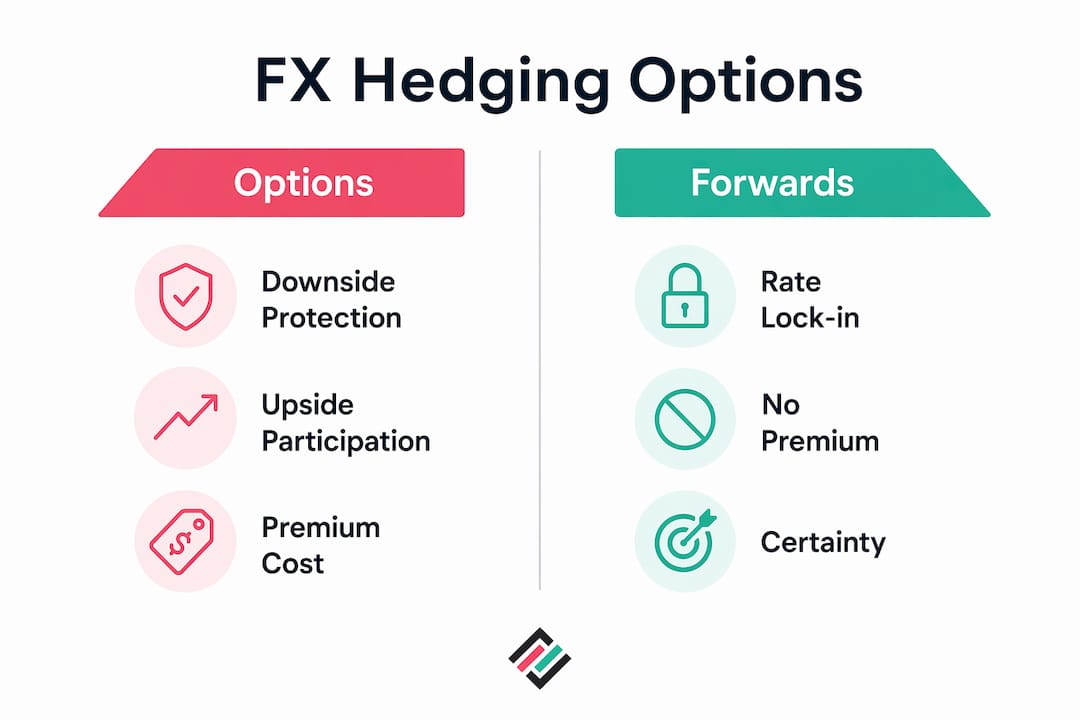
- Options vs. forwards in one line: a forward gives you certainty at the cost of upside; an option gives you a floor while preserving upside, at the cost of a premium.
- Best fit: uncertain receipts, contingent deals, tender bids, or any flow where the underlying transaction might not materialize.
- Worst fit: confirmed, high-certainty payables or receivables where a forward is cheaper and simpler.
Table of Contents
- Why use options in hedging instead of forwards?
- How FX options protect your exposure and which structures to use
- What do options actually cost, and how do you account for them?
- Implementation checklist for Central European treasuries
- How do you measure whether your options overlay is working?
- What risks and mistakes should you watch for?
- Corphedge makes options-based FX hedging practical for Central European firms
- Key Takeaways
- The case for governance over cleverness
- Useful sources
- FAQ
Why use options in hedging instead of forwards?
The decision comes down to exposure certainty. Forwards are the right tool when you know the amount, the date, and the direction. Options earn their premium when any of those three variables is in doubt.
Use a forward when:
- The cash flow is contractually confirmed and the settlement date is fixed.
- Margin sensitivity is high and any premium spend would directly erode profitability.
- The tenor is short (under three months) and implied volatility is low, making option pricing relatively expensive versus the protection gained.
Use an option when:
- The exposure is contingent, such as a bid, a tender, or a pipeline deal with uncertain close probability.
- You expect the market to move favorably and want to participate in that upside.
- The volatility regime is elevated, making a locked-in forward rate feel like a poor entry point.
- The exposure is probable but not confirmed, for example, a seasonal revenue forecast with a ±20% range.
Factors to weigh: exposure certainty, current implied volatility level, premium as a percentage of margin, hedge accounting eligibility, and your treasury counterparty's credit line capacity.
Pro Tip: A layered approach often outperforms a binary choice. Lock the certain portion of a forecast with forwards, then buy options on the uncertain tail. Premium spend stays targeted, and you avoid paying for protection on flows that will definitely materialize.
How FX options protect your exposure and which structures to use
An FX option gives the buyer the right, not the obligation, to exchange currency at a predetermined strike rate on or before expiry. The seller collects the premium upfront. If the market rate is better than the strike at expiry, the buyer simply lets the option expire and trades at spot. That asymmetric payoff profile is what distinguishes options from every other hedging instrument.
Common corporate structures:
- Plain-vanilla put or call: the simplest form. A European exporter receiving USD buys a USD put/EUR call to set a floor on the EUR value of those receipts. If EUR weakens, the option is exercised; if EUR strengthens, it expires and the exporter converts at the better spot rate.
- Collar: the buyer purchases a put (floor) and simultaneously sells a call (cap), limiting upside in exchange for reducing or eliminating the net premium. The sold call finances the bought put.
- Zero-cost collar: the call strike is set so the premium received exactly offsets the put premium paid. Net cost is zero, but upside participation is capped at the call strike. Exotic structures like these can deliver a zero-premium profile at the cost of some capped upside.
- Barrier/knock-out options: cheaper than vanilla options because the protection disappears if spot hits a trigger level. Useful for reducing premium when a specific adverse rate is considered unlikely.
Two short scenarios:
Scenario A — favorable move: A Polish exporter hedges EUR/PLN at a 4.20 strike put. EUR/PLN rises to 4.35 at expiry. The option expires worthless; the exporter converts at 4.35 spot, netting the upside minus the premium paid.

Scenario B — adverse move: EUR/PLN falls to 4.05. The exporter exercises the put at 4.20, recovering 15 groszy per euro versus spot, partially offset by the premium cost.
| Structure | Protection floor | Upside participation | Net premium |
|---|---|---|---|
| Vanilla put | Yes, at strike | Full above strike | Upfront cost (1–5% notional) |
| Collar | Yes, at put strike | Capped at call strike | Reduced |
| Zero-cost collar | Yes, at put strike | Capped at call strike | Zero |
| Knock-out option | Yes, unless barrier hit | Full above strike | Lower than vanilla |
What do options actually cost, and how do you account for them?
Direct costs to budget:
- Premium: typically 1–5% of notional for standard tenors and strikes.
- Bid-offer spread on OTC structures, which widens for less-liquid currency pairs.
- Structuring or advisory fees if the bank prices a bespoke collar or barrier.
The opportunity-cost logic matters as much as the cash outlay. Paying a 3% premium on a confirmed receivable that could have been forwarded at zero cost is an avoidable margin hit. The threshold rule: if the probability of the exposure materializing exceeds roughly 80–85%, a forward is almost always cheaper on a risk-adjusted basis.
On the accounting side, premiums paid for options designated as cash-flow hedges under IFRS 9 are initially recognized in other comprehensive income (OCI) and reclassified to profit or loss when the hedged item affects earnings. The time-value component may be deferred separately, which smooths the P&L impact but requires documentation. Treasuries should brief their CFO and auditors on the expected short-term OCI movement before the first trade settles.
Pro Tip: Book the premium payment as a separate line item in your cash-flow forecast the moment the option is executed. Surprises at settlement are a governance failure, not a market event.
Implementation checklist for Central European treasuries
Pre-trade governance:
- Confirm the hedging policy covers options (many Central European treasury policies still restrict instruments to forwards and swaps).
- Set a VaR cap for the options overlay and get sign-off from the CFO or risk committee.
- Identify authorized users and document the rationale for each trade per IFRS 9 hedge designation requirements.
Operational prerequisites:
- Establish a documented credit line or treasury limit with your bank before attempting to trade OTC options. Banks require a credit assessment and may impose margin or collateral triggers.
- Execute an ISDA Master Agreement and Credit Support Annex if margin posting is required.
- Confirm settlement mechanics: premium payment date (typically T+2), exercise notice deadlines, and delivery or cash-settlement terms.
Execution choices:
- OTC (bank or broker): fully customizable strike, tenor, and notional. Better for Central European mid-market firms with established bank relationships. Liquidity is strong for EUR/PLN, EUR/CZK, and EUR/HUF pairs.
- Exchange-traded options: standardized contracts, central clearing, no counterparty credit risk, but limited strike/tenor flexibility and thinner liquidity for regional currency pairs.
Timeline: from credit-line application to first trade, allow four to eight weeks for a new counterparty relationship. Existing bank clients with ISDA documentation in place can often execute within one to two weeks.
Questions to ask your counterparty: What is the margin trigger level? How is the premium quoted (mid vs. offer)? What is the exercise cut-off time? Can the structure be unwound or restructured before expiry, and at what cost?
How do you measure whether your options overlay is working?
Core metrics to track quarterly:
- Incremental VaR impact: compare portfolio VaR with and without the options overlay. A well-sized overlay should reduce 95% VaR materially without consuming disproportionate premium budget. Corphedge's VaR-driven hedging tools automate this comparison.
- Realized P&L vs. budget rate: did the hedged portfolio deliver cash flows within the budgeted FX rate band?
- Hedge hit/miss rate: what percentage of option positions expired in-the-money versus out-of-the-money? A persistently high miss rate on vanilla options may signal over-hedging of certain flows.
- Cost per percentage point of volatility reduced: divide total premium spend by the reduction in realized cash-flow volatility. This ratio lets you compare options versus forwards on a cost-efficiency basis.
Regime-aware monitoring means watching implied volatility (e.g., one-month EUR/PLN vol) alongside realized volatility. When implied vol spikes, option premiums become expensive and collars or knock-outs may deliver better economics. When implied vol is low, vanilla options are relatively cheap and worth buying for contingent exposures. Dynamic, regime-aware strategies have made this kind of overlay accessible to mid-sized Central European firms, not just large multinationals.
| Metric | What it tells you | Review frequency |
|---|---|---|
| Incremental VaR delta | Whether the overlay reduces portfolio risk | Quarterly |
| Realized P&L vs. budget rate | Whether hedged cash flows met planning targets | Monthly |
| Hedge hit/miss rate | Whether option strikes are calibrated to actual exposure | Quarterly |
| Cost per vol-point reduced | Premium efficiency vs. forwards | Semi-annual |
What risks and mistakes should you watch for?
Operational and financial risks:
- Counterparty credit risk: OTC options carry bilateral credit exposure until settlement. Ensure counterparty limits are set and monitored.
- Liquidity risk: bid-offer spreads widen significantly for emerging-market pairs and longer tenors. EUR/HUF and EUR/PLN options beyond 12 months can carry meaningful skew costs.
- Model risk: option pricing depends on volatility assumptions. A bank's model may price a barrier differently than your internal valuation, creating mark-to-market discrepancies.
- Margin/collateral exposure: if your ISDA includes a Credit Support Annex, adverse market moves can trigger collateral calls that affect working capital.
Common mistakes:
- Paying option premiums on high-certainty flows that should have been forwarded.
- Mismatching option expiry or notional with the underlying exposure, leaving a residual open position.
- Skipping governance sign-off and executing options under a policy that only authorizes forwards.
Red flags: frequent strategy changes between quarters without a documented rationale, escalating premium spend without a corresponding reduction in VaR, and options booked without a designated hedged item under IFRS 9. Any of these signals a process problem, not a market problem.
Corphedge makes options-based FX hedging practical for Central European firms
Managing an options overlay manually, tracking premiums, monitoring VaR, and updating hedge designations, is where treasury teams lose time and make errors. Corphedge is built to remove that friction.
The platform gives Central European treasuries VaR-based decision tools that show exactly how an option overlay shifts your risk profile before you trade. Live position reporting tracks open options alongside forwards in a single view, so nothing falls through the cracks at month-end. Options-structure simulation lets you model a collar or knock-out against your actual exposure before committing to a premium. For a mid-market Polish or Czech exporter running layered forwards plus options on seasonal EUR/PLN flows, that simulation capability alone can save meaningful structuring cost.
Corphedge integrates with counterparty systems and automates implied-volatility feeds, so your regime-aware signals update without manual data pulls. Take a product tour to see the workflow, or schedule a demo to walk through a live VaR delta analysis on your own exposure data.
This article is general information, not professional financial or legal advice. Confirm current regulations and instrument suitability with your bank, auditor, or a qualified treasury advisor for your specific situation.
Key Takeaways
Options provide downside protection while preserving upside participation, making them the right instrument for uncertain or contingent FX exposures, not a replacement for forwards on confirmed flows.
| Point | Details |
|---|---|
| Options vs. forwards | Use forwards for confirmed flows; use options when exposure is uncertain, contingent, or upside participation matters. |
| Premium economics | OTC option premiums typically run 1–5% of notional; paying that on high-certainty flows erodes margins unnecessarily. |
| Volatility benefit | Structured FX hedging can reduce cash-flow volatility by 23–45% and improve earnings stability by 30–50%. |
| Measurement discipline | Track incremental VaR delta, realized P&L vs. budget rate, and cost per volatility-point reduced on a quarterly basis. |
| Corphedge | Corphedge's VaR-driven platform simulates option structures, automates position reporting, and supports IFRS 9 hedge designation for Central European treasuries. |
The case for governance over cleverness
The most common failure mode I see in Central European treasury programs isn't choosing the wrong option structure. It's executing options without a policy that authorizes them, without a documented hedged item, and without a quarterly review that asks whether the overlay is actually reducing VaR or just spending premium. Options are a precise tool. Used on the right exposures, with a clear measurement framework, they genuinely improve earnings predictability. Used as a default hedge on every flow, they quietly drain margins.
The practical advice: start with one contingent exposure, run the VaR delta analysis before and after the option, and present the result to your CFO. That single exercise builds the institutional case for a broader program better than any theoretical argument. Governance and measurement come first. The structure choice is secondary.
Useful sources
- Corphedge VaR-driven hedging: the primary landing page for Corphedge's VaR-based decision framework and platform tools.
- Corphedge FX derivatives blog: covers option structures, premium ranges, and when to use each instrument.
- Corphedge FX hedging strategies: regime-aware strategies and the cash-flow volatility reduction data cited in this article.
- PKO Bank Polski: FX options and strategies: practical reference for credit-line and ISDA prerequisites for OTC option trading in Poland.
- SVB FX hedging advisory: useful for understanding how product choice (forward vs. option vs. collar) shapes the distribution of hedged outcomes.
- Corphedge currency risk management strategies: stepwise governance and policy templates for treasury teams building a hedging program.
FAQ
Why use options in hedging instead of just forwards?
Options preserve upside participation when market rates move favorably, while forwards lock in a rate regardless of direction. The premium cost is the price of that asymmetry, and it's worth paying when exposure is uncertain or contingent.
What is a typical FX option premium for a corporate?
OTC FX option premiums typically run 1–5% of notional, depending on tenor, strike distance from spot, and implied volatility at the time of execution.
When does an options strategy for hedging stop making economic sense?
When the underlying exposure is highly certain (above roughly 80–85% probability of materializing), a forward is almost always cheaper. Paying option premium on confirmed flows transfers avoidable cost directly to margins.
What is a zero-cost collar and how does it work?
A zero-cost collar combines a bought put (floor) and a sold call (cap) at strikes where the two premiums offset each other. You get downside protection at no net cash cost, but your upside is capped at the call strike.
How does Corphedge help with options-based hedging?
Corphedge provides VaR-based decision tools, options-structure simulation, and live position reporting that let Central European treasury teams model, execute, and monitor an options overlay without manual data management.