

TL;DR:
- A risk policy is a governance document that links an organization's risk philosophy to operational decisions and establishes clear boundaries. It includes six core elements: purpose and scope, risk appetite, roles, assessment methodology, reporting, and review cycles, ensuring consistent risk management across all units. Effective policies differentiate from programs by defining "what" and "who," while programs implement "how," with technology enforcing compliance and facilitating real-time responses.
A risk policy is a formal governance document that translates an organization's risk philosophy into operational decision-making, defining the boundaries within which every business unit, manager, and executive must act. Most organizations have risk management activities in place, but without a written policy anchoring those activities to board-approved principles, those efforts lack authority and consistency. The risk policy definition covers six core elements: purpose and scope, risk appetite and tolerance, roles and responsibilities, assessment methodology, reporting and escalation, and review cycles. For financial executives at multinational companies, understanding this document is not optional. It is the foundation of every compliant, defensible risk decision your organization makes.
What is risk policy and what does it actually contain?
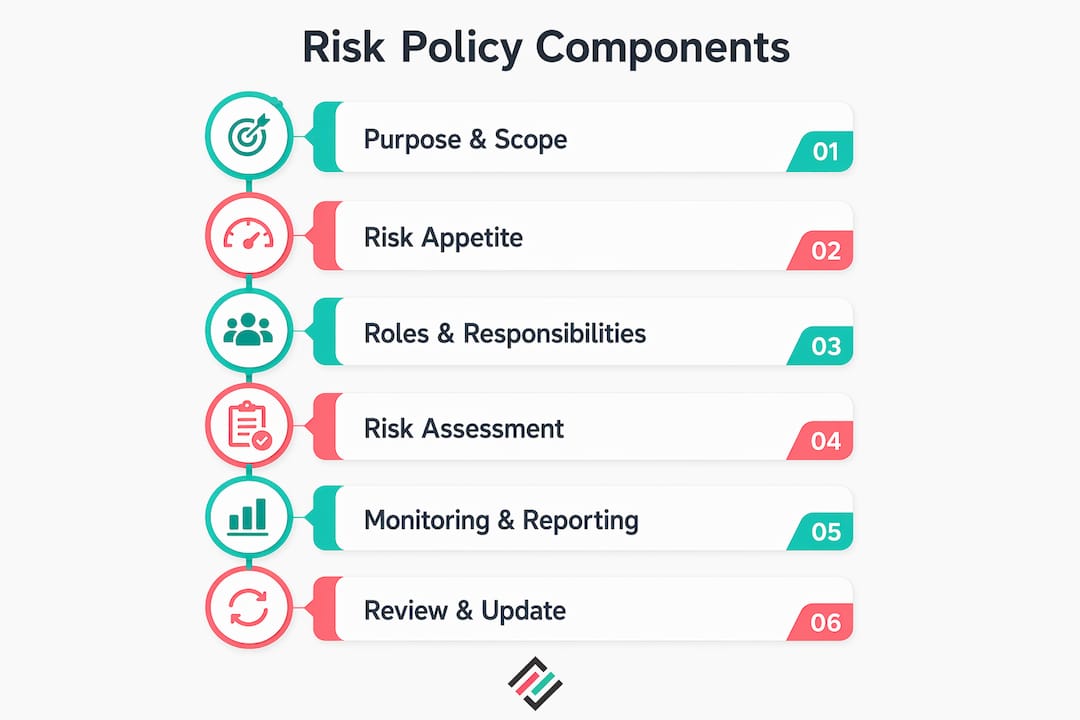
A risk policy is the organizational rulebook that governs how risk is identified, assessed, treated, monitored, and reported across all levels of the business. According to ISO 31000:2018, a well-structured policy includes six core sections: purpose and scope, risk appetite and tolerance, roles and responsibilities, risk assessment methodology, reporting and escalation, and a defined review cycle. Each section serves a distinct function, and omitting any one of them creates a governance gap.

The purpose and scope section defines which entities, geographies, and risk categories the policy covers. For a company operating in Poland, Sweden, and other international markets, this section must explicitly name each jurisdiction and the risk types relevant to each. The risk appetite and tolerance section is where most policies either succeed or fail. Vague language like "we avoid unnecessary risk" is unenforceable. Effective policies operationalize risk appetite through measurable tolerances, key risk indicators (KRIs), and defined triggers that activate escalation.
The roles and responsibilities section should map directly to the Three Lines of Defense model. The first line manages controls at the business unit level, the second line provides oversight and policy compliance monitoring, and the third line delivers independent audit assurance. Without clear role separation, risk policy implementation tends to fail because accountability becomes diffuse and escalation stalls.
Pro Tip: When drafting the risk assessment methodology section, specify whether your organization uses qualitative scoring, quantitative models like Value at Risk (VaR), or a hybrid approach. Ambiguity here leads to inconsistent assessments across business units.
Here is a quick reference for the six core components:
| Component | Function |
|---|---|
| Purpose and scope | Defines coverage: entities, geographies, risk categories |
| Risk appetite and tolerance | Sets measurable boundaries for acceptable risk-taking |
| Roles and responsibilities | Assigns accountability using the Three Lines of Defense |
| Risk assessment methodology | Specifies how risks are identified, scored, and prioritized |
| Reporting and escalation | Defines thresholds, timelines, and escalation paths |
| Review cycle | Mandates frequency of policy updates and performance checks |
How does a risk policy differ from a risk management program?
Executives frequently conflate these two concepts, and the confusion leads to real governance failures. A risk policy is the governance document. A risk management program is the operational activity. Mistaking one for the other creates gaps where neither the policy nor the program fully owns a risk domain.
The clearest way to understand the distinction is through a concrete example. Consider third-party risk. A third-party risk policy defines the standards: which vendor categories require due diligence, what risk tolerance applies to critical suppliers, and who has authority to approve exceptions. The vendor risk management program, by contrast, is the daily operational activity: sending questionnaires, reviewing SOC 2 reports, scheduling reassessments, and flagging non-compliant vendors. The policy governs the "what" and "who." The program governs the "how."
Here is why maintaining this separation matters in practice:
- Accountability clarity. When a vendor breach occurs, the policy tells you who was responsible for approving that vendor relationship. Without a policy, that accountability is undefined.
- Audit defensibility. Regulators and auditors examine policies first. A program without a governing policy has no documented authority for its activities.
- Scalability. Programs evolve as threats change. The policy provides stable governance principles that do not need to be rewritten every time a new tool or process is introduced.
- Consistency across geographies. For companies expanding into markets like Poland and Sweden, a single governing policy ensures that local programs operate within the same risk boundaries, even when local execution differs.
The Nordic Investment Bank's risk management policy illustrates this well. It includes a risk appetite statement, category-specific governance principles, and an annual review mandate. The bank's operational stress testing, capital adequacy calculations, and limit monitoring are all program-level activities that sit beneath that policy framework.
How can technology automate and enforce risk policies?
Technology does not replace a risk policy. It enforces one. The most instructive example in enterprise risk management today is Microsoft Entra Conditional Access, which translates identity risk policies into automated, real-time responses. When a user's sign-in risk reaches a medium or high threshold, the policy triggers multifactor authentication and session revocation automatically, without requiring a human decision at that moment.
What makes this model worth studying is the design philosophy behind it. Microsoft's approach prefers self-remediation over immediate blocking. A user flagged for medium risk is prompted to complete multifactor authentication and reset their password. Only at high risk levels does the system block access entirely. This mirrors the risk appetite logic that financial executives should apply to their own policies: graduated responses calibrated to risk severity, not binary block-or-allow decisions.
For financial executives managing currency or market risk, the same principle applies through platforms that automate hedging decisions based on VaR thresholds. Key benefits of integrating policy with technology enforcement include:
- Consistent application. Automated systems apply policy rules without human discretion errors or fatigue.
- Real-time response. Risk triggers activate remediation flows instantly, reducing exposure windows.
- Audit trails. Every automated decision is logged, creating a defensible record for compliance reviews.
- Scalability across jurisdictions. A single policy configuration can enforce consistent standards across operations in multiple countries simultaneously.
Pro Tip: Domain-specific risk policies require domain-specific technology enforcement. The signals, thresholds, and remediation flows for cyber risk differ substantially from those for credit risk or currency risk. Do not attempt to enforce all risk types through a single generic system.
What are best practices for creating and maintaining risk policies?
The most common failure mode in risk policy is treating the document as a compliance artifact rather than a decision tool. The NSW Government's risk management toolkit states directly that a policy must connect board-set risk appetite to daily accountability and escalation. When that connection breaks, the policy becomes decorative.
Building an effective risk management policy requires attention to several interconnected practices:
- Link every policy statement to a strategic objective. If your organization's growth strategy involves entering new currency markets in Poland and Sweden, your risk policy must explicitly address foreign exchange risk tolerance for those markets. Generic policies do not protect specific exposures.
- Assign named owners, not job titles. "The risk committee is responsible" is insufficient. Name the Chief Risk Officer, the CFO, or the specific business unit head. Accountability requires a person, not a committee label.
- Set a mandatory review cadence. Annual reviews are the minimum. Policies governing fast-moving risk categories like cyber or FX should be reviewed quarterly or whenever a material change in the risk environment occurs.
- Train beyond awareness. Most organizations run annual policy training that employees click through and forget. Effective training embeds policy logic into daily workflows, so that a treasury analyst knows the escalation threshold for an FX position without consulting the document.
The comparison below shows the difference between a static policy and a dynamic one:
| Dimension | Static policy | Dynamic policy |
|---|---|---|
| Risk appetite language | "Avoid excessive risk" | KRI thresholds with defined escalation triggers |
| Role assignment | "Risk committee" | Named individuals with specific decision authority |
| Review cycle | Ad hoc or annual | Scheduled quarterly with event-triggered reviews |
| Technology integration | Manual reporting | Automated monitoring with real-time alerts |
| Domain coverage | Single generic document | Domain-specific sub-policies for cyber, credit, FX |
Finance executives should also recognize that coverage gaps in risk transfer often trace back to policy documents that failed to anticipate specific risk scenarios. A policy written before a company entered international markets will not address political risk, currency controls, or cross-border counterparty exposure. Updating the policy before entering a new market is not bureaucratic caution. It is basic risk governance.
For executives building or overhauling a risk management policy, the ERM frameworks guide from Corphedge provides a practical starting point for integrating currency risk into enterprise-wide governance structures.
Key takeaways
A risk policy is only as effective as its connection to measurable risk appetite, named accountability, and operational enforcement through technology and programs.
| Point | Details |
|---|---|
| Risk policy definition | A formal governance document linking board-level risk philosophy to daily operational decisions. |
| Six core components | Purpose, risk appetite, roles, methodology, reporting, and review cycle aligned to ISO 31000. |
| Policy vs. program | Policy defines the "what" and "who"; the risk management program executes the "how." |
| Technology enforcement | Automated platforms apply policy rules consistently and create defensible audit trails. |
| Dynamic maintenance | Policies must be reviewed regularly and updated before entering new markets or risk categories. |
Why most risk policies fail before they're ever tested
I have reviewed risk policies across financial institutions, technology companies, and multinational manufacturers. The pattern is consistent: the document is well-written, the governance structure looks sound on paper, and then a real risk event exposes the fact that nobody in the organization actually knew what the policy required them to do.
The problem is almost never the policy itself. It is the gap between the governance document and the people responsible for executing it. Risk appetite statements that use language like "moderate tolerance for market risk" are useless when a treasury team needs to decide whether to hedge a EUR/PLN position at 3 a.m. before a Polish market open. The policy needs to say: hedge when exposure exceeds X, escalate when it exceeds Y, and block when it exceeds Z.
What I have found actually works is treating the risk policy as a decision tree, not a philosophy statement. Every section should answer a specific operational question. Who approves this? What triggers escalation? What does remediation look like? When I see a policy that cannot answer those questions in under 30 seconds, I know the organization is one bad quarter away from a governance failure.
The Three Lines of Defense model is genuinely useful, but only when the lines are staffed by people who understand their specific role. I have seen second-line risk functions that spent all their time doing first-line work because the business units did not have the capacity. That is not a policy problem. It is an implementation problem. But the policy should define the boundary clearly enough that the failure is visible before it becomes a crisis.
For companies expanding into new markets, including Poland and Sweden, the currency risk governance question is where I see the most policy gaps. FX exposure is often treated as a treasury operations issue rather than a governance issue. It belongs in the risk policy, with explicit appetite statements and escalation rules tied to VaR thresholds.
— Bartas
How Corphedge enforces risk policy for FX-exposed companies

Corphedge is built for financial executives who need their currency risk policy to do more than sit in a document repository. The platform translates risk appetite statements into live hedging decisions, using Value at Risk calculations to monitor FX exposure in real time and trigger hedging actions when positions breach policy thresholds. For companies operating across multiple currencies in markets like Poland and Sweden, that level of automation is the difference between a policy that governs and one that merely describes.
Corphedge integrates with platforms like Corpay and provides continuous position monitoring, so your risk management policy is enforced at the transaction level, not just reviewed at the quarterly board meeting. Explore the VaR-based hedging solutions or take the product tour to see how Corphedge maps directly to your corporate risk framework.
FAQ
What is the risk policy definition in corporate governance?
A risk policy is a formal governance document that defines an organization's risk appetite, roles, assessment methodology, and escalation procedures. It translates board-level risk philosophy into operational decision-making boundaries.
What are the main components of a risk policy?
The six core components are purpose and scope, risk appetite and tolerance, roles and responsibilities, risk assessment methodology, reporting and escalation, and a defined review cycle, aligned to ISO 31000:2018.
How does a risk policy differ from a risk management program?
A risk policy defines the governance standards and accountability framework. A risk management program is the operational activity that executes risk mitigation within those standards. Confusing the two creates accountability gaps.
Why is the importance of risk policy so high for multinational companies?
Multinational companies face jurisdiction-specific risks including currency exposure, regulatory variation, and political risk. A risk policy that explicitly covers each market ensures consistent governance standards across all operations.
How do you create a risk policy that stays relevant over time?
Link every policy statement to a measurable KRI, assign named individual owners rather than committees, schedule quarterly reviews, and update the policy before entering any new market or risk category.