

Centralize your FX exposures into a single source of truth, automate daily data feeds, and connect valuations to an integrated reporting platform. Those three moves, done in the right order, cut more manual work and reporting errors than anything else you can do this quarter. Treasury teams that make this shift stop chasing spreadsheets across business units and start producing board-ready FX reports in hours rather than days. The practical ways to streamline FX reporting below are sequenced by impact versus effort, so you can prioritize what moves the needle fastest.
Start this week with these eight actions:
- Replace emailed spreadsheet submissions with API or SFTP feeds from each ERP instance
- Map every exposure source: AR/AP ledgers, intercompany loans, cash-flow forecasts, and derivatives
- Set up automated daily valuation jobs using a published rate-of-record from a vendor feed
- Standardize currency fields and entity codes across all ERP and GL systems
- Configure automated trade confirmations and settlement sync to eliminate manual posting
- Build one management dashboard covering hedged vs. unhedged positions and realized/unrealized P&L
- Define exception thresholds and route variances to named owners automatically
- Assign a business-unit data steward accountable for exposure submissions in each entity
Teams that automate exposure capture and valuations typically reclaim dozens of hours per month previously spent on manual consolidation, and they close reconciliation exceptions faster because the data trail is clean from the start.
Table of Contents
- Why fragmented data breaks your FX reporting
- What are the highest-impact FX workflows to automate first?
- Which integrations make FX reporting reliable?
- How do you make valuations and reconciliations audit-ready?
- What does management actually want in an FX report?
- Phased implementation checklist: timeline, roles, and cost
- Why Corphedge suits Central European treasury teams
- Key Takeaways
- The part most treasury teams get wrong about FX automation
- A focused Corphedge pilot delivers results in 4–8 weeks
- Useful sources and further reading
- FAQ
Why fragmented data breaks your FX reporting
The root cause of late, inaccurate FX reports is almost never a bad hedging strategy. It is fragmented source data. According to Deloitte's global FX survey, a significant share of corporations pull exposure data from multiple separate sources (about 31% rely on three or more sources), and over 60% use manual forecasting processes. That combination directly erodes confidence in the numbers that reach the board.
The failure modes are predictable. Multiple ERP instances use different currency field definitions. Business units submit exposures on different schedules. Spreadsheets get emailed, edited locally, and re-emailed, so by the time treasury consolidates them, the figures are already stale. Timing mismatches between the GL close and the hedge valuation date produce P&L swings that look like strategy failures but are actually data-quality problems.
As insightsoftware's operational framework analysis puts it, execution failures caused by fragmented data are a leading cause of poor FX outcomes. The hedges are fine; the data feeding them is not. That is why a single source of truth for exposures is the prerequisite for everything else in this guide.
Pro Tip: Start your data audit with the source that feeds your P&L and cash forecasts. That is usually the AR/AP module in your primary ERP. Fix the currency field definitions there first, then work outward to subsidiaries and intercompany positions.
What are the highest-impact FX workflows to automate first?
Prioritize by the ratio of manual hours saved to implementation effort. Here is the sequence that works for most Central European treasury teams:
- Automated exposure collection (real-time or daily): Replace manual submissions with scheduled API pulls or SFTP batch files from each ERP. This is the highest-impact, lowest-effort starting point because it removes the single biggest source of stale data.
- Automated market-rate feed (real-time or end-of-day): Connect to a vendor rate feed (Bloomberg, Refinitiv, or OANDA) via API. OANDA's best-practice guidance is explicit: daily or real-time automated feeds are the baseline; monthly manual checks are insufficient in volatile markets.
- Automated valuation and mark-to-market (daily, end-of-day): Run deterministic valuation jobs against the published rate-of-record. Store the input rates and calculation artifacts so every valuation is reproducible for audit.
- Automated hedge proposal generation (daily or on-demand): Once exposures and valuations are clean, the system can propose hedges against policy thresholds without a treasury analyst building the analysis from scratch each time.
- Automated trade preparation and confirmations (event-driven): Pre-populate trade tickets from the hedge proposal and route them through an approval workflow. Electronic confirmations sync back to the position record automatically.
- Post-trade settlement sync (same-day): Automated settlement synchronization eliminates manual posting to the treasury ledger and cuts the reconciliation workload that otherwise piles up at month-end.
- Automated journal-entry creation (monthly or on-demand): Generate hedge accounting entries directly from the valuation and settlement records. This removes a significant manual step and makes the audit trail continuous rather than reconstructed.
For each workflow, the minimal viable automation is a scheduled job that pulls data, applies a rule, and writes an output to a defined location. You do not need a full TMS to start. Many Central European treasury teams begin with lightweight CSV ingestion with strong field validation, then graduate to direct API connections as confidence builds.
Tracking FX exposures with automated feeds rather than manual collection is the single change that most consistently unlocks the downstream workflows above.
Which integrations make FX reporting reliable?
The connectors that matter most, in rough order of impact:
ERP (multi-instance): SAP, Oracle, and Microsoft Dynamics are the most common in Central Europe. Each instance needs a dedicated feed. Direct API is preferred; SFTP batch is acceptable when APIs are not available. The key discipline is enforcing a canonical currency field and entity code at the source, not at the aggregation layer.
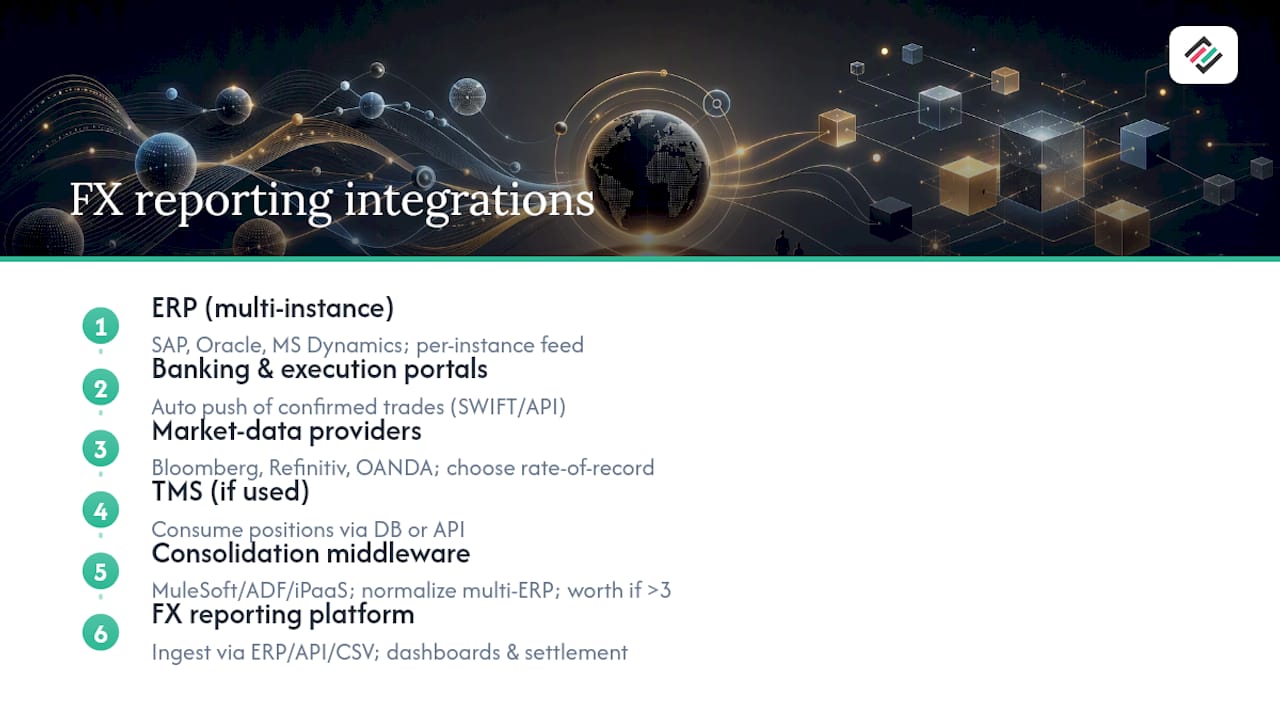
Banking and execution portals: Your bank's FX execution portal needs to push confirmed trade data back to treasury automatically. Without this, post-trade reconciliation stays manual. Most major banks operating in Central Europe support SWIFT MT or API-based confirmation delivery.
Market-data providers: Bloomberg Terminal, Refinitiv Eikon, and OANDA all offer API-based rate delivery. Choose one as your rate-of-record and document the timestamp convention. Mixing rate sources mid-month is a common cause of valuation discrepancies.
TMS (if used): If your organization runs a TMS, the FX reporting layer should consume its position data rather than duplicate it. The integration pattern here is usually a direct database connection or a vendor-provided API.
Consolidation and ELT tools: For multi-entity groups, a middleware layer (MuleSoft, Azure Data Factory, or a lightweight iPaaS) can normalize data from disparate sources before it reaches the FX reporting platform. This is worth the setup cost when you have more than three ERP instances.
Typical platform capabilities include multi-source ingestion via ERP connectors, CSV upload, and API, with position dashboards and settlement automation as standard features. Use that as your baseline requirement when evaluating any FX reporting tool.
Pro Tip: Before full rollout, run a source-to-report trace on a sample of 20–30 live trades. Follow each trade from the ERP entry through the valuation, into the report, and check the numbers match. This single test surfaces 80% of integration issues before they affect a board report.
How do you make valuations and reconciliations audit-ready?
Valuation accuracy starts with rate sourcing. Pick one market-data vendor as your rate-of-record, document the exact timestamp (London 4 PM WM/Reuters fix is the most common standard in Central Europe for month-end), and store every rate used in a valuation alongside the calculation output. If an auditor asks why a EUR/PLN forward was valued at a specific rate on a specific date, you need to produce that answer in under five minutes.
Key practices for audit-ready valuations:
- Publish the rate-of-record to all business units before month-end close so everyone marks to the same rates
For reconciliation workflows, set daily variance thresholds by currency pair and notional band. Any position that breaches the threshold routes to a named exception owner with a 24-hour SLA. Automated settlement synchronization keeps the trade ledger current so end-of-day reconciliation runs against fresh data rather than yesterday's manual entries.
Hedge accounting entries generated directly from valuation records, rather than reconstructed manually, are cleaner for auditors and faster to produce. The audit trail is continuous by design.
What does management actually want in an FX report?
Executives want to see four things: where the exposure is, how much is hedged, what the P&L impact is, and what the risk looks like under stress. Everything else is supporting detail.
Recommended management dashboards:
- Exposure by currency pair and legal entity (balance-sheet and cash-flow, separated)
- Hedged vs. unhedged positions with hedge ratio by currency
- Realized and unrealized FX P&L, period-over-period
- VaR and stress-test outputs (at least two scenarios: a 10% adverse move and a tail scenario)
- Forecast vs. actual exposures with variance commentary
Dedicated FX platforms that consolidate exposures enable portfolio-level analytics like VaR and scenario testing that many teams currently run manually or not at all. The Deloitte survey data cited earlier shows fewer than 25% of organizations generate advanced metrics like VaR or stress tests for senior management today. Automation is what makes those metrics feasible without adding headcount.
Sample FX management report template:
| Report Section | Key Metric | Frequency | Owner |
|---|---|---|---|
| Exposure summary | Total notional by currency and entity | Daily / Weekly | Treasury Manager |
| Hedge coverage | Hedge ratio % by currency | Weekly | Treasury Manager |
| P&L attribution | Realized FX P&L, unrealized MTM | Monthly | Finance Controller |
| Risk metrics | VaR and stress-test P&L | Monthly | Risk Manager |
| Forecast accuracy | Forecast vs. actual exposure variance % | Monthly | Business Unit Stewards |
| Exception log | Open reconciliation exceptions, age | Daily | Treasury Analyst |
For a board-ready risk reporting checklist that maps these KPIs to executive expectations, the linked resource covers the full set of metrics finance leaders need to present with confidence.
Phased implementation checklist: timeline, roles, and cost
A realistic rollout runs in four phases. The timeline below assumes a mid-market Central European treasury team with two to five ERP instances and no existing TMS.
Phase 0: Discovery and data mapping (4–8 weeks)
- Inventory all exposure sources: ERP instances, intercompany systems, bank portals
- Document currency field definitions and entity codes across systems
- Identify data quality gaps and assign business-unit stewards
- Select market-data vendor and agree on rate-of-record convention
- Define the target report structure and KPIs with the CFO
Phase 1: Pilot automation for exposure capture and valuations (8–12 weeks)
- Connect primary ERP via API or SFTP; validate a full month of exposure data
- Integrate market-rate feed; configure daily valuation job
- Build the first management dashboard (exposure summary + hedge ratio)
- Run parallel reconciliation against existing spreadsheet process for four weeks
- Sign off on data quality with the finance controller before decommissioning manual feeds
Phase 2: Expand integrations and reporting (12–24 weeks)
- Connect remaining ERP instances and banking portals
- Automate trade preparation, confirmations, and settlement sync
- Add VaR and stress-test reporting to the management dashboard
- Configure automated journal-entry creation for hedge accounting
- Complete role-based access controls and audit trail configuration
Phase 3: Scale, operate, and improve (ongoing)
- Monthly review of exception rates and reconciliation SLA performance
- Quarterly KPI review with CFO and business-unit stewards
- Annual data-quality audit and connector refresh
Roles:
- Project sponsor: CFO (budget, escalation, business-unit alignment)
- Project lead: Treasury Manager (day-to-day delivery, vendor coordination)
- IT integration owner: ERP/IT team (connector build and maintenance)
- Business-unit stewards: Finance leads in each entity (data quality accountability)
- Vendor/implementation partner: Platform provider or systems integrator
Cost guidance (Central European mid-market):
| Phase | Low tier | Medium tier | High tier | Primary cost drivers |
|---|---|---|---|---|
| Phase 0 | — | — | — | Consulting days, data audit scope |
| Phase 1 | — | — | — | ERP connectors, platform license |
| Phase 2 | — | — | — | Custom connectors, data cleansing |
| Phase 3 | Platform license | Platform license | Platform license + support | Ongoing SaaS + internal FTE |
Budget drivers are the number of ERP instances requiring custom connectors, the volume of historical data to cleanse, and whether you use a pre-built platform or build custom integrations. A pre-built platform with native ERP connectors cuts Phase 1 cost significantly.
Proven CFO-level strategies for building the business case and presenting ROI to leadership can help you frame the investment in terms the board will approve.
Why Corphedge suits Central European treasury teams
Corphedge maps directly to the automation targets in this guide. The platform aggregates exposures from multiple ERP instances, delivers live market-data feeds for daily valuation, runs a built-in valuation engine with a published rate-of-record, and generates hedge proposals based on Value at Risk analysis. Trade confirmation and settlement synchronization are built into the workflow, so post-trade reconciliation is automated rather than manual. The audit trail covers every exposure change, valuation, and trade action.
For Central European treasuries, Corphedge is available and actively expanding into Poland and Sweden, with the integration patterns and compliance controls that regional auditors expect.
Corphedge feature-to-benefit map:
| Automation target | Corphedge capability | Business benefit |
|---|---|---|
| Exposure aggregation | Multi-source ingestion (ERP, CSV, API) | Single source of truth; no manual consolidation |
| Market-data feed | Live rate feed with timestamped rate-of-record | Accurate daily valuations; audit-ready |
| Valuation engine | Built-in MTM with deterministic calculation rules | Reproducible valuations; faster close |
| Hedge proposals | VaR-based hedging workflows | Policy-aligned hedges without manual analysis |
| Trade workflow | Automated confirmations and settlement sync | Eliminates manual posting; clean audit trail |
| Reporting dashboards | Exposure, hedge ratio, P&L, VaR, stress tests | Board-ready reports in hours, not days |
| Compliance controls | Role-based approvals, immutable audit trail | Meets IFRS 9 and regional audit requirements |
A focused 4–8 week pilot covering exposure capture, daily valuations, and one management dashboard is enough to validate the core value. Success in the pilot looks like: exposures ingested automatically from at least one ERP, a daily valuation job running without manual intervention, and one board-ready report produced from the platform rather than a spreadsheet.
Explore the full platform features and integrations to assess technical fit before the pilot scoping call.
Key Takeaways
Automating FX reporting requires a data-first sequence: centralize exposures, automate feeds and valuations, then build reporting on top of clean, integrated data.
| Point | Details |
|---|---|
| Centralize first | Build a single source of truth for exposures before adding any advanced automation. |
| Automate feeds and valuations | Daily API-based rate feeds and automated valuation jobs cut the most manual hours fastest. |
| Integrate all source systems | Connect every ERP instance, banking portal, and market-data provider to eliminate reconciliation gaps. |
| Measure with clear KPIs | Track exposure capture rate, manual hours, and time-to-report from day one to prove ROI. |
| Corphedge for Central Europe | Corphedge covers the full automation stack, from exposure aggregation to VaR-based hedge proposals and audit-ready reporting, with active expansion in Poland and Sweden. |
The part most treasury teams get wrong about FX automation
The conventional wisdom says the hard part of FX reporting automation is the technology. It is not. The hard part is the data mapping, and specifically, getting business-unit finance leads to own their exposure submissions before you automate anything.
Every FX automation project I have seen stall does so at the same point: Phase 1 is nearly complete, the platform is connected to the primary ERP, and then someone discovers that three subsidiaries define "committed exposure" differently. The platform cannot reconcile what the source systems cannot agree on. At that point, the project either pauses for a data governance sprint that nobody budgeted for, or it ships with known data quality gaps that undermine every report it produces.
The fix is not complicated, but it requires discipline before the technology work starts. Map your exposure definitions in a shared document. Get sign-off from each business-unit steward. Run a manual parallel process for four weeks before you decommission the spreadsheets. That sequence feels slow, but it is what separates a pilot that earns budget for Phase 2 from one that gets quietly shelved.
Automate the smallest useful scope first. One ERP, one currency pair, one dashboard. Prove the numbers are right. Then expand. The teams that try to automate everything at once almost always end up with a system that nobody trusts.
A focused Corphedge pilot delivers results in 4–8 weeks
Most treasury teams spend months debating platform options and never run a real test. A short, scoped pilot changes that. Corphedge is built for exactly this kind of fast validation: connect your primary ERP, activate the daily rate feed, and have a live management dashboard within weeks, not quarters.
The pilot scope that works: exposure capture from one ERP instance, automated daily valuations against a published rate-of-record, and one board-ready report covering hedge ratio and unrealized P&L. Within the pilot window, you will see reconciliation hours drop and your first automated report replace a spreadsheet that someone was building manually every week.
Corphedge is actively available for Central European treasury teams, including those in Poland and Sweden, with the compliance controls and integration patterns the region requires. Take the product tour to see the workflows before your pilot scoping call, or go straight to the features overview to map capabilities against your current gaps.
Useful sources and further reading
- Continued evolution 2016 Global Foreign Exchange survey
- BEST PRACTICES (OANDA white paper)
- 5 Steps to Automate (and Optimize) Your FX Risk Management Program
- The science of FX exposure management
- FX Hedging: Simplify Data Capture and Decision-Making
- FX Risk Management Solutions | Treasury4
- FX Trading Reporting and Compliance
- FX risk management: the operational framework finance teams need
FAQ
How do you reduce FX risk through better reporting?
Centralizing exposures into a single source of truth and automating daily valuations gives treasury a complete, current picture of net exposure, which is the prerequisite for making hedging decisions that actually track your real risk. Without accurate aggregated data, hedges drift from actual exposures and the P&L impact looks like strategy failure when it is a data problem.
How do you record unrealized foreign exchange gains and losses?
Unrealized FX gains and losses are recorded by revaluing open positions at the period-end rate-of-record and posting the difference to a designated FX P&L account; under IFRS 9, the treatment depends on whether the instrument qualifies for hedge accounting. Automating this step with a built-in valuation engine and direct journal-entry generation eliminates the manual reconstruction that most audit findings trace back to.
What are the most efficient FX reporting techniques for treasury teams?
The highest-impact techniques are automated exposure collection via API feeds, a single published rate-of-record for all valuations, and a management dashboard that generates hedge ratio and VaR outputs without manual assembly. Corphedge combines all three in one platform, which is why it suits Central European treasury teams looking to cut reporting cycle time.
How do you stabilize currency exposure in a multi-entity group?
Consolidate all entity exposures into one platform before hedging at the portfolio level; netting intercompany positions first reduces gross notional and hedging cost. A platform with multi-source ERP ingestion and portfolio-level analytics makes this netting calculation automatic rather than a monthly spreadsheet exercise.
What does a realistic FX reporting automation timeline look like?
A phased rollout typically runs 4–8 weeks for discovery and data mapping, 8–12 weeks for a pilot covering exposure capture and valuations, and 12–24 weeks to expand integrations and full reporting. Most Central European mid-market teams reach a fully automated board-ready report within six months of starting Phase 1.