

TL;DR:
- Most finance teams believe they control FX exposure, but unexpected currency shocks reveal critical data gaps. Effective tracking requires a comprehensive register, standardized rates, regular sensitivity tests, clear ownership, and real-time technology; without these, risk assessment is unreliable. Consistent data collection, governance, and advanced analytics enable accurate, proactive currency risk management in complex, multi-entity environments.
Most finance teams believe they have FX exposure tracking under control. Then a currency shock hits, and suddenly the spreadsheets don't reconcile, the intercompany balances were never captured, and nobody can tell the CFO what the actual exposure is. FX exposure tracking is not just a reporting exercise. It is the operational foundation that determines whether your hedging decisions are grounded in reality or built on incomplete data. This guide walks you through the frameworks, measurement standards, and technology choices that separate teams with genuine currency risk visibility from those who discover gaps only when it is too late.
Table of Contents
- Key Takeaways
- FX exposure tracking: why data collection is where most teams fail
- Measurement standards that make your FX data trustworthy
- Operationalizing your exposure tracking process
- Advanced analytics and technology for deeper FX visibility
- What I've learned from watching FX tracking programs succeed and fail
- How Corphedge supports your FX exposure tracking
- FAQ
Key Takeaways
| Point | Details |
|---|---|
| Build a full exposure register | Capture transaction, translation, and economic exposures from all entities and systems to get accurate risk visibility. |
| Standardize your exchange rates | Use one authoritative rate source consistently across budgeting, actuals, and reporting to avoid misleading hedge ratios. |
| Run sensitivity tests regularly | Apply 1%, 5%, and 10% exchange rate shock tests to quantify how exposure values affect earnings and cash flow. |
| Define ownership and process | Assign clear roles across treasury, FP&A, and subsidiaries so exposure data is updated on schedule without gaps. |
| Use technology to close data gaps | Integrated treasury platforms replace manual reconciliation and give you real-time foreign exchange monitoring across entities. |
FX exposure tracking: why data collection is where most teams fail
There are three types of FX exposure every corporate treasurer needs to account for. Transaction exposure covers cash flows already committed in foreign currency, such as receivables, payables, and loan repayments. Translation exposure arises when consolidating foreign subsidiary financials into the reporting currency. Economic exposure is broader and harder to pin down. It reflects how currency movements affect future revenues and competitive positioning over time.
The problem is that the data for each type lives in a different place. ERP systems hold payables and receivables. Treasury management platforms track bank accounts and debt instruments. Subsidiary accounting software holds local balance sheet positions. And intercompany balances, one of the most commonly missed sources of FX exposure, often sit in a separate reconciliation file that nobody updates consistently.
Fragmented data across systems forces treasury teams into manual extraction and transformation, which slows response times and creates the risk of acting on stale numbers. A company that discovers a EUR 15 million payable was excluded from its exposure register two weeks after a 3% EUR/USD move has already absorbed a loss it could have hedged.
A practical exposure register should document every currency transaction from receivables, payables, intercompany balances, bank accounts, and debt instruments across all relevant entities. That register needs a data governance layer: who owns each data source, how often it is refreshed, and what the escalation path is when data is missing or inconsistent.
- Identify all source systems contributing to FX exposure data (ERP, TMS, local accounting)
- Map each exposure type to its source system and responsible owner
- Define update frequency for each data feed, daily for transaction exposure, monthly minimum for translation
- Document intercompany balances separately and reconcile them before consolidation
- Flag missing or estimated data points clearly so risk reports reflect actual confidence levels
Pro Tip: Set a hard rule that any exposure above a defined materiality threshold, say 500,000 in reporting currency equivalent, cannot remain unconfirmed for more than 48 hours. This single discipline catches most of the reconciliation gaps before they compound.
Measurement standards that make your FX data trustworthy
Even with complete data, inconsistent measurement destroys the reliability of your FX risk analytics. The most common failure is using different exchange rates for different purposes. The budget rate is set in January, actuals use a monthly average, and the risk report uses a spot rate pulled from a data feed at an arbitrary time. The result is that your hedge ratio looks fine on paper but reflects three different realities simultaneously.

The U.S. Bureau of the Fiscal Service publishes Treasury Reporting Rates of Exchange as a standardized conversion model for foreign currency balances. While that framework was designed for government agencies, it illustrates exactly what corporate treasury needs: one authoritative source, applied uniformly, updated on a documented schedule. Corporate teams that adopt a similar discipline, whether through a Bloomberg fixing rate, an ECB reference rate, or an internally agreed monthly rate, produce metrics that are actually comparable across periods and entities.
Once your rate source is locked in, the next step is running exchange rate shock sensitivity tests. Here is how to structure them:
- Define your base exposure by currency pair, using the standardized rate and your confirmed exposure register.
- Apply a 1% shock to each currency pair and calculate the impact on earnings, cash flow, and balance sheet values.
- Apply a 5% shock to reflect a moderate but realistic currency move over a quarter.
- Apply a 10% shock to stress-test your position against a significant market dislocation.
- Compare results against hedge positions to identify gaps where exposure is uncovered at each shock level.
These sensitivity tests are not just an internal exercise. They are what your board and CFO actually need to make informed decisions about hedging budgets and risk appetite. A table format makes the output immediately readable:
| Shock level | EUR/USD impact | GBP/USD impact | Net P&L effect |
|---|---|---|---|
| 1% move | Low | Low | Within tolerance |
| 5% move | Moderate | Moderate | Review hedge coverage |
| 10% move | High | High | Activate contingency hedges |
Pro Tip: Build your sensitivity table directly into your monthly treasury report template. When executives see the same format every month, they stop asking for clarification and start asking the right strategic questions instead.
Inconsistent rate usage does not just produce misleading numbers. It undermines hedge ratios and scenario analysis in ways that only surface during audits or when a hedge fails effectiveness testing under ASC 815 or IFRS 9.
Operationalizing your exposure tracking process
Knowing what to measure and how to measure it is only half the work. The other half is building a process that runs reliably without depending on one person's institutional knowledge. Effective FX risk management requires three integrated pillars: exposure management as the foundation, currency risk standardization in the middle, and treasury execution at the top. Each layer depends on the quality of the one below it.
Clear role definition is where most treasury transformations stall. Treasury owns the exposure register and hedge execution. FP&A owns the forward-looking exposure forecasts tied to budget assumptions. Accounting owns the translation exposure data from subsidiary reporting packages. Subsidiaries own the local transaction data and are responsible for submitting it on schedule. When those boundaries are blurry, data arrives late, gets estimated, or gets skipped entirely.
Documented processes with clear accountability also support audit readiness and hedge accounting compliance. If your external auditor asks how a specific hedge was designated and what exposure it was tied to, you need a paper trail that goes back to the original exposure register entry, not a verbal explanation from the person who set it up.
- Publish a written FX exposure tracking policy covering data sources, update schedules, rate standards, and escalation paths
- Assign a named owner for each data feed, not a team, a specific person
- Schedule a weekly exposure register review with treasury and a monthly cross-functional review with FP&A and accounting
- Link every hedge instrument in your TMS directly to the underlying exposure entry it covers
- Build a risk management workflow that includes sign-off checkpoints before any new hedge is executed
Pro Tip: Treat your exposure register like a living document, not a monthly snapshot. Any time a new contract is signed in a foreign currency, it should trigger an immediate update to the register. Waiting for month-end is how gaps accumulate.
Regular review cycles matter beyond compliance. Structured dashboards and periodic reassessment of hedging policies keep your risk strategy aligned with actual business conditions, especially when revenue mix or supplier base shifts across currency zones.
Advanced analytics and technology for deeper FX visibility
The gap between teams that track FX exposure well and those that track it exceptionally well comes down to how they use technology. Spreadsheets can technically hold an exposure register. They cannot alert you when a subsidiary misses its data submission, automatically recalculate sensitivity impacts when spot rates move, or show you a consolidated multi-entity exposure position in real time.
AI-powered FX analytics combine historical transaction data, macroeconomic indicators, and forward-looking forecasts to give treasury teams predictive exposure insights rather than just backward-looking reports. That shift from reactive to forward-looking is significant. Instead of discovering that last quarter's EUR exposure was larger than expected, you get a signal three weeks out that your EUR receivables are building faster than your hedge program covers.
Modern foreign exchange monitoring platforms offer multi-entity, multi-currency dashboards that consolidate exposure data across subsidiaries in real time. The practical benefits include faster response to currency moves, cleaner hedge accounting documentation, and more credible reporting to boards and regulators. For companies expanding into new markets, such as Poland or Sweden, where PLN and SEK exposures add new currency pairs to manage, this kind of consolidated visibility is not optional. It is the difference between scaling currency risk management and letting it scale against you.
The comparison between spreadsheet-based and platform-based foreign exchange monitoring is not really about features. It is about whether your exposure data is current enough to act on.
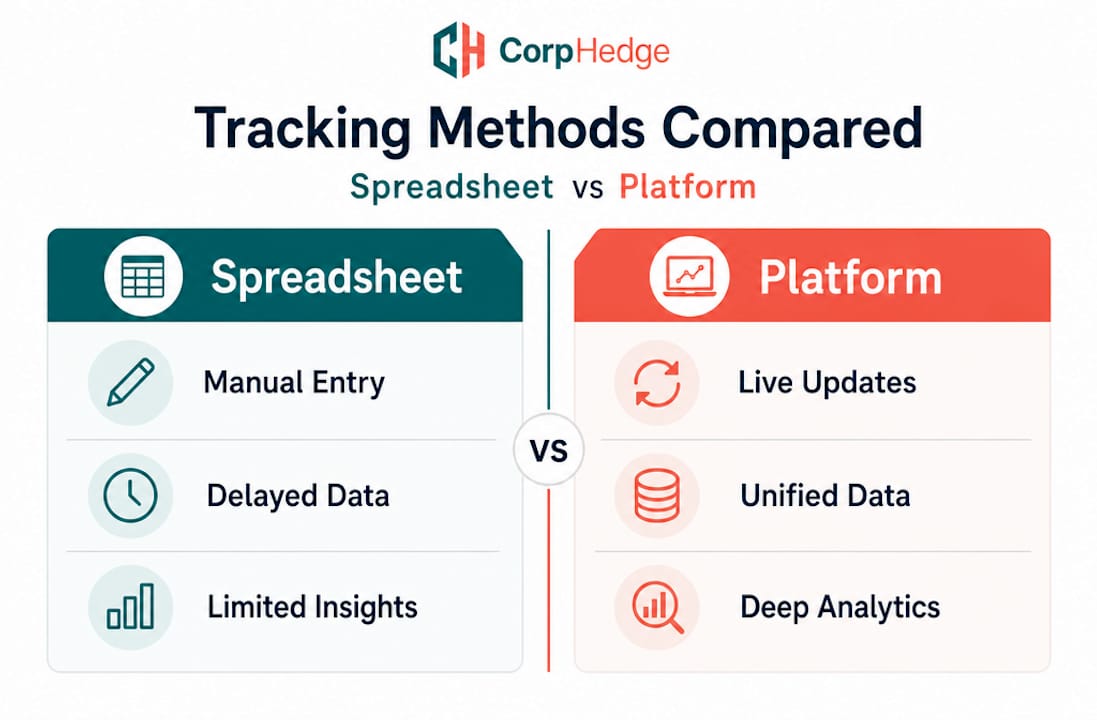
| Capability | Spreadsheet approach | Integrated platform |
|---|---|---|
| Data freshness | Manual, often days old | Real-time or daily automated feeds |
| Multi-entity consolidation | Manual aggregation | Automatic across all entities |
| Sensitivity analysis | Static, rebuilt each cycle | Dynamic, recalculates on rate changes |
| Hedge linkage | Tracked separately | Linked directly to exposure entries |
| Audit trail | Difficult to reconstruct | Built-in version history |
What I've learned from watching FX tracking programs succeed and fail
I've seen treasury teams invest heavily in analytics platforms and still produce unreliable FX exposure reports. The reason is almost always the same: the underlying data was incomplete before the technology was layered on top. Data quality is the primary determinant of exposure tracking accuracy, not the sophistication of the tools you use to analyze it.
In my experience, the teams that get this right share one habit. They treat exposure data collection as a non-negotiable operational discipline, not a best-effort exercise. They have named owners for every data source. They escalate missing data the same day it is due. They do not publish a risk report until the register is confirmed complete.
The other lesson I keep coming back to is that FX exposure tracking is not a project with an end date. Currency mix changes as businesses grow. New subsidiaries bring new exposure sources. Hedging strategies evolve. The teams that maintain confidence in their risk reporting are the ones that review and update their processes at least annually, not just when something breaks.
My honest take: if you are still relying on a spreadsheet to consolidate exposure data across more than three entities, you are not tracking FX exposure. You are approximating it. And in a year where PLN and SEK volatility is adding new complexity for businesses entering Central and Northern European markets, approximation is not a risk management strategy.
— Bartas
How Corphedge supports your FX exposure tracking

Corphedge was built for exactly the kind of multi-entity, multi-currency complexity described throughout this article. The platform consolidates exposure data across subsidiaries, applies standardized exchange rates consistently, and delivers real-time dashboards that replace the manual reconciliation cycle most treasury teams still rely on. For companies managing FX exposure across EUR, PLN, SEK, and other currency pairs, Corphedge provides sensitivity analysis and hedge tracking in one place, with the audit trail your compliance team needs. The value at risk hedging framework helps you size hedge positions based on actual risk quantification rather than gut feel. Corphedge is now expanding support for businesses operating in Poland and Sweden, making it a timely option for treasury teams entering those markets. Take the product tour to see how it fits your current setup.
FAQ
What is FX exposure tracking?
FX exposure tracking is the process of identifying, measuring, and monitoring a company's financial positions that are subject to foreign currency movements, covering transaction, translation, and economic exposure across all entities and systems.
How do you build an FX exposure register?
An exposure register documents every foreign currency position from receivables, payables, intercompany balances, bank accounts, and debt instruments, with a named data owner and defined update schedule for each source.
Why does exchange rate consistency matter for FX risk analytics?
Using different rate sources for budgeting, actuals, and reporting creates discrepancies that distort hedge ratios and sensitivity analysis, making it impossible to assess true exposure levels accurately.
How often should FX exposure data be updated?
Transaction exposure data should be updated daily or in real time where possible, while translation exposure from subsidiary reporting can be updated monthly, provided the process is documented and consistently followed.
What is the role of sensitivity analysis in hedging FX exposure?
Sensitivity analysis quantifies how exposure values change under 1%, 5%, and 10% exchange rate shocks, giving treasury teams and boards a clear picture of risk levels and informing decisions about hedge coverage and strategy.