

A hedging program is working when eight things line up at once: the hedge coverage ratio sits inside its policy band, the hedge effectiveness ratio lands between roughly 80% and 125%, the realized hedged rate tracks close to budget, exposure forecast accuracy holds steady month over month, mark-to-market and back-testing happen on a set cadence, a board-approved FX policy exists and gets followed, operational controls catch errors before settlement, and reporting reconciles cleanly without surprises. Industry commentary from groups like NeuGroup and treasury standards bodies frame these as the baseline for judging any hedging book, not just the sophisticated ones.
None of these signs work alone. A tight hedge ratio means little if forecast accuracy is falling apart underneath it, and a clean effectiveness ratio doesn't matter if nobody's board ever approved the policy that produced it. This guide breaks down each signal, the KPI math behind it, and the governance and operational habits that keep them honest, so you can run a real audit instead of guessing.
- Hedge coverage ratio stays within policy-defined bands
- Hedge effectiveness ratio consistently between 80% and 125%
- Realized hedged rate tracks close to budgeted rate
- Exposure forecast accuracy holds steady across cycles
- Regular mark-to-market and back-testing cadence
- Documented, board-approved FX policy in active use
- Segregated duties and auditable trade controls
- Cost of hedging stays proportionate to risk reduced
Key Takeaways
Effective FX hedging shows up as measurable alignment between hedge ratio, effectiveness ratio, forecast accuracy, and a board-approved policy that operations actually follow.
| Point | Details |
|---|---|
| Watch the effectiveness ratio | Keep it between 80% and 125%; outside that band, the hedge isn't doing its job. |
| Governance beats cleverness | A board-approved policy with segregated duties predicts consistency better than instrument choice. |
| Fix forecast data first | Forecast accuracy problems undermine every other metric, so audit exposure data before adjusting strategy. |
| Layer instruments by exposure type | Match forwards, options, and collars to contracted, forecasted, and translational exposure separately. |
| Automate to catch drift early | CorpHedge's live dashboards and automated mark-to-market flag coverage or cost drift before it becomes a red flag. |
Table of Contents
- Signs of Effective FX Hedging: The KPIs That Prove It
- Governance Signs That Point to a Mature FX Program
- Which Hedging Strategies Signal a Good Fit for Your Exposure?
- What Operational Controls Look Like When Hedging Works
- How Accounting and Reporting Confirm Hedge Effectiveness
- Red Flags That Signal a Hedging Program Is Failing
- How Do Your Numbers Compare to Industry Benchmarks?
- Run This One-Quarter Self-Audit on Your Hedging Program
- See How CorpHedge Turns This Checklist Into a Live Dashboard
- Sources
- FAQ
Signs of Effective FX Hedging: The KPIs That Prove It
Six metrics separate a hedging program that actually works from one that just looks busy. Each needs its own measurement method and its own read on what "good" looks like.
Hedge coverage ratio measures the percentage of forecasted exposure covered by hedging instruments at a given point in time.
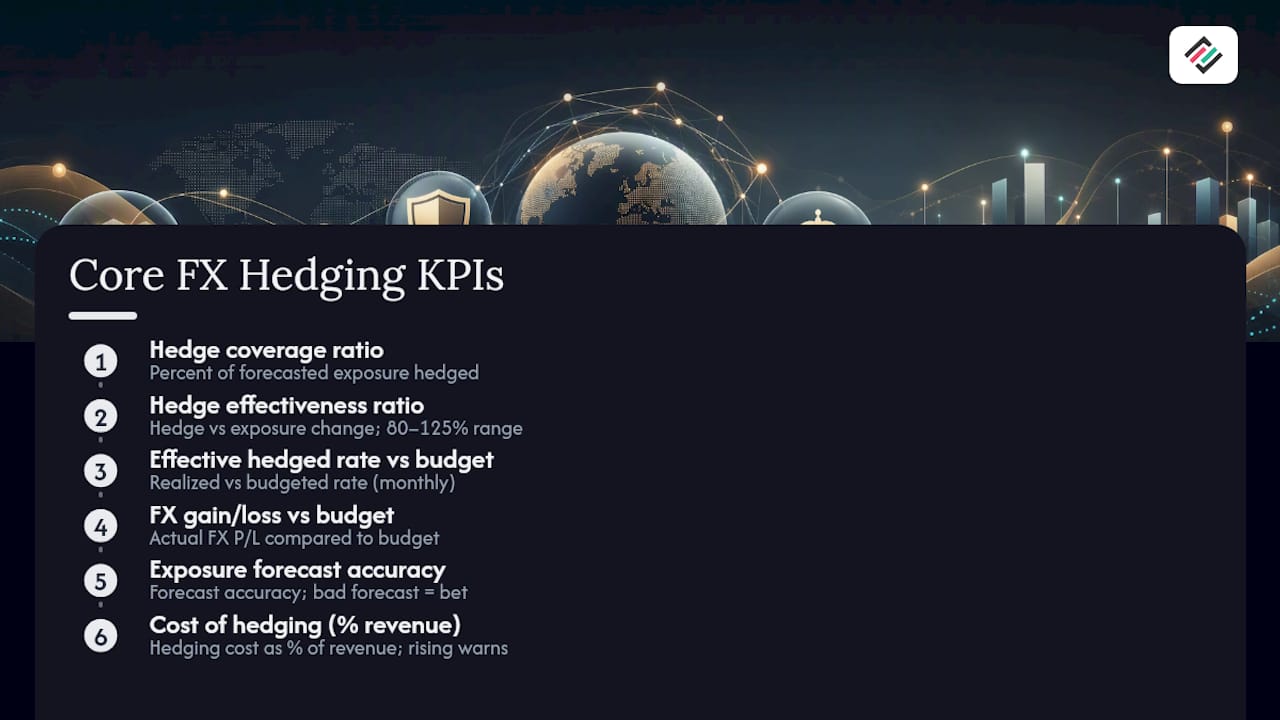
Hedge effectiveness ratio compares the change in value of the hedge against the change in value of the exposure it's covering. A ratio between 80% and 125% is the commonly accepted range for calling a hedge effective; outside that band, the hedge is arguably not doing its job.
Effective hedged rate vs. budget and FX gain/loss vs. budget are the two numbers finance committees actually ask about. Practitioners tracking seven core FX metrics point to comparing the realized rate against the budgeted rate monthly, alongside the percentage impact on EPS versus target.
Exposure forecast accuracy deserves its own line because a hedge built on a bad forecast is a bet, not a hedge. Earnings-at-Risk (EaR) or VaR for FX quantifies the potential earnings swing from unhedged exposure at a confidence interval, typically reviewed monthly or quarterly. Watch cost of hedging as a percentage of revenue, too. Rising cost without rising exposure is a warning sign, not a sign of diligence.

Pro Tip: Always mark both the hedge and the underlying exposure at the same time. Marking one without the other is the single most common way treasuries fool themselves into thinking a hedge is working.
Governance Signs That Point to a Mature FX Program
A hedging program with no paper trail is a hedging program you can't defend to an auditor. The strongest signal of maturity isn't a clever instrument mix, it's a governance structure that survives staff turnover.
- Board or senior management has formally approved the FX policy
- Objectives and permitted instruments are documented in writing
- Duties are segregated between deal execution, confirmation, and settlement
- An authority matrix defines who can approve what size trade
- Counterparty limits exist and get monitored, not just set once
- An exceptions log tracks every deviation from policy and why it happened
Cross-functional ownership matters more than most treasuries admit. FP&A, accounting, procurement, and tax all touch FX exposure differently, and a monthly FX risk committee cadence keeps their assumptions aligned. Treasury leaders increasingly validate their KPI targets and volatility assumptions with multiple banking partners rather than relying on a single bank's view, which catches biased inputs before they become policy.
Pro Tip: Keep hedge designation memos and decision logs even when nothing seems wrong. The first time an auditor asks why a hedge was de-designated, you'll be glad the paper trail already exists.
Which Hedging Strategies Signal a Good Fit for Your Exposure?
The instrument mix itself tells you a lot about whether a program is well-designed or just accumulated over time. Natural hedges, matching revenue and costs in the same currency, work best for companies with genuine operational offsets and cost nothing to maintain. Forwards lock in a rate with no premium but no upside either. Options cost a premium in exchange for keeping upside intact. Collars split the difference, capping both the downside and the upside for a lower net cost than a standalone option.
- Contracted revenue with a known settlement date usually calls for forwards, since certainty matters more than flexibility.
- Forecasted pipeline with lower confidence often fits options or a collar, because the exposure might not materialize at all.
- Translational exposure from consolidating foreign subsidiaries typically favors partial hedging or natural offsets rather than aggressive derivative coverage.
Layering, staggering coverage across multiple future periods rather than hedging one date at a time, reduces concentration risk and smooths the realized rate over time. Programs that combine a static core hedge with a dynamic overlay tend to hold up better in volatile markets. One analysis of advanced hedging strategies found hedged firms using this hybrid approach cut cash-flow variance by roughly 8% to 12% compared to unhedged peers, with dynamic overlays outperforming static-only books during stressed currency regimes.
What Operational Controls Look Like When Hedging Works
Good metrics and good policy still fail without the operational plumbing to back them up. Exposure needs to be mapped by currency and month, fed by integrated cash-flow data rather than a finance analyst's spreadsheet guesswork. Deal capture should be automated, and mark-to-market needs to run daily or weekly, not whenever someone remembers.
- Exposure mapped by currency and settlement month
- Automated deal capture feeding directly into position records
- Daily or weekly mark-to-market with documented reconciliations
- Settlement controls that flag mismatches before funds move
Counterparty management is the part treasuries most often underinvest in. That means committed credit lines, diversification across multiple banks rather than concentration in one relationship, active CSA and margin planning, and ongoing monitoring of counterparty credit quality.
- Diversified counterparty relationships with committed credit lines
- CSA and margin terms reviewed on a fixed schedule
- Live dashboards showing net exposure by currency and hedge ratio by bucket
- Exception alerts tied to an auditable trade approval workflow
How Accounting and Reporting Confirm Hedge Effectiveness
Hedge accounting eligibility hinges on documentation you create before the trade, not after. That means a signed designation memo, mark-to-market of both the hedge and the hedged item on a set schedule, weekly or quarterly depending on materiality, and a documented effectiveness test that shows the relationship still qualifies.
- File a hedge designation memo at trade inception, not retroactively.
- Run effectiveness tests on the same cadence as your mark-to-market.
- Disclose ineffectiveness the moment a test fails, not at quarter-end cleanup.
Fail hedge accounting and the P&L absorbs volatility that was supposed to stay off it, which is exactly the outcome hedging was meant to prevent. A de-designation playbook, built in advance, keeps that failure from becoming a scramble. Constant-currency bridges that reconcile FX impact back to operating metrics also make investor communications far easier to defend under questioning.
Red Flags That Signal a Hedging Program Is Failing
Persistent forecast error, coverage ratio drifting outside policy without explanation, and hedging cost climbing while exposure stays flat all point to the same underlying problem: the program has drifted from its own rules. Frequent one-off, ad hoc hedges usually mean there's no real strategy, just reactive trading. Basis risk from proxy hedging (using a correlated but different currency pair) can quietly erode effectiveness for months before anyone notices.
- Forecast error stays elevated for two or more consecutive quarters
- Coverage ratio sits outside its band with no documented rationale
- Hedging cost rises without a corresponding rise in exposure
- Ad hoc hedges appear outside the normal review cycle
- Counterparty credit quality deteriorates without a response plan
Pro Tip: If your exposure and hedge data still live in separate spreadsheets that someone reconciles by hand, that's the root cause behind most of these red flags, not a symptom of them.
How Do Your Numbers Compare to Industry Benchmarks?
Comparing your program to peers only works if you're comparing against real numbers, not internal assumptions dressed up as benchmarks. Firms running hybrid static-plus-overlay programs have shown roughly 8% to 12% lower cash-flow variance than those relying on static hedges alone, a gap that widens further during volatile currency regimes.
Validation should happen on multiple fronts. Cross-check assumptions with more than one banking partner rather than trusting a single dealer's volatility view, run independent back-testing on realized versus modeled outcomes, and build a constant-currency revenue bridge to see how much of your reported performance swing was actually operational versus currency noise. NeuGroup members report that comparing effective hedged rate to budget monthly, and tracking what percentage of exposure remains unprotected, gives management a clearer read than any single metric alone.
Pro Tip: Treat your calibration as a living process, not a one-time setup. Programs built for perfect precision on day one tend to break the first time the market regime shifts; programs built to recalibrate quarterly tend to survive it.
Run This One-Quarter Self-Audit on Your Hedging Program
A useful audit doesn't need six weeks. Work through these in order, starting with the checks that take an hour and moving toward the ones that take a day.
- Pull your top five currency pair exposures and check hedge ratio against policy band.
- Review forecast accuracy for the last two quarters against actuals.
- Reconcile mark-to-market values for hedges against underlying exposures.
- Check counterparty exposure concentration against your limits.
- Confirm the FX policy has current board or senior management sign-off.
- Trend your KPIs (hedge ratio, effectiveness ratio, cost vs. revenue) over four quarters.
- Pull a sample of hedge designation memos and confirm they're complete.
- Test whether your exposure data source is automated or still manual.
- Expected output for each check: a clear pass/fail against a documented threshold, not a subjective impression
- Minimum data needed: exposure ledger, trade blotter, bank confirmations, and the current policy document
- Quick fix for manual data gaps: consolidate exposure feeds into one system before the next quarter's review
- Medium-term fix for policy drift: schedule a governance committee re-approval cycle every twelve months
Where should treasuries fix things first?
Fix exposure data and forecast accuracy before anything else. Governance and policy clarity come second, and instrument mix or dynamic overlays come third. A hedging strategy built on a shaky forecast fails no matter how sophisticated the instruments are, while a program with accurate data and a simple forward-only strategy often outperforms one with fancy overlays and bad inputs.
I've seen treasuries spend months debating collar structures while their exposure forecast was off by double digits every quarter. Fix the data first. Everything else is easier after that.
See How CorpHedge Turns This Checklist Into a Live Dashboard
Every sign covered above, coverage ratio, effectiveness ratio, forecast accuracy, mark-to-market cadence, depends on having exposure and hedge data in one place instead of scattered across spreadsheets and bank statements. CorpHedge gives treasury teams live exposure dashboards, automated mark-to-market, KPI tracking, and VaR-based hedging simulations built to run the exact audit outlined in this guide without the manual reconciliation work.
The platform's auditable trade workflow means every designation memo, exception, and counterparty limit check is logged automatically, which matters as much for board reporting as it does for your own peace of mind. As CorpHedge expands into Poland and Sweden, treasury teams in those markets get the same live exposure tracking and compliance integrations already used elsewhere. Take the product tour to see how the dashboards map directly onto the checklist above.
Sources
This article is general information, not a substitute for advice from a qualified financial advisor. Consult a qualified financial professional about your own circumstances before acting on anything here.
FAQ
How do FX hedges work?
An FX hedge locks in or limits a future exchange rate using instruments like forwards, options, or collars, offsetting the risk that currency movements will hurt cash flow or earnings before a transaction settles.
How do you hedge a foreign currency receivable?
Most treasuries hedge a foreign currency receivable with a forward contract matched to the expected collection date, though options are common when the receivable's timing or amount isn't certain.
What are effective hedging techniques for foreign currency risk?
Natural hedging, forwards, options, collars, and layered coverage across multiple future periods each address different exposure types; the most effective programs combine a static core hedge with a dynamic overlay rather than relying on one instrument alone.
How often should hedge effectiveness be reviewed?
Mark-to-market and reconciliation should happen weekly or monthly depending on exposure size, with a full policy and KPI review at least quarterly, more often during periods of high currency volatility.
Can a platform like CorpHedge track these signs automatically?
Yes. CorpHedge tracks hedge ratio, effectiveness ratio, and forecast accuracy through live dashboards and automated mark-to-market, replacing the manual spreadsheet reconciliation that causes most reporting delays.