

TL;DR:
- Real-time FX monitoring enables proactive risk mitigation and immediate response to currency movements.
- Hybrid architectures combining streaming and batch processing offer cost-effective and reliable risk management solutions.
- Successful implementation requires disciplined oversight, proper infrastructure, and validation to prevent gaps and false confidence.
Waiting until end-of-day to review your FX exposure is no longer a viable strategy. Currency markets move in milliseconds, and a single rate swing during trading hours can quietly erode margins before your batch report even runs. Real-time data enables proactive risk mitigation by detecting emerging risks early, allowing immediate action to reduce financial losses in volatile currency markets. This guide walks through how real-time monitoring works, what technologies power it, where AI and machine learning amplify results, and how to decide when a hybrid approach is smarter than full streaming.
Table of Contents
- Why real-time data matters in today's risk landscape
- How real-time pipelines enable currency risk detection and mitigation
- AI/ML in real-time risk: Accuracy and automation for FX stress forecasting
- Balancing speed, cost, and reliability: When to use real-time vs. hybrid approaches
- The real world of real-time: What most articles don't tell you
- Take your next step in real-time FX risk management
- Frequently asked questions
Key Takeaways
| Point | Details |
|---|---|
| Early risk detection | Real-time data gives firms the ability to spot market threats before losses mount. |
| Automation and speed | Instant currency updates unlock automated hedging and decision-making across global operations. |
| ML accuracy gains | Combining real-time data with machine learning improves FX risk forecasting by up to 35 percent. |
| Cost-benefit tradeoff | Full real-time streaming is not always optimal; hybrid approaches balance speed and cost for most use cases. |
| Implementation challenges | Deploying real-time risk systems demands significant technical investment and operational diligence. |
Why real-time data matters in today's risk landscape
The case for real-time monitoring is not theoretical. Over the past two years, currency markets have delivered sharp, sudden moves that exposed the limits of daily reporting cycles. The British pound dropped nearly 5% in a single session during 2022's mini-budget crisis. The Japanese yen tested multi-decade lows in 2023 and 2024, forcing intervention from the Bank of Japan. Any treasury team relying on overnight batch reports during those windows was already behind.
The operational consequences are concrete. Real-time monitoring reduces downtime and losses by catching emerging risks before they compound. When a rate breach triggers an automated alert at 10:42 a.m. rather than appearing in a 6:00 p.m. summary, your team has hours to respond instead of waiting until the next morning. That window is where hedging decisions get made or missed.
Here is what real-time data actually changes for corporate risk teams:
- Continuous position visibility: You see your net FX exposure updated as transactions settle, not as a snapshot from last night.
- Threshold-based alerting: Automated triggers fire when a rate crosses a predefined level, removing the need for manual monitoring.
- Faster hedge execution: When you know a move is happening now, you can act on it now, not after the fact.
- Audit trail integrity: Every rate, every alert, every action is timestamped, which matters for both internal governance and regulatory review.
"High-velocity risks from 2023 to 2024 volatility require streaming over batch. Network fluctuations need auto-reconnect, and large subscriptions should be batched to avoid failures." — Why Risk Systems Never Really Became Real-Time
This is not just about speed for its own sake. It is about control. Following risk management best practices means building systems that match the pace of the markets you operate in, not the pace of your reporting cycle.
How real-time pipelines enable currency risk detection and mitigation
Understanding the value is one thing. Knowing what the architecture actually looks like is what lets you evaluate vendors, ask the right questions, and build a resilient system.
Modern real-time FX risk pipelines rely on a combination of streaming technologies and API-based data feeds. The two most widely used frameworks are Apache Kafka for event streaming and Apache Flink for stateful stream processing. Together, they allow firms to ingest high-frequency rate data, compute running exposures, and trigger downstream actions, all with sub-second latency for intraday control and early warning indicators. This matters when a currency pair moves 80 basis points in three minutes, which happens more often than most finance teams expect.
Real-time FX data feeds via APIs and WebSockets enable automated monitoring of exchange rates, volatility detection, and hedging decisions, replacing manual processes that introduce lag and human error. WebSocket connections are particularly valuable because they maintain a persistent, low-latency channel between your system and the data provider, pushing updates the moment they occur rather than waiting for your system to request them.

Here is a simplified view of how a typical real-time currency risk pipeline is structured:
| Stage | Technology | Function |
|---|---|---|
| Data ingestion | WebSocket / REST API | Pull live FX rates from market data providers |
| Event streaming | Apache Kafka | Route rate events to downstream consumers |
| Stream processing | Apache Flink | Compute running exposure, detect threshold breaches |
| Risk calculation | In-memory engine | Update VaR, Greeks, and hedge ratios in real time |
| Alerting and action | Webhook / messaging | Trigger alerts, initiate hedge orders, log events |
| Reporting layer | Batch or near-real-time | Aggregate for audit, compliance, and management reporting |
To implement this effectively, follow these steps:
- Define your monitoring universe. List every currency pair you have exposure to, including indirect exposures through subsidiaries or supply chain contracts.
- Set threshold parameters. Decide what rate moves, volatility spikes, or position sizes trigger an alert. Be specific and tie thresholds to your actual risk appetite.
- Choose your data provider. Evaluate providers on latency, reliability, breadth of currency coverage, and API documentation quality.
- Build or buy the processing layer. Kafka and Flink are powerful but require engineering resources. Many firms use managed cloud services or vendor platforms to reduce the build burden.
- Test connectivity resilience. Simulate network drops, reconnect scenarios, and data gaps before going live. Real markets do not pause for infrastructure issues.
- Integrate with your hedging execution platform. Real-time detection is only useful if it connects to a system that can act on what it finds.
Pro Tip: Do not try to monitor every currency pair with the same frequency. Prioritize streaming for your top five to ten most volatile or highest-volume pairs, and use polling for lower-priority exposures. This reduces infrastructure cost without sacrificing meaningful coverage. You can find more detail on structuring this approach through currency volatility prevention methods and smart forex risk management frameworks.
AI/ML in real-time risk: Accuracy and automation for FX stress forecasting
Once real-time data flows are established, the next leap comes from pairing speed with advanced analytics. Machine learning models fed by live data streams do not just react to what is happening now. They forecast what is likely to happen next, which is where the real competitive advantage emerges.
The evidence is compelling. Random forests reduce quantile loss by 27% for FX stress forecasting at three to twelve month horizons compared to traditional econometric methods. That is not a marginal improvement. A 27% reduction in forecast error translates directly into better hedge sizing, fewer over-hedges, and less capital tied up in unnecessary protection. Empirical benchmarks show 27 to 35% accuracy gains when real-time data is combined with ML models, though firms must validate scalability and explainability before enterprise deployment.
Here is how traditional analytics and ML-powered real-time approaches compare across key dimensions:
| Dimension | Traditional analytics | ML with real-time data |
|---|---|---|
| Forecast horizon | Short-term, rule-based | 3 to 12 months, probabilistic |
| Data inputs | Historical rates, economic indicators | Live rates, news sentiment, order flow |
| Update frequency | Daily or weekly | Continuous |
| Tail event detection | Limited | Strong (trained on stress scenarios) |
| Explainability | High | Requires additional tooling |
| Implementation cost | Low to medium | Medium to high |
The explainability point deserves attention. Corporate finance teams and boards need to understand why a model is recommending a hedge, not just that it is. Regulators and auditors ask the same question. Modern ML frameworks offer tools like SHAP (SHapley Additive exPlanations) that break down model outputs into readable factor contributions, making it possible to say "the model is recommending increasing EUR hedge coverage because implied volatility spiked and forward premiums widened."
Real-world use cases include anticipating tail events before they hit your financial statements. A manufacturer with significant USD/MXN exposure, for example, can use an ML model trained on political risk signals, cross-border trade data, and real-time volatility to flag elevated stress probability weeks before a rate dislocation appears in traditional indicators. That early warning is what separates firms that hedge proactively from those that absorb the loss and explain it in the next earnings call.
Integrating these models into your value at risk workflow and broader FX risk workflow requires deliberate design. The model output needs to feed into your decision framework, not sit in a separate analytics silo that nobody checks until after the fact.
Balancing speed, cost, and reliability: When to use real-time vs. hybrid approaches
Even with the performance advantages of real-time systems, a strategic approach requires knowing when not to use them. Full streaming is not always the right answer, and treating it as a universal default is an expensive mistake.
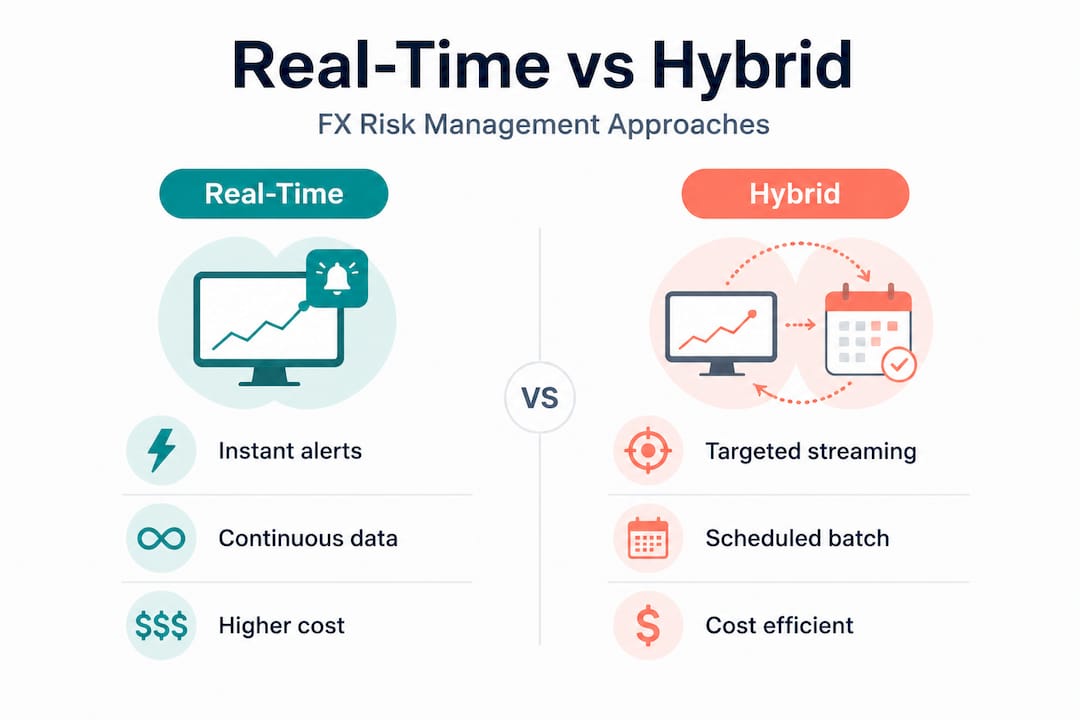
Streaming infrastructure runs three to five times costlier than batch processing for equivalent data volumes. Real-time is clearly essential for fraud detection, liquidity monitoring, and active hedging decisions. But for regulatory reporting, historical analysis, and management dashboards that update hourly, batch or near-real-time processing often delivers better cost and stability outcomes.
Here is how to evaluate which approach fits each use case:
- Map your use cases by urgency. Separate decisions that need sub-second data (active hedge triggers, liquidity alerts) from those that need hourly or daily data (management reporting, audit trails, compliance submissions).
- Estimate the cost of being slow. For each use case, calculate what a one-hour delay in detection would cost in a realistic adverse scenario. If the number is small, batch is probably fine.
- Assess your engineering capacity. Real-time systems require ongoing maintenance, monitoring, and incident response. If your team is stretched, a managed platform or hybrid vendor solution reduces that burden significantly.
- Design for graceful degradation. Build systems that fall back to near-real-time or batch if streaming infrastructure fails, rather than going dark entirely.
- Review and recalibrate regularly. Market conditions change. A currency pair that was low-priority in 2023 may become high-priority in 2026 due to geopolitical shifts or new business exposure.
"Hybrid architectures often deliver the best return on investment for corporate treasury teams. Real-time where it counts, batch where it is sufficient."
Pro Tip: Start with a hybrid architecture even if your long-term goal is full real-time coverage. Deploy streaming for your two or three most critical currency pairs and use batch for everything else. This gives you operational experience with real-time systems at manageable cost and risk before you scale. Explore advanced strategies for forex risk and corporate FX risk management to understand how leading firms structure these decisions.
The real world of real-time: What most articles don't tell you
The frameworks above make real-time sound like the obvious answer to every FX risk problem. The operational reality is more complicated, and we think it is worth being direct about that.
Most firms significantly underestimate the engineering lift required to build and maintain a real-time risk system. Kafka clusters need tuning. WebSocket connections drop and need auto-reconnect logic. State management in stream processors is genuinely complex, especially when you are tracking multi-currency positions across dozens of entities and legal structures. The first six months of a real-time implementation often feel like you are running faster just to stay in place.
There is also a subtler risk: false confidence. When you have a dashboard showing live rates and positions, it is tempting to assume the system is catching everything. But real-time data only captures what you have instrumented. If a subsidiary is booking transactions in a system that does not feed your pipeline, or if your model has a blind spot for a particular market structure, the dashboard looks fine while the exposure grows. Automation reduces human error in monitored areas but can mask gaps in coverage.
The firms that get the most value from real-time systems are not the ones that deployed the most sophisticated technology. They are the ones that paired technology with disciplined human oversight, clear escalation protocols, and regular model validation. A well-designed hybrid approach, near-real-time for active hedging and batch for audit and reporting, often delivers better ROI than a full streaming build that the team does not have the capacity to maintain properly.
The honest answer is that hedging based on value at risk still requires human judgment about model inputs, hedge ratios, and risk appetite. Real-time data makes that judgment faster and better informed. It does not replace it.
Take your next step in real-time FX risk management
If the frameworks in this article resonate with where your team needs to go, the practical question is what tools and partners can help you get there without rebuilding your entire risk infrastructure from scratch.
CorpHedge is built specifically for corporate treasury and risk teams that need to operationalize real-time and hybrid FX risk management without the overhead of a full internal build. The platform delivers live currency position visibility, Value at Risk-based strategy tools, and integrations with execution platforms, all designed for international companies managing complex, multi-currency exposure. Whether you are starting with a single currency pair or managing a global portfolio, hedging based on value at risk is where the strategy comes to life. Explore corporate FX use cases to see how firms like yours are applying these approaches, or visit CorpHedge to review the full platform capabilities.
Frequently asked questions
What advantages does real-time data offer for currency risk management?
Real-time data enables early risk detection and immediate hedging action, which directly reduces financial losses from sudden currency movements. Unlike batch reporting, it gives treasury teams the ability to respond while a move is still developing.
How do real-time FX data feeds work?
APIs and WebSockets deliver exchange rate updates continuously, supporting automated monitoring, instant alerting, and hedging decisions without manual intervention. WebSocket connections are particularly efficient because they push data to your system rather than waiting for a request.
When is hybrid or batch processing preferable to full real-time streaming?
Streaming costs three to five times more than batch for equivalent workloads, making hybrid or batch the smarter choice for analytics, compliance reporting, and management dashboards where sub-second detection is not required.
Do AI and machine learning make a real difference when paired with real-time data?
Yes. Random forests improve FX stress forecast accuracy by 27% at three to twelve month horizons compared to traditional methods, and broader benchmarks show 27 to 35% gains when ML is combined with live data feeds.
What technical challenges do firms face in adopting real-time risk systems?
High-velocity market conditions require streaming rather than batch, but network reliability, state management complexity, and the engineering cost of maintaining these systems are significant hurdles that most teams underestimate before they start building.