

Non-deliverable forwards are the right tool when a corporate's exposure sits in a currency that cannot be delivered offshore. That covers most restricted or non-convertible currencies across emerging markets. The trade-off is real: you trade convertibility risk for basis risk, rollover risk, and counterparty exposure. The immediate next step is simple. Quantify the exposure and confirm exactly which fixing source your contract will reference before you trade.
TL;DR:
- NDFs are primarily used for restricted currencies where offshore delivery is impossible, but they carry basis, rollover, and counterparty risks.
- Setting the exact fixing source and date before trading is crucial to avoid settlement disputes and ensure accurate hedge execution.
- Hedging confirmed payables with full NDF coverage and partial forecasts helps manage exposure effectively, with proper documentation necessary for hedge accounting.
- In markets with tight or uncertain convertibility, NDFs are preferable over deliverable forwards, despite wider spreads and potential liquidity issues.
- Ongoing governance, including precise exposure quantification, counterparty vetting, and regular position reviews, is essential to prevent errors and losses in NDF programs.
Table of Contents
- What Is an NDF and How Does Settlement Work?
- How Corporates Actually Use NDFs Day to Day
- NDF, Deliverable Forward, or Something Else Entirely?
- The Risks That Quietly Undermine an NDF Hedge
- A Step-by-Step Template for Executing an NDF Hedge
- What Treasury Teams Get Wrong About NDF Governance
- Where CorpHedge Fits Into an NDF Hedging Program
- Sources
- FAQ
What Is an NDF and How Does Settlement Work?
An NDF is a cash-settled forward contract used when the underlying currency cannot be delivered outside its home market, either because of capital controls or thin convertibility. No principal changes hands at maturity. Instead, both parties settle the difference between the contracted forward rate and a fixing rate, in a convertible currency, usually US dollars.
That fixing rate is the mechanism everything else depends on. It is typically a spot rate published by a central bank or a designated financial data provider, and the fixing is commonly set two business days before contract maturity, a convention known as T minus 2.
Pro Tip: Always confirm the exact fixing page or Reuters/Bloomberg ticker named in your confirmation before you trade, not after. A dispute over which page published the rate is one of the most common and avoidable settlement headaches in NDF hedging.
Here's a simplified example. A UK company has a $2 million Brazilian real payable due in 90 days. It buys an NDF at a forward rate of 5.40. At fixing, the published spot rate is 5.60. The counterparty owes the company the dollar-equivalent difference, which offsets the extra cost of buying real at the weaker spot rate. No reals are exchanged. Only dollars move.
Key mechanics to remember:
- Settlement currency is almost always a hard currency, typically USD.
- The fixing source and fixing date must be named explicitly in the trade confirmation.
- No physical delivery of the restricted currency ever occurs.
How Corporates Actually Use NDFs Day to Day
Corporate treasuries reach for NDFs when a deliverable forward isn't available or isn't liquid enough for the currency in question. The use cases cluster around a handful of recurring scenarios:
- Supplier payables in a restricted currency, where the invoice date and amount are already fixed.
- Expected receipts from local subsidiaries or customers, where timing is reasonably firm but not contractually locked.
- Project milestones tied to capital expenditure abroad, where cash outflows land on a known schedule.
- Repatriation timing constraints, where a subsidiary can only move dividends or profits out on set dates or under regulatory approval windows.
Matching the NDF to the underlying exposure sounds obvious but gets sloppy in practice. A confirmed payable should get a notional and value date that mirror the invoice exactly. A forecast receivable, by contrast, deserves a partial hedge ratio, since the underlying amount could still shift with sales volume or contract renegotiation.
Hedge accounting adds another layer. Under both IFRS and US GAAP, claiming hedge accounting treatment for an NDF requires documented evidence: the hedged item, the hedging instrument, the risk being hedged, and an assessment of hedge effectiveness, all recorded at inception. Combining NDFs with other instruments as part of a documented program makes that effectiveness testing considerably easier to defend to auditors.
NDF, Deliverable Forward, or Something Else Entirely?
The choice usually comes down to one question first: can the currency be delivered offshore at all? If yes, a deliverable forward is almost always cheaper and simpler. If no, or if convertibility is uncertain, an NDF becomes the default instrument.
A few decision rules help narrow it further:
- Convertibility: fully restricted currencies (Chinese yuan in some structures, Indian rupee, Brazilian real) point toward NDFs by default.
- Liquidity and cost: NDF markets tend to have wider bid/ask spreads than deliverable forwards, and long-dated NDF tenors can carry particularly unattractive spreads because fewer counterparties are willing to hold the risk that far out.
- Exposure certainty: options make more sense than NDFs when the exposure is genuinely uncertain, since you pay a premium for the right, not the obligation, to hedge.
- Natural hedges: if the business can shift local costs or revenues to offset the exposure, that often beats paying any derivative spread at all.
A workable checklist: confirm the currency is genuinely restricted, size the exposure against confirmed versus forecast cash flows, price both an NDF and any deliverable alternative, and only then commit to tenor and counterparty.
The Risks That Quietly Undermine an NDF Hedge
NDFs solve the convertibility problem, but they introduce three risks that deliverable forwards mostly avoid.
- Basis risk: NDF pricing can diverge from the onshore forward curve, especially when capital controls tighten or a central bank intervenes. The gap between onshore and offshore rates can widen sharply during exactly the moments a hedge is supposed to protect you, which is a pattern worth monitoring closely rather than assuming away.
- Rollover risk: multi-period exposures need repeated rolling, and each roll can accumulate basis mismatch if not handled carefully.
- Counterparty credit risk: since there's no physical delivery, you're relying entirely on the counterparty's willingness and ability to settle the cash difference.
- Liquidity constraints: some tenors and currency pairs simply don't have deep two-way markets, which widens spreads right when you need to trade.
Pro Tip: For multi-period hedges, don't just let each NDF expire and rebook a fresh one. Use a forward-forward swap executed a day or two before expiry, which locks the same spot rate for both settling the old contract and establishing the new one, cutting the basis drift that builds up across repeated rolls.
A Step-by-Step Template for Executing an NDF Hedge
Most failed NDF programs don't fail on strategy. They fail on sequencing. Here's the order that works:
- Quantify the exposure. Separate confirmed cash flows from forecasts, then set a hedge ratio, commonly full coverage for confirmed amounts and partial coverage for forecasts.
- Choose and document the fixing source. Name the exact page or index and the fixing date in writing before execution, and include a fallback provision for a disputed or missing fixing.
- Select tenor and roll strategy. For exposures beyond one settlement cycle, plan the forward-forward roll in advance rather than reacting at expiry.
- Run counterparty due diligence. Confirm credit lines, margin requirements, and settlement mechanics before the first trade, not after a near-miss.
- Reconcile and govern post-trade. Match settlement amounts against invoices, file hedge accounting documentation, and report exposure and mark-to-market to whoever owns treasury oversight.
Pro Tip: Build steps 1 through 5 into a recurring calendar item, not a one-off project. Currency exposure shifts every quarter as sales, purchasing, and capex plans change, and a static hedge program goes stale fast. For teams building this out for the first time, a structured walkthrough of governance steps is worth reviewing before the first trade ticket gets cut.
What Treasury Teams Get Wrong About NDF Governance
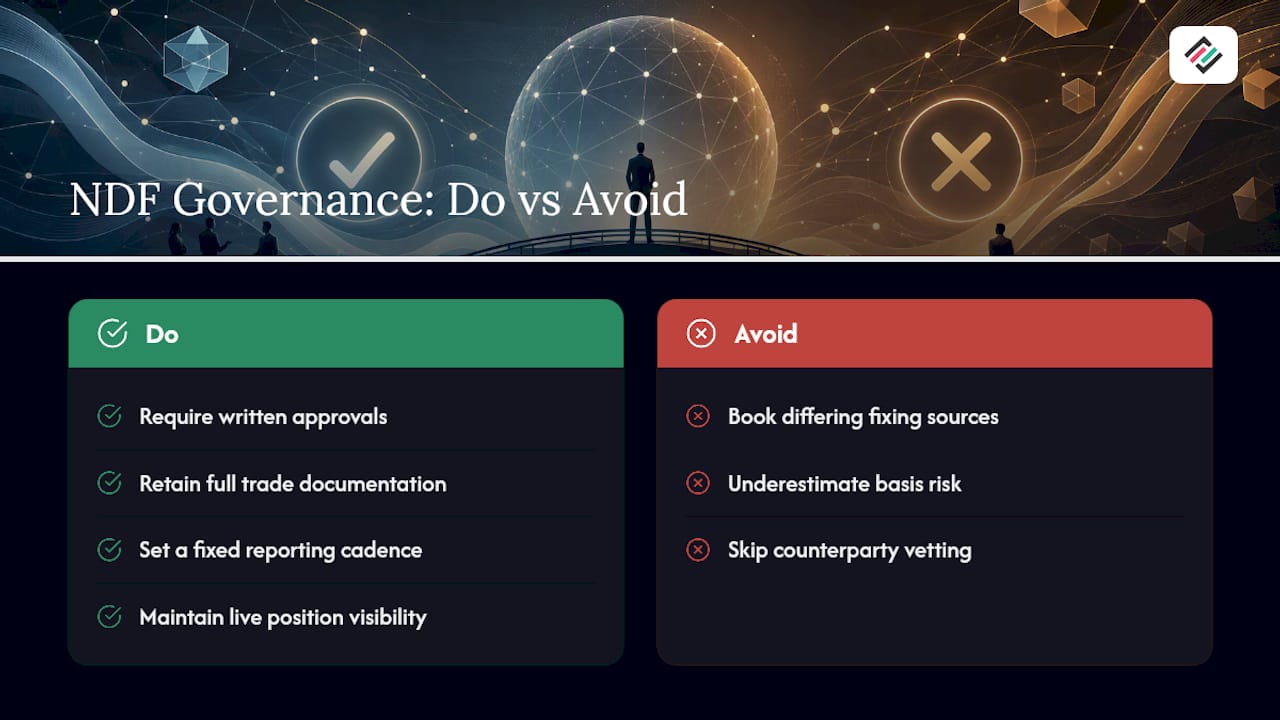
The mistakes I see repeat themselves across companies and currencies. Someone books an NDF against a fixing source that turns out to differ from the one named in the confirmation. Someone underestimates how far basis risk can move during a policy shock. Someone skips proper counterparty vetting because the desk quoted a tight spread and nobody asked why.
Good governance is unglamorous: written approvals, retained documentation, a fixed reporting cadence. What surprises people is how much of that discipline comes down to visibility. A treasury that can see its live positions, run Value at Risk scenarios against them, and get flagged before a fixing date sneaks up, catches these errors before they become losses. The instrument was never the weak link. The process around it usually is.
— Bartas
Where CorpHedge Fits Into an NDF Hedging Program
NDFs work best inside a layered program, not as a standalone bet, and that's exactly the gap CorpHedge is built to close. The platform gives treasury teams live visibility into currency positions, VaR-based strategy tools to size hedges like the ones described above, and reporting that keeps fixing dates, tenors, and documentation from slipping through the cracks.
Corphedge is expanding into Poland and Sweden markets, adding local relevance for treasury teams managing zloty and krona exposure alongside restricted-currency positions elsewhere in their book. If you want to see how the platform handles day-to-day exposure tracking and VaR-based hedge sizing, the product tour walks through the actual workflow. Teams that want a deeper grounding before committing budget can start with the FX hedging course, built specifically around practical treasury decisions like the ones covered here. One honest caveat: in markets facing acute sovereign or regime risk, where fixings themselves may be disrupted, loop in your banks or brokers directly rather than relying on any single platform or instrument alone.
Sources
FAQ
Can Foreign Currency Exchange Risk Be Hedged?
Yes, using instruments like deliverable forwards, options, and non-deliverable forwards, chosen based on whether the currency is freely convertible and how certain the exposure timing is.
How Do You Hedge a Foreign Currency Receivable?
Match the NDF's notional and value date to the expected receipt, using a full hedge ratio for confirmed amounts and a partial ratio for forecast receivables, then document the hedge relationship for accounting purposes.
What Is the Difference Between an NDF and a Forward?
A deliverable forward settles with an actual exchange of both currencies, while an NDF settles only the cash difference between the contracted rate and a published fixing rate, since the underlying currency can't be delivered offshore.
Does NDF Hedging Remove Currency Risk Entirely?
No. It reduces exposure to rate movement but introduces basis risk, rollover risk, and counterparty risk, which is why most treasuries layer NDFs with other instruments rather than relying on one tool alone.
How Often Should a Corporate Review Its NDF Positions?
Quarterly at minimum, since sales forecasts, purchasing plans, and capital expenditure schedules shift often enough to make a static hedge ratio stale within a few months.