

Corporate treasuries should diversify currency holdings by combining natural hedges, multi-currency liquidity, layered financial hedges, and a portfolio-level Value at Risk (VaR) framework rather than hedging each currency in isolation at 100%. This approach stabilizes cash flow, lowers net hedging costs, and gives the CFO a defensible, auditable process instead of a patchwork of one-off forward contracts.
The immediate benefits show up fast:
- Stabilized cash flow and earnings because offsetting currency positions reduce the swings that show up in quarterly results.
- Lower all-in hedging cost since portfolio VaR accounts for correlations between currencies instead of over-hedging each one separately.
- Centralized, policy-driven governance that a risk committee can review, back-test, and defend to auditors.
The recommended path: define your tolerable residual risk first, measure exposure using Value at Risk and Monte Carlo simulation, then implement portfolio hedging rules that satisfy GAAP hedge accounting requirements before you scale execution across entities.
Key Takeaways
Portfolio-level VaR hedging, combined with natural hedges and multi-currency liquidity, reduces both cash-flow volatility and net hedging cost more effectively than hedging every currency individually.
| Point | Details |
|---|---|
| Diversify at the portfolio level | Combine natural hedges, multi-currency cash, and layered derivatives instead of hedging each currency alone. |
| Measure with VaR and Monte Carlo | Quantify tolerable residual risk and map cost versus risk reduction on an efficient frontier. |
| Document governance before scaling | A written FX policy, centralized treasury authority, and monthly reconciliation make the program auditable. |
| Expect trade-offs, not free lunches | Negative carry, hedge accounting timing, and correlation breakdowns need active mitigation, not avoidance. |
| Corphedge supports execution | Corphedge provides VaR modelling, simulation, and automated reporting tools built for this exact framework. |
Table of Contents
- Why Diversify Currency Holdings in the First Place?
- How Do You Diversify a Currency Portfolio in Practice?
- What Does VaR-Based Modelling Actually Measure?
- Governance: Turning Policy Into a Repeatable Process
- What Are the Trade-Offs of Currency Diversification?
- A Real-World Example: What Portfolio Hedging Actually Saved
- How Do You Roll This Out in 90 to 180 Days?
- Why This Approach, Not the Conventional One
- How CorpHedge Supports a Portfolio-Level Approach
- Sources
- FAQ
Why Diversify Currency Holdings in the First Place?
Currency diversification exists to protect the business, not to chase market-level currency gains. That distinction matters more than most finance teams admit. A treasury that diversifies currency holdings is trying to reduce cash-flow and earnings volatility, make budgeting more reliable, and lower the borrowing and hedging costs that eat into operating margins.
McKinsey's research on this point is blunt: companies should manage currency risk to support operational planning and performance management rather than to try to move the needle on shareholder-level currency exposure. Shareholders can diversify currency risk themselves through their own portfolios. Your job is different: keep the business predictable enough that the board can trust the forecast.
Consider a manufacturer with euro-denominated revenue and dollar-denominated debt service. If the euro weakens, revenue in dollar terms drops, but so does the relative burden of servicing dollar debt if local operating costs are also euro-based. Multiple currency exposures on both sides of the balance sheet can offset each other before a single hedge is even placed.
What actually matters to a CFO:
- Predictability of quarterly cash flow, not perfect forecasting.
- A lower blended hedging cost across the portfolio, not the cheapest single trade.
- Faster, cleaner capital allocation decisions because currency noise has been filtered out of the numbers.
How Do You Diversify a Currency Portfolio in Practice?
Diversifying currency holdings is not one technique. It is four levers used together, in the order that fits your exposure profile.
- Match assets to liabilities where you can. If a subsidiary earns in Swedish krona, fund it with krona debt or krona-denominated intercompany loans instead of dollars. This natural hedging approach costs nothing beyond structuring and is often the cheapest lever available.
- Hold multi-currency cash buffers. Keep working capital in the currencies where you actually spend it. This reduces unnecessary conversion drag and gives treasury flexibility during volatile weeks.
- Layer financial hedges by purpose and tenor. Use forwards for contracted receivables, options where the exposure is uncertain, and stagger maturities so no single settlement date carries the full risk.
- Apply portfolio-level VaR-weighted hedging across the whole currency book, not currency by currency. This is where correlation between currencies starts working in your favor instead of being ignored.
A rough rule of thumb: prefer operational hedges (matching, sourcing, pricing adjustments) where derivatives markets are thin or exposure is structural, and reserve financial hedges for exposures that are contractual and near-term. The Bank for International Settlements found that firms are often already "optimally hedged" once offsetting exposures are counted, which means blanket 100% hedging frequently overshoots the actual risk.
Pro Tip: Centralize the VaR calculation in your execution platform instead of running it manually in a spreadsheet once a month. Ad-hoc recalculation invites inconsistent hedge ratios and makes back-testing nearly impossible.
Some treasuries also use currency ETFs or pooled instruments for smaller, non-core exposures where a dedicated forward book isn't cost-effective, though most corporate policies limit this to a narrow, pre-approved list of instruments.
What Does VaR-Based Modelling Actually Measure?
Portfolio VaR estimates the maximum expected loss on your currency book at a given confidence level over a defined period, and it captures something per-currency hedge ratios miss entirely: correlation. If your euro and Swiss franc exposures tend to move together, hedging them independently wastes money hedging the same underlying risk twice.
Monte Carlo simulation runs thousands of randomized market scenarios against your actual exposure book, producing a distribution of possible outcomes instead of a single point estimate. Feed that distribution into an efficient frontier, and you get a visual trade-off between risk reduction and cost of carry, letting you pick the hedge ratio that fits your board's actual risk appetite instead of guessing.
What a CFO needs out of this exercise:
- Portfolio VaR at a defined confidence level (95% and 99% are common choices).
- Expected carry cost for each candidate hedge ratio.
- Efficient frontier checkpoints showing where extra hedging stops paying for itself.
A chart plotting risk reduction against cost of carry makes this trade-off obvious in a board meeting in a way a spreadsheet of forward rates never will. Treasury teams that adopt this framework consistently report meaningful reductions in hedging cost once VaR replaces uniform per-currency hedging.
Governance: Turning Policy Into a Repeatable Process
Diversification only works if it is boring and repeatable. That means policy documents, not tribal knowledge.

Start with a policy checklist: objectives, risk appetite, the tolerable residual risk figure, permitted instruments, approval limits by exposure size, and clear escalation triggers when VaR breaches a threshold. Documented FX risk policies with centralized treasury responsibilities consistently outperform decentralized, ad-hoc hedging across business units.
Organizationally:
- Centralize FX trading in parent treasury or a regional hedging center rather than letting every subsidiary hedge independently.
- Define exactly where business-unit responsibility ends and treasury's begins.
- Maintain a desk book that translates high-level policy into daily execution steps, so a new analyst can run the process the same way a ten-year veteran would.
Reporting cadence matters just as much as the policy itself: monthly exposure submissions from every entity, netting before hedging, reconciliation of treasury P&L to GAAP P&L, daily mark-to-market monitoring, and pre-set escalation thresholds. The risk committee should see VaR outputs, back-testing logs, and an audit trail of every automated hedge selection, not just a quarterly summary slide.
What Are the Trade-Offs of Currency Diversification?
Nothing here is free. Know the costs before you commit budget to the program.
- Negative carry: hedging costs money even when the market doesn't move against you. Mitigate with layered tenors instead of hedging 100% at once.
- Hedge accounting complexity: ASC 815 and IFRS 9 documentation requirements add real overhead. Align hedge tenor with revenue timing to keep effectiveness testing simpler.
- Timing mismatches: a hedge maturing before the underlying cash flow arrives creates its own exposure. Match maturities deliberately, not by default.
- Liquidity constraints: thin markets in some currencies limit how much you can hedge without moving the price yourself.
- Correlation breakdowns: currencies that historically moved together can decouple during a crisis, which is exactly when your VaR model needs stress-testing and back-testing against historical shocks, not blind trust in the last twelve months of data.
A Real-World Example: What Portfolio Hedging Actually Saved
A global manufacturer moved away from hedging every currency exposure at 100% individually and adopted an automated, portfolio VaR-led approach instead.
The reported result: more than US$1 million in annualized hedging-cost savings, alongside more consistent monthly outcomes and clearly defined escalation thresholds that removed the guesswork from monthly hedge decisions.
- Annual hedging-cost savings: over US$1 million reported.
- Monitoring cadence: consistent monthly review with defined thresholds.
- Governance: automated, Monte Carlo-driven portfolio selection replacing manual per-currency decisions.
The operational change that unlocked those savings wasn't a smarter trader. It was replacing manual, currency-by-currency judgment calls with a modelled, automated, centrally governed process.
How Do You Roll This Out in 90 to 180 Days?
- Scope every currency exposure across entities, including intercompany positions (weeks 1 to 2, owner: treasury lead).
- Update or draft your FX policy with risk appetite and tolerable residual risk defined explicitly (weeks 2 to 4, owner: head of risk).
- Build a pilot VaR model on your largest three to five currency pairs (weeks 4 to 8, owner: treasury lead).
- Back-test the model against at least two years of historical volatility, including stress periods (weeks 6 to 10).
- Select permitted instruments and get sign-off from the CFO or risk committee (weeks 8 to 12).
- Automate exposure data collection from ERP and subsidiary reporting feeds (weeks 10 to 16).
- Run a live pilot portfolio on a subset of exposures before full rollout (weeks 14 to 20).
- Roll out fully with monthly reconciliation, KPI tracking, and quarterly policy review (weeks 20 to 26).
Track monthly VaR movement, the carry-cost delta versus the old hedging method, and hedge accounting reconciliation variance as your core KPIs through the rollout.
Why This Approach, Not the Conventional One
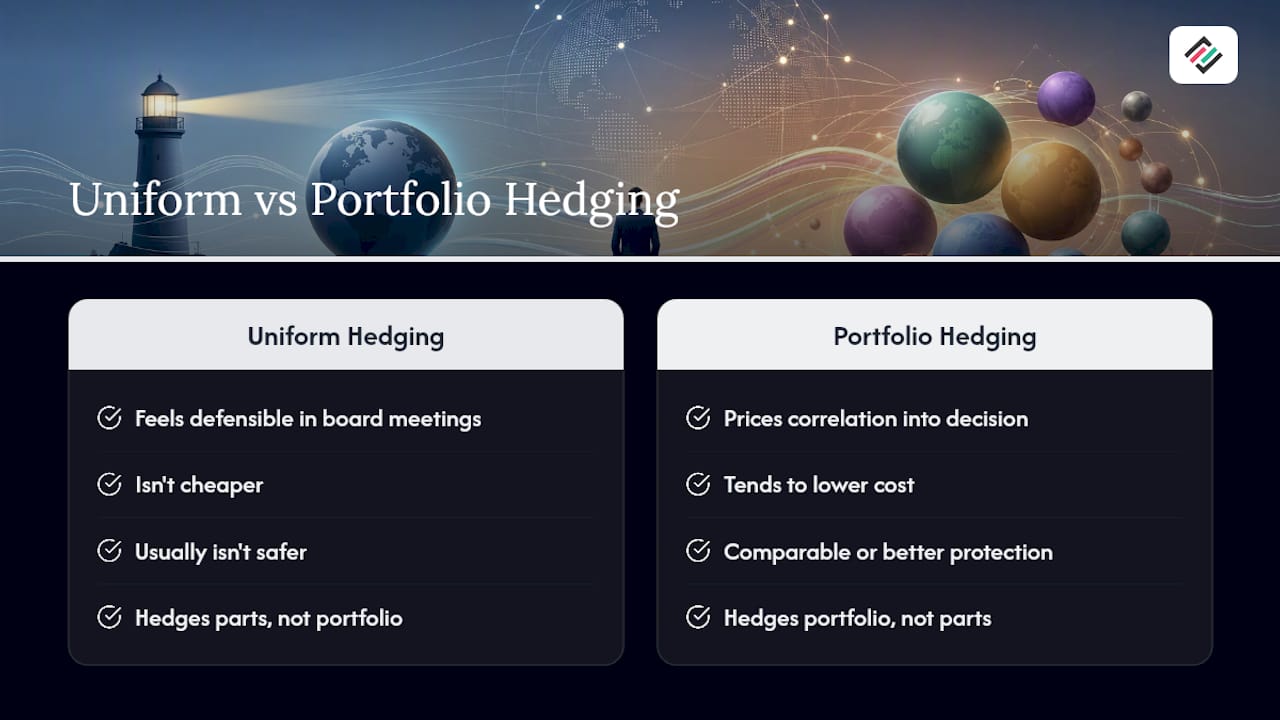
It isn't cheaper, and it usually isn't safer either. It just feels defensible in a board meeting because "we hedged everything" sounds responsible.
The uncomfortable truth is that uniform hedging often overpays for risk reduction you don't need, because it ignores how currencies actually move together. A treasury that measures correlation through VaR and Monte Carlo simulation, then hedges the portfolio rather than the parts, tends to end up with lower cost and comparable or better protection. The Avery Dennison numbers aren't an outlier result. They're what happens when correlation gets priced into the decision instead of ignored.
What gets underestimated is the governance side. A VaR model without a documented policy, defined approval limits, and monthly reconciliation is just a spreadsheet with better math. The discipline of centralizing the decision and automating the repeatable parts is what turns a good model into a program the audit committee can actually trust.
How CorpHedge Supports a Portfolio-Level Approach
CorpHedge gives treasury teams the tooling to run this framework without building it from scratch: live position tracking, VaR-based strategy simulation, and Monte Carlo modelling that maps your exposures onto an efficient frontier instead of leaving hedge ratios to guesswork.
The platform covers the parts that take the longest to build internally: automated exposure collection across entities, portfolio hedge selection with an audit trail for your risk committee, reporting exports formatted for reconciliation against GAAP P&L, and governance controls that enforce your approval limits automatically rather than relying on someone remembering the policy. CorpHedge is currently expanding into Poland and Sweden, extending the same VaR-based hedging infrastructure to treasury teams managing exposure in those markets.
If your team is still hedging currency by currency and wants to see what a portfolio VaR approach looks like against your own exposure book, request a demo and bring your last twelve months of hedge data. That's the fastest way to see the cost delta for yourself.
Sources
- How Avery Dennison hedged FX risk with automated VaR solution | Treasury Today
- Getting a better handle on currency risk | McKinsey
- FX debt and optimal exchange rate hedging | BIS
Corphedge's blog covers implementation detail for teams building this framework internally.
This article is general information, not a substitute for advice from a qualified financial advisor. Consult a qualified financial professional about your own circumstances before acting on anything here.
FAQ
Why should a company diversify currency holdings instead of hedging one main currency?
Diversifying across currencies reduces earnings volatility because offsetting exposures cancel out some risk, while a single-currency approach concentrates all of that risk in one exchange rate.
What is the difference between natural hedging and financial hedging?
Natural hedging matches foreign revenues to foreign liabilities operationally, at no direct cost, while financial hedging uses instruments like forwards and options to cover exposures that can't be matched internally.
Does VaR-based hedging cost more than hedging every currency at 100%?
No. Portfolio VaR hedging typically lowers overall cost because it accounts for correlation between currencies instead of over-hedging positions that already offset one another.
How often should a treasury team review its currency diversification strategy?
Most policies call for monthly exposure reconciliation and VaR monitoring, with a full policy review at least quarterly or whenever a major market shift occurs.
Can Corphedge help implement a VaR-based currency diversification strategy?
Yes. Corphedge provides VaR modelling, Monte Carlo simulation, live position tracking, and automated reporting built specifically for this portfolio-level approach.