

A layered hedging strategy protects a forecast exposure by building coverage in stages across multiple tenors rather than hedging it all at once. The result is a blended, smoothed hedge rate that cuts earnings and cash-flow volatility far more effectively than a single forward or a static hedge. Treasury teams typically use forwards, options, and collars across the layers, and the mechanics for building, topping up, and rebalancing those layers are what separate a well-run program from a haphazard one.
TL;DR:
- Layered hedging reduces earnings volatility more effectively than rolling strategies, cutting standard deviation by 44 percent versus just 7 percent.
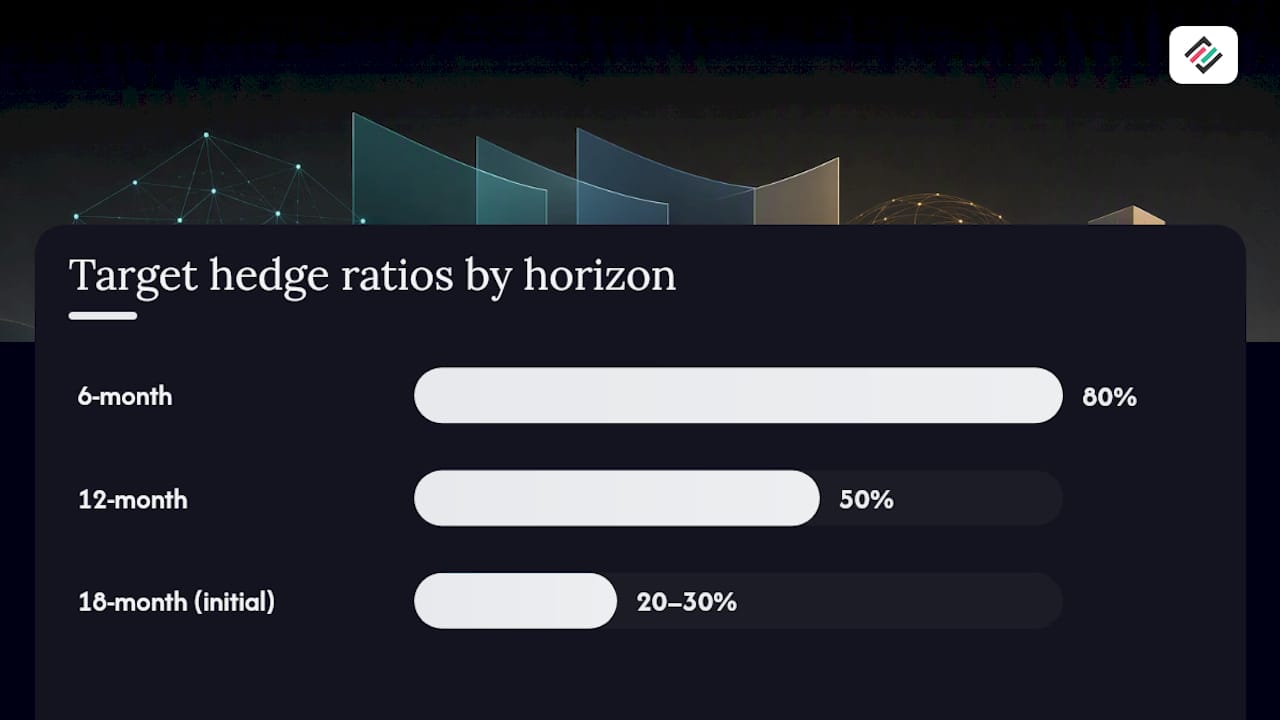
- The typical approach involves hedging 80 percent at six months, 50 percent at twelve months, and 20 percent at eighteen months, with adjustments as forecasts change.
- Maintaining real-time exposure tracking and VaR-based analytics is essential for managing multiple overlapping tranches efficiently.
- Layering is less effective for highly volatile or unpredictable exposures, especially if forecasts are inaccurate or reforecasting is infrequent.
Table of Contents
- How Does a Layered Hedging Strategy Work in Practice?
- What Evidence Supports Layered Hedging Over Alternatives?
- How Do You Design a Layered Hedging Program?
- What Systems and Controls Does Layered Hedging Require?
- When Should You Avoid a Layered Hedging Strategy?
- CorpHedge Perspective: Why Analytics-Driven Layering Matters Now
- Run Your Layered Hedging Strategy on CorpHedge
- Sources
- FAQ
How Does a Layered Hedging Strategy Work in Practice?
Each "layer" is a hedge placed against the same future exposure but executed at a different time, so the effective coverage averages several rates rather than being locked at one rate. "Topping up" means adding a new tranche as an existing layer matures or as the exposure date draws closer, maintaining coverage for nearer-dated exposures. This differs from a static hedge, where the exposure is covered in one transaction, and from rolling hedges, where a single hedge is rolled forward without overlapping tenors.
A typical structure, drawn from Association of Corporate Treasurers guidance, looks like this:
- 80% of the exposure hedged at 6 months out
- 50% hedged at 12 months out
- 20% hedged at 18 months out
Alternatively, many treasuries run a quarterly cadence: forwards executed at 12, 9, 6, and 3 months ahead of the exposure date, each adding to the position until it reaches full coverage. Some corporates extend tenors to 24 or even 36 months, though forecast reliability, liquidity, and hedge accounting rules usually cap how far out that makes sense. The lifecycle runs on a loop: initiate the furthest-dated layer, top up nearer layers as time passes, and rebalance if forecasts shift materially. For a deeper look at matching exposure types to instruments, see this treasury guide to exposure hedging.
What Evidence Supports Layered Hedging Over Alternatives?
The case for layering isn't theoretical. A widely cited study found that a layered forward program reduced the standard deviation of earnings outcomes by 44% compared with staying unhedged, while a simple rolling program managed only a 7% reduction over the same period. That gap is the entire argument for layering in one number.
Statistic callout: Layered forwards cut earnings volatility by 44% versus unhedged exposure; rolling hedges achieved just 7% under the same conditions.
Treasury association guidance frames this as the "smooth hedge" effect: averaging execution points across time reduces mark-to-market swings and gives budgeting a steadier baseline, a point the Association of Corporate Treasurers makes directly in its hedging guidance. Longer hedge horizons combined with more frequent execution periods reduce period-to-period rate deviation further, according to Treasury Management International's analysis of rolling hedge programs. The trade-off is real: layering caps upside participation if the currency moves favorably, and it adds operational complexity. Most treasuries measure success through standard deviation of realized rates and Value at Risk (VaR), not through whether any single layer beat the spot rate.
How Do You Design a Layered Hedging Program?
Building a layered hedging strategy that survives contact with real markets takes more than picking ratios out of a treasury magazine. Follow a sequence:
- Start with FP&A alignment. Pull forecast exposures, currency pairs, and horizons directly from financial planning, and reforecast regularly. Layering against a stale forecast is worse than not hedging at all.
- Set target ratios and cadence. A common template mirrors the Association of Corporate Treasurers example: 80% at 6 months, 50% at 12 months, 20% at 18 months. A quarterly variant executes 12m, 9m, 6m, and 3m forwards in sequence, building toward full coverage by the exposure date, as detailed in Treasury Management International's rolling hedge program guide.
- Match instruments to purpose. Use forwards for the structural, high-confidence portion of exposure; layer in collars or options where you need downside protection but want to keep some upside, particularly on the tactical, near-term overlays.
- Define governance triggers. Set explicit approval thresholds, rebalancing rules, and sizing logic for when to top up a layer versus wait.
To top up correctly, when a nearest-dated hedge matures, size the new tranche to restore the next layer back to its target ratio, for example moving a 12-month hedge from 50% to 80% coverage with a fresh 30% tranche.
Pro Tip: Size your initial 18-month layer conservatively, around 20% to 30% of forecast exposure, since forecast uncertainty is highest at that horizon and over-hedging early creates accounting mismatches if the exposure never materializes.
Hybrid approaches that blend natural hedges, like invoicing in the exposure currency, with financial layers tend to lower cost while preserving flexibility, a combination CorpHedge's own guidance on FX best practices recommends for 2026 market conditions.
What Systems and Controls Does Layered Hedging Require?
Running several overlapping tranches across multiple tenors is not a spreadsheet exercise past a certain scale. Treasury teams need analytics that model VaR and run scenario simulations, so they can see how a rate shock at any single layer propagates through the blended position. Factor models help distinguish currency-specific risk from broader market moves, which matters when deciding whether to rebalance or hold.
On the systems side, a few things become non-negotiable:
- Real-time exposure tracking that feeds directly from ERP or FP&A systems, not manual uploads.
- Treasury management system (TMS) integration for execution workflow and audit trail.
- Live market data feeds so layer pricing reflects current, not stale, rates.
- Mark-to-market monitoring tied to hedge accounting documentation, since qualifying for hedge accounting treatment depends on documented effectiveness testing, a topic covered in more depth in this guide to currency exchange accounting.
Review cadence matters as much as the initial design: set rebalance thresholds (a forecast variance beyond a set percentage, for instance) that trigger a scheduled review rather than ad hoc intervention.
When Should You Avoid a Layered Hedging Strategy?
Layering isn't the right fit for every exposure profile. Watch for these situations:
- Highly seasonal or volatile exposures where forecast confidence beyond 3 to 6 months is weak.
- FP&A processes that don't reforecast often enough to keep layer sizing current.
- Thin currency pairs where liquidity makes multiple tranche executions costly.
- Hedge accounting constraints that limit qualifying tenor or documentation requirements.
- Over-hedging driven by poor governance, or layering on top of exposures that already have a natural offset elsewhere in the business.
Before committing, run scenario tests against your last two years of forecast accuracy. If actuals routinely miss forecast by wide margins, fix the forecasting problem before building a multi-tenor hedge program on top of it.
CorpHedge Perspective: Why Analytics-Driven Layering Matters Now
Central banks are diverging on policy at a pace that makes static hedging look outdated. Dynamic layering, recalibrated against live VaR data, holds up better than a rigid schedule set once a year and forgotten. It should sit alongside natural hedges, not replace them. Automation and integrated analytics are what actually make that combination manageable without adding headcount.
— Bartas
Run Your Layered Hedging Strategy on CorpHedge
CorpHedge gives you what a spreadsheet-based layering program can't: real-time exposure tracking, VaR-based hedge calibration, and automated topping-up alerts that flag when a tranche needs rebalancing before it becomes a governance problem. This approach supports treasury teams managing exposure in multiple currencies.

If you're evaluating whether layering fits your currency book, start with the platform use-cases page to see how exposure tracking and reporting map onto real treasury workflows, or take the product tour for a walkthrough of the VaR calibration tools. For teams that want to build internal expertise before rolling out a program, the FX hedging course walks through hedge design and governance step by step. Book a demo to see how the platform handles topping-up logic and rebalance triggers on your own exposure data.
Sources
- Minimizing Year-on-year Currency Impact on Earnings: a Layered Hedging Approach - The Global Treasurer
- Harness your hedges | Association of Corporate Treasurers
FAQ
What Is Layering Hedges?
Layering hedges means covering the same future currency exposure with several hedge contracts executed at different times and tenors, rather than one hedge for the full amount. The overlapping tranches produce a blended rate that smooths out timing risk, an approach detailed in Association of Corporate Treasurers guidance.
What Is the Most Effective Hedging Strategy?
There's no single "most effective" strategy across every business, but layered hedging has outperformed both no hedging and simple rolling hedges in reducing earnings volatility. One study found layered forwards cut the standard deviation of earnings by 44% versus unhedged exposure, compared with 7% for rolling hedges. The right choice still depends on forecast quality, exposure size, and accounting constraints.
Which Hedging Strategy Is Best for Treasury Teams With Uncertain Forecasts?
Teams with weaker forecast visibility usually do better starting with smaller, near-term layers (heavier coverage at 6 months, lighter at 12 and 18 months) rather than committing large ratios far out. Platforms like CorpHedge that combine VaR analytics with real-time exposure data help size those layers as forecasts improve rather than locking in ratios too early.
What Are the Different Types of Hedging Strategies?
The main approaches are static hedging (one hedge for the full exposure), rolling hedges (a single hedge repeatedly renewed), and layered hedging (multiple overlapping tranches at different tenors). Instrument choice adds another layer of variation, with forwards, options, and collars each suited to different risk and cost trade-offs.
How Does Layered Hedging Differ From Rolling Hedges?
Rolling hedges renew one position over and over as it matures, while layered hedging builds several coverage tranches at once across different maturities that get topped up independently. The layered structure is what produces the averaging effect behind the smoother blended rate, whereas rolling hedges track closer to whatever the current market rate happens to be at each renewal.