

Hedge effectiveness testing measures whether a hedging program is actually cutting currency risk, not just adding trades to the books. The test compares portfolio Value-at-Risk (VaR) or P&L volatility with and without the hedge, and it should produce one clear outcome: a quantified drop in exposure risk or a specific policy change, backed by formal backtesting methods like Kupiec and Christoffersen coverage tests, VaR modeling, and stress scenarios.
TL;DR:
- Portfolio VaR should significantly decline when a hedge effectively reduces currency risk, confirmed through regular backtesting and statistical coverage tests.
- Using both parametric and historical simulation VaR models side by side provides more reliable signals, especially during volatile market conditions.
- Out-of-sample testing over a rolling three-year window, with proper data validation and version control, ensures more accurate hedge effectiveness assessments.
- Kupiec and Christoffersen tests help identify model failures, especially during stress periods, prompting model adjustments or extended data windows.
- Running stress scenarios with correlated currency shocks and liquidity effects helps uncover potential blind spots that VaR alone might miss.
Table of Contents
- What Operational Hedge Effectiveness Testing Covers
- Core Metrics That Actually Tell You If a Hedge Works
- Building a Test You Can Trust: Data, Windows, and Sampling
- Backtesting With Kupiec and Christoffersen: What the Numbers Actually Mean
- Stress Testing: Catching What VaR Misses
- A Practical Testing Workflow for Treasury Teams
- Governance and Executive Reporting: What Actually Goes Wrong
- Run Your Hedge Effectiveness Tests Inside Corphedge
- Sources
- FAQ
What Operational Hedge Effectiveness Testing Covers
This is not the accounting exercise your auditors run to qualify a hedge for special treatment under IFRS 9 or ASC 815. Operational hedge effectiveness testing asks a narrower, more practical question: did the hedge reduce risk, and by how much?
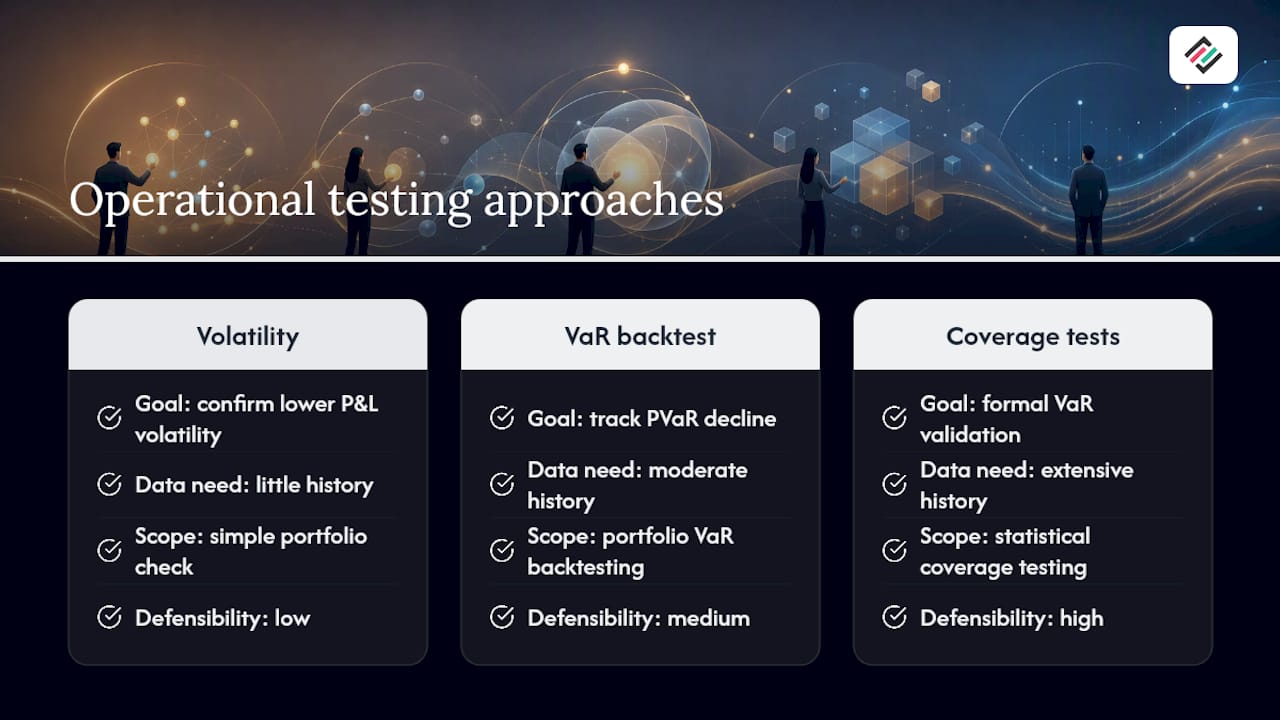
Treasury teams run this test for three reasons. First, to confirm the hedge program is lowering P&L volatility against the underlying exposure. Second, to track whether portfolio VaR (PVaR) has actually declined since the hedge went on. Third, to weigh that risk reduction against the cost of carrying it, since a hedge that removes 40% of risk at triple the cost of a hedge removing 30% isn't automatically the better trade.
The methods available range from straightforward volatility comparisons to full VaR-based backtesting with formal statistical coverage tests. Which one you pick depends on how much history you have, how many currencies you're managing, and how defensible the result needs to be when a board member asks about it.
Core Metrics That Actually Tell You If a Hedge Works
Portfolio VaR is the starting point. It estimates the maximum expected loss over a given horizon at a chosen confidence level, and it should drop measurably once a hedge is applied. Marginal VaR takes this further: it isolates how much a single currency's hedge changes the risk of the whole portfolio, which matters because offsetting exposures across currencies mean hedging one position in isolation can overstate the real risk reduction.
Three model families dominate practice:
- Parametric variance-covariance VaR: fast to compute but can understate tail risk when returns aren't normally distributed or volatility clusters
- Historical simulation: preserves actual empirical tails and tends to produce more conservative, reliable thresholds, though results shift with window length
- Monte Carlo / Expected Shortfall (ES): useful for capturing nonlinear payoffs and correlation shifts across multiple currency pairs
Empirical comparisons show dynamic hedging strategies, especially carry-based and minimum-volatility approaches, often beat static fully-hedged or unhedged positions on a risk-adjusted basis across most developed markets, though results vary by home currency. That's the case for testing more than one model side by side rather than trusting a single VaR number.
Cost-of-carry belongs in this analysis too. A VaR-based framework that weighs risk reduction against hedge cost lets you plot an efficient frontier of hedge ratios and find the point where additional protection stops being worth the premium.
Building a Test You Can Trust: Data, Windows, and Sampling
Bad inputs produce confident, wrong answers. Before you run any model, confirm the data pipeline is clean.
- Pull the right inputs: net currency exposures by entity, full spot and forward rate histories, forward points, hedge costs, and margin requirements.
- Set your sample window: a rolling three-year covariance window is a reasonable default for most corporate portfolios, long enough to capture a full rate cycle without diluting recent volatility regimes.
- Reserve a holdout period: never validate a model on the same data used to build it. Out-of-sample testing, using only information that would have been available at each historical decision point, avoids look-ahead bias and mirrors how the model behaves in live operations.
- Fix a rebalancing cadence: monthly or quarterly rebalancing is standard; track turnover so cost creep doesn't erode the hedge's net benefit.
- Version every input set: exposure snapshots, rate feeds, and model parameters all need timestamps and version control for audit purposes, particularly if you're documenting IFRS 9 hedge relationships alongside the operational test (see audit-ready hedge documentation practices for how the two workstreams connect).
Backtesting With Kupiec and Christoffersen: What the Numbers Actually Mean
A VaR model that "feels right" isn't validated. It's validated when it passes formal statistical scrutiny, and two tests do most of the work.
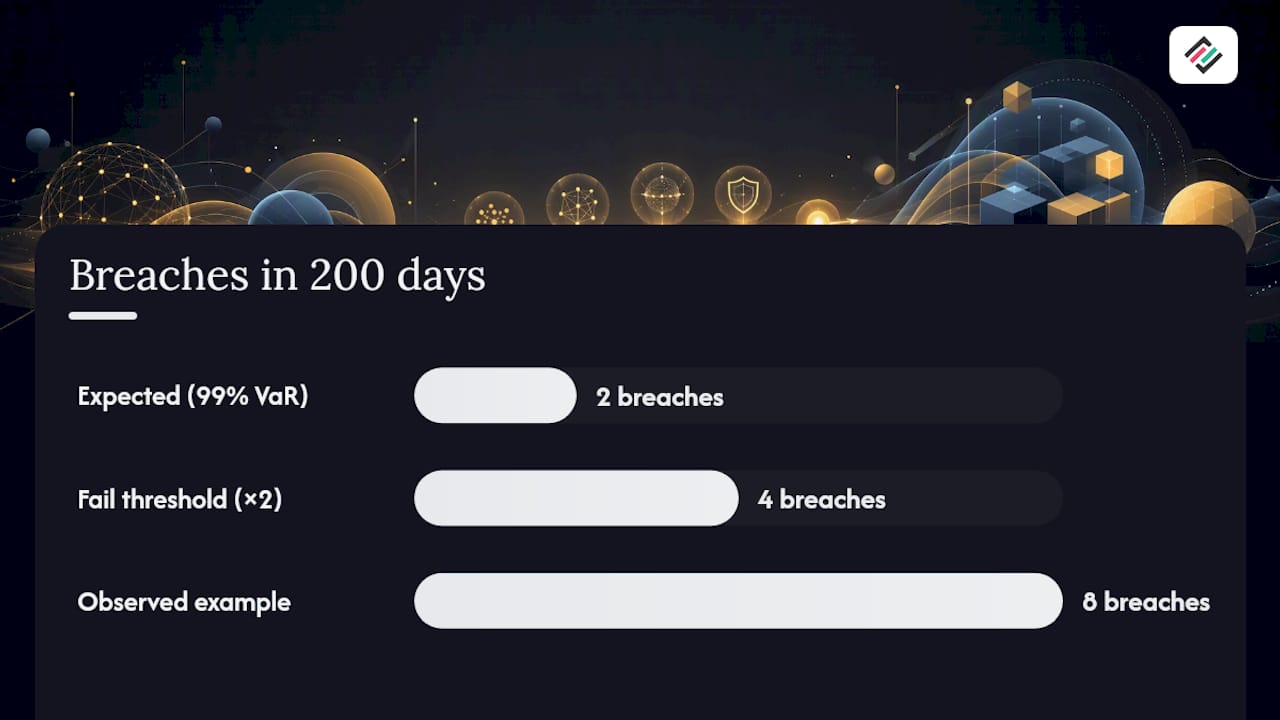
The Kupiec unconditional coverage test checks whether the number of VaR breaches over a sample period matches the number your confidence level predicts. If your 99% VaR model is breached 8 times in 200 days instead of the expected 2, Kupiec flags that mismatch.
The Christoffersen conditional coverage test goes a step further and checks whether those breaches are independent or clustered together. A model can pass Kupiec on raw hit rate and still fail Christoffersen if breaches bunch up during volatile weeks, which is exactly when a treasury team needs the model to hold.
- Run both tests together. Passing one and failing the other still means the model is unreliable somewhere.
- Watch for hit rates that drift over multiple quarters even if a single test period passes.
- Set a threshold in advance (a common approach is treating breach rates more than double the expected count as a fail) so the review isn't decided after the fact.
Combining parametric and historical simulation VaR and reporting where they diverge turns a modeling choice into an early warning system: divergence during stress periods is itself a signal to tighten monitoring.
Pro Tip: If a model keeps failing Christoffersen during earnings-season volatility, don't just recalibrate the confidence level. Extend the sample window first. A model tuned to pass on thin data will fail again the next time volatility spikes.
If a model fails either test, the fix is usually one of: switch to historical simulation, extend the sample, add Monte Carlo simulation for nonlinear exposures, or adjust the confidence level to match what the business can actually tolerate.
Stress Testing: Catching What VaR Misses
VaR tells you the likely loss at a given confidence level. It says nothing about what happens in the 1% of scenarios you didn't plan for, and that's where scenario analysis earns its place in the toolkit.
- Build multi-currency shock scenarios (simultaneous 10 to 15% moves across correlated pairs), not just single-currency shifts.
- Model liquidity and margin stress: what happens to collateral calls if three currencies move against you at once.
- Test extreme carry-trade unwinds, historically some of the sharpest and fastest FX moves on record.
Report results the same way every time: P&L impact, change in VaR, incremental margin needed, and a sensitivity table by currency pair. Selecting the parameters most likely to move against you and testing realistic up and down shifts gives a more complete measurement framework when paired with VaR outputs. Use the outcomes to set hard policy triggers, like a maximum acceptable margin call under a defined stress case, rather than leaving stress results as an academic exercise nobody revisits.
A Practical Testing Workflow for Treasury Teams
Running this well doesn't require a quant team. It requires a sequence, discipline, and a platform that can hold live data without manual reconciliation.
- Consolidate exposures across entities and currencies, then validate the feed against your ERP or treasury management system.
- Choose your objective metric: PVaR reduction, volatility smoothing, or a cost-benefit target, and set it before you run any model, not after.
- Run parallel VaR models (parametric and historical) on a rolling out-of-sample basis, tracking turnover and cost-of-carry alongside risk reduction.
- Backtest with Kupiec and Christoffersen, run your stress scenarios, and log every result with a timestamp.
- Set a monitoring cadence: monthly backtesting reviews at minimum, with an immediate re-test triggered by any major rate regime shift.
Pro Tip: Build your reporting template before your first test run, not after. Tying results to a stated objective, like "protect 60% of forecast revenue" or "reduce PVaR by a defined percentage", makes the numbers mean something to a board that doesn't think in basis points.
A platform like Corphedge's VaR-based hedging approach maps directly onto steps three and four: live exposure feeds remove the manual data-pull risk, and running parametric and historical models side by side is a configuration choice rather than a spreadsheet rebuild every quarter.
Governance and Executive Reporting: What Actually Goes Wrong
The failures I see most often aren't modeling failures. They're data gaps between what treasury tracks and what the ERP shows, timing mismatches between when exposure is booked and when the hedge is executed, and hedging costs that get left out of the effectiveness math entirely, flattering a program that's actually expensive.
The fix isn't a better model. It's translation: turn PVaR reduction into margin protection, turn volatility figures into cash flow predictability a board understands. Build an audit trail for every test run, set a fixed sign-off schedule, and define exactly what triggers a re-test, a rate regime shift, not a calendar reminder, before results go stale without anyone noticing.
— Bartas
Run Your Hedge Effectiveness Tests Inside Corphedge
Most treasury teams run this kind of testing across three or four disconnected tools: a spreadsheet for exposures, a separate risk system for VaR, and a manual process for stress scenarios. This kind of testing can be consolidated into one workflow, with live exposure feeds, VaR-based hedge ratio analysis, and reporting built around the same metrics covered above.

The platform's feature set covers real-time position tracking and portfolio analytics, so the data inputs behind your backtesting are current instead of reconstructed at month-end. The VaR-based hedging module runs parametric and historical models against your actual currency mix, and integrations with platforms like Corpay keep exposure data synced without manual re-entry. Corphedge is also expanding into the Poland and Sweden markets, extending this same testing framework to treasury teams managing zloty, krona, and euro exposures alongside the majors.
If you want to see how the checklist above runs inside an actual platform rather than a spreadsheet, the product tour walks through the workflow end to end.
Sources
- The best strategies? (excerpts) — Duke research paper
- Value-at-Risk based approach for currency hedging (2021)
- Empirical study integrating VaR and backtesting (2026)
FAQ
What Is Hedge Effectiveness Testing in Treasury?
It's the process of measuring whether a hedging strategy actually reduces currency risk, typically tracked through changes in portfolio VaR or P&L volatility, rather than the accounting compliance test used to qualify hedges under IFRS 9.
Which VaR Method Is Best for Testing Hedge Performance?
Historical simulation tends to produce more reliable coverage results than parametric variance-covariance VaR, but running both models in parallel and comparing where they diverge gives a more complete signal.
How Often Should Companies Backtest Their FX Hedges?
Monthly backtesting reviews are standard practice, with an immediate re-test triggered by any significant rate regime shift or a failed Kupiec or Christoffersen result.
Can a VaR Platform Like Corphedge Run These Tests Automatically?
Corphedge's VaR-based hedging tools combine live exposure data with parametric and historical VaR modeling, which supports the rolling out-of-sample testing this kind of analysis requires.
What's the Difference Between Backtesting and Stress Testing?
Backtesting validates whether your VaR model's past predictions matched actual outcomes, while stress testing simulates hypothetical extreme scenarios that historical data may never have produced.