

A reliable daily hedging workflow turns exposures into rule-based hedges every day, automated where possible and exception-reviewed where necessary. That loop, exposure capture, netting, rule-based decisioning, execution, and reporting, is what separates treasury teams who trust their numbers from those who scramble at month-end. Built on codified policy and tools like VaR-based thresholds, it cuts manual reconciliation and speeds up execution without adding headcount.
TL;DR:
- Automating exposure capture and reporting first ensures data accuracy and reduces manual errors before automating trade execution.
- Building in feed validation, daily reconciliation, and manual approval paths mitigates risks from feed outages and rate mismatches.
- Automating audit logs, role-based permissions, and timestamped policy approvals creates a transparent, auditable trail required for external review.
- Running the workflow daily takes about 30 to 45 minutes, weekly around an hour, and monthly or quarterly involves policy and threshold reviews.
- Starting automation with low-volatility, high-volume corridors allows teams to validate rule engine accuracy before expanding to riskier exposures.
Table of Contents
- What Does a Daily Hedging Workflow Actually Look Like?
- Which Systems and Touchpoints Should You Automate First?
- How Do You Keep the Workflow Auditable?
- What Should Treasury Run Daily, Weekly, and Monthly?
- How CorpHedge Fits Into a Daily Hedging Workflow
- Why Treasury Teams Resist Automation, and How to Fix That
- Ready to Automate Your Daily Hedging Workflow?
- Sources
- FAQ
What Does a Daily Hedging Workflow Actually Look Like?
Most treasury teams picture hedging as a strategic quarterly decision. In practice, the work that protects margin happens in five repeatable steps, run every single business day.
- Capture and validate exposures. Pull data from ERP feeds, bank balances, and intercompany positions. Flag anything that fails a sanity check, a duplicated invoice, a stale FX rate, before it pollutes the day's numbers.
- Aggregate and net by currency corridor. Netting intercompany and third-party receivables against payables in the same currency pair reduces the notional amount you actually need to hedge, which lowers transaction costs immediately.
- Apply codified policy rules and tolerance bands. A position under a set threshold might auto-hedge; one that breaches a volatility band or touches an unusual counterparty gets routed for human review.
- Execute or escalate. Permitted trades fire automatically through connected execution channels. Everything else lands in an exception queue with context attached, not just a flagged row in a spreadsheet.
- Update positions and push outputs. Close the loop by refreshing position data and generating the accounting and reporting outputs finance needs before the next morning.
Pro Tip: Run step one first thing, before market open in your primary trading corridor. Stale exposure data compounds every error downstream, from netting math to rule-engine triggers.
Which Systems and Touchpoints Should You Automate First?
Sequencing matters more than tooling. Automating exposure capture and reporting before execution builds the foundation everything else depends on. Jump straight to execution automation without clean exposure data, and you've just automated your own mistakes.
The typical integration chain runs ERP to treasury management system to execution APIs or FIX connectivity, closing with bank confirmations. Each handoff is a place where straight-through processing (STP) either holds or breaks.
- Trigger rules decide when a hedge fires (a threshold breach, a scheduled rebalance).
- Sizing rules determine notional based on net exposure and policy limits.
- Instrument rules route a trade to forwards, options, or swaps depending on exposure type.
- Threshold rules set the tolerance band before an item escalates to a human.
Survey data shows a significant share of corporate treasuries still run these steps manually, which is exactly the gap automation closes. The usual failure points are feed outages and rate mismatches, so build in feed validation, daily reconciliation routines, and a fallback manual approval path for when the automated one stalls.
How Do You Keep the Workflow Auditable?
Automation without governance just moves risk from human error to unmonitored code. A workable control framework needs four things running underneath the daily cadence:
- Machine-readable policy that timestamps every approval and links it directly to the trade it authorized.
- Role-based permissions with genuine separation of duties between the person who sets exposure and the one who executes.
- Exception logs that capture why a trade was flagged, not just that it was.
- Automated outputs feeding hedge accounting and effectiveness testing, plus a change-control process for updating volatility and VaR assumptions.
Connecting exposure management to straight-through execution produces exactly this kind of timestamped, auditable trail, which is what your external auditor will ask for at year-end whether you've built it or not.
What Should Treasury Run Daily, Weekly, and Monthly?
Treat the workflow as three nested rhythms rather than one long checklist. Short, repeatable cadences outperform sporadic model runs that look sophisticated but never become routine.
- Daily (roughly 30 to 45 minutes total): refresh the exposure dashboard, net positions, run the rule engine, execute auto-bookings, review exceptions, update P&L.
- Weekly (about an hour): rebalance top currency corridors, check platform and feed health, review your STP rate for slippage.
- Monthly or quarterly: refresh volatility assumptions, run hedge effectiveness testing, revisit policy thresholds against actual market moves.
Assign a named owner to each cadence tier. A daily task nobody owns quietly becomes a weekly task, then a monthly one, then a gap your auditor finds first.
How CorpHedge Fits Into a Daily Hedging Workflow
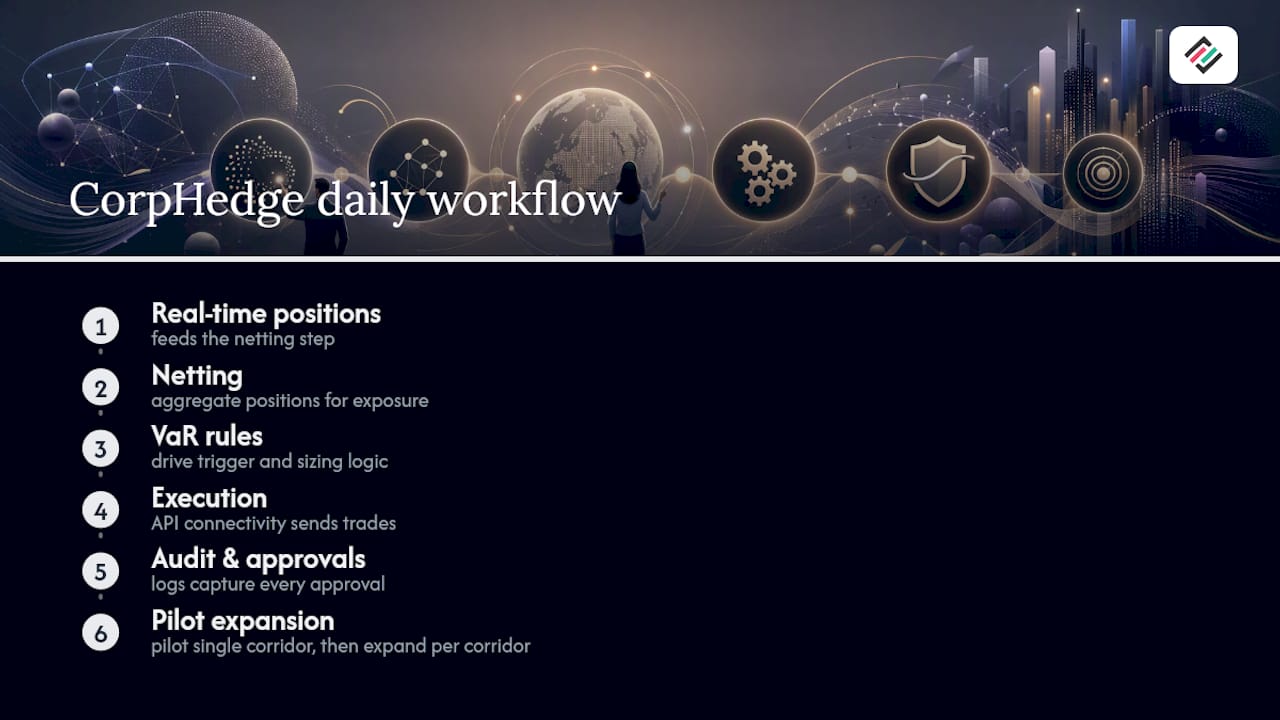
CorpHedge maps directly onto this cadence: real-time position data feeds the netting step, VaR-based strategy rules drive the trigger and sizing logic, and API connectivity handles execution while audit logs capture every approval. Most teams pilot on a single currency corridor, prove the rule engine's accuracy, then expand governance thresholds corridor by corridor.
Pro Tip: Start your pilot with your highest-volume, lowest-volatility corridor. It's the fastest way to prove the rule engine works before you trust it with a corridor that actually keeps you up at night.
Why Treasury Teams Resist Automation, and How to Fix That
Most resistance isn't about the technology. It's fear of losing visibility. Tolerance bands and exception-only alerts solve this by filtering noise, not eliminating oversight. Start with a small, transparent pilot before automating the whole book, and hedge committed exposures with forwards while reserving buffers or options for forecasts you're less sure about. Over-hedging a forecast that never materializes is a self-inflicted loss.
— Bartas
Ready to Automate Your Daily Hedging Workflow?
Corphedge is the practical alternative to running this workflow in spreadsheets and manual approval chains. Instead of stitching together ERP exports, email approval threads, and a separate VaR model, you get exposure capture, rule-based decisioning, and execution connectivity in one connected system, with the audit trail already built in.
As Corphedge expands into the Poland and Sweden markets, treasury teams there get the same rule engine and VaR-based approach already running for corridors elsewhere. If you want to see how the platform handles your specific currency mix, the product tour walks through exposure capture, thresholds, and execution end to end. Teams that want to build internal expertise first can start with the FX hedging course before rolling out automation on a live corridor.
Sources
For deeper technical grounding, see the implementation guidance from Treasurer Magazine and the rule-based hedging framework overview from Routefusion.
FAQ
What Is the Most Effective Hedging Strategy?
There's no single "most effective" strategy. The strongest approach combines forwards for committed exposures with codified policy rules and tolerance bands, so routine hedges execute automatically and only genuine exceptions need human judgment.
What Are the Three Main Types of Hedging?
The three most common instruments are forwards, options, and swaps. Forwards typically cover known, committed exposures; options suit uncertain forecasted flows; swaps manage longer-dated or recurring currency mismatches.
Is Hedging in Trading Illegal?
No. Hedging currency exposure is a standard, legal risk management practice used by corporate treasuries worldwide to protect cash flow and margin from exchange-rate swings.
What Is a Hedging Process?
A hedging process is the repeatable sequence a treasury team follows to identify currency exposure, apply policy rules, execute a protective trade, and record the result for accounting and reporting. Platforms like Corphedge codify that sequence into a daily, rule-based workflow rather than a manual, case-by-case decision.