

Three exposures drive currency risk in a multinational company: transaction, translation, and economic. Transaction exposure gets hedged with cash-flow tools like forwards and money-market hedges. Translation exposure calls for balance-sheet fixes like netting and currency swaps. Economic exposure needs operational and strategic hedges, often layered with derivatives on top.
- Instrument classes: forwards, options, currency swaps, money-market hedges
- Program types: cash-flow programs, balance-sheet programs, layered or micro-hedging structures
- Performance signals: hedge rate, Value at Risk (VaR)
Each exposure demands a different diagnostic and a different tool. Confusing them, which happens more often than treasury teams like to admit, is how companies end up hedging the wrong risk at the wrong horizon.
Table of Contents
- What Are the Types of Exposure Hedging?
- How Do You Match Exposure to a Hedging Objective?
- Which Financial Instruments Cover Each Exposure?
- What Are the Main Hedging Program Types?
- How Should Treasury Choose an Approach?
- What Controls Keep a Hedging Program Running Safely?
- Does Hedging Actually Increase Firm Value?
- What This Guide Gets Right That Most Advice Misses
- Manage Every Exposure Type From One Platform
- Sources
- FAQ
What Are the Types of Exposure Hedging?
Transaction exposure is the risk tied to specific, contracted cash flows: an invoice denominated in euros, a supplier payment due in yen. It is short to medium term, usually settling within days to twelve months, and it hits the income statement directly when the exchange rate moves against you. This is the exposure most finance teams learn to manage first because it is the easiest to quantify.
Translation exposure shows up when you consolidate foreign subsidiaries into group financial statements. It is a balance-sheet phenomenon, not a cash one, and its horizon is really "whenever you next report." According to IMF Working Paper 06/255, translation exposure gets hedged less frequently than transaction exposure precisely because it doesn't move actual cash, even though it can swing reported equity and spook shareholders who don't read footnotes.
Economic exposure, sometimes called operating exposure, is the long game. It's the effect of currency movements on your competitive position, pricing power, and future cash flows, and it's the hardest of the three to measure because it has no line item of its own. A stronger home currency doesn't just hurt this quarter's invoices. It can make your products structurally more expensive than a competitor's for years.
Treasuries that conflate these three definitions tend to hedge the visible risk (transaction) while ignoring the risk that actually erodes enterprise value (economic).
How Do You Match Exposure to a Hedging Objective?
Each exposure needs its own success metric, not a generic "reduce volatility" goal.
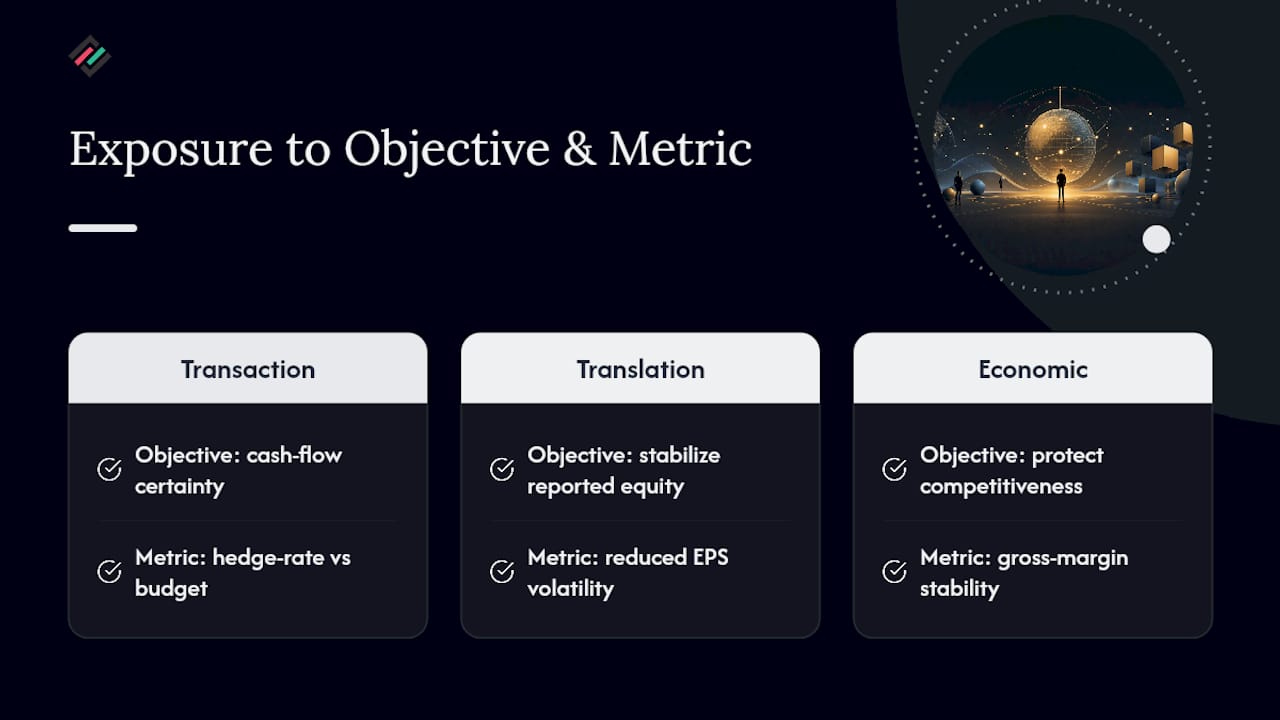
Transaction exposure maps to cash-flow certainty. The objective is protecting invoice margins, and the metric is your effective hedge rate against a budget rate, sometimes called hedge-rate distance. Translation exposure maps to stabilizing reported equity, measured through reduced earnings-per-share volatility or a tighter VaR band on net asset translation. Economic exposure maps to protecting long-term competitiveness, which shows up in gross margin stability across currency cycles rather than any single quarter's number.
As a rule of thumb: hedge when your forecast confidence is high and the exposure crosses a materiality threshold you've set in policy. Accept the exposure when hedging costs exceed the volatility you'd actually experience, or when the forecast itself is too unreliable to hedge against with any precision.
Which Financial Instruments Cover Each Exposure?
Instrument choice comes down to four tradeoffs: cost, liquidity, accounting treatment, and whether you want to keep upside participation.
- Outright forwards: lock a rate for a future date. Cheap, liquid, and simple, but you give up any favorable rate movement.
- FX options: pay a premium for the right, not the obligation, to exchange at a set rate. Costlier than forwards but preserves upside if the market moves your way.
- Currency swaps and cross-currency swaps: exchange principal and interest in different currencies over a longer period, well suited to funding a foreign subsidiary or restructuring balance-sheet debt.
- Currency futures: exchange-traded, standardized, and useful where counterparty risk needs to sit with a clearinghouse rather than a bank.
- Money-market hedges: borrow and invest in the two currencies involved to synthetically lock a rate, often used when the forward market is thin or unavailable.
Corporate Finance Institute frames the instrument decision around exposure horizon and accounting need as much as price. A ninety-day invoice usually calls for a forward. A subsidiary with a currency mismatch on its balance sheet is a swap conversation.
Pro Tip: Use options when you need to preserve upside for a client-facing quote or a competitive bid. Use forwards when certainty matters more than opportunity.
What Are the Main Hedging Program Types?
Programs differ by objective, horizon, and how much discretion sits with the desk versus the policy.
A balance-sheet program targets net asset translation exposure and tends to be strategic, reviewed annually rather than daily. The checklist item that matters most: define which subsidiaries' net assets actually get hedged before you touch a swap. The IMF's guidance notes treasuries should watch for hedges that reduce balance-sheet volatility but introduce new P&L noise from the hedge itself.

A cash-flow program at the local entity level is tactical, invoice by invoice, and usually runs on a rolling schedule, hedging 30, 60, and 90 percent of forecast exposure across successive months.
A translation or EBITDA program sits between the two, hedging forecast EBITDA in foreign currency rather than the balance sheet itself, useful for companies whose covenants or guidance depend on reported earnings.
An enterprise-value program is the most strategic tier, addressing economic exposure through structural decisions, currency of debt issuance, and sourcing footprint rather than derivatives alone.
How Should Treasury Choose an Approach?
Follow this sequence when building or reviewing a program:
- Identify every material exposure by currency pair and exposure type.
- Quantify materiality against a policy threshold, not gut feel.
- Set an explicit objective per exposure (cash-flow certainty, equity stability, competitiveness).
- Select instruments and program type based on horizon, cost, and accounting fit.
- Backtest the approach against historical rate moves and adjust hedge ratios.
- Document the policy, including who can execute and at what limits.
- Monitor and report against benchmarks on a fixed schedule.
Tradeoffs worth writing into policy explicitly:
- Cost versus certainty: options cost more upfront than forwards but keep flexibility.
- Upside participation versus lock-in: a 100% forward hedge removes both risk and reward.
- Hedge-accounting triggers: some structures require formal documentation to avoid earnings volatility from mark-to-market swings.
Track hedge ratio, effective hedge rate distance from budget, portfolio VaR, and realized P&L against your benchmark rate every reporting period.
What Controls Keep a Hedging Program Running Safely?
The operational backbone runs policy to execution rules to platform to reconciliation to reporting to audit trail. Skip a link and the program looks fine until an auditor or a rogue trade proves otherwise.
Controls that matter most: counterparty exposure limits, a defined collateral and settlement process, segregation of duties between trade execution and confirmation, and documented netting rules across entities.
Common pitfalls, per CFO Dive's practitioner guidance: letting treasury express a market view instead of following policy, relying on a single instrument for every exposure, and ignoring liquidity constraints when a forward market is thin. Diversifying instruments preserves optionality that a single-tool approach quietly gives away.

Pro Tip: Reconcile hedge effectiveness monthly, not just at quarter-end. A drifting hedge ratio is far cheaper to fix in week three than after the close.
Does Hedging Actually Increase Firm Value?
The evidence says yes, under specific conditions. Firms that hedge with derivatives and foreign-denominated debt measurably reduce their FX exposure, and research on hedging and firm value shows the mechanism: hedging reduces the odds of costly outcomes like financial distress or a forced capital raise at a bad moment.
- Cross-country data from the Bank for International Settlements finds most firms' hedging patterns look consistent with optimal hedging once you account for FX debt, revenues, and assets together.
- Emerging-market firms show thicker tails of unhedged depreciation risk, leaning more heavily on operational hedges alone.
The efficient-frontier approach compares hedge cost against risk reduction, testing scenarios from a zero hedge to a full forward hedge to layered options, and picks the cheapest structure that hits a target VaR. This works best when a treasury has reliable cash-flow forecasts; without them, optimization models just add false precision to a bad number.
What This Guide Gets Right That Most Advice Misses
Most treasury content treats hedging as a single decision: hedge or don't. That framing misses the point entirely. The real skill is diagnosis, correctly identifying which of the three exposures you're actually looking at before you touch an instrument.
Conventional advice overweights transaction exposure because it's visible and easy to explain to a board. Economic exposure gets a paragraph, if that, because it resists a clean metric. That's backward. Research on operational versus financial hedging confirms operational fixes like sourcing shifts and invoicing currency changes cannot substitute for financial derivatives on their own. They work together, not as alternatives.
If you take one thing from this guide, prioritize the diagnosis step. A well-executed hedge on the wrong exposure is still a mistake. Build your materiality thresholds and objectives before you call a bank for a forward quote, not after.
Manage Every Exposure Type From One Platform
Building a hedging program across transaction, translation, and economic exposure usually means juggling spreadsheets, bank quotes, and a policy document nobody updates. Corphedge replaces that with live position tracking, hedging strategy simulation, and VaR-based hedging analysis in one place, so treasury teams can test a forward-versus-option scenario before committing capital, not after.
As Corphedge expands into Poland and Sweden, more finance teams managing cross-border currency risk in Central and Northern Europe can now access the same automated notifications, compliance integrations, and portfolio reporting used by internationally active companies elsewhere. Whether you're running a cash-flow program for local entities or a balance-sheet program across subsidiaries, the platform maps directly onto the exposure types covered here. Take the product tour to see how strategy simulation and live market data work together, then run your own exposure through it before your next hedging decision.
This article is general information, not a substitute for advice from a qualified financial advisor. Consult a qualified financial professional about your own circumstances before acting on anything here.
Sources
- Exchange Rate Risk Measurement and Management: Issues and Approaches for Firms; Michael Papaioannou; IMF Working Paper 06/255
- Optimal foreign currency hedging by non‑financial corporations (BIS working paper)
- Research on hedging value creation (Springer article excerpt)
- Exchange‑Rate Hedging: Financial versus Operational Strategies (Rice/Weston AER paper)
- FX dos and don’ts for CFOs navigating currency volatility | CFO Dive
FAQ
What Are the Three Types of Hedging?
The three types correspond to the three exposures they address: cash-flow hedges for transaction exposure, balance-sheet hedges (netting, swaps) for translation exposure, and operational or strategic hedges for economic exposure.
What Are the Three Main Types of Currency Exposure?
Transaction exposure (contracted cash flows), translation exposure (balance-sheet consolidation effects), and economic exposure (long-term competitive and cash-flow impact) are the three canonical categories, as defined in IMF Working Paper 06/255.
What Is Hedge Exposure?
Hedge exposure refers to the portion of a currency risk a company has covered with a financial or operational hedge, typically expressed as a hedge ratio or percentage of forecast exposure.
What Are the Different Types of Hedging Strategies?
Strategies range from tactical, invoice-level hedges using forwards, to strategic programs covering balance-sheet or enterprise-value exposure, often layered with options or currency swaps depending on the horizon and objective. Platforms like Corphedge let treasuries simulate these strategies against a VaR target before executing.
How Do You Decide Between a Forward and an Option?
Use a forward when certainty matters more than upside and cost efficiency is the priority; use an option when you need to preserve favorable rate movement, such as in a competitive bid, and can absorb the premium cost.