
TL;DR:
- A 5% EUR/USD exchange rate swing can eliminate months of corporate operating margins, making hedging essential.
- Effective EUR/USD risk management requires identifying exposure types, selecting appropriate instruments, and maintaining disciplined monitoring and adjustments.
For any international company with EUR/USD exposure, a 5% swing in the exchange rate can erase months of operating margin. Knowing how to hedge EURUSD is not optional knowledge for a corporate treasury team — it is foundational. This article walks you through every critical decision point: identifying the right exposure type, selecting instruments matched to your certainty level, executing and monitoring positions, and navigating the accounting rules that affect how your hedge lands on the balance sheet. No generic advice. Just practical frameworks you can apply to your specific situation.
Table of Contents
- Understanding your EUR/USD exposure and hedging objectives
- Choosing the right EUR/USD hedging instruments: forwards, options, and more
- Step-by-step process to implement an effective EUR/USD hedge
- Common challenges and accounting considerations in EUR/USD hedging
- Verifying hedge effectiveness and adjusting strategies for evolving EUR/USD risks
- The hidden truth behind EUR/USD hedging: why perfect offset is a myth and how to think differently
- Explore CorpHedge solutions for sophisticated EUR/USD risk management
- Frequently asked questions
Key Takeaways
| Point | Details |
|---|---|
| Identify your exposure | Clearly quantify and categorize your EUR/USD currency risks by amount, timing, and certainty before hedging. |
| Match instruments to needs | Choose forwards for certain cash flows and options when downside protection with upside participation is needed. |
| Hedging reduces risk, not all loss | Even perfect hedges cannot guarantee zero losses due to costs, execution differences, and market frictions. |
| Comply with hedge accounting | Meeting ASC 815 documentation and effectiveness requirements is essential for accounting benefits and strategy design. |
| Monitor and adjust regularly | Continuously test hedge effectiveness and adapt strategies to shifting market and exposure conditions. |
Understanding your EUR/USD exposure and hedging objectives
Before you pick an instrument, you need to know exactly what you are hedging. Lumping all currency exposure together is one of the most common and costly mistakes in corporate FX risk management. There are three distinct exposure types, and they demand different approaches.
Transactional exposure arises from actual cross-border cash flows: a European supplier invoice due in 90 days, a USD revenue stream from a US subsidiary, or a customer contract priced in the opposite currency. This is the most urgent and most easily hedged exposure type.
Translational exposure shows up when a company consolidates foreign subsidiary financials into its reporting currency. A US parent with a eurozone subsidiary faces P&L and balance sheet volatility even when no cash changes hands. Hedging this is more complex and often relies on natural offsets or balance sheet hedges.
Economic exposure is the hardest to quantify. It reflects how long-term EUR/USD movements shift your competitive position, pricing power, and cost base relative to peers. This requires strategic rather than purely financial responses.
Once you have mapped your exposure type, you need to measure exposure clearly, including amounts, timing, and certainty, before setting objectives such as profit protection, cash flow stabilization, or translation risk management.
Here is a practical framework for categorizing your exposures:
| Exposure type | Typical source | Certainty level | Typical hedging instrument |
|---|---|---|---|
| Transactional | Payables, receivables | High | Forward contracts, options |
| Translational | Subsidiary consolidation | Medium | Balance sheet hedges, cross-currency swaps |
| Economic | Competitive pricing dynamics | Low | Strategic hedges, long-dated options |
Setting clear objectives matters just as much as identifying the exposure. Are you protecting a specific margin target? Stabilizing cash flows for budgeting purposes? Or simply reducing P&L volatility for reporting? Your objective determines your hedge ratio and instrument choice.
For guidance on reducing FX risk effectively at the transaction level, it helps to separate firm commitments from forecasted exposures early in the process. Firm commitments warrant full coverage. Forecasted exposures, which carry higher uncertainty, typically justify partial hedges or options-based structures.
With a clear grasp of your exposure and goals, you are ready to evaluate your hedging options.
Choosing the right EUR/USD hedging instruments: forwards, options, and more
EURUSD hedging strategies span a broad menu of instruments. The right choice depends on three factors: how certain the exposure is, how much upside participation matters to your business, and what premium cost your treasury policy allows.
Forward contracts are the workhorse of corporate FX hedging. They lock in a specific rate for a future date, giving you budget certainty. The tradeoff: if the EUR/USD moves in your favor, you cannot benefit. For highly certain exposures, forwards and futures lock in rates but remove upside, while options provide downside protection while preserving upside potential, suited for uncertain exposures.

Options solve the upside participation problem at the cost of a premium. A European manufacturer selling into the US market that buys EUR put / USD call options is protected if the dollar weakens but still benefits if the dollar strengthens. Options-based hedges can be constructed as zero-cost structures by selling calls to finance puts, allowing asymmetric protection rather than simple offsets of risk. This collar structure is especially practical when treasury policy prohibits net premium outflow.
Futures on CME EUR/USD contracts offer exchange-traded transparency and daily mark-to-market, but their standardized contract sizes and fixed settlement dates introduce basis risk when your actual exposure does not align precisely with contract specifications.
Cross-pair hedging uses correlations between EUR/USD and other pairs (GBP/USD, EUR/CHF) to construct indirect hedges. These FX hedging instrument strategies can reduce cost but introduce correlation risk that must be actively monitored.
Here is a side-by-side comparison to guide instrument selection:
| Instrument | Rate certainty | Upside retained | Cost | Basis risk |
|---|---|---|---|---|
| Forward contract | Full | No | Spread only | Low |
| Vanilla option | Partial (floor) | Yes | Premium | Low |
| Zero-cost collar | Bounded | Partial | None (net) | Low |
| CME EUR/USD futures | Full | No | Margin + spread | Medium |
| Cross-pair hedge | Partial | Partial | Spread | High |
Pro Tip: Never select an instrument based purely on cost. A forward saves you the option premium but may lock you into an unfavorable rate if your underlying exposure does not materialize. Match instrument to exposure certainty first, then optimize for cost.
Be aware of practical hedging pitfalls including liquidity mismatches and rollover risk when building multi-leg structures.
Having selected suitable instruments, the next step is to structure and implement your EUR/USD hedge effectively.
Step-by-step process to implement an effective EUR/USD hedge
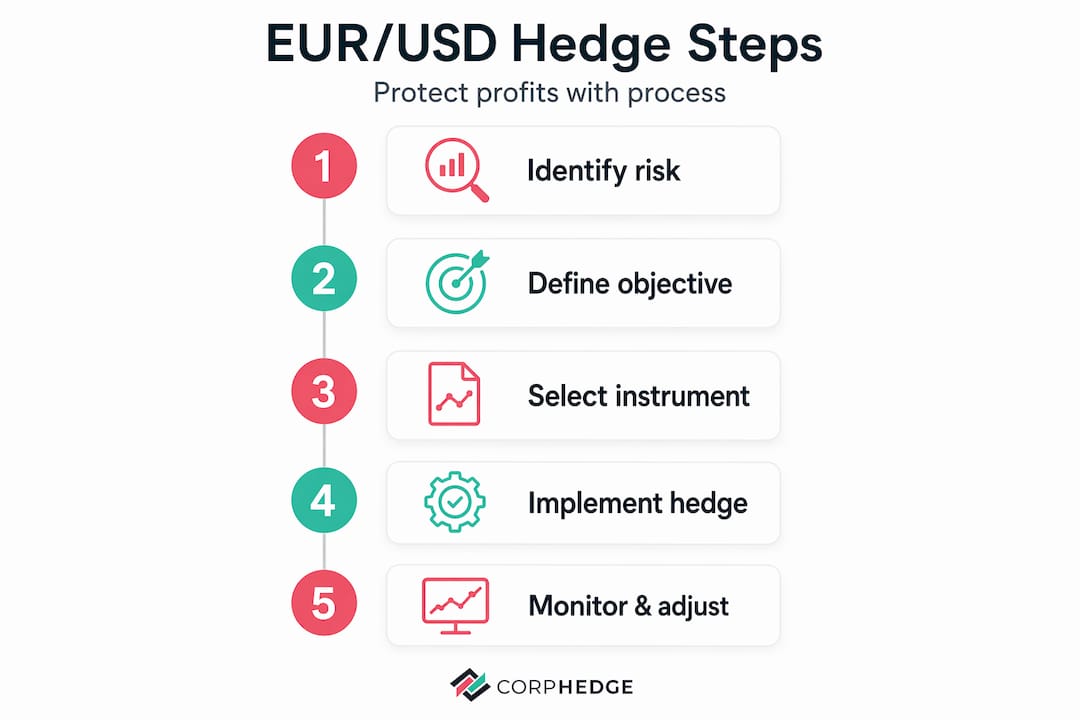
The best way to hedge EURUSD is through a disciplined, sequential process rather than reacting to market moves. Here is the execution sequence that corporate treasury teams should follow:
- Confirm exposure amount and timing. Pull confirmed payable or receivable amounts, invoice dates, and settlement timelines. Separate firm from forecasted amounts.
- Determine hedge ratio. Decide whether to hedge 100% of the exposure or a partial amount (commonly 50-80% for forecasted flows). Full hedging suits certain exposures; partial hedging suits forecast-based ones.
- Select tenor. Identify exposure, choose offset position or contract, select tenor and size, monitor and unwind when appropriate. Match maturity to your cash flow date. Do not use a 3-month forward for a 6-month receivable.
- Execute the hedge. Place the forward, purchase the option, or enter the futures position through your FX provider or bank. Document the transaction details immediately.
- Record and designate. If pursuing hedge accounting treatment, complete designation documentation at inception. This is non-negotiable for ASC 815 compliance.
- Monitor and adjust. Review hedge performance versus underlying exposure monthly. Both perfect and imperfect hedges require ongoing management, as timing, sizing, transaction costs, and execution all affect hedge effectiveness.
Key monitoring variables to track regularly:
- Spot EUR/USD rate versus your hedged rate
- Forward points (carry cost or benefit) on rolling positions
- Hedge effectiveness ratio (dollar offset or regression method)
- Counterparty credit exposure on outstanding forwards
- Forecast versus actual exposure divergence
Pro Tip: Build a simple hedge log in your TMS or spreadsheet that tracks original exposure, hedge notional, instrument type, maturity, and current MTM (mark-to-market). This takes 20 minutes to set up and saves hours during audits.
See corporate forex risk strategies for templates and frameworks used by treasury teams at mid-market multinationals.
Even with a well-structured hedge, awareness of common pitfalls and accounting rules is essential to maintain effectiveness.
Common challenges and accounting considerations in EUR/USD hedging
Hedging EURUSD risks sounds clean in theory. In practice, several friction points consistently erode hedge quality and create accounting complexity.
Cost erosion is the most underestimated challenge. Hedges may not perfectly offset exposure due to transaction costs, carry, execution timing, and sizing differences. When the USD/EUR interest rate differential is wide, the forward points on a EUR/USD forward can represent a meaningful cost or gain depending on direction.
Execution timing gaps occur when your hedge is placed days before or after the exposure crystallizes. Even a one-day difference can create a residual P&L mismatch, particularly during high-volatility events like ECB or FOMC announcements.
Accounting complexity under ASC 815 (the US GAAP standard for derivatives and hedge accounting) is where many treasury teams stumble:
- Formal hedge designation must occur at inception, not retroactively
- Effectiveness testing is required at least quarterly
- The hedging relationship must be documented in writing before the first day of hedging
- Instrument choice affects whether you qualify for fair value hedge or cash flow hedge treatment
- Ineffectiveness must be measured and recorded in earnings immediately
"Hedge accounting eligibility under US GAAP ASC 815 requires formal documentation, designation, and ongoing effectiveness assessment; compliance drives instrument choice and structuring."
This accounting pressure directly influences how companies build their hedges. Forward contracts are often favored for cash flow hedge designation because their changes in fair value closely mirror the hedged item. Options require more nuanced treatment of time value under ASC 815.
Review currency risk management best practices for a detailed breakdown of how accounting requirements interact with hedging economics.
Understanding these challenges enables better hedge validation and strategic improvement.
Verifying hedge effectiveness and adjusting strategies for evolving EUR/USD risks
A hedge placed and forgotten is a hedge that will eventually fail. Verification is not an administrative formality — it is how you catch problems before they reach your income statement.
Effectiveness testing methods accepted under ASC 815 include the dollar-offset method (comparing dollar changes in the hedge versus the hedged item) and regression-based testing. Effectiveness testing is required at hedge inception and periodically, and adjustments may involve size, tenor, or instrument changes when results fall outside acceptable bands.
Use this review sequence at least quarterly:
- Reforecast underlying exposures and compare to current hedge notional
- Run effectiveness test using your designated method
- Identify and quantify any ineffectiveness for P&L reporting
- Assess whether market conditions have changed significantly (rate levels, volatility, correlation shifts)
- Decide whether to adjust, roll, or unwind positions
Event-driven adjustments are equally important. Catalyst-driven hedges around ECB or FOMC meetings often require tailored option structures to manage event risk explicitly. A standard 3-month forward does not protect you from an overnight 2% EUR/USD move on a policy surprise date. Short-dated straddles or strangles on EUR/USD options can complement your core hedging program during scheduled binary-risk events.
Key adjustment triggers to monitor:
- Effectiveness ratio falls below 80% or above 125%
- Forecasted exposure declines by more than 20% from the hedged notional
- Interest rate differentials shift materially, changing forward point economics
- Counterparty credit rating deteriorates below your internal threshold
Pro Tip: Calendar your hedge review dates in advance, lining them up with ECB and FOMC meeting schedules. Reviewing effectiveness the week after a major policy announcement gives you the most relevant data to act on.
Check monitoring and adjusting FX hedges for a deeper framework on managing hedge portfolios across multiple currency pairs simultaneously.
With verification and adjustment routines, hedging remains robust against EUR/USD volatility.
The hidden truth behind EUR/USD hedging: why perfect offset is a myth and how to think differently
Here is something the sales pitch for any hedging product will never tell you: hedges reduce exposure rather than eliminate it, and perfect offset rarely happens due to costs, execution, and market frictions. The companies that manage EUR/USD risk most effectively are not the ones chasing perfect hedges. They are the ones who have internalized this and built their programs around it.
The dangerous belief is that a fully hedged book means zero currency risk. It does not. It means reduced directional risk, with residual risks from basis, timing, costs, counterparty credit, and correlation shifts still present. When a treasury team enters 2026 believing their hedges are airtight, they stop monitoring. That is exactly when the gap between the hedge and the exposure quietly grows.
Tail risks are the most overlooked dimension. Catalyst event hedges require managing tail risks beyond breakeven strikes to be effective. A collar that caps your downside at 1.10 EUR/USD does nothing for you if the pair gaps to 1.05 on a policy shock. Layered strategies — a core forward with an out-of-the-money option overlay — cost more but provide genuine protection depth.
Our view at CorpHedge: a well-documented, actively reviewed hedging program running at 75% effectiveness consistently beats an ad hoc program that claims 100% coverage but drifts. Discipline and transparency matter more than precision. If you are reviewing your advanced corporate forex strategies, start with the documentation and review cadence, not the instrument selection.
The treasury teams we see struggle most are those that set a hedge once per year and revisit it only when a CFO asks a difficult question. The ones that perform best treat hedging as a living program with scheduled reviews, clear escalation rules, and enough flexibility to adapt when the market changes their assumptions.
Explore CorpHedge solutions for sophisticated EUR/USD risk management
Managing EUR/USD hedging across multiple instruments, tenors, and accounting frameworks is genuinely complex work. The analytical demands alone, from exposure aggregation and effectiveness testing to reporting under ASC 815, create real operational burden for treasury teams without dedicated tooling.
CorpHedge provides an integrated platform built specifically for corporate FX risk management. The platform gives you real-time visibility into open positions, supports hedging based on Value at Risk methodology, and includes structured tools to document hedge designation and run effectiveness assessments. Whether you are executing forwards, options, or structured products to reduce EURUSD volatility, the workflow is built to reduce manual effort and support audit-ready compliance. Explore the full CorpHedge product capabilities to see how the platform fits your treasury program.
Frequently asked questions
What is the difference between forwards and options for hedging EUR/USD exposure?
Forwards lock in a specific future rate removing upside participation, while options provide downside protection with continued upside. Forwards suit certain exposures; options suit uncertain ones where retaining favorable rate potential matters to the business.
How does hedge accounting affect EUR/USD hedging strategies under US GAAP?
US GAAP ASC 815 requires formal designation, documentation, and ongoing effectiveness assessment for hedge accounting eligibility. These requirements directly influence which instruments companies choose and how hedging relationships are structured from the outset.
Can perfect hedging completely eliminate EUR/USD currency risk?
No. A perfect hedge reduces exposure but cannot guarantee zero losses because transaction costs, execution timing differences, and other market frictions always leave residual risk in the position.
When should companies consider using options instead of forwards to hedge EUR/USD exposures?
Options are the better tool when exposure timing is uncertain or when the business wants downside protection without surrendering upside potential. Use options when downside is painful and upside matters, and forwards for highly certain, firm exposures.
What role do scheduled central bank events play in EUR/USD hedging?
Catalyst-driven hedges can be engineered with options on EUR/USD futures around ECB and FOMC meeting dates. These event-specific structures manage binary risk explicitly rather than relying on standard rolling hedges that may not cover overnight gap moves.