

TL;DR:
- Effective risk controls in Central Europe depend on a risk-based approach tailored to each firm's operations and regulatory requirements. Supervisors in Poland and Sweden mandate documented, board-approved processes covering key risks, continuous monitoring, and separate levels of defense with clear accountability. Technology must support, not replace, human oversight in managing compliance with evolving standards like DORA.
Effective global financial risk controls in Central Europe rest on one non-negotiable foundation: a risk-based approach calibrated to your firm's size, activity profile, and the specific regulatory mandates of the jurisdictions where you operate. For institutions active in Poland and Sweden, that means satisfying requirements set by the Polish Financial Supervision Authority (KNF) and Sweden's Finansinspektionen (FI), two supervisors with distinct but complementary expectations. Both demand that risk management systems cover credit, market, operational, liquidity, and currency risks, with board-level accountability for effectiveness and documented processes at every organizational level.
The core components every institution must address:
- Risk identification and measurement: Systematic methods tailored to the firm's activity scale and complexity
- Internal limits: Set and approved by the management board, with documented breach procedures
- Reporting: Timely, accurate information flowing to the supervisory board and management
- Continuous monitoring: Frequency adjusted to the size and risk profile of the institution
- Three lines of defense: Business units own risk at level one, an independent risk function oversees at level two, and internal audit provides assurance at level three
- Board oversight: The supervisory board approves the overall risk appetite and conducts an annual assessment of system adequacy
KNF issues mandatory risk recommendations covering derivatives, concentration, interest rate, currency, operational, liquidity, and model risks. Finansinspektionen requires credit institutions to maintain integrated frameworks covering all material risks, with digital resilience requirements under DORA taking full effect from 2026 onward. Getting these fundamentals right before expanding into either market is not optional. Supervisors look for documented evidence, not good intentions.
How do you design effective internal controls over financial reporting?
Internal controls over financial reporting (ICFR) are the policies, processes, limits, and reporting mechanisms that prevent material errors from reaching your financial statements. In Poland, banking law mandates that the management board designs, implements, and maintains an adequate internal control system across all organizational units, with the supervisory board exercising oversight and conducting annual adequacy reviews.
The design of a sound ICFR framework starts with identifying which processes are material. Polish regulations require banks to link material processes explicitly to the goals defined in the Banking Act, then assign key control mechanisms to each. Those mechanisms include procedures, segregation of duties, authorization of financial transactions, access controls, physical controls, performance indicators, and training. None of these are optional add-ons; they are statutory requirements.
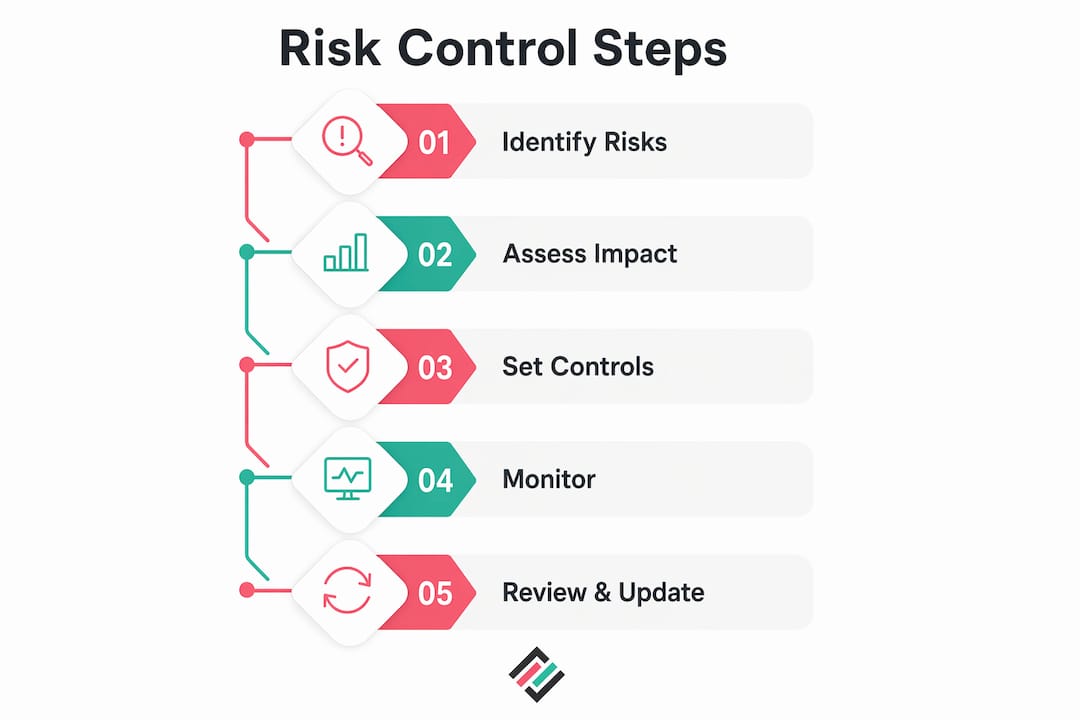
Board responsibility is specific, not ceremonial. The management board approves internal control procedures in writing. The supervisory board then approves those procedures and monitors their implementation. When the risk profile changes or irregularities appear, the management board must introduce amendments promptly. This cycle of design, approval, monitoring, and revision is what regulators actually inspect.
Proportionality matters here. A mid-size bank entering Poland does not need the same ICFR architecture as a systemically important institution, but the structure must still be adjusted to the size and complexity of its activities. Applying a one-size-fits-all policy from a larger parent entity without local calibration is one of the most common findings in KNF supervisory reviews.
Key ICFR design principles for Central European institutions:
- Document all internal control procedures in writing, approved by both the management board and supervisory board
- Assign key control mechanisms to each material process, not just to the institution as a whole
- Separate the risk management function at level two from business unit risk ownership at level one
- Build independent monitoring of control mechanism compliance into the system, not as an afterthought
- Ensure the internal audit unit evaluates and audits control procedures and mechanisms on a scheduled basis
Pro Tip: Test ICFR effectiveness at least annually, but also after any significant change to the business model, product range, or external environment. KNF's Resolution 258/2011 explicitly requires the internal capital assessment process to be reviewed at least once a year and adjusted whenever new risk types emerge or strategy changes materially.
What does implementing and evaluating financial risk controls actually involve?
Implementation is where frameworks either hold or fall apart. The practical sequence runs from risk identification through control deployment to ongoing performance monitoring, and each phase requires documented evidence that regulators can inspect.
The three lines of defense model is the structural backbone. Business units at level one identify and manage the risks they generate. An independent risk function at level two challenges their risk exposure, sets limits, and monitors compliance. Internal audit at level three provides independent assurance that the whole system works as designed. KNF guidance is explicit that these three levels must be clearly separated, with defined authority at each. Regulators look for that separation during inspections.
| Risk Type | Key Metric | Evaluation Method | Review Frequency |
|---|---|---|---|
| Credit risk | Exposure vs. limit | Counterparty credit assessment, limit monitoring | Ongoing; formal review quarterly |
| Market risk | Value at Risk (VaR), sensitivity | Stress testing, back testing | Daily for trading books; monthly for banking book |
| Operational risk | Loss event frequency, near-misses | Incident reporting, scenario analysis | Monthly; escalation on breach |
| Liquidity risk | Liquidity coverage ratio, funding gaps | Contingency plan testing, cash flow modeling | Weekly; daily in stress conditions |
| Currency risk | Open FX position vs. limit | Position monitoring, hedging effectiveness review | Daily |
Breach management deserves more attention than most frameworks give it. Polish regulations require institutions to define in advance the situations where limits may be exceeded, the conditions under which an overrun is acceptable, and the exact steps to reverse it. That documentation must exist before a breach occurs, not after. When a limit is exceeded, the supervisory board receives a report on the breach and the corrective actions planned or taken.
Best practices for implementation and evaluation:
- Pre-document breach procedures for every material risk limit before deployment
- Require written analyses as the basis for every limit value set by the management board
- Conduct stress tests under assumptions that produce accurate risk assessment, not optimistic scenarios
- Apply back testing to risk measurement models on a cyclical basis
- Involve the risk control function in pre-approval of new products and system changes, where operational risk scrutiny is highest
- Report monitoring results to the supervisory board at a frequency that enables genuine oversight, not just annual summaries
What are the regulatory requirements for risk controls in Poland and Sweden?
Poland and Sweden share the EU regulatory baseline but apply it through distinct supervisory frameworks. Understanding both is essential for any institution operating or expanding across these markets.
In Poland, the KNF operates under the Banking Act and a detailed ministerial regulation on risk management and internal control systems. The KNF framework requires banks to manage risk through identification, measurement, monitoring, control, and reporting, with the supervisory board conducting an annual assessment of system adequacy and effectiveness. KNF also issues specific recommendations covering derivatives (Recommendation A), concentration risk (Recommendation C), interest rate risk (Recommendation G), internal control (Recommendation H), currency risk (Recommendation I), operational risk (Recommendation M), liquidity risk (Recommendation P), credit risk (Recommendation R), and model risk (Recommendation W). Each recommendation carries an implementation deadline, and KNF expects compliance from banks and, where applicable, branches of foreign credit institutions operating in Poland.
Sweden's Finansinspektionen takes a comparable approach but with its own supervisory architecture. FI supervises more than 100 firms through the Supervisory Review and Evaluation Process (SREP), which evaluates risk management quality and determines capital and liquidity requirements annually for the largest banks. SREP covers credit risk, liquidity risk, market risk, and operational risk, drawing on each firm's Internal Capital Adequacy Assessment Process (ICAAP) and other supervisory information. For systemically important banks, FI conducts more intensive supervision through supervisory colleges that include representatives from other EU jurisdictions where the bank operates.
From 2026, both markets are subject to DORA, the EU Regulation on digital operational resilience. DORA establishes requirements for managing ICT risk, including incident reporting, resilience testing, and oversight of critical third-party ICT providers. Swedish institutions must align their integrated risk frameworks with DORA's requirements, and KNF has signaled that digital transformation in governance and management systems raises regulatory questions that existing frameworks will need to address.
Geopolitical and macroeconomic factors are shaping supervisory priorities in both countries. FI's 2026 financial stability report highlights preparedness as a core supervisory concern, reflecting the broader European context of elevated geopolitical uncertainty. Institutions expanding into Poland or Sweden should expect regulators to scrutinize not just the design of risk frameworks but their resilience under stress scenarios that reflect current macroeconomic conditions.
Key regulatory compliance requirements:
- Supervisory board must approve the overall risk appetite level and monitor adherence
- Risk management strategy must be approved by the supervisory board and reviewed annually
- Reporting to the supervisory board must enable genuine oversight of the risk management system
- SREP participation is mandatory for Swedish credit institutions, with capital and liquidity requirements set based on outcomes
- DORA compliance is required for ICT risk management from 2026 onward in both markets
How does technology fit into a compliant risk control framework?
Technology is reshaping how risk controls operate, but regulators in both Poland and Sweden are clear that automation does not transfer accountability. The KNF supervisory blog has addressed this directly: the primary role of humans in digital transformation is to control and identify the risks the process entails, and to find out how to protect against their materialization. That framing matters for how you structure governance around automated systems.

AI and machine learning offer genuine advantages in risk identification and reporting. Automated data analysis can process transaction volumes and flag anomalies faster than manual review. Real-time position monitoring reduces the lag between a risk event and a management response. For currency risk specifically, tools that track open FX positions against limits continuously give treasury teams a material edge over end-of-day reporting cycles. Interval AI and similar AI-driven risk tools are increasingly used to enhance transparency and explainability in risk decisions, which is precisely what regulators want to see documented.
The regulatory challenge is governance, not capability. KNF has raised specific questions about whether a bank using an integrated AI-based management information system still needs separate policies, procedures, and manuals, and how management board responsibility should be defined when decisions are generated by an IT system. Those questions do not yet have settled regulatory answers, which means institutions deploying AI in governance functions carry the burden of demonstrating clear human oversight and accountability at every decision point.
DORA adds a structural layer. From 2026, institutions must manage ICT risk through documented frameworks, report major ICT incidents to supervisors, conduct resilience testing, and oversee critical third-party ICT providers. The DORA compliance requirements for finance leaders are specific: you need documented ICT risk management policies, defined incident classification criteria, and evidence that third-party dependencies are assessed and monitored.
Practical technology adoption strategies for Central European firms:
- Map every automated risk decision to a named human accountable for its output
- Document the assumptions and limitations of AI and machine learning models used in risk measurement
- Build explainability into automated systems so that supervisors can audit the logic of risk decisions
- Integrate real-time position monitoring for currency and market risk to reduce reporting lag
- Treat DORA compliance as a framework requirement, not a checklist exercise; FI and KNF will assess substance
Pro Tip: When deploying automated risk monitoring, maintain a parallel manual review process for the first six months. This gives you a documented baseline for comparing automated outputs against human judgment, which is exactly the kind of evidence regulators ask for when assessing whether human oversight is genuine.
What timelines, costs, and risk appetite decisions should you plan for?
Building a compliant risk control framework from scratch in Poland or Sweden takes longer than most institutions budget for. The regulatory documentation requirements alone, covering written policies, limit analyses, breach procedures, and board approvals, add weeks to each phase. Institutions that have tried to compress this timeline by importing a parent entity's framework without local calibration have consistently faced supervisory findings.
Typical implementation phases and their time demands:
- Gap assessment and framework design: 2–4 months, depending on existing documentation and organizational complexity
- Policy drafting and board approval cycle: 1–3 months; supervisory board approval of risk management strategy and internal control procedures is a statutory step, not an administrative formality
- System and process deployment: 3–6 months for technology integration, limit setting, and staff training
- Initial monitoring and testing cycle: 3–6 months to generate the back-testing and stress-testing evidence regulators expect
- First annual review: Required within 12 months of deployment; the internal capital assessment process must be reviewed at least annually
Cost drivers are concentrated in three areas: technology infrastructure, qualified personnel, and external advisory support for regulatory interpretation. Institutions entering Poland or Sweden for the first time typically underestimate the cost of translating group-level frameworks into locally compliant documentation. KNF and FI both expect jurisdiction-specific policies, not translated group documents with local headers.
Risk appetite setting is a governance exercise, not a technical one. The management board defines the current and future willingness to take risk. The supervisory board approves the overall acceptable risk level and monitors adherence. That articulation must be specific enough to drive limit-setting decisions across all material risk types, including currency risk for institutions with cross-border FX exposure. A risk reporting checklist for finance executives can help structure the board-level communication of risk appetite in a format that satisfies supervisory expectations.
Cross-border coordination adds complexity for institutions operating in both Poland and Sweden simultaneously. Consolidated risk limits must be set at the group level, with subsidiary-level limits nested within them. The management information system must support consolidated reporting without losing the jurisdiction-specific granularity that local supervisors require. Compliance, risk, and governance functions need regular joint reviews to keep the two frameworks aligned as regulations evolve.
How should you build staff training programs for financial risk controls?
Training is a statutory control mechanism in Poland, not a best-practice recommendation. The ministerial regulation on risk management and internal control systems lists training explicitly among the required types of control mechanisms. That means training programs must be documented, assigned to processes, and subject to the same internal audit review as other control mechanisms.
Effective training for risk control staff covers three distinct layers. The first is regulatory literacy: staff responsible for risk identification, measurement, and reporting need to understand the specific KNF recommendations and FI regulations that apply to their risk type. A treasury professional managing FX positions needs working knowledge of Recommendation I on currency risk. An operational risk officer needs familiarity with Recommendation M. Generic financial risk training does not satisfy this requirement.
The second layer is process-specific training tied to the institution's own documented procedures. When a new limit framework is deployed or a breach procedure is updated, the staff who operate those processes need documented training on the changes before they go live. This is where many institutions fall short: they update the policy but delay the training, creating a gap that internal audit will find.
The third layer is scenario-based exercises. Stress testing and breach management are skills, not just procedures. Running tabletop exercises where teams work through a limit breach or a liquidity stress event builds the judgment that written procedures cannot fully capture. For institutions expanding into Poland or Sweden, including scenarios that reflect local market conditions, such as PLN or SEK volatility events, makes the training directly relevant to the risks staff will actually face.
Currency risk strategies for 2026 should be part of the training curriculum for any institution with cross-border operations in Central Europe, given the FX exposure that comes with operating across PLN and SEK denominated environments.
What data privacy and cybersecurity rules apply to Central European financial institutions?
Data privacy and cybersecurity in Central European financial institutions sit at the intersection of three regulatory frameworks: the EU General Data Protection Regulation (GDPR), DORA, and local supervisory expectations from KNF and FI. Getting this intersection right requires treating data protection and ICT security as integrated components of the risk control framework, not separate compliance workstreams.
GDPR applies to all personal data processed by financial institutions operating in Poland and Sweden. For risk management purposes, the most relevant obligations are data minimization, purpose limitation, and the requirement to implement appropriate technical and organizational security measures. Risk control systems that aggregate customer data for credit scoring or behavioral analysis must have documented legal bases for that processing and data retention policies that align with both GDPR and supervisory record-keeping requirements.
DORA goes further on the ICT security side. From 2026, institutions must maintain documented ICT risk management frameworks that cover protection, detection, response, and recovery. They must classify ICT incidents by severity and report major incidents to their competent authority, which is KNF in Poland and FI in Sweden. They must also conduct regular resilience testing, with advanced testing requirements for systemically important institutions. Third-party ICT providers that are critical to the institution's operations fall under DORA's oversight requirements, meaning institutions must assess, monitor, and document those dependencies.
KNF has been direct about the regulatory implications of digital transformation in governance systems. When AI or automated systems process management information or generate risk decisions, the institution must be able to explain those decisions to supervisors and demonstrate that human accountability is maintained. The automation role in risk management is expanding, but the accountability structure must keep pace with it.
Cybersecurity controls specific to financial institutions in Central Europe include:
- Documented ICT risk management policies covering the full lifecycle from protection through recovery
- Incident classification criteria aligned with DORA's reporting thresholds
- Regular penetration testing and resilience exercises, with results reported to the management board
- Third-party ICT provider registers with documented risk assessments and contractual security requirements
- Data breach response procedures that satisfy both GDPR notification timelines and DORA incident reporting requirements
Corphedge gives you real-time currency risk control built for Central Europe
Currency risk is where many institutions expanding into Poland and Sweden discover their existing frameworks have gaps. PLN and SEK positions require daily monitoring against approved limits, documented hedging strategies, and reporting that satisfies both KNF's Recommendation I and FI's integrated risk framework requirements.
Corphedge is built specifically for this problem. The platform gives corporate treasury and risk teams real-time visibility into FX positions, Value at Risk calculations, and hedging effectiveness, without the overhead of a full enterprise risk system. For institutions that need to demonstrate to KNF or FI that currency risk is actively monitored and controlled, Corphedge provides the position data and reporting infrastructure that supervisors expect to see. The platform integrates with Corpay and other execution platforms, so your hedging activity and your risk monitoring stay in sync. VaR-based hedging through Corphedge gives you a documented, methodology-driven approach to FX risk governance that holds up under supervisory scrutiny. For institutions building out their FX risk management capabilities in Poland or Sweden, Corphedge is a practical starting point that covers the monitoring, reporting, and governance requirements without requiring a multi-year implementation.
Key Takeaways
Effective global financial risk controls in Central Europe require a risk-based framework calibrated to firm complexity, with board-level accountability, documented processes, and continuous monitoring aligned to KNF and Finansinspektionen requirements.
| Point | Details |
|---|---|
| Board accountability is statutory | In Poland and Sweden, the management board designs controls and the supervisory board approves and annually reviews their adequacy. |
| Three lines of defense are mandatory | Business units own risk at level one, an independent risk function oversees at level two, and internal audit assures at level three. |
| DORA applies from 2026 | Both Polish and Swedish institutions must meet ICT risk management, incident reporting, and resilience testing requirements under DORA. |
| Training is a control mechanism | Polish regulations list training as a required control mechanism, subject to internal audit review, not just a best-practice recommendation. |
| Corphedge supports FX compliance | Corphedge provides real-time currency position monitoring and VaR-based hedging documentation aligned with KNF and FI supervisory expectations. |
FAQ
What are the four types of risk control in financial institutions?
The four primary types are preventive controls (stopping a risk event before it occurs), detective controls (identifying events after they happen), corrective controls (reversing or limiting damage), and directive controls (policies and procedures that guide behavior). Most regulatory frameworks, including those of KNF and Finansinspektionen, require all four types to be present and documented across material processes.
Is ICFR a legal requirement in Poland?
Yes. Polish banking law and the ministerial regulation on risk management and internal control systems require banks to maintain an internal control system covering all organizational units, with written procedures approved by both the management board and supervisory board. The supervisory board conducts an annual adequacy review, making ICFR a statutory obligation rather than a voluntary governance standard.
What is global financial risk in the context of Central European institutions?
Global financial risk refers to the exposure of financial institutions to credit, market, operational, liquidity, and currency risks arising from cross-border activities and interconnected markets. For institutions in Poland and Sweden, this includes FX exposure from PLN and SEK positions, counterparty risk from international transactions, and systemic risks amplified by geopolitical and macroeconomic conditions in the broader European environment.
What are the five methods of risk control used by regulators?
Regulators including KNF and Finansinspektionen recognize five core methods: avoidance (not taking on a risk), reduction (implementing controls to lower probability or impact), transfer (hedging or insurance), acceptance (holding capital against the risk), and monitoring (continuous tracking against approved limits). Effective frameworks use all five in combination, calibrated to the materiality of each risk type.
How does DORA affect risk control frameworks in Poland and Sweden?
DORA, which took full effect in 2026, requires financial institutions in both countries to maintain documented ICT risk management frameworks, report major ICT incidents to KNF or Finansinspektionen respectively, conduct regular resilience testing, and oversee critical third-party ICT providers. Institutions must demonstrate that human oversight is maintained even where automated systems generate risk decisions or management information.