

TL;DR:
- DORA compliance reporting involves timely incident classification, documentation, and collaboration across functions. Firms must meet strict timelines for incident reports and maintain continuous evidence to pass supervisory reviews. Operational discipline and integrated processes are essential to ensure accurate filings and minimize compliance risks.
DORA compliance reporting support is the structured process by which financial entities meet their obligations under EU Regulation 2022/2554, the Digital Operational Resilience Act, through timely incident reporting and accurate third-party information submissions. For compliance officers and financial leaders at international firms, including those operating in Poland and Sweden, this is not optional paperwork. The European Banking Authority (EBA), the European Securities and Markets Authority (ESMA), and the European Insurance and Occupational Pensions Authority (EIOPA) all hold supervisory authority under DORA, and each expects verifiable, audit-ready evidence. Getting DORA regulatory compliance right means understanding three things: what triggers a report, when each report is due, and who inside your organization owns the process.
What are the mandatory DORA incident reporting requirements and timelines?
DORA's incident reporting framework applies to major ICT-related incidents, which are classified under Article 19 of the regulation and further defined in RTS 2024/1772. Classification is the trigger point for all deadlines. The 4-hour initial notification clock starts at classification, not at detection. That distinction matters more than most compliance officers initially realize.
The three-stage reporting timeline works as follows:
- Initial notification: Due within 4 hours of classifying an incident as major. This uses the harmonized template in RTS 2025/301 Annex II and covers basic facts, the affected services, and an early impact estimate.
- Intermediate report: Due within 72 hours of the initial notification. This report adds root cause analysis, a fuller impact assessment, and the actions taken so far.
- Final report: Due within one month of the intermediate report. The EBA requires this to include aggregated costs and losses caused by the incident, remediation steps, and lessons learned.
Each report goes to your competent national authority, which then coordinates with the relevant European Supervisory Authority depending on your sector.
| Report stage | Deadline | Key content |
|---|---|---|
| Initial notification | 4 hours after classification | Basic facts, affected services, early impact estimate |
| Intermediate report | 72 hours after initial notification | Root cause analysis, impact assessment, actions taken |
| Final report | 1 month after intermediate report | Costs and losses, remediation, lessons learned |
Pro Tip: Set two internal calendar alerts for every incident: one at detection and one at classification. The gap between those two events is where most firms lose time and miss the 4-hour window.
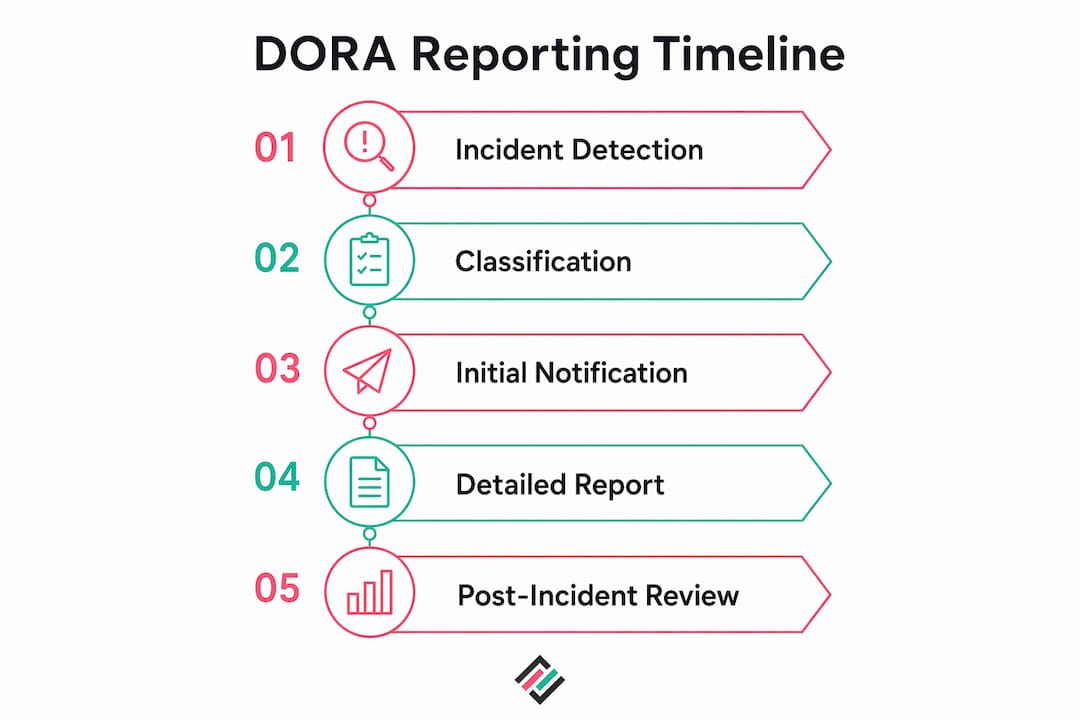
A common mistake is treating detection and classification as the same moment. Confusing detection with classification is one of the most cited compliance pitfalls under DORA. Classification must happen within approximately 24 hours of detection. If your team takes 20 hours to classify, you have only 4 hours left to file the initial notification.
How to operationalize DORA compliance reporting support within your organization
Effective DORA reporting assistance does not happen through good intentions. It requires defined roles, documented workflows, and tested processes before an incident occurs.
-
Assign clear ownership. Your IT team detects and logs the incident. Your risk function applies the classification criteria. Your compliance function prepares and submits the regulatory reports. Your management body reviews and approves before submission. Each role must be named, not assumed.
-
Build a classification workflow. Map the RTS 2024/1772 classification criteria into a decision tree your team can run under pressure. Include thresholds for client impact, transaction volume affected, duration, and geographic spread.
-
Maintain a live audit trail. Every incident log, internal communication, approval record, and report draft must be stored with timestamps. Regulators do not accept reconstructed evidence. Your compliance documentation must show continuous control operation, not a snapshot assembled after the fact.
-
Integrate with GDPR and NIS2. Managing DORA, GDPR, and NIS2 separately creates duplication and increases the risk of conflicting notifications. A unified incident management process that maps each event to all applicable frameworks reduces both workload and compliance risk.
-
Run dry runs quarterly. Test your portal access, template completion, and escalation chain before a real incident forces you to learn under pressure. Supervisory authorities increasingly expect evidence that firms have rehearsed their reporting processes.
Pro Tip: Pre-populate your RTS 2025/301 Annex II template with static firm data, contact details, and authority submission addresses. Under a 4-hour deadline, every saved minute counts.
There is also a dual governance obligation that many firms overlook. Senior management must be informed during the incident response. The management body must be separately briefed before the regulatory notification is finalized. Failing to distinguish these two steps is a recurring audit finding.

What are best practices for managing third-party ICT arrangements and the Register of Information?
DORA's third-party requirements add a second major reporting obligation on top of incident reporting. Financial entities must submit the Register of Information on ICT third-party service arrangements annually, with an EU-wide deadline of april 30. Supervisory authorities began cross-referencing and validating this data at scale in 2025, and that scrutiny has only increased in 2026.
The Register of Information is not a one-time exercise. It must reflect your actual vendor relationships at the point of submission, including contract dates, service categories, criticality classifications, and subcontractor chains. Keeping this data accurate across a large vendor portfolio is operationally demanding.
Key practices for managing third-party data effectively:
- Assign a data owner for each vendor record. Vendor data goes stale quickly. A named owner inside your organization is responsible for validating each record before the april 30 deadline.
- Build contractual hooks for incident cooperation. ICT third-party incidents must be tied back to affected vendors in your final report, with documented remediation. Your contracts must require vendors to notify you promptly and cooperate with your reporting obligations.
- Use structured workflows for Register updates. Static spreadsheets fail under audit. A controlled update process with version history and approval records is the minimum standard regulators expect.
| Practice | Why it matters |
|---|---|
| Named data owner per vendor | Prevents stale records at submission deadline |
| Contractual notification clauses | Supports timely final report vendor attribution |
| Version-controlled Register updates | Provides audit trail for supervisory review |
| Annual validation cycle | Confirms accuracy before april 30 submission |
Pro Tip: Start your Register of Information validation cycle in february, not april. Chasing vendor confirmations in the final two weeks before the deadline is a predictable failure mode.
Firms that treat the Register as a living document, with controlled updates and verifiable evidence, consistently perform better in supervisory reviews than those relying on static files updated once a year.
What common challenges do financial entities face in DORA reporting, and how can you overcome them?
DORA reporting failures cluster around a small set of recurring problems. Recognizing them early gives you a clear path to fix them before a regulator does.
-
Misreading the classification trigger. The 4-hour clock starts at classification, not detection. Firms that treat these as simultaneous routinely miss the initial notification deadline. Build a classification decision log that timestamps each step separately.
-
Fragmented evidence. Incident logs stored in one system, approvals in email, and communications in a chat tool create an evidence trail that cannot be reconstructed cleanly. Centralize all incident artifacts in a single, access-controlled repository from the moment an event is detected.
-
Siloed regulatory reporting. Teams that manage DORA, GDPR, and NIS2 in separate processes duplicate work and risk inconsistent notifications to different authorities. A single incident taxonomy that maps to all three frameworks is the correct solution.
-
Static documentation. DORA compliance requires living processes, not documents filed once and forgotten. Regulators expect proof that controls operate continuously. Your risk reporting practices must reflect current operations, not last year's audit preparation.
-
Governance gaps. The management body's active engagement during incident response is a compliance requirement, not a courtesy. Documented evidence of board-level oversight is a standard inspection item. Firms that cannot show this evidence face findings regardless of how well their technical reporting performs.
Pro Tip: After every incident, conduct a 30-minute post-submission review. Document what worked, what slowed you down, and what needs to change before the next event. This record itself becomes evidence of continuous improvement for supervisory inspections.
Key Takeaways
Effective DORA compliance reporting requires precise classification timing, documented governance, and living evidence processes that hold up under supervisory scrutiny.
| Point | Details |
|---|---|
| Classification starts the clock | The 4-hour initial notification deadline begins at classification, not detection. |
| Three-stage reporting timeline | Initial notification, 72-hour intermediate report, and 1-month final report are all mandatory. |
| Dual governance obligation | Senior management and the management body must each be briefed separately before filing. |
| Register of Information deadline | Annual submission is due by april 30; validation should begin in february. |
| Living evidence, not static files | Audit-ready compliance requires continuously maintained records, not documents assembled after the fact. |
Why DORA reporting is an operational discipline, not a compliance checkbox
I have watched compliance teams treat DORA as a documentation project. They build templates, assign owners on paper, and file the Register of Information once. Then an incident hits at 11 PM on a Friday, and the entire structure collapses because nobody has actually run the process under pressure.
The firms that pass supervisory inspections with minimal findings share one characteristic: they have embedded incident classification and reporting into their daily operations. The management body receives regular briefings on ICT risk, not just post-incident summaries. The Register of Information has a named owner who validates vendor data on a rolling basis, not in a panic in late april. The incident log is a live system, not a Word document someone updates after the fact.
Cross-functional collaboration is the part most compliance officers underestimate. Your IT team knows what happened technically. Your risk team knows how to classify it. Your legal team knows what GDPR and NIS2 require in parallel. None of these functions can produce a complete, accurate report alone. The compliance officer's job is to own the process that connects them, not to be the expert in each domain.
The regulatory audit preparation work you do between incidents is what determines your outcome when an incident occurs. Build the process now. Test it. Fix what breaks. That is the only version of DORA compliance that actually works.
— Bartas
How Corphedge supports your operational risk and compliance needs
Corphedge is a risk management platform built for international firms that need structured, evidence-based approaches to financial and operational risk. For compliance officers and financial leaders in Poland, Sweden, and across the EU, Corphedge provides real-time visibility into currency positions and risk exposures, with value at risk hedging tools that integrate directly into your risk governance workflows. Managing operational resilience under DORA requires the same discipline you apply to financial risk: clear thresholds, documented decisions, and verifiable audit trails. Explore the Corphedge product tour to see how structured risk management tools support your compliance reporting infrastructure.
FAQ
What triggers the DORA major incident reporting obligation?
An ICT incident triggers mandatory reporting when it meets the classification criteria in RTS 2024/1772, including thresholds for client impact, service disruption duration, and transaction volume affected. Classification must occur within approximately 24 hours of detection.
When does the 4-hour initial notification deadline start?
The 4-hour clock starts at the moment of classification, not detection. Firms that confuse these two timestamps routinely miss the initial notification deadline.
What must the DORA final report include?
The final report must include aggregated costs and losses caused by the incident, a root cause analysis, remediation actions taken, and documentation of any third-party vendors involved. The EBA mandates standardized cost and loss estimation as part of this submission.
When is the Register of Information due each year?
Financial entities must submit the Register of Information on ICT third-party service arrangements by april 30 each year. Supervisory authorities cross-reference and validate this data, so accuracy and completeness are both required.
How does DORA interact with GDPR and NIS2 reporting?
DORA, GDPR, and NIS2 can all apply to the same incident simultaneously. A unified incident management process that maps each event to all three frameworks reduces duplication and prevents inconsistent notifications to different regulatory authorities.