

Forwards remain the default for confirmed, custom cash flows because they can be sized and dated to match an invoice exactly, while futures win when a treasury needs liquidity, standardized contract sizes, or wants to avoid tying up bilateral credit lines. The real trade-off isn't complexity versus simplicity. It's counterparty credit risk on forwards against daily margin cashflow volatility on futures, and which one your treasury can absorb more easily.
TL;DR:
- Forwards are preferable when exact notional and settlement dates are required, especially for confirmed cash flows like large receivables or payables.
- Futures are better suited for liquid, standardized exposures and when collateral and credit capacity are constrained, but may introduce basis risk and rollover challenges.
- Clearing reduces bilateral credit risk in futures but shifts the risk to daily margin cashflows, which can be costly for treasuries with limited liquidity buffers.
- Regulatory and tax environments influence the choice, with futures often benefiting from lower capital charges and simpler reporting in some jurisdictions.
- Operational tools like treasury platforms help manage positions, run margin scenarios, and maintain audit-ready documentation regardless of the chosen instrument.
Table of Contents
- Futures vs Forwards Hedging: A Side-by-Side Comparison
- How Clearing Changes Who Bears the Credit Risk
- Why Margin Calls and Basis Risk Change the Real Cost of Hedging
- Settlement Timing and Hedge Accounting Considerations
- A Step-by-Step Framework for Choosing Your Instrument
- What a Treasury Platform Adds to This Decision
- What Are Forwards and Futures, Exactly?
- How Regulation Shapes Which Instrument Corporates Actually Use
- Tax Treatment Differs by Instrument and Jurisdiction
- Gap Risk, Rollover Risk, and Other Instrument-Specific Exposures
- The Take: Stop Treating This as a Binary Choice
- Let Corphedge Handle the Execution Side
- Sources
- FAQ
Futures vs Forwards Hedging: A Side-by-Side Comparison
The two instruments solve the same problem (locking in a future price) through almost opposite mechanics. Forwards are private contracts negotiated bilaterally with a bank; futures are standardized contracts traded on an exchange like CME Group and cleared through a central counterparty.
| Dimension | Forwards | Futures |
|---|---|---|
| Customization/flexibility | Fully customizable amount, currency pair, and settlement date | Fixed contract size and standardized expiry dates |
| Counterparty/credit exposure | Bilateral exposure to the bank or dealer | Cleared through a central counterparty, credit risk largely removed |
| Liquidity/market transparency | Depends on the bank relationship; pricing is not publicly quoted | Continuous order-book pricing, generally deep liquidity in major pairs |
| Margin/cashflow implications | Typically no daily margin unless a CSA requires it | Daily variation margin, meaning cash moves in and out constantly |
| Basis risk/hedge mismatch | Low, since terms match the exposure precisely | Can be meaningful if contract size or expiry doesn't line up with the exposure |
| Operational complexity/documentation | Requires ISDA and credit approval, but few ongoing mechanics | Requires margin account setup and monitoring, but standardized paperwork |
For most corporate treasuries, the dimension that actually drives the decision is the second-to-last row. Basis risk on futures is rarely catastrophic, but it compounds when a company hedges a niche currency pair or an odd notional that doesn't divide cleanly into standard contract lots. Meanwhile, the margin row explains why treasuries with thin cash buffers often lean toward forwards even when futures would otherwise fit better on paper.
- Forwards suit exact-amount, exact-date corporate exposures like a single large receivable.
- Futures suit liquid, standardized exposures where speed of execution and clearing certainty matter more than a perfect match.
- Hybrid approaches (forwards as a baseline, futures as an overlay) show up often in practice for firms managing both types of exposure at once.
How Clearing Changes Who Bears the Credit Risk
Every futures contract gets novated to a central clearinghouse the moment it trades. That means your counterparty is no longer the specific bank on the other side of the trade. It's the clearinghouse itself, backed by a mutualized default fund. This structural shift is the single biggest reason futures exist as a separate product category from forwards, and it's well documented in NBER's working paper on OTC versus exchange-traded derivatives, which walks through how novation reduces bilateral exposure across a derivatives book.
Forwards don't get this protection. Your treasury is directly exposed to whichever bank wrote the contract, for the full life of the trade. That's why every forward relationship typically requires an ISDA Master Agreement, often paired with a Credit Support Annex (CSA) that dictates when collateral changes hands, plus an internal credit line sized to the notional and tenor of the hedge.
A practical credit checklist before committing to a forward:
- Confirm the counterparty bank's credit rating and your internal limit against it.
- Check whether the CSA requires two-way collateral posting or one-way (usually unfavorable to the corporate).
- Identify a fallback counterparty in case the credit line gets exhausted mid-program.
- Set a monitoring cadence for mark-to-market exposure, not just at trade inception.
Pro Tip: Don't wait for a credit review cycle to discover your forward book has outgrown your bank's comfort level. Run a quarterly stress test on aggregate notional against each counterparty's limit, especially during periods of currency volatility.
Why Margin Calls and Basis Risk Change the Real Cost of Hedging
Futures settle daily through variation margin, meaning gains and losses on the position get credited or debited to your margin account every single trading day, based on CME's margin methodology. That's very different from a forward, where nothing changes hands until settlement (unless a CSA forces interim collateral posting).
This daily cash movement is where futures hedging quietly gets expensive for treasuries that aren't prepared for it. A currency move against your position triggers a same-day cash outflow, even though the hedge is working exactly as intended and will offset against the underlying exposure at maturity.
A 2025 case study on corporate currency risk management documented a futures basis-risk deviation and collateral call triggered by adverse currency movement during the hedge period, illustrating margin risks of futures hedging. That same study found the forwards side of the comparison carried its own cost: missed upside participation worth several million euros, since a forward locks in a rate with no ability to benefit if the market moves favorably.
- Size futures notional conservatively to leave room for basis mismatch.
- Build a margin call scenario into your cash forecast, not just your hedge P&L.
- Remember forwards trade certainty for opportunity cost. There's no free option here.
Settlement Timing and Hedge Accounting Considerations
Futures come in fixed contract sizes with quarterly or monthly expiries set by the exchange. If your exposure doesn't land on one of those dates or divide evenly into contract units, you carry a residual position that needs its own management. Forwards, by contrast, settle exactly when your cash flow does. That precision is a big part of why forwards remain the workhorse instrument for confirmed receivables and payables.
Liquidity matters at unwind, too. A corporate that needs to exit a futures position early can generally do so in seconds during market hours, given the depth most G10 currency futures carry. Unwinding a forward early means renegotiating with the original bank, which usually means paying whatever breakage cost the bank calculates at that moment, with far less price transparency than an exchange quote.
Hedge accounting adds another layer regardless of instrument choice. Under most accounting frameworks, qualifying for hedge accounting treatment requires:
- Formal documentation at inception, naming the hedged item, the hedging instrument, and the risk being hedged.
- Prospective effectiveness testing to justify the hedge relationship before it starts.
- Ongoing retrospective testing to confirm the hedge is still working as designed.
- A plan for where P&L volatility lands if effectiveness testing ever fails.
Managing these mechanics is more about internal process discipline than instrument choice. Treasury teams that already track currency exchange accounting requirements systematically tend to find both instruments manageable; the ones treating it as an afterthought get surprised by either one.
A Step-by-Step Framework for Choosing Your Instrument
Run through this sequence before committing capital to a hedge:
- Confirm exposure certainty. Is this a signed contract with a known date and amount, or a forecast that could shift?
- Check credit capacity. Does your bank relationship have room for another forward, or is the credit line tight?
- Evaluate tenor and size match. Would a futures contract's fixed expiry and lot size leave meaningful residual exposure?
- Simulate cashflow under margin scenarios. Model a 5% adverse move and see whether your liquidity can absorb the variation margin calls.
- Decide instrument or hybrid, based on which constraint (credit or cash) is tighter for your organization right now.
Three scenarios illustrate how this plays out:
A manufacturer with a confirmed €10 million payable due in 90 days to a known supplier should default to a forward. The exposure is exact, the counterparty relationship exists, and there's no reason to accept basis risk or margin volatility for a hedge that already matches perfectly.
A company managing a structural, ongoing balance-sheet exposure in a liquid pair like EUR/USD, where credit lines are already stretched across multiple hedges, often leans toward futures specifically because clearing frees up bank credit capacity.
A firm in a liquidity-constrained position, worried about tying up cash in margin calls, may prefer forwards even at the cost of counterparty concentration, simply because predictable cashflow matters more than credit diversification in that moment.
Pro Tip: A layered approach works well in practice: use forwards as your baseline hedge for confirmed flows, then add a futures or options overlay for the uncertain, forecast-driven portion of your exposure. This is a pattern worth exploring further in a guide to international transaction hedging.
What a Treasury Platform Adds to This Decision
Choosing between futures and forwards is only step one. The harder part is tracking positions, running margin scenarios, and keeping documentation ready for auditors, across every currency pair and every hedge in the book.
This is where platform tooling earns its place. Real-time position tracking eliminates the spreadsheet reconciliation that eats a treasury analyst's week. Value-at-risk simulation lets a treasurer model the exact margin-call scenario described in the case study above before committing notional, rather than discovering it after the fact. Bank and payment integrations, such as connections to Corpay, reduce the manual work of reconciling settlement instructions across multiple counterparties.
- Rolling forward positions monthly becomes a tracked workflow instead of a manual calendar reminder.
- Margin triggers on futures positions get flagged before they become a liquidity surprise.
- Reporting output maps directly to hedge accounting documentation requirements.
None of this changes which instrument fits a given exposure. It changes how much operational risk your team carries while managing whichever one you pick.
What Are Forwards and Futures, Exactly?
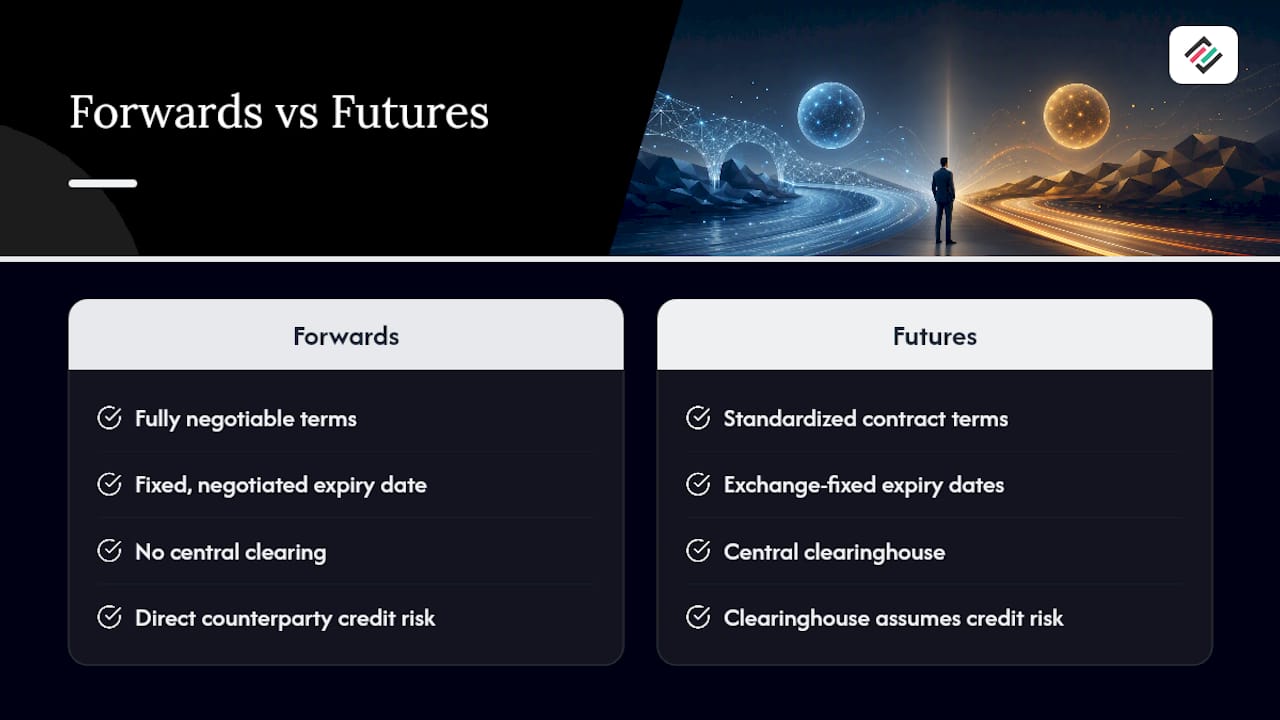
A forward contract is a private agreement between two parties to exchange a specific amount of currency or a commodity at a fixed price on a fixed future date. Nothing about it is standardized; the bank and the corporate negotiate every term.
A futures contract is a standardized version of the same idea, traded on a regulated exchange with fixed contract sizes, fixed expiry dates, and a central clearinghouse standing between buyer and seller. You're not trading directly with the other party. You're trading with the exchange's clearing mechanism, which nets and guarantees every position.
Both instruments hedge the same underlying risk: an adverse move in a currency rate or commodity price between now and a future date. The difference is entirely structural, in who bears counterparty risk, how the contract gets priced, and how much flexibility exists in the terms.
How Regulation Shapes Which Instrument Corporates Actually Use
Regulatory frameworks push corporate treasuries toward one instrument or the other depending on how capital and reporting rules treat each type of exposure. Firms operating under frameworks that impose capital charges on uncleared bilateral derivatives sometimes find futures more attractive purely because central clearing reduces the regulatory capital burden compared to an OTC forward, a dynamic CME Group has highlighted as a driver of the shift toward exchange-traded FX products.
Reporting obligations differ too. OTC forwards typically require trade reporting to a swap data repository under derivatives reporting rules, adding an administrative layer that futures, cleared and reported automatically by the exchange, largely avoid.
Corphedge is currently expanding into the Poland and Sweden markets, and treasuries operating across multiple European jurisdictions should expect some variation in how local regulators treat OTC derivatives documentation and clearing thresholds. None of this changes the underlying hedge mechanics, but it does affect how much administrative overhead sits on top of a forwards program versus a futures program in a given jurisdiction.
Tax Treatment Differs by Instrument and Jurisdiction
Tax treatment of hedging gains and losses depends heavily on local rules, but the structural difference between the two instruments creates a consistent pattern worth understanding before assuming they're taxed identically.
Futures generate realized gains and losses through daily variation margin settlement, which in some jurisdictions triggers different timing for tax recognition than a forward that only settles once at maturity. Forwards, because they settle in a single transaction, tend to produce a single realized gain or loss event rather than a stream of daily marks.
Whether a hedge qualifies for special tax treatment (matching the tax timing of the hedge to the timing of the underlying exposure) usually depends on formal hedge identification and documentation at the time the position is opened, not after the fact. This is a separate test from hedge accounting under financial reporting standards, though the two often get confused. A treasury team should confirm both the accounting and tax treatment with its advisors before assuming a hedge automatically qualifies for favorable tax timing in its jurisdiction, since rules vary by country and by instrument.
Gap Risk, Rollover Risk, and Other Instrument-Specific Exposures
Forwards carry gap risk, the danger that a major market move happens between trade dates in an illiquid pair, leaving no way to adjust the position until the bank quotes a new price. Because forwards don't trade continuously on an open market, there's no intraday price discovery to react to.
Futures carry rollover risk instead. Because every futures contract expires on a fixed date, a treasury hedging an exposure longer than the available contract tenor has to roll the position forward into a new contract, and that roll happens at whatever the market is pricing at that moment. A poorly timed roll during a volatile period can lock in a worse rate than the original hedge intended.
Both instruments also carry basis risk when the hedge doesn't perfectly track the underlying exposure, whether from a mismatched currency pair, a slightly different notional, or a settlement date that doesn't align. The 2025 case study referenced earlier captured this directly in its basis-risk figure. Treasury teams that treat rollover and gap risk as edge cases rather than standard planning items tend to get caught off guard precisely when volatility spikes, which is exactly when these risks matter most.
The Take: Stop Treating This as a Binary Choice
Most treasury guidance frames forwards and futures as competing products, and that framing gets the decision backwards. They solve different problems. Forwards solve certainty for confirmed cash flows. Futures solve credit-capacity constraints and liquidity for standardized exposures. Treating this as an either-or choice is where a lot of treasury teams go wrong.
What's overrated in the conventional advice: the assumption that futures are inherently "safer" because of central clearing. Clearing removes counterparty credit risk, but it replaces it with margin cashflow risk, and for a treasury with tight liquidity, that swap isn't obviously an improvement.
What's underrated: the basis risk that comes with standardized contracts. Treasuries should model that mismatch before assuming a futures overlay is a clean substitute for a forward.
The reader's real priority should be matching instrument to exposure certainty first, and only then optimizing for cost or credit efficiency. Get the sequencing backwards, and you end up hedging the wrong risk with the wrong tool.
— Bartas
Let Corphedge Handle the Execution Side
Once you've decided between a forward, a future, or a layered mix of both, the harder job starts: tracking every position, running margin scenarios, and keeping documentation audit-ready across currency pairs. Corphedge is built for exactly that gap between deciding on a hedging strategy and actually running one day to day.
The platform gives treasury teams automated exposure reporting, VaR-based scenario simulation to stress-test margin calls before they hit your cash position, and bank integrations that cut down on manual reconciliation. It's built for treasury teams that want fewer spreadsheets and more certainty around what their hedge book is actually doing on any given day, whether that's a single forward against a confirmed payable or a rolling futures position that needs monitoring every trading session. Corphedge is currently expanding to the Poland and Sweden markets, extending that same automated reporting and monitoring to treasury teams in those regions.
If your treasury manages currency exposure across more than a handful of contracts, take a look at the platform's feature set or walk through the product tour to see how position tracking and VaR simulation work together. For a tailored setup across multiple entities or currency pairs, contact the Corphedge sales team directly.
Sources
- NBER working paper on OTC vs exchange-traded derivatives
- Futurization: Futures vs. Forwards — CME Group (2025)
- Evaluating Corporate Currency Risk Management Practices (2025 case study)
FAQ
Is There a Real Difference Between Forwards and Futures?
Yes. Forwards are private, customizable OTC contracts with bilateral counterparty credit risk; futures are standardized, exchange-traded contracts cleared through a central counterparty, which removes bilateral credit exposure but adds daily variation margin.
Are Forwards Riskier Than Futures?
Forwards carry more counterparty credit risk since there's no clearinghouse standing behind the trade, but futures carry their own risks, including margin cashflow volatility and basis risk when contract terms don't perfectly match the exposure. Neither instrument is categorically safer; they carry different types of risk.
Can Futures Be Used for Hedging Corporate Exposures?
Yes, futures are commonly used to hedge liquid, standardized currency and commodity exposures, particularly when credit lines are constrained or when a corporate wants the transparency of exchange-based pricing described by CME Group.
Why Would a Treasury Choose Futures Instead of Options?
Futures typically cost less upfront than options since there's no premium to pay, making them attractive when a treasury wants a full hedge rather than one-sided protection. Options suit situations where a treasury wants to keep upside participation and is willing to pay a premium for that flexibility.
Does Corphedge Support Both Forwards and Futures Hedging Programs?
Corphedge's platform tracks exposures and simulates hedging scenarios using Value at Risk analysis, which applies to programs built on forwards, futures, or a hybrid mix of both instruments.