

Currency basis risk is the extra cost or gain a hedge produces because the interest rate parity used to price forwards, swaps, and cross-currency instruments doesn't actually hold in real markets. Even when a treasury has perfectly matched its spot exposure and its interest rate exposure, the basis component can still move against the position and create losses that have nothing to do with where the exchange rate went. The main defenses are diversifying instrument types, matching collateral currencies on swap agreements, and treating basis as a standing cost of capital rather than a rounding error.
TL;DR:
- The persistent negative cross-currency basis, especially in EUR/USD, results from structural demand for dollars and new post-2008 regulatory constraints on arbitrage.
- Basis risk can cause significant unrealized losses over multi-year horizons, with stress scenarios suggesting potential moves of 25 to 30 basis points or more.
- The basis impacts all hedging instruments differently: minuscule in short-term forwards but material and slow to revert in long-term swaps and futures.
- Effective risk management involves instrument diversification, collateral currency matching, and implementing operational controls that account for quarter-end basis widenings.
- Most treasury teams underestimate basis risk by treating it as background noise; building dedicated monitoring, stress testing, and specialized dashboards is essential.
Table of Contents
- What Is Currency Basis Risk in FX Markets?
- Why Does Cross-Currency Basis Stay Nonzero?
- What Historical Basis Shocks Teach Risk Managers
- How Basis Risk Hits Forwards, Swaps, Futures, and Options
- How Do You Calculate and Stress-Test Basis Risk?
- Building a Hedging Program That Controls for Basis
- What Belongs on a Basis Risk Dashboard?
- Why Most Treasury Teams Underprice Basis Risk
- Manage Basis Risk Without Building It From Scratch
- Primary Sources and Further Reading
- Sources
- FAQ
What Is Currency Basis Risk in FX Markets?
Cross-currency basis is the gap between the interest rate implied by the forward market and the actual interest rate differential between two currencies. In a textbook world, covered interest parity (CIP) says these two numbers should match exactly. They don't, and haven't consistently since the 2008 financial crisis, according to BIS research on covered interest parity.
Here's where it shows up in practice. A EUR/USD forward price is built from spot plus an adjustment for the interest rate gap between euros and dollars. If that adjustment consistently runs cheaper or more expensive than the pure interest rate math predicts, the difference is the basis. It's usually quoted in basis points added to (or subtracted from) the foreign currency's interest rate leg of a cross-currency swap. A negative EUR/USD basis, which has been the norm for over a decade, means it costs more to borrow dollars synthetically through the FX swap market than the interest rate differential alone would suggest.
You'll find basis quoted across several venues and formats:
- FX swap points — where basis is embedded in the pricing of short-dated forwards, though it's rarely broken out separately by data vendors at short tenors.
- Cross-currency basis swap markets — where it trades directly, typically quoted against 3-month USD SOFR or equivalent reference rates.
- CME's EUR/USD basis futures — an exchange-traded proxy that lets you see a real-time, standardized basis print rather than relying on dealer quotes, as CME Group explains in its contract education material.
If you're pulling this data into a risk system, watch four fields specifically: the tenor bucket (basis behaves differently at 1-month versus 5-year), whether you're looking at mid or bid/ask (spreads widen fast in stress), whether the print is implied from swap points or observed directly in the basis swap market, and the reference date relative to quarter-end, when basis reliably distorts.
Pro Tip: Don't rely on a single tenor to represent your whole basis exposure. A company rolling 3-month hedges against a 5-year underlying liability is exposed to a completely different part of the basis curve than the headline number in a market commentary usually references.
Why Does Cross-Currency Basis Stay Nonzero?
The basis persists because the banks that would normally arbitrage it away can't do so for free anymore. Before 2008, if the basis opened up, banks would borrow the cheap currency, swap it, and lend the expensive one until the gap closed. Balance sheet regulation broke that mechanism.
Three forces keep the basis from returning to zero:
- Structural dollar demand. Non-US banks, corporates, and asset managers routinely need dollars for trade finance, reserve holdings, and dollar-denominated debt issuance, and that demand doesn't fade just because the basis is expensive.
- Balance sheet cost. Post-crisis capital rules mean every dollar of matched-book FX swap trading still consumes a bank's leverage ratio and counterparty credit adjustment (CVA) capacity, so dealers charge for it instead of arbitraging it flat.
- Collateral and liquidity scarcity. When high-quality collateral is tight, or when funding markets seize up, the cost of bridging currencies through swaps rises independently of anything happening in spot markets.
A 2024 study in the Journal of International Economics found that surges in corporate and institutional FX swap demand, arriving faster than dealer balance sheets can absorb, explain much of the observed widening in cross-currency basis. That's a demand story layered on top of a supply constraint story, and it's why basis spikes tend to cluster around specific triggers: heavy foreign bond issuance calendars, quarter-end regulatory reporting dates, and periods when banks are actively shrinking balance sheets to hit capital targets.
Basis as a standing cost: The BIS has documented persistent, non-zero cross-currency basis dating back to 2007, meaning this isn't a crisis-only phenomenon corporates can ignore between shocks. It's a structural feature of post-crisis FX funding markets that shows up in ordinary market conditions too, just at smaller magnitudes.
Seasonal patterns matter more than most treasury teams appreciate. Basis reliably widens into quarter-end and especially year-end, when banks pull back from FX swap intermediation to manage regulatory ratios reported on those specific dates. If your hedge program happens to roll a large notional right at December 31, you're paying a premium that has nothing to do with your currency view and everything to do with bank balance sheet timing.
Tenor behavior also isn't uniform. Short-dated basis (overnight to 1-month) tends to be noisier but mean-reverts faster. Longer-dated basis (5-year and beyond) moves less often but the moves, when they happen, tend to be structural and slow to reverse, which matters enormously if your underlying exposure is a multi-year intercompany loan rather than a 90-day trade payable.
What Historical Basis Shocks Teach Risk Managers
Three episodes give treasury teams a real sense of scale, and each one exposes a different failure mode in hedge design.
2008 (Global Financial Crisis): Dollar funding markets froze as counterparty trust evaporated. The cross-currency basis moved to levels not seen before, widening sharply across major currency pairs as non-US banks scrambled for dollar funding. Central bank swap lines between the Federal Reserve and other major central banks were the intervention that eventually compressed it, and that policy tool has been redeployed in every subsequent stress episode.
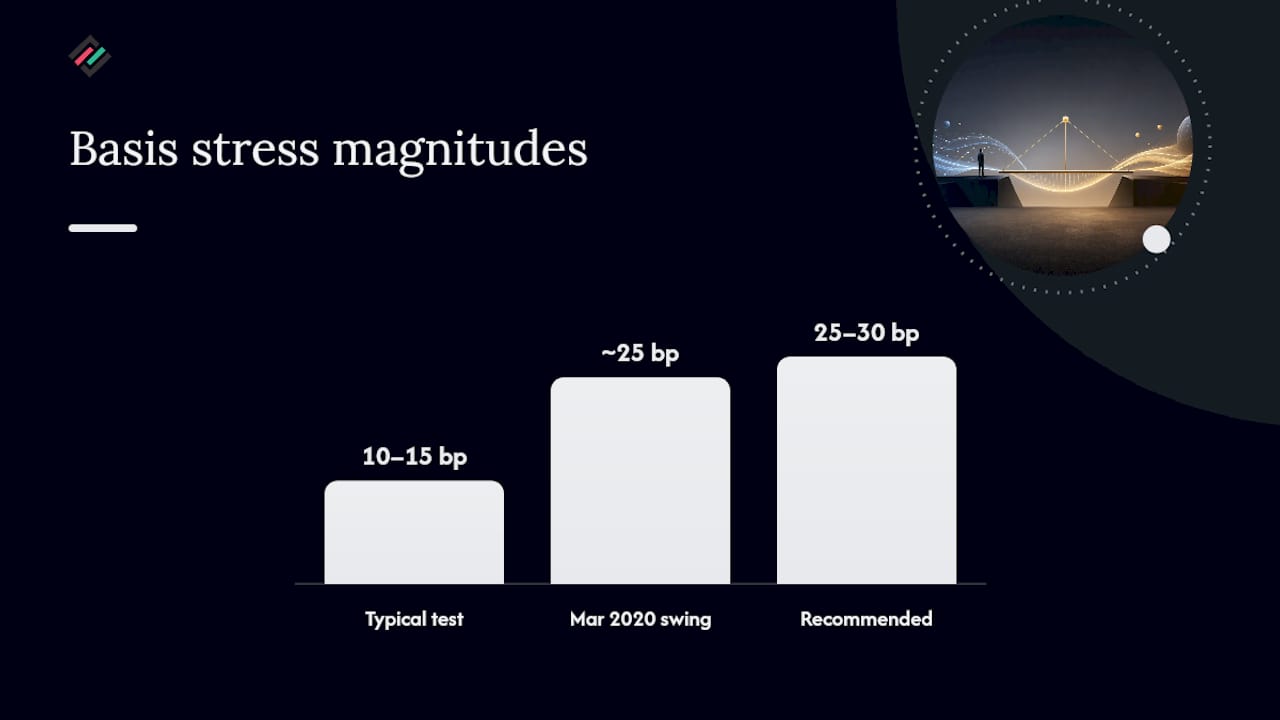
March 2020 (COVID liquidity crisis): The ECB documented the EUR/USD 5-year basis moving from roughly negative 15 basis points to roughly negative 40 basis points within days. For a company holding a $500 million notional cross-currency swap at that tenor, that swing alone represents a meaningful mark-to-market loss, generated entirely by basis, independent of any spot rate movement or interest rate change.
March 2023 (banking sector stress): The failures of several regional US banks and the Credit Suisse resolution triggered another dollar funding squeeze, though shorter-lived than 2020 thanks to swap lines being activated quickly and market participants having learned from the prior episode.
- Each episode shows the basis functioning as a real-time proxy for dollar scarcity, tightening exactly when credit conditions deteriorate elsewhere.
- Central bank swap lines compressed the basis rapidly once activated in both 2008 and 2020, according to BIS analysis, which tells you the mechanism for de-escalation even if you can't predict the trigger.
- Basis widening tends to precede or coincide with credit spread widening elsewhere, giving risk teams a secondary confirmation signal rather than a standalone one.
For program design, the practical takeaway is severity calibration. If your stress test for basis risk only contemplates a 10 to 15 basis point move, you're testing for a calm year, not a real one. The March 2020 episode alone argues for stress scenarios in the 25 to 30 basis point range at longer tenors, and worse at points of maximum stress.
How Basis Risk Hits Forwards, Swaps, Futures, and Options
Every hedging instrument carries basis exposure differently, and knowing which one you're using changes what kind of surprise you should expect.
Forwards and FX swaps. Basis is baked into the forward points from day one. For short-dated forwards (under three months), the basis component is usually small relative to the interest rate differential, so most corporates rolling short trade hedges barely notice it. The exposure grows as tenor extends, and it becomes material once you're rolling forwards to hedge exposures longer than six to twelve months, because you're repeatedly repricing at whatever the basis happens to be on each roll date.
Cross-currency swaps. This is where basis risk is most visible and most consequential. When you enter a cross-currency swap, you lock in the basis at that moment as part of the swap's fixed terms. From that point forward, the swap's mark-to-market value moves with changes in the basis, completely separate from moves in the underlying interest rates or spot rate. Investopedia's explainer on cross-currency swaps notes that mismatches between the benchmarks and instruments used to construct a hedge are a primary source of this kind of basis risk. If you entered a 5-year EUR/USD cross-currency swap when the basis was negative 20 basis points and it moves to negative 40, you're carrying a mark-to-market loss on that swap even if EUR/USD spot hasn't budged and rates haven't moved either. Practitioner writeups on cross-currency swaps and basis risk describe the basis as a live gauge of relative dollar scarcity embedded directly into the swap's valuation.
Basis futures. CME's EUR/USD cross-currency basis futures let you take a position directly on the basis without also taking on full cross-currency swap counterparty exposure. That's useful for expressing a tactical view or hedging basis risk sitting on an existing book, but liquidity thins out at longer tenors, and the futures curve won't always track the exact tenor bucket of your underlying exposure. Treat it as a partial hedge, not a perfect one.
Options. Currency options don't hedge basis directly, but a mixed program using options alongside forwards and swaps can reduce the notional that needs to sit in basis-sensitive instruments in the first place, which shrinks your total basis exposure by construction rather than by directly offsetting it.
Pro Tip: If your hedge accounting policy tests effectiveness including the basis component, a basis shock can push an otherwise well-designed hedge outside its effectiveness band, forcing you to reclassify gains or losses through the income statement at the worst possible time.
How Do You Calculate and Stress-Test Basis Risk?
Basis exposure is measurable with a formula treasury teams already use for other mark-to-market calculations, adapted for the basis component specifically.
The standard practitioner approximation is:
P&L ≈ (Current Basis − Entry Basis) × Notional × Remaining Tenor (years) × 0.01
Here's a worked example. Say your company entered a $200 million cross-currency swap at a basis of negative 20 basis points, with 4 years remaining on the swap. The basis then widens to negative 35 basis points, a move of 15 basis points.
- Basis change: negative 35 minus negative 20 equals negative 15 basis points.
- Apply the formula: negative 15 × $200,000,000 × 4 × 0.01 = negative $1,200,000.
- That's an approximate $1.2 million mark-to-market loss driven entirely by the basis component, separate from any interest rate or spot move on the same swap.
Beyond this point estimate, three additional metrics round out a proper basis risk framework:
| Metric | What it captures | Typical use |
|---|---|---|
| Standard deviation of basis (by tenor) | Historical volatility of the basis at a given maturity point | Sizing stress scenarios and setting limits |
| Correlation to credit spreads | Whether basis moves track broader credit stress or move independently | Confirming whether a move is idiosyncratic or systemic |
| Tenor surface fitting | How basis behaves across the full curve, not just one point | Identifying mispriced tenors and roll timing decisions |
For stress testing, apply the observed historical extremes as your severity anchors rather than inventing arbitrary shock sizes. Aggregate exposure across all basis-sensitive instruments, not just swaps, since forwards, futures, and swaps all contribute to the same underlying sensitivity even though they're booked differently. A treasury with $50 million in cross-currency swaps and another $30 million in long-dated rolling forwards should stress both legs under the same basis shock scenario, because in a real crisis, the basis doesn't discriminate by instrument type.
Building a Hedging Program That Controls for Basis
Program design determines whether basis risk stays a manageable line item or becomes a quarterly surprise for the CFO.
Start with instrument mix and tenor laddering. Concentrating all your hedging in a single instrument type at a single tenor bucket maximizes your exposure to a shock in that specific part of the basis curve. Spreading notional across forwards, swaps, and where liquid, basis futures, and staggering maturities so you're not rolling a disproportionate share of your book on any single date, reduces the odds that one bad quarter-end print does outsized damage.
Collateral and CSA terms deserve more attention than they typically get. If your Credit Support Annex requires posting collateral in a currency different from your hedge's exposure currency, you've created a second, unhedged FX exposure sitting inside your risk management infrastructure. Matching collateral currency to the swap's exposure currency, where counterparties will agree to it, removes this secondary risk entirely.
Accounting treatment is a separate question from economic exposure, and conflating the two is a common mistake. IFRS 9 gives companies some flexibility in how basis is treated within hedge effectiveness testing, meaning you can, in some structures, exclude the basis component from your hedge accounting designation and record its fluctuation separately. This changes where the volatility shows up on your financial statements, not whether the underlying economic exposure exists. Treasury teams should coordinate closely with their accounting function on this election, since it affects earnings volatility even though it does nothing to change actual cash flow risk.
Operational controls round out the program:
- Stagger roll dates so no single week carries more than a defined share of total notional coming due.
- Set notional caps by tenor bucket, not just an aggregate cap, since a $500 million total limit means little if it's all concentrated at the 5-year point.
- Maintain a liquidity buffer sized to cover at least one adverse basis move at your largest tenor concentration, based on the stress scenarios from your historical analysis.
- Review roll calendars quarterly specifically for concentration around quarter-end and year-end dates, when basis reliably widens.
Pro Tip: Ask your swap counterparties directly what percentage of their FX swap book rolls on the same dates yours does. If you're rolling alongside a large share of the market, you're bidding against everyone else for the same liquidity at the worst possible moment.
What Belongs on a Basis Risk Dashboard?
A functional basis risk dashboard needs four elements to be useful for daily decisions and board-level reporting alike.
- Basis curve by tenor, updated daily, showing where each maturity bucket sits relative to its historical range.
- Entry versus current basis P&L, tracked per position, so the treasury team can see exactly which trades are driving basis-related gains or losses at any moment.
- Counterparty concentration, since a basis shock combined with a counterparty credit event compounds fast. If one dealer holds a disproportionate share of your cross-currency swap book, a stress event that hits both the basis and that counterparty's credit standing simultaneously is a much worse outcome than either risk alone.
- Rolling calendar view, flagging upcoming maturities concentrated near quarter-end or other known basis-widening windows.
Set escalation triggers before you need them, not during a crisis. A defined basis move (for instance, a 10 basis point shift at your primary tenor within a week) should trigger a review, not just a note in a weekly report. Quarter-end widening beyond your historical norm and any sign of central bank swap line activation are both worth an immediate look, since the latter historically signals the tail end of a basis shock rather than its start. Fold basis stress results into the same cadence as your other market risk stress tests and board reporting, rather than treating it as a separate, occasional exercise that gets skipped when things feel calm.
Why Most Treasury Teams Underprice Basis Risk
Most corporate treasuries still treat basis risk as background noise, something that shows up in a footnote when a hedge underperforms and gets explained away as "market conditions." That's backwards. The BIS has been documenting persistent, non-zero cross-currency basis since 2007, which means this isn't an occasional glitch. It's a structural tax on cross-currency funding that every company running an international hedging program pays, whether it tracks the cost or not.
The gap between what conventional hedge accounting shows and what's actually happening economically is where most surprises originate. A company can have a textbook-perfect hedge on spot and interest rate exposure and still take a real mark-to-market hit purely from basis, and if nobody on the team is watching the basis curve specifically, that loss looks unexplained right up until finance has to explain it to the board.
Here's what I'd prioritize this quarter if I were running a corporate treasury desk. First, separate basis exposure from your existing FX risk reporting so it has its own line, its own limit, and its own owner. Second, build the tenor-by-tenor stress test described above using the 2020 episode as your minimum severity, not your worst case. Third, revisit your CSA terms with every active cross-currency swap counterparty and fix any currency mismatch in collateral posting, since that's often the cheapest fix available and the one most commonly ignored.
Platforms built for real-time position tracking and VaR-based hedging strategy design exist precisely because spreadsheet-based monitoring can't keep pace with a curve that moves daily across multiple tenors and counterparties. Getting basis risk under control isn't about predicting the next shock. It's about knowing your exposure well enough that the shock doesn't need explaining after the fact.
— Bartas
Manage Basis Risk Without Building It From Scratch
Corphedge is the alternative to running basis exposure through disconnected spreadsheets: real-time position tracking, VaR-based hedging strategy design, and scenario testing live in one platform instead of three. Corphedge is expanding to Poland and Sweden markets, adding to its existing coverage for internationally active companies managing currency exposure across multiple hedging instruments.

If you're currently trying to model basis P&L by hand on a rolling basis, or you've been caught flat-footed by a quarter-end basis widening you didn't see coming, the fix isn't more spreadsheet columns. It's a dashboard that already tracks entry-versus-current basis by position, flags counterparty concentration, and runs the stress scenarios automatically. The platform pulls live market data into VaR-based strategy workflows so teams can spend time deciding what to do about basis risk, not reconstructing what happened last week. Pair that with strategic hedging program design guidance, or if your team needs to build internal expertise first, the FX Hedging Academy course walks through exactly the mechanics covered here. Start with a product tour to see how the basis curve, position tracking, and scenario tools fit into your existing reporting cadence.
Primary Sources and Further Reading
- BIS: Covered interest parity lost, understanding the cross-currency basis — the foundational analysis on why CIP breaks down and how persistent the basis has become since 2007.
- ECB focus note on FX swap markets during COVID-19 — documents the March 2020 basis widening with specific figures.
- CME Group: Understanding EUR/USD Cross-Currency Basis Futures — contract mechanics for exchange-traded basis exposure.
- Journal of International Economics: The widening of cross-currency basis — 2024 academic research on FX swap demand and arbitrage limits.
- Investopedia: Cross-Currency Swap — plain-language mechanics of cross-currency swaps and benchmark mismatches.
- Adverbum: Managing cross-border fund prospectus localization risk in the EU — a related look at cross-border regulatory exposure for internationally active firms.
Sources
- Covered interest parity lost: understanding the cross‑currency basis — BIS
- ECB: focus note on FX swap markets and basis during COVID‑19
- Understanding EUR/USD Cross‑Currency Basis Futures — CME Group
- Cross‑Currency Swap — Investopedia
FAQ
What Does Currency Risk Mean?
Currency risk is the possibility that a company's cash flows, earnings, or asset values change because of exchange rate movements. Basis risk is a distinct, secondary layer within currency risk that arises from pricing mismatches in the hedging instruments themselves, separate from spot rate moves.
How Is Basis Risk Calculated?
Practitioners commonly approximate basis P&L as (current basis minus entry basis) multiplied by notional, remaining tenor in years, and 0.01. A 15 basis point move on a $200 million position with four years remaining produces roughly a $1.2 million mark-to-market swing.
Can You Give an Example of a Cross-Currency Basis Swap?
A company borrows dollars and swaps them into euros to fund a European subsidiary, agreeing to exchange interest payments and principal at a locked-in basis spread over the swap's life. If the EUR/USD basis widens after entry, as it did from roughly negative 15 to negative 40 basis points at the 5-year tenor during March 2020, the swap's mark-to-market value moves against the company even without any spot rate change.
What Does XCCY Basis Mean?
XCCY basis is shorthand for cross-currency basis, the spread added to one leg of a cross-currency swap to reflect the actual cost of swapping currencies once you account for hedging demand and dealer balance sheet constraints, rather than the theoretical cost implied by pure interest rate differentials.
How Does CorpHedge Help Track Basis Exposure?
Corphedge's platform provides real-time position tracking and VaR-based hedging strategy tools that let treasury teams monitor basis-sensitive instruments alongside spot and interest rate exposures in one dashboard, rather than reconciling separate spreadsheets during a live market move.