

The corporate FX checklist is a repeatable monthly cycle with four distinct weekly stages: updating exposures, reviewing risk metrics and approving hedge decisions, executing trades, and reporting outcomes with escalation of exceptions. According to Xe's FX hedging workflow guide, formalizing this cadence into a Treasury Management System (TMS) materially reduces operational risk compared with decentralized spreadsheets.
Hand this to Treasury today:
- Exposures: Capture transactional, translational, and economic exposures by entity and currency pair, with notional amounts and timing
- Risk metrics: Calculate VaR (portfolio/balance-sheet lens) and CFaR (cash-flow/budget protection) monthly; run sensitivity and stress tests quarterly
- Hedge ratio: Set tiered ratios by exposure certainty (e.g., confirmed payables at higher coverage than forecast revenues)
- Permitted instruments: Forwards, non-deliverable forwards (NDFs), vanilla options, cross-currency swaps, natural hedges
- Roles: CFO approves policy; Treasurer owns execution; FP&A owns exposure data; Controller owns reconciliation; Risk Committee provides independent oversight
- Immediate next actions: (1) Pull current exposure inventory from FP&A and Accounting; (2) Load into TMS or structured template; (3) Schedule Week 2 risk review with CFO and Treasurer; (4) Confirm counterparty limits and ISDA/GMRA documentation are current
Pro Tip: Keep the FX hedging policy to one page of rules plus an operating appendix. Short policies get followed; long manuals get filed.
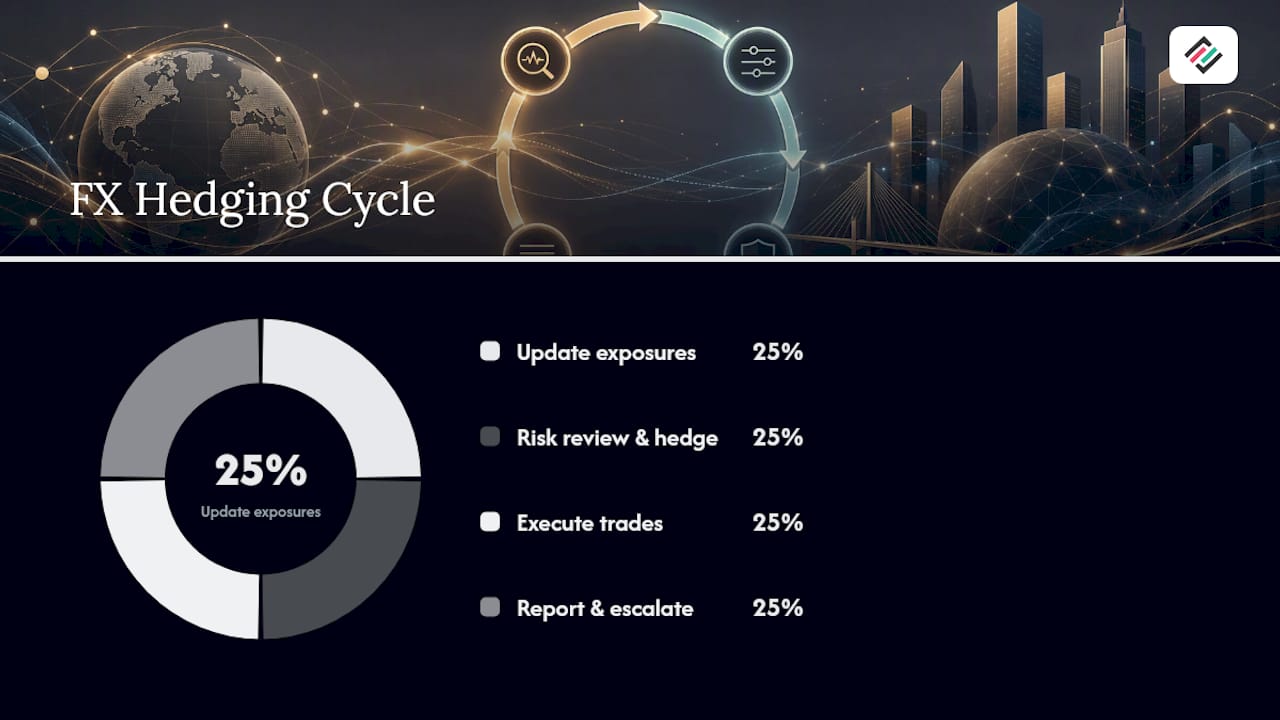
Key Takeaways
A disciplined corporate FX program runs on a four-week cadence, uses VaR and CFaR to size hedges, centralizes controls in Treasury, and requires CFO-level governance to stay current.
| Point | Details |
|---|---|
| Run a 4-week cadence | Update exposures, review risk, execute, and report on a fixed monthly cycle. |
| Use VaR and CFaR together | VaR covers portfolio risk; CFaR protects cash-flow and budget targets. |
| Centralize and segregate | Treasury owns execution; back office confirms independently; no self-confirmation. |
| Document before you hedge | IFRS 9 designation, ISDA agreements, and policy approval must precede the first trade. |
| Corphedge supports the full cycle | Exposure tracking, VaR analysis, approval workflows, and reporting in one platform for Poland and Sweden teams. |
Table of Contents
- What does a solid executive FX checklist start with?
- How do you quantify FX exposure and choose the right risk metric?
- How do you decide which hedging instruments to use?
- What operational controls make the checklist repeatable?
- What does the trade execution process look like step by step?
- How do you measure and report FX program performance?
- What should Central European CFOs know about local regulations and banking?
- How does Corphedge map to each step of this checklist?
- Corphedge gives your treasury team a running start
- Sources
- FAQ
What does a solid executive FX checklist start with?
Exposure identification is the foundation. Every material currency risk must be classified before you can size or hedge it. The three categories are transactional (invoices, payables, receivables in foreign currency), translational (consolidation of foreign-subsidiary balance sheets), and economic (competitive or structural sensitivity to exchange rates over time). Missing any one of them leaves gaps that surface as P&L surprises. Understanding all three FX risk types before selecting instruments is what separates a disciplined program from reactive hedging.
Step-by-step exposure collection:
- Pull AR/AP aging reports from Accounting, filtered by currency
- Collect forward revenue and cost forecasts from FP&A by currency and quarter
- Request intercompany loan and dividend schedules from Subsidiaries
- Obtain balance-sheet translation exposures from the Controller (net asset/liability by entity)
- Map economic exposures: identify revenue lines or cost structures sensitive to a 10% move in key pairs
Exposure map template:
Pro Tip: The two most common gaps are intercompany timing mismatches (one entity books a payable before the other books the receivable) and invoice currency mismatches (sales team invoices in the wrong currency). Fix both with a monthly intercompany netting run and a standard invoice currency policy.

How do you quantify FX exposure and choose the right risk metric?
Use VaR for portfolio and balance-sheet lenses; use CFaR for cash-flow and budget protection. Sensitivity analysis and stress tests fill in the scenario-planning layer. Each metric answers a different question, so running all three is not redundant.
Metric inputs template:
Mark-to-market valuations should run weekly for active hedges and reconcile to GAAP/IFRS at each month-end. Hedge accounting documentation (IAS 39 or IFRS 9 designation, effectiveness testing) must be in place before the hedge is executed, not after. Currency exchange accounting reconciliation is a common audit finding when this step is skipped.
CFaR in practice: If a 90% CFaR on your EUR/PLN receivables book shows a potential shortfall of PLN 1.2M over the next quarter, that figure directly sets your hedge budget and the minimum notional you need to cover.
How do you decide which hedging instruments to use?
Choose the simplest instrument that matches the exposure and fits the company's cost tolerance. Over-engineered strategies tend to underperform disciplined use of plain instruments, particularly in Central European corridors where local market knowledge matters more than product complexity.
Decision matrix:
Layering means building coverage gradually across tenors rather than hedging the full notional at once. This reduces timing risk and keeps average rate costs competitive. For NDFs in PLN or SEK corridors, confirm that your bank counterparty offers competitive pricing before committing.
Pro Tip: Reserve options for two situations: when cash runway is short and a large adverse move would threaten liquidity, or when the exposure is highly uncertain and you need asymmetric protection. For everything else, a forward is cheaper and simpler.
What operational controls make the checklist repeatable?
Centralize FX trading and risk in Treasury, support it with a TMS, and segregate back-office functions from trading. The Group of 31 core principles are explicit: uniform accounting procedures, independent oversight, and documented controls are what separate programs that hold up under audit from those that don't.
Required controls:
- Segregation of duties: traders cannot confirm their own trades or access settlement instructions
- Counterparty credit limits: set per bank, reviewed quarterly
- Trade documentation: ISDA master agreements and CSAs in place before first trade
- Valuation sources: independent mid-market rates (not dealer quotes) for mark-to-market
- Settlement controls: dual authorization for payment instructions above threshold
- Record retention: trade tickets, confirmations, and valuations retained per local regulatory requirements
Role matrix:
| Role | Responsibility |
|---|---|
| CFO | Policy approval, exception sign-off, Risk Committee chair |
| Treasurer | Exposure oversight, hedge decision, counterparty management |
| FP&A | Exposure data supply, forecast updates |
| Controller | Hedge accounting, GAAP/IFRS reconciliation |
| Back Office | Confirmations, settlement, record-keeping |
| Risk Committee | Independent oversight, policy review, limit monitoring |
A TMS with exposure feeds, API integrations, automated mark-to-market, and approval workflows replaces the error-prone manual handoffs that Excel-based programs rely on. Operational best practices consistently point to system-enforced controls as the most reliable way to prevent settlement errors and unauthorized trades.
Pro Tip: During TMS onboarding or an audit, run a controls checklist: confirm segregation is enforced in the system (not just on paper), test that approval workflows fire correctly, and verify that settlement instructions require dual authorization.
What does the trade execution process look like step by step?
Execution must follow documented approval, confirmation, and settlement steps. Skipping any one of them creates P&L surprises or settlement failures.
- Pre-trade approval: Treasurer or authorized delegate approves trade within policy limits; CFO sign-off required above threshold
- Booking: Trade entered into TMS immediately after execution; no verbal-only trades
- Independent confirmation: Back office confirms trade details against counterparty confirmation within same business day
- Settlement instructions: Nostro account details and netting instructions sent to bank; use netting where volume supports it to reduce settlement costs
- Settlement verification: Back office confirms funds received/delivered on value date; exceptions flagged within two hours of settlement window
- Accounting match: Controller books hedge to correct accounting designation; mark-to-market updated in TMS
For failed or delayed settlements, escalate to Treasurer within two hours; CFO notification required if settlement failure exceeds counterparty limit or creates overnight exposure above policy threshold.
Pro Tip: Standard SWIFT confirmation matching (MT300 for FX, MT320 for deposits) is the baseline. For higher-volume programs, historical FX conventions and nostro reconciliation practices are worth reviewing with your bank's operations team before go-live.
How do you measure and report FX program performance?
Measure hedge effectiveness and reconcile hedging results to GAAP/IFRS. Report a concise KPI dashboard weekly for active positions and monthly for the full program. Corporate governance principles require that the Risk Committee sees independent performance data, not just management summaries.
Essential KPIs and report cadence:
| KPI | Frequency | Owner |
|---|---|---|
| Exposure by currency (gross/net) | Weekly | Treasurer |
| Hedge coverage ratio | Weekly | Treasurer |
| Upcoming maturities (monthly intervals) | Weekly | Back Office |
| Mark-to-market P&L on open hedges | Monthly | Controller |
| Realized cost vs. notional (spread + premium) | Monthly | Controller |
| Forecast error (exposure vs. actual) | Monthly | FP&A |
| Exceptions and limit breaches | As they occur | Risk Committee |
The Risk Committee reviews the full dashboard monthly and approves any exception to policy. Policy itself should be reviewed quarterly for active programs, annually at minimum, and immediately after any material market event or organizational change.
What should Central European CFOs know about local regulations and banking?
Central European markets require local banking knowledge for cost-efficient settlement and correct regulatory treatment. There is no universal hedging strategy, and local partners materially reduce settlement and legal friction in less-transparent currency corridors.
Key accounting and tax touchpoints:
- IFRS 9 hedge accounting designation must be documented before trade date; retrospective designation is not permitted
- Local VAT treatment on FX gains/losses varies by jurisdiction; confirm with local tax counsel in Poland and Sweden
- Cross-border payment reporting thresholds apply in Poland (NBP statistical reporting for transactions above PLN 10,000 equivalent); Sweden has Riksbank reporting requirements for large cross-border flows
- Withholding tax on interest payments embedded in cross-currency swaps may apply; check bilateral tax treaties
Regional notes for Poland and Sweden:
In Poland, NBP (Narodowy Bank Polski) requires statistical reporting for cross-border FX transactions, and local bank subsidiaries often provide faster PLN settlement and better market color on EUR/PLN than international banks operating remotely. In Sweden, Riksbank reporting and SFSA (Finansinspektionen) oversight mean that documentation standards are high; local banking relationships reduce regulatory friction and improve access to SEK liquidity at competitive spreads.
Pro Tip: When entering Poland or Sweden for the first time, open a local bank account before executing your first hedge. Settlement in local currency through a local nostro account is faster, cheaper, and avoids correspondent bank delays that can create overnight exposure.
How does Corphedge map to each step of this checklist?
Corphedge supports the checklist end-to-end: exposure mapping, VaR analysis, hedge decision workflows, execution, confirmations, and reporting. The platform's FX exposure management features align directly with each checklist item.
| Checklist step | Corphedge feature |
|---|---|
| Exposure capture (Week 1) | Exposure tracking module with entity/currency granularity |
| Risk quantification | VaR-based hedging analysis and scenario tools |
| Hedge decision workflow | Approval workflows with tiered authorization |
| Trade execution | Integration with execution venues and counterparty connectivity |
| Confirmations and settlement | Automated confirmation matching and settlement alerts |
| Reporting and KPIs | Portfolio reporting, mark-to-market dashboard, exception alerts |
For a CFO in Poland or Sweden running the four-week cycle for the first time, Corphedge reduces the setup time from weeks to days by importing existing exposure data, running VaR calculations immediately, and generating the Week 4 report automatically.
Corphedge's real-time position data and automated notifications mean the Risk Committee sees the same numbers as the Treasurer, without manual report preparation.
Pro Tip: Connect Corphedge's API to your FP&A system so that forecast updates flow directly into the exposure module. This closes the most common gap in the 4-week cadence: stale exposure data driving hedge decisions.
The checklist works when the CFO owns it
The four-week cadence described here is operational, not academic. Every step has a named owner, a system touchpoint, and a reporting output. What I've seen fail in practice is not the hedging strategy itself but the governance layer: no one owns the exposure data, the Risk Committee meets quarterly instead of monthly, and the policy hasn't been updated since the company entered a new market.
The checklist is designed for immediate handoff to Treasury. Run it once, fix the gaps you find, and you'll have a program that holds up under audit and delivers measurable budget certainty within two quarters.
Corphedge gives your treasury team a running start
CFOs entering Poland or Sweden face a specific problem: the checklist is clear, but the tooling to run it consistently isn't in place yet. Corphedge closes that gap faster than building a manual process from scratch. The platform covers exposure tracking, VaR-based hedging, approval workflows, and automated reporting in one place, with API connectivity to FP&A systems and local banking partners.
For treasury teams in Poland and Sweden, Corphedge's local market support and real-time position data mean the four-week cycle runs on day one, not after a six-month implementation. Take a product tour to see how the platform maps to your existing workflow, or request a tailored demo for your Poland or Sweden entity.
Sources
- The Group of 31 Report: Core Principles for Managing Multinational FX Risk
- Hedging in CEE: Big Business, Small Risk | RBI Insights
This article is general information, not a substitute for advice from a qualified financial advisor. Consult a qualified financial professional about your own circumstances before acting on anything here.
FAQ
What is the executive FX checklist's four-week cadence?
Week 1 updates all exposures, Week 2 reviews risk metrics and approves hedge decisions, Week 3 executes trades, and Week 4 reports outcomes and escalates exceptions. This cycle repeats monthly.
When should a company use options instead of forwards?
Use options when cash runway is short and a large adverse move would threaten liquidity, or when exposure certainty is low and asymmetric protection is needed. Forwards are cheaper for confirmed, high-certainty exposures.
What risk metrics does the checklist require?
VaR for portfolio and balance-sheet risk, CFaR for cash-flow and budget protection, sensitivity analysis for spot-rate shifts, and stress tests for tail scenarios. All four serve different decision-making purposes.
How does Corphedge support the checklist for Poland and Sweden?
Corphedge provides exposure tracking, VaR-based analysis, approval workflows, and automated reporting, with API connectivity to FP&A systems and local banking partners in both markets.
What governance does a corporate FX program need?
The CFO approves policy and exceptions; the Risk Committee provides independent monthly oversight; policy is reviewed quarterly at minimum and immediately after any material market event or organizational change.