

An optimized FX risk workflow automates KRI-driven monitoring, integrates live market data, and keeps every hedge decision audit-ready under IFRS 9. Three things to act on now: (1) define KRI thresholds with warning and hard-limit tiers, (2) automate exposure aggregation and market-data feeds to eliminate manual rate lookups, and (3) document hedge designations contemporaneously so VaR-based decisions hold up in an accounting review.
- Set two-tier KRI thresholds (warning + hard limit) before touching any hedging instrument
- Connect your ERP and payment platforms to a live data source — stale spreadsheets are the single biggest source of policy non-compliance
- Designate hedges under IFRS 9 at inception, not after the fact
Table of Contents
- Core components you need in an optimized FX risk workflow
- How to implement the workflow step by step
- What to prioritize in automation and system integrations
- How to make hedge documentation audit-ready for Central Europe
- How to measure and report success with KRIs and dashboards
- Common mistakes that undermine FX risk programs
- Realistic timeline and cost drivers for Central European teams
- How Corphedge implements this playbook in Central Europe
- Key Takeaways
- The part most finance teams skip
- Corphedge supports your pilot from day one
- Useful sources and further reading
- FAQ
Core components you need in an optimized FX risk workflow
KRI-driven monitoring measures risk velocity and intensity, not just aggregate exposure. A KRI that only tracks total open position tells you how big the problem is; one that tracks time-to-hedge or rate-of-exposure-growth tells you how fast it is getting worse. Both matter.
Exposure capture must cover every source: trade receivables, payables, intercompany loans, foreign-currency bank accounts, and forecast flows pulled from your ERP. Missing one category, typically intercompany, is where operational gaps silently inflate net exposure.
Value at Risk (VaR) belongs in hedging decisions, not just reporting. When VaR on a EUR/PLN position crosses a pre-approved threshold, the policy should trigger a review of whether a forward contract, an option, or a natural hedge is the right response. McKinsey's guidance on currency risk management is clear: focus on cash-flow risk, not accounting earnings, and understand where risks offset each other before reaching for a derivative.
Natural hedges — matching currency inflows to outflows, renegotiating payment terms, or holding reserves in the transaction currency — materially reduce risk without derivatives and should be exhausted before adding instrument complexity.
| Pillar | What it covers | Output |
|---|---|---|
| Exposure capture | Receivables, payables, intercompany, forecasts | Consolidated exposure register |
| KRI monitoring | Velocity, intensity, coverage ratio | Threshold alerts |
| VaR analysis | Currency-pair VaR, sensitivity, stress tests | Hedge decision input |
| Documentation | Designation memos, effectiveness tests | IFRS 9 audit trail |
How to implement the workflow step by step
-
Assessment. Inventory every data source feeding FX exposure: ERP modules, bank statements, intercompany netting reports. Map each currency pair and identify reconciliation gaps where two systems show different open positions.
-
KRI design. Choose four to six KRIs (coverage ratio, time-to-hedge, net open position by currency, VaR vs. budget). Set two-tier thresholds: a warning level that triggers a management review and a hard limit that triggers automatic hedging actions or escalation.
-
VaR parameters. Define confidence level (typically 95% or 99%), holding period, and the historical window. Document these choices in the policy so effectiveness testing is consistent quarter to quarter.
-
Pilot scope. Pick two to three currency pairs and one or two legal entities. For Polish or Swedish subsidiaries entering cross-border trade, EUR/PLN or EUR/SEK are natural starting points.
-
Roles and responsibilities. Treasury identifies and logs exposures. The CFO or finance director approves hedges above a defined notional threshold. Accounting maintains the IFRS 9 designation file and runs effectiveness tests.
-
Success criteria. Before scaling, confirm: KRI alerts fire correctly, hedge coverage ratio is within policy, and the audit trail is complete for at least one full hedge lifecycle.
| Phase | Who owns it | Gate to proceed |
|---|---|---|
| Assessment | Treasury / FP&A | Exposure register complete |
| Design | Risk lead + CFO | Policy signed off |
| Pilot | Treasury + Accounting | One hedge lifecycle documented |
| Scale | All finance functions | KPI targets met for 30 days |
What to prioritize in automation and system integrations
Automation removes the weakest link: manual rate lookups and stale spreadsheets produce inconsistent execution and create audit difficulties. The priority feature list is short but non-negotiable.
- Live market-data feeds. Rates pulled from an authoritative source (ECB reference rates, Reuters, Bloomberg) at a defined frequency, not copied from a browser tab.
- Automated exposure aggregation. ERP connectivity that pulls open positions on a schedule, not on request.
- Hedge-tracking ledger. A single record that links each derivative or natural hedge to the underlying exposure and the IFRS 9 designation memo.
- Audit trail. Timestamped logs of every rate lookup, hedge approval, and threshold breach.
- Payment platform integration. Connecting to platforms such as Corpay closes the loop between hedge execution and settlement, so the rate used in the ledger matches the rate paid.
- Real-time data quality controls: exception routing when a feed fails, reconciliation between ERP and treasury system, and a single authoritative rate source per currency pair.
Pro Tip: Run a short integration smoke test before scaling: execute one end-to-end transaction from rate feed to ledger entry and confirm the rate, notional, and currency match exactly. Catching a mapping error at this stage costs an hour; catching it during an audit costs weeks.
How to make hedge documentation audit-ready for Central Europe
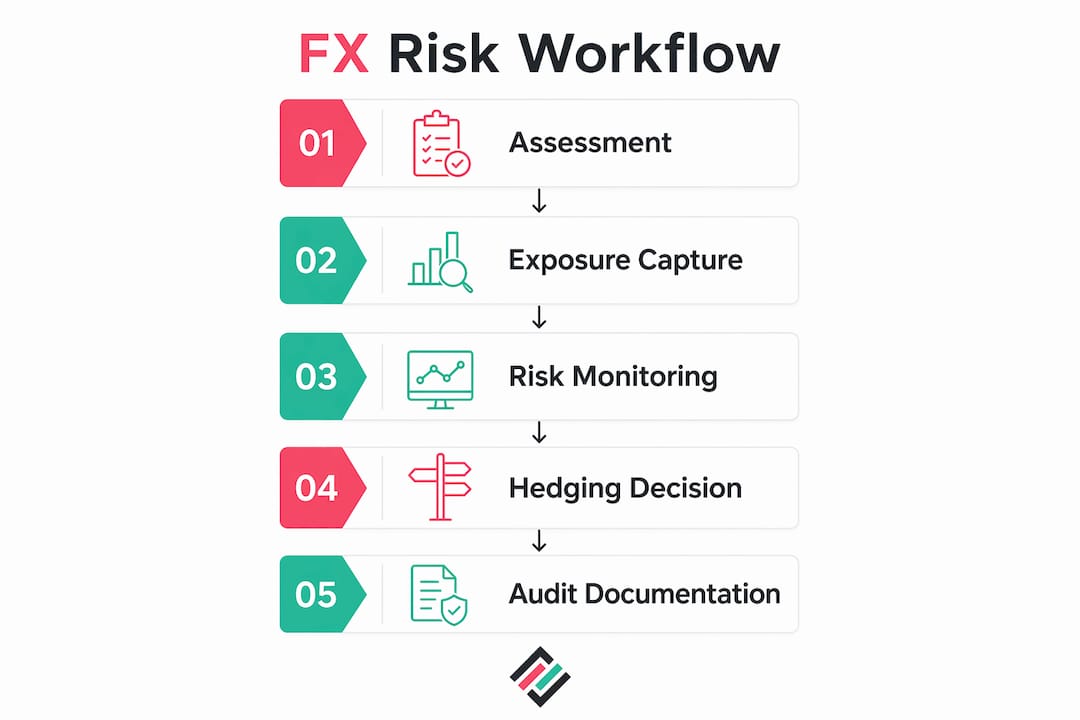
A living FX policy is the foundation. It should state objectives, scope, approved instruments, KRI thresholds, and a review cadence — and it should be short enough that a new treasury analyst can read it in 20 minutes. Clarity beats complexity: a concise policy with real-time tooling shifts the team from data gathering to decision-making.
IFRS 9 hedge accounting requires four documented artifacts at designation: the hedging relationship description, the risk management objective, the effectiveness testing method, and the hedge ratio. Miss any one and the accounting treatment is at risk. For Polish and Swedish entities, the IFRS 9 documentation requirements are identical to the rest of the EU, but local auditors increasingly expect digital audit trails, not PDF folders.
"Doing nothing" is a legitimate tactical choice — but it must be documented. If the treasury team reviews a EUR/PLN exposure and decides the natural hedge from matching receivables is sufficient, that decision and its rationale belong in the policy record. Transparency with stakeholders preserves accounting benefits and avoids the appearance of oversight failure.
Operational controls to enforce: segregation of duties between the person who approves a hedge and the person who books it, written confirmations for every derivative trade, and a settlement checklist that matches the confirmation to the payment.
Pro Tip: Schedule a quarterly policy review on the same calendar as the board risk meeting. Policies that drift out of date are the second most common reason FX programs lose CFO support, right after undocumented losses.
How to measure and report success with KRIs and dashboards
| KRI | Frequency | Audience |
|---|---|---|
| Net open position by currency | Daily | Treasury |
| Hedge coverage ratio | Weekly | Treasury + CFO |
| VaR vs. budget | Weekly | Risk lead |
| Time-to-hedge | Monthly | Finance director |
| P&L impact vs. budget | Monthly | Management pack |
| Derivative liquidity (open positions) | Quarterly | Board |
Reporting cadence should match decision cycles: daily and weekly operational reports for treasury, a monthly management pack for the CFO and FP&A, and a quarterly board review that includes VaR trends and policy compliance. The Group of 31 principles recommend marking both hedges and underlying exposures to market frequently and using VaR alongside sensitivity analysis and stress testing — not as a standalone number.
PwC's treasury benchmarking work confirms that mature treasury functions use dashboards that tie FX outcomes directly to business KPIs, not just to derivative P&L. That connection is what makes the reporting credible to a board that does not live in the treasury system.
Common mistakes that undermine FX risk programs
- Manual rate lookups. One analyst using a different rate source than the system creates reconciliation failures and audit questions.
- Missing hedge rationale. Booking a forward without a designation memo means the hedge may not qualify for IFRS 9 treatment.
- Overly complex policies. A 40-page policy that nobody reads is worse than a 5-page one that gets followed.
- Inconsistent rate sources between the ERP, treasury system, and payment platform — the most common red flag in Central European multi-entity setups.
- Stale exposure data. Weekly manual uploads miss intraweek movements that can breach KRI thresholds undetected.
- Absent KRI thresholds. Without defined limits, every breach becomes a judgment call, which slows execution and creates audit exposure.
| Red flag | Quick remediation |
|---|---|
| Inconsistent rate sources | Designate one authoritative feed; map it to all systems |
| Stale exposure data | Automate ERP pull to at least daily |
| Missing confirmations | Add confirmation receipt to the hedge approval checklist |
| No KRI thresholds | Set warning and hard-limit tiers in the policy within 30 days |
Pro Tip: If your team cannot produce a complete hedge lifecycle audit trail in under 10 minutes, that is the remediation priority — not the hedging strategy itself.
Realistic timeline and cost drivers for Central European teams
| Phase | Duration | Primary cost drivers |
|---|---|---|
| Discovery | 2–4 weeks | Internal time; data mapping |
| Pilot (2–3 currency pairs, 1–2 entities) | 6–12 weeks | Vendor licensing; integration work |
| Company-wide rollout | 3–6 months | ERP connectors; data cleansing; training |
Timeline extenders: multiple ERPs, entities in both Poland and Sweden with separate accounting systems, and significant data cleansing requirements. For smaller exporters, shortening the time between contract signing and payment and building a simple exposure map are low-cost first steps that reduce risk before any platform is deployed.
Pilot success criteria worth defining upfront: KRI alerts firing correctly on test data, one complete IFRS 9 hedge lifecycle documented, and hedge coverage ratio within policy for 30 consecutive days.
How Corphedge implements this playbook in Central Europe
Corphedge maps directly to the workflow above. The platform provides live market-data feeds, automated exposure aggregation, a VaR calculation engine, a hedge-tracking ledger, and reporting templates — the same components the playbook requires. For teams in Poland and Sweden, Corphedge supports integration with Corpay for payment-platform connectivity and connects to major ERP systems to automate the exposure pull.

Corphedge internal data indicates that companies using structured FX workflows with the platform have achieved up to 30% reduction in FX volatility. The platform's KRI alert system uses the two-tier threshold model described in this playbook: a warning level for management review and a hard limit for automatic escalation.
For finance teams evaluating automated filings analysis alongside FX reporting, tools like FilingsIQ.ai can complement the workflow by surfacing regulatory benchmarks from SEC filings.
Pro Tip: Start the Corphedge pilot with your highest-volume currency pair and one entity. A focused pilot produces a clean audit trail and a defensible ROI case for the CFO within 8–10 weeks.
Key Takeaways
An optimized FX risk workflow requires KRI-driven monitoring, automated data integration, and contemporaneous IFRS 9 documentation working together — not separately.
| Point | Details |
|---|---|
| Two-tier KRI thresholds | Set a warning level for review and a hard limit for automatic action to avoid analysis paralysis. |
| Automate before you hedge | Live market-data feeds and automated ERP pulls eliminate the manual errors that cause audit failures. |
| Document at designation | IFRS 9 requires four artifacts at inception; missing one risks the accounting treatment. |
| Pilot before scaling | Scope to 2–3 currency pairs and confirm one full hedge lifecycle before company-wide rollout. |
| Corphedge for Central Europe | Corphedge delivers VaR workflows, KRI alerts, and a hedge-tracking ledger, and companies using it have achieved up to 30% reduction in FX volatility according to internal data. |
The part most finance teams skip
The playbook above is not technically difficult. The hard part is governance: getting the CFO, treasury, and accounting to agree on thresholds, documentation standards, and who owns what before the first hedge is booked. Most FX programs that fail do so not because the strategy was wrong but because the operational ownership was never settled. Treasury assumed accounting would maintain the IFRS 9 file; accounting assumed treasury would. Nobody did.
Cross-functional training matters more than most risk leads expect. A treasury analyst who understands why the designation memo exists will write a better one than one who treats it as a compliance checkbox. The same logic applies to FP&A: if the team building the budget does not understand how hedge coverage ratio affects reported variance, the monthly management pack becomes a source of confusion rather than insight.
The practical tip: hold a 90-minute cross-functional session at the start of the pilot. Walk through one hedge lifecycle end to end — from exposure identification to settlement to effectiveness test. Do it with real numbers from your own balance sheet. That session will surface more process gaps than any consultant's gap analysis.
Corphedge supports your pilot from day one
Finance teams in Poland and Sweden that want to move from spreadsheet-based FX tracking to a structured, audit-ready workflow have a direct path with Corphedge. The platform covers every step in this playbook: live rate feeds, automated exposure aggregation, VaR-driven hedging workflows, KRI threshold alerts, and a hedge-tracking ledger built for IFRS 9 compliance.
A typical pilot runs 6–10 weeks, covers two to three currency pairs, and produces a complete audit trail and KPI baseline the CFO can present to the board. Corphedge also integrates with Corpay for payment execution, closing the gap between hedge booking and settlement.
The next step is a product demo — a 45-minute walkthrough of the platform mapped to your specific currency pairs and entity structure. No long-term commitment required to start.
Useful sources and further reading
- Corporate risk governance: currency risk strategies — Corphedge blog; covers KRI design and two-tier threshold methodology for Central European corporates.
- FX Risk Management: The Operational Framework Finance Teams Need — InsightSoftware; detailed treatment of the three operational pillars.
- The Group of 31 Report: Core Principles for Managing Multinational FX Risk — Primary reference for VaR methodology, performance measurement, and multinational governance principles.
- McKinsey: Getting a Better Handle on Currency Risk — Executive-level framework for deciding which risks to manage and how to focus on cash flow over earnings.
- PwC: Managing Global Pricing and FX Risk — Benchmarking data on treasury maturity and governance frameworks.
- Advanced accounting for FX risk — Corphedge blog; IFRS 9 documentation requirements and hedge accounting for global companies.
- FX risk workflow: practical strategies — Corphedge blog; operational how-to material and the platform's internal data on volatility reduction.
| Source | Best for |
|---|---|
| Group of 31 Report | VaR methodology and multinational governance |
| McKinsey currency risk paper | Deciding which risks to manage; cash-flow focus |
| Corphedge blog (KRI / workflow) | Implementation checklists and threshold design |
| IFRS 9 (IASB) | Hedge accounting documentation requirements |
| PwC treasury benchmarking | Maturity curve and governance frameworks |
FAQ
What are the first steps to optimize an FX risk workflow?
Start by mapping all exposure sources across your ERP and bank accounts, then set two-tier KRI thresholds (warning and hard limit) before booking any hedges. Automation of the data feed comes next, before any hedging instrument is added.
How does VaR fit into an FX hedging decision?
VaR quantifies the potential loss on an open currency position at a given confidence level, giving treasury a threshold to trigger hedge review. When VaR exceeds the pre-approved limit in the policy, it signals that a forward, option, or natural hedge should be evaluated.
What documentation does IFRS 9 require for hedge accounting?
IFRS 9 requires four artifacts at designation: the hedging relationship description, the risk management objective, the effectiveness testing method, and the hedge ratio. These must be prepared at inception, not retrospectively.
How long does a typical FX workflow pilot take?
A focused pilot covering two to three currency pairs and one or two entities typically runs 6–12 weeks. Success criteria should include at least one complete hedge lifecycle with a full audit trail before scaling.
How does Corphedge support FX workflow optimization in Poland and Sweden?
Corphedge provides live market-data feeds, automated exposure aggregation, VaR workflows, KRI alerts, and a hedge-tracking ledger designed for IFRS 9 compliance, with integration support for ERP systems and payment platforms used by Polish and Swedish entities.